There was a time when Audi believed the best way to make a beautiful luxury coupé faster was to give it a naturally aspirated V8, an enormously capable all-wheel-drive system and just enough aggression to frighten a BMW M3. The first-generation RS 5 is a reminder of that rather wonderful period.
The Audi RS 5: German Engineering With an Italian Sense of Style
Some performance cars announce their intentions with enormous wings, extravagant air intakes and exhaust systems capable of disturbing wildlife several kilometres away. The Audi RS 5 takes a slightly more sophisticated approach. It looks like a beautifully tailored German grand tourer, right up until its naturally aspirated V8 comes alive and reminds you that underneath the elegant bodywork lives a remarkably serious performance machine.
Introduced globally in 2010, the RS 5 represented the performance pinnacle of Audi’s A5 family. It sat above the regular A5 and the more powerful S5, combining the elegance of a traditional two-door coupé with the engineering expertise of Audi’s performance division. This was never intended to be a stripped-out racing car with number plates. Instead, Audi wanted something capable of covering enormous distances comfortably, demolishing an unrestricted autobahn and handling a winding mountain road without becoming unnecessarily dramatic.
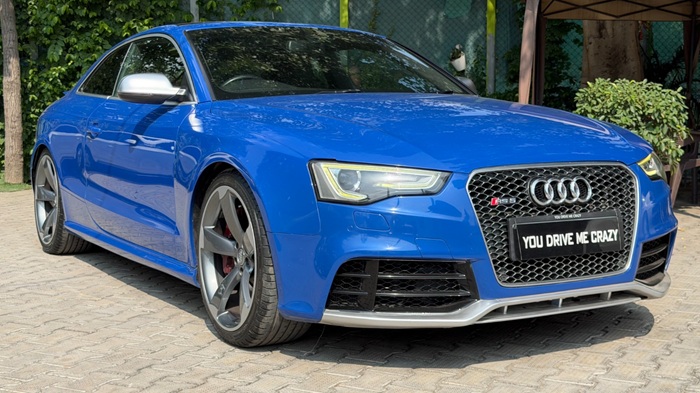
The example featured here is a 2013 Audi RS 5 V8 Coupé, belonging to the facelifted first generation. Finished in the particularly attractive Sepang Blue, it represents one of the most appealing chapters in Audi’s performance-car history: the period when naturally aspirated engines still occupied the upper reaches of the company’s sporting hierarchy.
In India, the facelifted RS 5 arrived in July 2013, with launch prices around ₹95.28 lakh ex-showroom Maharashtra and ₹96.81 lakh ex-showroom Delhi. Historical price references for the model also extend towards approximately ₹1.24 crore, depending on the period and configuration. It was offered with a petrol V8 rather than a selection of different engines.
This particular pre-owned example is advertised at ₹45 lakh through You Drive Me Crazy dealership. That makes it considerably less expensive than its original purchase price, although anyone shopping for a decade-old German performance car should remember that depreciation affects the asking price rather more enthusiastically than it affects maintenance bills.
An Italian Designer, a German Platform and a Remarkably Beautiful Shape
To understand the RS 5, it is worth going back to the original Audi A5 introduced in 2007. Its design was created under the direction of the celebrated Italian automotive designer Walter de Silva, whose influence extended across several of the world’s most recognisable automotive brands.
De Silva’s portfolio includes significant work associated with the Audi A3, A6, Q7, TT and R8, along with the Alfa Romeo 147, SEAT León and numerous Volkswagen models, including the Golf, Jetta and Passat. His career also involved ambitious concept-car programmes, including the Lamborghini Miura concept and projects connected with the Bugatti Veyron’s development. His work even extended beyond automobiles into product design, including Leica camera projects.
For all those achievements, de Silva was particularly proud of the Audi A5, describing its proportions and architecture as a masterpiece. Looking at the first-generation car today, it is difficult to disagree.
The design drew inspiration from Audi’s 2003 Nuvolari quattro concept, a luxurious grand-touring study that established several styling themes subsequently adopted by production models. The RS 5 retained the A5’s flowing roofline, powerful shoulder line and carefully balanced proportions, adding muscular bodywork without destroying the original elegance.
Underneath, the car belongs to Audi’s 8T-generation A5 family and uses the Volkswagen Group’s longitudinal-engine MLB architecture, related to the foundations underpinning contemporary models such as the Audi A4 and Q5, as well as the Porsche Macan.
The first-generation RS 5 was built in Germany, with production continuing until around 2016. A Cabriolet version broadened its appeal, while subsequent generations introduced the practical RS 5 Sportback. The RS 5 name has since entered its third generation, with the 2026 model adopting plug-in hybrid technology and sedan and Avant body styles. That newest generation has been confirmed for India, although a local launch had not been established at the time of writing.
The original V8-powered coupé consequently belongs to a very different automotive era. Its appeal rests on mechanical character rather than electrification.
Exterior: Muscular Without Being Obnoxious
At first glance, the RS 5 looks unmistakably like an Audi A5, which is precisely what makes the design successful. The aggression comes through the details rather than through a wholesale attempt to disguise the car’s origins.
Up front sits Audi’s familiar Singleframe grille, reinterpreted for the RS model with a black honeycomb pattern. The grille is wider and more assertive than the one found on the standard A5, while the bumper incorporates substantial lower air intakes that give the car a planted, purposeful appearance.
The 2013 facelift introduced sharper styling around the headlights, bonnet and bumpers. Automatic Xenon Plus headlights are accompanied by LED daytime running lights, automatic beam functionality and headlamp washers. Rain-sensing windscreen wipers add a useful everyday convenience feature.
The bonnet features carefully sculpted contours that reinforce the width of the front end. Nothing looks excessively complicated, and there is a pleasing absence of unnecessary decoration. The RS 5 looks powerful because its proportions suggest real performance, not because someone at the design studio discovered an unlimited supply of plastic vents.
Viewed from the side, the car becomes even more appealing. Its long bonnet, low roofline and compact rear deck give it the proportions of a traditional grand tourer. The pronounced wheel arches and muscular shoulders distinguish it from the comparatively understated A5, while the smooth roofline preserves the elegance of de Silva’s original design.
The car measures approximately 4,649 mm long, 1,860 mm wide and 1,366 mm tall, with a wheelbase of 2,751 mm. Including its mirrors, the overall width approaches two metres. It is substantial without being oversized, although the low bodywork requires more attention over steep speed breakers than the typical Indian SUV driver might appreciate.
The electronically adjustable exterior mirrors can fold electrically and incorporate automatic dimming, memory functionality and LED turn indicators. Heat-insulating glass is provided, while the fully galvanised body was engineered to resist corrosion. Audi originally offered a 12-year rust-perforation warranty, demonstrating how seriously the company approached long-term body protection.
The Sepang Blue paintwork is especially well suited to the RS 5. It highlights the muscular surfaces without overwhelming the design. Buyers originally had alternatives including red, grey, silver, black and white, while the Audi Exclusive programme allowed more personalised paint finishes.
Then there are the wheels.
This example wears distinctive 20-inch five-arm rotor-design alloy wheels, among the most recognisable wheel designs associated with Audi’s performance models. The original range also offered 19-inch wheels.
Fitted to this particular vehicle are Accelera PHI-2 tyres measuring 285/30 ZR20 99Y XL at both ends. These Indonesian-made, steel-belted radial tubeless tyres have particularly low-profile sidewalls, giving the car a purposeful stance. They are not the typical original factory 20-inch tyre specification, however, so their fitment should be checked against the wheel dimensions and the vehicle’s approved tyre requirements.
That matters considerably in a car capable of travelling at 250 km/h. Tyres are not merely something that fills the wheel arches; they are the final connection between several hundred horsepower and the road.
At the rear, the RS 5 retains its restrained sporting character. LED tail lamps sit on either side of a relatively clean boot lid, while an integrated diffuser and two large oval exhaust outlets provide the necessary visual evidence of what lies beneath the bonnet.
The dual-branch exhaust arrangement is one of the model’s most recognisable details. Unlike the decorative exhaust surrounds fitted to some modern cars, the RS 5’s oval outlets belong to an era when exhaust design was closely connected to an engine’s actual soundtrack.
The rear spoiler is another clever touch. Normally integrated into the boot lid, it automatically extends at around 120 km/h to improve high-speed aerodynamic stability. Rather than permanently advertising its presence, it waits until its assistance becomes useful.
Understatement, apparently, can be aerodynamic.
Practicality: More Than Just a Weekend Toy
Despite its sporting appearance, the RS 5 retains much of the practical character that made the original A5 successful.
Its kerb weight is approximately 1,800 kg, while the gross vehicle weight is around 2,200 kg. The body also has a specified roof-loading capacity of 75 kg, although accessories and mounting arrangements must be suitable for the vehicle.
The boot offers 455 litres of luggage capacity, a perfectly respectable figure for a performance coupé. Folding the split rear seats expands the available luggage volume to approximately 829 litres.
That means weekend luggage, shopping bags or the occasional airport run should not present much difficulty. The boot opening and relatively low roofline are less convenient for bulky items, but the RS 5 offers considerably more everyday usefulness than its aggressive appearance might suggest.
The turning circle is around 11.6 metres. Combined with the substantial width, low seating position and long doors, this makes manoeuvring in crowded parking areas less effortless than driving the car on an open road.
Four occupants can travel in the RS 5, although the two rear seats are better regarded as occasional accommodation. Adults may find rear headroom restricted by the descending coupé roofline, while access requires considerably more flexibility than climbing into a conventional sedan.
For children, shorter journeys or supplementary luggage, however, the rear compartment gives the RS 5 an advantage over strictly two-seat sports cars.
Interior: Audi’s Old-School Approach to Luxury
Open the long door and the RS 5 reveals another reason why this generation continues to attract enthusiasts: its interior was designed at a time when premium manufacturers still believed physical buttons were rather useful inventions.
The dashboard follows the familiar Audi architecture of the early 2010s, combining a relatively straightforward layout with carefully chosen materials and restrained decorative elements. Rather than surrounding the driver with illuminated glass panels, the cabin concentrates on solid switchgear, clear instruments and functional ergonomics.
The quality of construction is one of the strongest aspects of the original RS 5. The controls have the substantial, precisely engineered feel associated with Audi interiors of the period. The centre console is densely populated compared with modern minimalist dashboards, but most important functions remain identifiable without navigating endless touchscreen menus.
Leather upholstery gives the cabin a suitably premium atmosphere, while Alcantara was available as an alternative or complementary trim material. Aluminium detailing reinforces the sporting theme without making the interior look like a racing-car accessories catalogue.
The electrically adjustable front sport seats feature four-way lumbar adjustment and are intended to offer enough lateral support for enthusiastic cornering without compromising long-distance comfort. Their position is low, helping establish a suitably sporting relationship between the driver, steering wheel and pedals.
The leather-wrapped three-spoke multifunction sports steering wheel incorporates controls for the infotainment system, volume, voice functions and instrument information. Aluminium pedals provide another subtle reminder that this is the RS rather than an ordinary A5.
Ahead of the driver sits a conventional analogue instrument cluster. The large tachometer and speedometer dominate the presentation, while supporting displays provide the odometer, trip information, clock, coolant temperature, fuel level and outside temperature.
The RS-specific instrumentation also incorporates an oil-temperature display and lap timer, equipment that seems delightfully optimistic in Indian traffic but considerably more relevant on a racing circuit.
There is something refreshing about the clarity of these instruments. You do not need to choose between six different display themes simply to discover how fast the engine is turning.
The infotainment system centres around a 7-inch Audi MMI display. By modern standards it is modest, but the system provides functions including Bluetooth connectivity, navigation, SIM-card-related connectivity, CD and DVD playback, AUX and USB interfaces, FM radio and voice controls, depending on equipment and market configuration.
Naturally, contemporary smartphone integration and touchscreen responsiveness have moved forward considerably since 2013. Anyone accustomed to modern wireless connectivity may find the older MMI interface somewhat dated.
On the other hand, the system avoids the modern tendency to place every conceivable vehicle function inside a touchscreen.
One of the more appealing available features is the Bang & Olufsen sound system, with 14 speakers and a rated output of 505 watts. Its combination of power and cabin-specific audio tuning was a serious luxury feature for the period.
Whether it can compete with the naturally aspirated V8 as the cabin’s favourite source of entertainment is another question entirely.
The RS 5 also offers three-zone automatic climate control with air-quality and humidity sensors, allowing more individual temperature regulation. An automatically dimming interior mirror, a glass tilting sunroof and the powered front seats add further everyday convenience.
Taken together, the interior succeeds because it prioritises quality and function rather than novelty. Some plastics and electronic interfaces inevitably reveal the car’s age, but the overall design remains coherent and pleasingly driver-focused.
The Main Attraction: A Naturally Aspirated 4.2-Litre V8
Everything discussed so far explains why the RS 5 makes an appealing luxury coupé. The engine explains why enthusiasts continue to care about it.
Under the bonnet sits a 4,163 cc naturally aspirated FSI V8 petrol engine producing 450 metric horsepower, equivalent to approximately 444 mechanical bhp, at 8,250 rpm. Maximum torque is 430 Nm, available between 4,000 and 6,000 rpm.
FSI stands for Fuel Stratified Injection, Audi’s terminology for its direct petrol-injection technology. Rather than introducing fuel into the intake port, the system injects it directly into the combustion chamber, allowing precise control of combustion.
What makes this engine special is its high-revving character.
The RS 5’s V8 was developed around the High-Rev Concept philosophy, prioritising a wide operating-speed range and strong performance at elevated engine speeds. Unlike a turbocharged engine that delivers an enormous wall of torque relatively early, this motor encourages the driver to explore the upper half of the tachometer.
At low and moderate speeds, the engine can behave with the restraint expected of a premium German coupé. Increase the throttle opening, allow the revs to rise and the character becomes considerably more urgent.
The difference is fundamental. A modern turbocharged performance engine often delivers its greatest shove early in the rev range. The RS 5 instead builds towards its power peak, rewarding the driver for keeping the engine working.
It is a more traditional performance philosophy, and for some enthusiasts a more emotionally satisfying one.
The 4.2-litre V8 belongs to Audi’s wider family of high-performance petrol engines, with engineering relationships to the engines found in the RS 4 and R8. Other 4.2-litre FSI derivatives appeared in models such as the A6, A8, Q7, S5 and Volkswagen Touareg, although these should not be mistaken for mechanically identical RS 5 engines.
There are also broader engineering connections between Audi’s high-revving V8 programme and its 5.2-litre FSI V10 technology.
Lubrication is particularly important in high-performance engines because sustained acceleration, braking and cornering can move engine oil away from where it is required. Audi’s motorsport experience influenced the development of oil-management systems capable of handling substantial dynamic loads. The RS 5’s lubrication engineering belongs to that performance tradition, although it should not be assumed to use an identical system to the R8 GT3 LMS racing car.
The result is one of Audi’s most celebrated naturally aspirated V8 applications.
It is often regarded as a robust and characterful engine when properly maintained, although calling any complex, high-revving German V8 completely trouble-free would be unnecessarily optimistic.
Its greatest quality is not simply how much power it produces. It is how it produces that power.
Performance: 450 PS Without a Turbocharger in Sight
Audi claimed that the facelifted RS 5 could accelerate from 0 to 100 km/h in 4.5 seconds, with an electronically limited top speed of 250 km/h.
Those figures remain respectable even by modern performance-car standards. More importantly, the car delivers them using an engine that relies on displacement, breathing and engine speed rather than forced induction.
The throttle response is consequently central to its appeal. A naturally aspirated engine does not need to wait for turbocharger boost to build, offering a more direct relationship between the accelerator pedal and the mechanical response.
That does not necessarily mean the RS 5 delivers the strongest possible acceleration at very low engine speeds. With its torque peak arriving comparatively high in the rev range, extracting maximum performance requires the engine to be kept spinning.
On a winding road, this characteristic encourages more deliberate gear selection. On the highway, strong acceleration is available, but serious overtaking performance is best accessed with an appropriate downshift.
Then there is the soundtrack.
A high-revving V8 has a distinctive mechanical personality, and the RS 5’s exhaust arrangement was designed to let that personality become part of the driving experience.
At restrained engine speeds, the car can remain relatively civilised. Higher in the rev range, the V8 develops a much more aggressive voice.
There is no artificially generated engine soundtrack required to explain what is happening underneath the bonnet.
And while modern electric cars can outperform the RS 5 in a straight line, few can reproduce the experience of an eight-cylinder engine approaching 8,000 rpm.
Seven-Speed S tronic: Two Clutches, One Very Clever Gearbox
The V8 is paired with Audi’s seven-speed S tronic dual-clutch automatic transmission, sending power to all four wheels.
Unlike a conventional torque-converter automatic, this gearbox uses two clutches and two interconnected transmission sections. One clutch manages one group of gears while the other manages the alternating gears.
For example, when accelerating in third gear, the transmission can have fourth gear preselected. The next ratio is therefore prepared before the actual shift occurs, allowing the gearbox to exchange clutch engagement with very little interruption in power delivery.
In practice, this arrangement is designed to deliver extremely quick gear changes under acceleration while remaining capable of automatic operation in everyday traffic.
The gearbox suits the V8’s personality because it allows the engine to remain in its preferred operating range. Rapid downshifts bring the engine closer to its power peak, while longer ratios help it settle down during cruising.
There is a compromise, however.
Dual-clutch transmissions of this generation can feel less smooth during crawling traffic and parking manoeuvres than a well-calibrated conventional automatic. Their complexity also makes correct maintenance particularly important as the vehicle ages.
It is a transmission designed to make a fast car faster, not necessarily to make every encounter with a crowded shopping-mall basement completely effortless.
Quattro: The Science Behind the Grip
The RS 5’s performance would be considerably harder to exploit without Audi’s quattro permanent all-wheel-drive system.
The standard mechanical torque distribution favours the rear axle, sending approximately 40% to the front wheels and 60% to the rear under normal conditions.
This rear-biased arrangement helps give the RS 5 a more sporting character than a conventional front-heavy all-wheel-drive configuration, while retaining the traction advantages associated with quattro.
At the centre of the system is a self-locking crown-gear differential capable of adjusting torque distribution according to available grip.
The car also employs wheel-selective torque control, using carefully calculated brake interventions to influence how effectively the vehicle negotiates corners.
An electronic differential-lock function further assists traction on slippery surfaces by braking a spinning wheel when required. This should not be confused with a fully mechanical locking axle differential; the system works through electronic intervention and the braking system.
The objective is straightforward: ensure that the engine’s substantial performance can be translated into forward motion without unnecessary wheelspin.
On dry roads, the system contributes to stability and confidence when accelerating out of corners. On wet or slippery surfaces, its traction advantage becomes even more relevant.
But quattro also contributes to the RS 5’s defining compromise.
The all-wheel-drive hardware adds weight and mechanical complexity, and the car is not a lightweight rear-wheel-drive sports coupé. Its personality is consequently more about secure, rapid progress than delicate oversteer or playful rear-axle behaviour.
For drivers who value precision and confidence, that may be exactly the attraction.
Ride and Handling: A Grand Tourer With Serious Intentions
The RS 5 uses sophisticated independent suspension at both ends.
At the front is a lightweight five-link arrangement incorporating Audi’s virtual steering-axis geometry and structural bracing. At the rear, a trapezoidal-link independent suspension system manages wheel movement and traction.
Tubular stabiliser bars, coil springs and gas-filled dampers form part of the suspension arrangement, while Audi offered optional Dynamic Ride Control technology with variable damping for buyers seeking greater control over the ride-and-handling balance.
The engineering objective was to combine substantial cornering ability with sufficient comfort for daily driving.
Audi Drive Select allows the driver to alter selected vehicle characteristics through Comfort, Auto, Dynamic and Individual modes.
Comfort prioritises a more relaxed character, while Dynamic sharpens the vehicle’s responses. Auto adapts settings according to driving conditions, and Individual allows supported parameters to be configured according to preference.
Depending on the fitted equipment, these adjustments can influence throttle response, transmission behaviour, steering assistance and suspension settings.
The electromechanical rack-and-pinion steering uses speed-dependent assistance, helping reduce effort during parking while providing a firmer response at higher speeds.
Yet this is one area where the RS 5 has historically faced criticism. Although its steering is accurate, it does not deliver the same degree of tactile feedback associated with some of the best rear-wheel-drive performance coupés.
The car’s substantial weight also becomes relevant during rapid changes of direction. The chassis can generate impressive cornering grip, but it cannot entirely disguise the mass of a luxury grand tourer carrying a large V8 and all-wheel-drive hardware.
On smooth, flowing roads, the combination should feel particularly suited to fast, stable progress. On tighter, more technical roads, a lighter and more communicative rival may offer greater involvement.
Indian road conditions introduce another consideration.
The large wheels and very low-profile tyres provide relatively little rubber sidewall to absorb sharp imperfections. Broken roads, expansion joints and poorly designed speed breakers therefore require attention, especially when the car is fitted with its firmer suspension settings.
It is worth remembering that a German autobahn and an Indian municipal road are often rather different interpretations of the same transport concept.
Highway stability is one of the car’s natural strengths, while its wide stance and all-wheel-drive system provide an inherently reassuring foundation.
Ultimately, the RS 5 was engineered to cover ground quickly, securely and with very little drama. It is less interested in entertaining the driver with sudden slides than in making substantial performance feel accessible.
Braking: Proper Hardware for Serious Performance
A car approaching 1.8 tonnes and capable of reaching 250 km/h requires an appropriately substantial braking system.
The RS 5 features disc brakes at all four wheels, supported by electronic braking and stability technologies. Carbon-ceramic braking hardware was also available as an option on certain configurations.
For demanding driving, carbon-ceramic brakes can offer advantages in heat management and resistance to brake fade. However, replacement costs can be considerably higher than those associated with conventional steel discs.
This is particularly relevant when buying a used example. Brake condition matters far more than the prestige of the equipment listed in an old brochure.
The same applies to tyres. A powerful all-wheel-drive system can help the car accelerate, but stopping distances remain heavily dependent on tyre grip, road conditions, brake condition and driver input.
Audi’s electronic systems provide assistance; they do not repeal the laws of physics.
Fuel Economy: Nine Kilometres Per Litre, If Conditions Cooperate
Efficiency was never going to be the RS 5’s greatest selling point.
The naturally aspirated V8 was associated with an Indian-cycle fuel-economy figure of approximately 9.26 km/l, broadly consistent with the 9 km/l figure commonly quoted for the car. These are certification or claimed values rather than independently measured results for this particular example.
Actual consumption depends heavily on driving conditions and how frequently the engine is encouraged to explore its upper rev range.
A relaxed highway journey will produce very different results from congested city traffic or enthusiastic performance driving.
The 61-litre fuel tank provides a reasonable touring capacity, although owners should not expect the running costs of a conventional diesel executive sedan.
Audi incorporated a recuperation system intended to improve efficiency by recovering some energy during deceleration and managing electrical generation more intelligently.
This is not a hybrid propulsion system. It does not provide a separate electric motor to accelerate the car; rather, it reduces the energy the engine must devote to electrical requirements under suitable conditions.
A useful engineering feature, certainly, but not something likely to transform a high-revving V8 into an economy champion.
There are more efficient ways of travelling 100 kilometres. Very few, however, involve this much naturally aspirated theatre.
Safety: Serious Engineering Beneath the Performance
The RS 5 was equipped with an extensive range of safety systems for its period.
Its occupant-protection equipment includes six airbags, three-point seatbelts, front seatbelt pretensioners and force limiters, ISOFIX child-seat mounting points and integrated head restraints.
The body incorporates engineered crumple zones, while aluminium front wings contribute to the vehicle’s lightweight construction strategy.
Electronic safety features include anti-lock brakes, electronic brakeforce distribution, electronic stability control, anti-slip regulation or traction control, brake assist and hill-hold assistance.
Parking assistance includes a reversing camera, which is particularly welcome given the coupé’s dimensions and comparatively restricted rearward visibility.
Other equipment includes an anti-theft alarm, electronic immobiliser, central locking, security wheel bolts, a tyre-repair kit, warning triangle and first-aid kit.
A brake booster provides additional braking assistance, while the electronically controlled systems work together to manage traction and vehicle stability.
The RS 5 offers a reassuring amount of engineering sophistication, although its safety equipment inevitably reflects the technology of the early 2010s. It should not be expected to offer the comprehensive camera-based assistance and automated driving technologies found in newer luxury cars.
No specific independent crash-test rating for this 2013 RS 5 Coupé has been established here, so it would be inappropriate to assign one.
Ownership: The Purchase Price Is Only the Beginning
For enthusiasts considering this 2013 example at ₹45 lakh, the emotional case is compelling.
It offers the design and performance of a once enormously expensive German grand tourer for a fraction of its original asking price. It has a naturally aspirated V8, permanent all-wheel drive, sophisticated suspension and a cabin that still feels appropriately premium.
But buying a used RS 5 requires rather more discipline than admiring its paintwork.
The engine has a generally favourable reputation when properly serviced, but its direct-injection system can develop carbon deposits on intake valves over time. Symptoms can include uneven idling, misfires and reduced performance.
The timing-chain system should also be assessed carefully, particularly if unusual mechanical noise is present during a cold start. Oil leaks, coolant-system condition and previous maintenance should be checked by a specialist familiar with Audi’s high-performance engines.
The seven-speed S tronic gearbox deserves equal attention. Unusual hesitation, harsh engagement or inconsistent shifting may require investigation, while documented transmission servicing is an important part of the ownership history.
Suspension components, electronic systems, engine mounts and the condition of the all-wheel-drive system should also be examined.
If the car has optional Dynamic Ride Control suspension or carbon-ceramic brakes, the condition and potential replacement cost of those components become especially relevant.
The original corrosion warranty was a useful selling point when new, but buyers in 2026 should not assume that any historical warranty remains valid. Eligibility depends on the vehicle’s age and original terms.
A comprehensive inspection by an independent Audi specialist, verification of the service history, accident-repair assessment and confirmation of genuine mileage are essential before purchase.
Particular attention should be paid to the fitted wheels and tyres. This example’s 285/30 ZR20 tyres differ from the commonly specified 275/30 R20 factory fitment, making verification of wheel width, clearance, load ratings and approved compatibility important.
At this age, maintenance history is more valuable than a freshly polished engine cover.
Rivals: BMW M3, Mercedes-AMG C 63 and the Battle of the V8 Coupés
When the RS 5 was new, its natural rivals included the BMW M3 and Mercedes-Benz C 63 AMG, both of which approached the performance-coupé formula from different directions.
The E92-generation BMW M3 was arguably the more focused driver’s car. Its naturally aspirated V8, rear-wheel-drive layout and communicative chassis made it particularly rewarding for enthusiasts who prioritised steering feel and cornering balance.
The Audi countered with superior all-weather traction, a more understated appearance and a character better suited to effortless long-distance performance.
The Mercedes-Benz C 63 AMG Coupé offered a different sort of entertainment, powered by a larger 6.2-litre naturally aspirated V8 with tremendous character. Its rear-wheel-drive layout and muscular power delivery could be exhilarating, but extracting that performance on slippery surfaces demanded considerably more restraint.
The RS 5’s quattro system made it the more secure and approachable option when conditions were less than ideal.
For used-car buyers, the choice is now as much about condition and maintenance history as about outright performance.
An immaculately maintained M3 or C 63 could be a better purchase than a neglected RS 5, regardless of which badge originally carried the highest showroom price.
Equally, buyers seeking modern infotainment, advanced driver-assistance technology and lower everyday running costs may find a newer performance sedan or coupé more sensible.
But sensible alternatives rarely offer exactly the same experience as a high-revving V8 built during the final years of naturally aspirated luxury-performance dominance.
Verdict: An Audi That Deserves to Be Remembered
The first-generation Audi RS 5 occupies an interesting position in automotive history.
It arrived when the German performance-car establishment was producing some of its most memorable naturally aspirated engines, and when manufacturers still believed that driving enjoyment could be enhanced by mechanical sophistication rather than simply increasing the size of the dashboard screen.
Its greatest strengths remain immediately apparent on paper and in its design: a beautifully proportioned body, an exceptionally characterful V8, a rapid dual-clutch gearbox, sophisticated quattro all-wheel drive and the reassuring sense of quality that defined Audi’s best products of the era.
Its compromises are equally important.
The RS 5 is heavy, its steering is less communicative than that of the finest rear-wheel-drive rivals, its ride can be demanding on broken surfaces and its fuel consumption is unlikely to impress anyone examining the monthly household budget.
Age adds another consideration. Parts, tyres, servicing and repairs remain those of a high-performance luxury car, irrespective of how dramatically its resale value has fallen.
Nevertheless, for someone who wants an elegant performance coupé with genuine grand-touring ability, all-weather traction and a naturally aspirated engine that rewards every additional revolution, the original RS 5 remains an appealing proposition.
At an advertised ₹45 lakh, this particular 2013 example could offer considerable emotional value, provided its mechanical condition, maintenance records and asking price withstand proper scrutiny.
A BMW M3 may offer more delicate handling, while a Mercedes C 63 AMG may provide more outrageous rear-wheel-drive entertainment. The Audi instead combines its considerable performance with a different virtue: composure.
And that is what ultimately defines the RS 5.
It is a beautiful German coupé with Italian design influence, quattro engineering and a V8 that becomes more interesting the harder it works. Modern performance cars may be quicker, cleverer and more economical, but the original RS 5 belongs to a generation that understood something increasingly rare.
Not every great performance car needs to shout about how fast it is. Sometimes, all it needs is eight cylinders, a beautifully balanced shape and an empty stretch of road.