

With prices starting at ₹5.29 lakh, the Tata Aeris replaces the Tigor with more sophisticated styling, a feature-rich cabin and the unusual luxury of choosing an automatic gearbox even with CNG. But beneath the fresh identity lies a familiar mechanical package, and that brings both strengths and compromises.
There was a time when buying a sedan in India meant you had arrived in life. A proper boot, a long bonnet and a three-box silhouette were symbols of upward mobility. Then SUVs came along, raised their suspension, added plastic cladding to everything and persuaded an entire generation that sitting higher was somehow the ultimate measure of automotive achievement. Yet the humble sedan refuses to disappear. The Tata Aeris, launched in September 2026, is the latest reminder that not everyone wants their family car to look as though it is preparing for an expedition across the Himalayas. Some people simply want comfort, efficiency, respectable road presence and a boot large enough to accommodate an Indian family’s increasingly ambitious luggage requirements.
The Aeris is Tata Motors’ newest entrant in the subcompact sedan segment, replacing the long-serving Tigor with a considerably more contemporary identity. Available with petrol and factory-fitted CNG powertrains, manual and automated manual transmissions, and an impressive selection of technology, it has been developed specifically for private customers rather than commercial fleet operators. Tata is attempting something relatively straightforward but increasingly uncommon: making an affordable sedan feel like a desirable personal purchase rather than merely the sensible option at the dealership.
Prices begin at ₹5.29 lakh and extend to ₹9.74 lakh, ex-showroom, placing the Aeris firmly in the territory occupied by the Maruti Suzuki Dzire, Hyundai Aura and Honda Amaze. Our focus is the range-topping Accomplished trim, presented in the rather distinctive Dandeli Drizzle purple finish. The featured car’s specific engine and gearbox combination has not been identified, so both petrol and CNG powertrains are considered here.
A New Identity With Familiar Foundations
The Aeris name makes its debut in 2026, making this the first generation to carry the badge. Mechanically, however, it is more evolution than revolution. Its foundations and core powertrain hardware have considerable continuity with the Tigor, which originally arrived in 2017. The Aeris represents a substantial redesign and repositioning of that familiar formula rather than an entirely clean-sheet engineering exercise.
That distinction is important because it explains much of the car’s personality. Tata has retained the fundamental ingredients that made the Tigor practical while investing in the areas where buyers increasingly judge a modern car: appearance, perceived quality, technology, convenience and safety equipment.
The name itself is derived from Latin, associated with air or atmosphere, which seems appropriate for a car intended to introduce a fresher personality into a rather conventional segment. Tata could have gone for something considerably more aggressive, although a name suggesting fresh air makes considerably more sense for a family sedan than one suggesting an imminent military operation.
The design has been shaped under the direction of Martin Uhlarik, Tata Motors’ Global Head of Design, whose extensive career includes involvement with projects at Škoda, Nissan, MG and Tata. His professional portfolio encompasses names such as the Škoda Octavia and Fabia, Nissan Qashqai and Evalia, and MG GS, while his Tata association extends across design programmes involving the Nexon, Harrier, Safari, Sierra, Altroz, Curvv and Avinya.
The Aeris is associated with Tata’s Agile Light Flexible Advanced Architecture, commonly referred to as X-ALFA, an architecture also associated with models such as the Punch and Altroz. At the same time, much of the Aeris’s mechanical character and packaging remains rooted in its Tigor predecessor. The objective has been to combine structural strength, manageable weight, practicality and everyday driving comfort without unnecessarily increasing complexity.
Its closest family relative remains the Tata Tiago hatchback, which starts at ₹4.76 lakh, ex-showroom. The Tiago serves buyers who prioritise compact dimensions, while the Aeris adds a more formal sedan profile and the benefits of a separate luggage compartment.
Tata offers the Aeris in Smart, Pure, Pure+, Creative and Accomplished trims, with petrol and CNG alternatives. Both fuels can be combined with a five-speed manual or five-speed AMT on applicable variants, although the entry-level Smart is manual-only. Prices for the Accomplished range begin at ₹8.19 lakh for the petrol manual and rise to ₹9.74 lakh for the CNG AMT.
This broad choice is significant. Buyers no longer need to regard CNG as the stripped-down economy option, nor must they automatically surrender the convenience of an automatic transmission in pursuit of lower fuel bills.
Exterior Design: A Small Sedan With a Bigger Personality
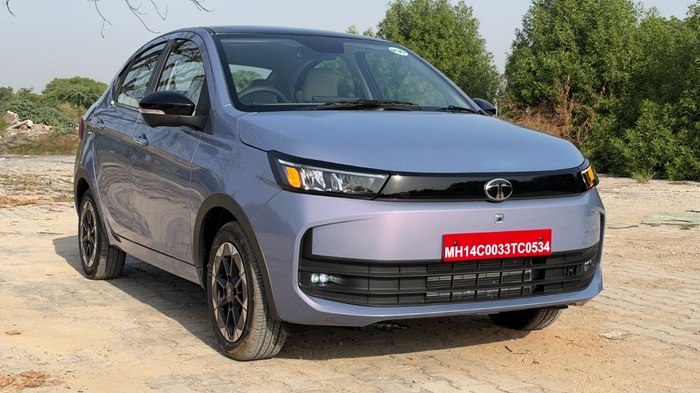
The first thing that strikes you about the Aeris is how decisively Tata has moved away from the softer appearance of the Tigor. The new car looks more assertive, with a noticeably cleaner front-end treatment and sharper detailing. It borrows some visual inspiration from the Tiago but has sufficient individuality to avoid looking like a hatchback with a boot attached as an afterthought.
At the front, slender automatic LED headlamps incorporate daytime running lights and a follow-me-home function. The narrow upper grille creates a relatively sophisticated expression, while the wide lower front grille introduces visual width and a more substantial appearance. LED fog lamps sit lower in the bumper, adding both illumination and visual character.
The treatment works because the various elements appear to have been designed together. The headlamps give the car a focused expression without making it look unnecessarily angry, and the lower grille supplies enough visual aggression without overwhelming the relatively modest dimensions.
There is a temptation among modern car designers to make every family car look as though it is permanently furious with the vehicle ahead. The Aeris demonstrates that a little restraint can be equally effective.
The bonnet features carefully controlled surfacing rather than excessive creases, helping the car maintain a contemporary look. Rain-sensing windscreen wipers offer a welcome convenience during India’s monsoon months, while the GPS-enabled shark-fin antenna keeps the roofline tidy.
Moving along the sides reveals proportions shaped by the constraints of India’s sub-four-metre category. The car measures approximately 4,000 mm in length, 1,700 mm in width and 1,500 mm in height. Its 170 mm ground clearance is a particularly relevant figure for Indian conditions, where even a relatively innocent-looking speed breaker can occasionally possess the ambition of a small mountain.
The profile is defined by a rising character line, pronounced wheel arches and carefully integrated body surfacing. Tata has used Cosmo Grain textured cladding around the wheel arches, introducing a slightly rugged visual element without making the sedan pretend to be an SUV.
The Accomplished petrol version can be equipped with 15-inch diamond-cut aero alloy wheels, while 14-inch steel-wheel configurations are available elsewhere in the range, including the CNG derivatives. The featured 15-inch tyre specification is 175/60 R15 81H, with Bridgestone B250 Enliten radial tubeless tyres.
The 15-inch alloys provide the car with a more sophisticated appearance, although buyers prioritising comfort over visual drama may appreciate the additional tyre sidewall provided by certain smaller-wheel configurations. The front wheels use disc brakes, while the rear employs drums, a familiar arrangement for this price category.
Electrically adjustable and automatically folding outside mirrors incorporate turn indicators and camera hardware. Beyond making the car look more expensive, these features are genuinely useful when navigating narrow streets or parking beside vehicles whose owners have apparently decided that lane markings are optional suggestions.
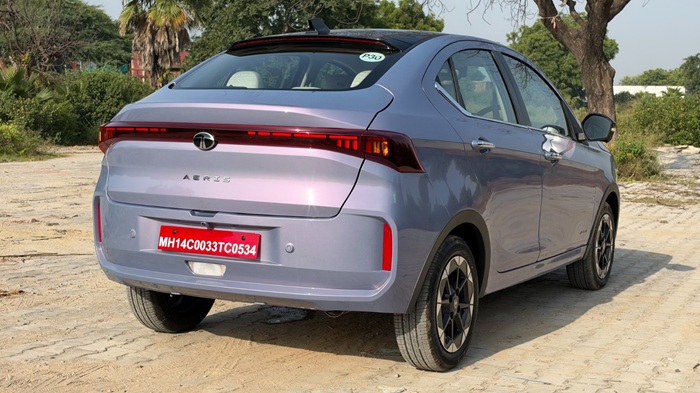
Colour selection is another area where Tata has allowed itself some personality. The Dandeli Drizzle purple finish seen here gives the Aeris an unusually distinctive appearance. It is expressive without being excessively loud, and it works particularly well with the darker exterior detailing.
Other available shades include red, grey, white and Dune Glow beige, with the full palette comprising Nitro Crimson, Daytona Grey, Pure Grey and Pristine White. The dual-tone treatment uses a contrasting black roof, providing a sportier aesthetic for buyers who prefer a little extra visual contrast.
The rear is arguably where the Aeris makes its most convincing departure from its predecessor. Tata’s Infinity Connected LED Tail Lamp treatment stretches across the width of the car, giving the compact sedan a more substantial appearance after dark. The boot lid and bumper have been redesigned to create a neater, more upright visual impression.
A rear defogger improves visibility in damp or cold conditions, while the sculpted bumper contributes to the car’s contemporary appearance. There is no need for theatrical fake exhaust outlets or oversized decorative diffusers. The Aeris is a practical sedan, and its design is more convincing when it remembers that.
The overall result is a car that looks noticeably more sophisticated than the Tigor it replaces. It may not have the dramatic presence of Tata’s larger SUVs, but within the limitations of its size and price, the design manages to give the Aeris a distinct identity.
Dimensions and Practicality: Small Outside, Sensible Inside
One of the continuing arguments in favour of a compact sedan is its ability to provide useful passenger accommodation and luggage space without becoming difficult to manoeuvre.
The Aeris follows that philosophy closely. Its sub-four-metre length makes it manageable in urban environments, while the approximately 1.7-metre width helps keep the car suitable for narrow parking spaces and congested streets.
The 170 mm ground clearance offers a sensible balance between maintaining a relatively low sedan stance and negotiating rough roads. It is not intended for serious off-road driving, but it should be considerably more appropriate for ordinary Indian road conditions than a low-slung performance car with expensive bodywork.
The most persuasive practicality figure is the petrol version’s 419-litre luggage compartment. That is a substantial amount of space for a car of this size, and it makes the Aeris suitable for airport runs, family holidays and everyday shopping duties.
A separate boot also keeps luggage away from the passenger compartment, something that can be particularly welcome when carrying dusty bags or other less-than-pristine cargo.
The CNG version deserves separate attention. Tata’s twin-cylinder arrangement is designed to preserve usable luggage space rather than occupying the entire boot with one large cylinder. There is inevitably less available volume than in the petrol version, but the packaging is considerably more practical than the traditional CNG installation that leaves owners wondering whether they can carry anything larger than a laptop bag.
The Aeris is a five-seater, although, as with most cars in this category, the rear bench will be more comfortable for two adults than three over long distances.
Interior: Tata Has Clearly Been Paying Attention
Step into the Aeris and the emphasis shifts from exterior drama to creating a cabin that feels more sophisticated than its price might suggest.
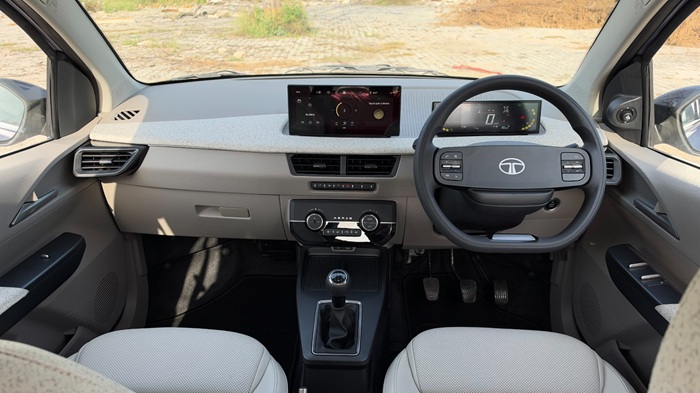
The OpenView dashboard adopts a relatively clean, horizontal layout with modern display integration. Rather than overwhelming the entire cabin with enormous screens, Tata has attempted to create a sensible balance between digital technology and everyday usability.
The lighter interior theme contributes to an airy impression, although pale upholstery also introduces the usual practical challenge of keeping it clean. Families with small children, muddy footwear or a fondness for eating snacks inside the car may wish to develop a healthy relationship with interior-cleaning products.
The Accomplished trim features LuxTouch leatherette upholstery, adding a more premium visual and tactile character than conventional fabric. Materials and surface textures have been selected to improve perceived quality, but this remains an affordable compact sedan. Hard plastics are still part of the package, and buyers should judge fit, finish and consistency carefully during a showroom inspection.
The seats are an important part of the Aeris’s appeal. Tata’s Ergo Under-Thigh Support design aims to provide better support during longer journeys, while a height-adjustable driver’s seat allows occupants of different builds to find a more comfortable position.
The front AeroLux ventilated seats are arguably among the most useful premium features offered here. In a country where a parked car can become remarkably similar to an industrial oven during summer, seat ventilation is much more than a novelty.
It is the sort of equipment that can improve everyday comfort far more meaningfully than another decorative lighting animation.
The driver faces a Sportluxe two-spoke steering wheel with tilt adjustment. Its multifunction controls allow convenient operation of phone calls, audio volume, infotainment functions, voice commands, the instrument display and cruise control.
The 5-inch Digital Island instrument cluster provides essential driving information in a relatively compact format. It may not have the cinematic ambitions of the enormous displays appearing in increasingly expensive cars, but clear speed, fuel and vehicle information remain more valuable than visual theatre.
At the centre of the dashboard sits a 10.24-inch-class HD touchscreen infotainment system, commonly described as a 10.25-inch unit, supporting wireless Apple CarPlay and Android Auto. USB and Bluetooth connectivity are also available, while lower variants receive an 8-inch touchscreen depending on specification.
The top-end system includes compatibility with Tata’s MultiView Digital Video Recorder, integrating the camera-based recording functionality into the broader infotainment experience.
A six-speaker audio system accompanies the higher-specification entertainment package. Its presence is welcome, although speaker count alone is never a guarantee of exceptional sound. Placement, acoustic tuning and door insulation matter just as much as the number printed on a specification sheet.
Wireless smartphone charging reduces cable clutter, while the dual-smartphone arrangement and available fast-charging ports help accommodate the increasingly common situation where every occupant has at least one device demanding electricity.
The fully automatic climate-control system is another useful inclusion. Unlike some modern interiors that hide every adjustment inside layers of touchscreen menus, the Aeris retains a cabin layout intended to be approachable during everyday driving.
The cooled glovebox adds another practical touch, particularly for keeping smaller items away from the worst of the summer heat. There is also a day-night interior rear-view mirror, driver-side one-shot-down power window functionality and Tata’s iToggle window-control arrangement.
Storage provision and small convenience features matter enormously in a family car. A sensible place for a phone, accessible controls and usable compartments often contribute more to satisfaction over five years than an elaborate digital welcome ceremony.
Rear-seat accommodation should be considered in the context of the car’s compact footprint. Legroom is adequate for the category, and the upright seating arrangement makes the cabin reasonably family-friendly. However, taller passengers may find headroom less generous than expected, particularly compared with more upright hatchbacks or compact SUVs.
For regular use by four occupants, the Aeris makes a convincing case. For five adults travelling substantial distances, a wider car would naturally be preferable.
Technology That Has a Purpose
Tata has equipped the Aeris with an assortment of connected features through its iRA application, which provides smartphone access to more than 35 vehicle functions and information services.
Depending on the specific function and configuration, users can access vehicle alerts, remote operations, real-time vehicle information and other connected services.
The usefulness of connected-car technology depends largely on execution. A reliable alert or convenient remote function can be genuinely helpful. A feature that requires several attempts, a strong internet connection and unreasonable patience quickly becomes less impressive.
The Aeris also offers passive entry and passive start, reducing the need to repeatedly retrieve the key from a pocket or bag.
Its 360-degree HD camera system is particularly relevant for urban driving. Combined with the Blind View Monitor, the camera arrangement can help the driver identify obstacles and monitor surrounding traffic in situations where outward visibility alone is insufficient.
The MultiView Digital Video Recorder adds recording capability to the camera system, potentially providing useful documentation of traffic incidents.
These technologies are best regarded as assistance systems rather than substitutes for observation. A camera can reveal an obstacle, but it cannot compensate for careless driving.
Importantly, Tata has concentrated on technology that has clear everyday applications rather than simply adding equipment for the sake of a longer brochure.
Engine and Transmission: Familiar Hardware, Useful Choices
Under the bonnet sits Tata’s familiar 1,199 cc Revotron petrol engine. This naturally aspirated, inline three-cylinder unit develops approximately 84–85 bhp, commonly quoted as 86 PS, and produces 113 Nm of torque.
Those figures are entirely appropriate for a compact family sedan, although they make it clear that the Aeris has been engineered for sensible everyday motoring rather than dramatic acceleration.
The engine is offered with a five-speed manual gearbox or a five-speed automated manual transmission. Power is delivered to the front wheels, which is exactly the straightforward mechanical arrangement expected in this segment.
The absence of turbocharging helps keep the powertrain relatively simple, but it also means the engine lacks the substantial low-speed torque reserve offered by some modern turbo-petrol units.
In everyday traffic, a compact sedan rarely needs enormous power. What matters is predictable throttle response, sufficient flexibility and the ability to maintain momentum without requiring constant aggressive acceleration.
Independent road-test impressions suggest that the petrol Aeris is adequate for city commuting and regular highway use, particularly with the manual gearbox. The engine is capable of maintaining cruising speeds, but overtaking performance depends on selecting an appropriate gear and allowing the motor to work.
It is not the kind of engine that delivers effortless thrust with a slight movement of the accelerator. Drivers who frequently travel with a full passenger load and substantial luggage will need to account for that modest performance reserve.
The AMT offers convenience in congested traffic, but its operation remains recognisably that of an automated manual rather than a conventional torque-converter automatic. Gear changes can introduce pauses, especially when the driver demands rapid acceleration.
This is not necessarily a serious problem for relaxed urban driving. It becomes more noticeable when overtaking or attempting to make brisk progress on an open road.
The CNG version uses the same 1.2-litre three-cylinder Revotron engine, producing approximately 74 bhp, or 75.5 PS, and 96.5 Nm of torque when operating on CNG.
The lower output is a natural consequence of the alternative-fuel calibration, although the difference is unlikely to be especially troublesome during gentle city driving.
What makes the Aeris interesting is the availability of the five-speed AMT with both petrol and CNG. Buyers who previously had to choose between lower running costs and automatic convenience can now combine the two.
Direct CNG starting is another useful feature. Rather than requiring the engine to start on petrol before switching over, the system can start directly using CNG under suitable conditions.
The petrol engine is E20-compliant, accommodating petrol blended with up to 20 per cent ethanol.
There is no attempt to disguise the car’s modest mechanical ambitions. The Aeris is designed to deliver straightforward, economical transport, not to entertain its driver with explosive acceleration or an exhaust soundtrack worthy of a sports car.
Ride and Handling: Where the Aeris Makes Its Strongest Argument
The Aeris uses an independent front suspension arrangement incorporating lower wishbones, MacPherson struts and coil springs. At the rear, a semi-independent closed-profile twist-beam setup with Dual Path Strut characteristics manages suspension movement.
This arrangement is conventional for the category, but suspension specification tells only part of the story. Spring rates, damping, bushings, tyre characteristics and overall tuning determine how effectively a car deals with the roads it encounters.
And Indian roads provide a remarkably comprehensive test of suspension engineering.
Early independent reviews of the Aeris have been particularly positive about its ability to absorb poor road surfaces. Broken tarmac, surface imperfections and uneven patches are handled with a degree of composure that suits the car’s family-oriented character.
The suspension appears tuned to prioritise comfort without allowing the body to become excessively unsettled. At urban speeds, that is a valuable quality, particularly for rear-seat passengers.
The 170 mm ground clearance also improves confidence when negotiating large speed breakers, uneven entrances and deteriorated road surfaces. It does not transform the Aeris into an off-roader, but it makes the sedan more usable in the conditions many buyers actually experience.
On the highway, published first-drive assessments generally describe the Aeris as stable and composed, with suspension control that helps it remain reassuring at cruising speeds.
The steering is reasonably light for urban manoeuvring, although it does not offer the precision or communication that an enthusiastic driver might expect from a genuinely sporting sedan.
Some independent assessments have identified a degree of vagueness around the straight-ahead position, and the steering response is better suited to relaxed driving than rapid direction changes.
Body roll and chassis movement are controlled sufficiently for ordinary family use, but the Aeris is not a car that encourages aggressive cornering.
The brake arrangement consists of discs at the front and drums at the rear. Electronic assistance systems provide additional stability and braking support, although stopping performance will ultimately depend on tyre grip, road conditions and vehicle load.
Refinement is a more obvious area for improvement.
The three-cylinder engine has an inherently different vibration character from a comparable four-cylinder unit, and independent tests report that mechanical noise becomes pronounced when the engine is revved hard. Wind and road noise can also intrude more noticeably at higher speeds.
That means the Aeris is at its most convincing when driven smoothly. Demanding maximum acceleration exposes the limitations of the powertrain and cabin insulation, while a measured driving style allows the comfortable suspension and practical interior to become the dominant characteristics.
It is an interesting contrast: the chassis feels capable of delivering a mature driving experience, but the engine is less enthusiastic about participating.
Fuel Economy: The Case for Sensible Motoring
The petrol Aeris has a 35-litre fuel tank, while the supplied specifications quote fuel economy of approximately 19 km/l.
Those figures should be treated as quoted efficiency information rather than independently measured results. Actual consumption will depend on traffic conditions, road gradients, driving style, passenger load, air-conditioning usage and transmission choice.
The CNG version is listed with a 70-litre CNG cylinder capacity rating alongside its 35-litre petrol tank, giving owners access to two fuel sources.
Its quoted efficiency is approximately 26 km/kg on CNG, although, once again, actual consumption will vary with driving conditions.
For a buyer covering substantial monthly distances, CNG could offer meaningful savings over petrol, particularly where reliable CNG infrastructure is available.
However, the financial calculation needs to include more than the fuel price alone. The initial cost difference, convenience of nearby filling stations, reduced luggage capacity and likely annual mileage all influence whether CNG makes economic sense.
For someone who drives relatively little, the standard petrol version may be the more convenient choice. For a commuter covering long daily distances, the CNG option becomes substantially more attractive.
The availability of an AMT with CNG also makes the Aeris unusually versatile. It allows high-mileage urban drivers to pursue lower fuel expenditure without spending every traffic jam operating a clutch pedal.
Safety: More Than Just a Strong Structure
Tata has placed considerable emphasis on safety equipment in the Aeris, using ultra-high-strength steel in the body structure and incorporating enhanced rear-impact protection measures.
The safety package includes six airbags, ABS with electronic brakeforce distribution, corner stability control, Electronic Stability Program, traction control and Hill Hold Control.
ISOFIX child-seat mounting points improve the convenience and security of installing compatible child restraints, while three-point ELR seatbelts and seatbelt reminders provide essential occupant-protection features.
There are also speed-sensitive automatic door locks, central locking, rear parking sensors and an intelligent tyre-pressure monitoring system, with equipment availability varying by trim.
The Blind View Monitor and 360-degree HD camera system contribute to situational awareness, particularly in restricted parking environments or congested traffic.
The MultiView Digital Video Recorder is another notable addition, offering recording functionality that may prove useful when documenting unexpected incidents.
The CNG version incorporates additional safety measures, including gas-leak detection, advanced leak-proof materials, thermal-incident protection, rear-crash protection provisions and a fire extinguisher provision or equipment as specified.
These are important considerations because a factory-engineered CNG installation involves different packaging and safety requirements from a conventional petrol-only vehicle.
However, safety equipment should not be confused with independently verified crash performance. The Aeris should be assessed on its own crash-test results when available; the performance of a predecessor or related Tata model cannot automatically be transferred to it.
Until an independently verified Bharat NCAP or Global NCAP rating is established for the Aeris, it would be premature to attach a specific star rating to the car.
Ownership: The Practical Side of the Equation
Tata provides the Aeris with a warranty of three years or 1,00,000 km, whichever comes first.
That coverage offers a defined period of protection against eligible manufacturing defects, although buyers should examine the applicable terms, exclusions and maintenance requirements before purchase.
Service accessibility and after-sales consistency will naturally influence the long-term ownership experience. The Aeris benefits from being part of Tata’s established passenger-car portfolio and using familiar engine and transmission technology, but its long-term reliability record and resale performance will only become clear with time.
There is also a surprisingly extensive range of optional accessories.
The more conventional choices include door-edge guards, ceramic-coating kits, floor mats, neck rests, key covers, valve caps, puddle lamps, ambient lighting, additional speakers, vehicle tracking, front parking sensors and wireless-charging equipment.
Useful ownership accessories include tyre inflators, puncture-repair kits, vacuum cleaners, microfibre cloths, car shampoo, car-care kits, plastic bins, tissue holders and air fresheners.
Then the catalogue becomes considerably more adventurous. Depending on accessory availability and compatibility, buyers can explore mobile holders, cabin humidifiers, seat massagers, heated blankets, pet-care packs, umbrellas, bicycle carriers, foldable seating, inflatable beds, portable tables, camping tents, foldable chairs, power stations and even portable washing equipment.
It is an extensive selection for a compact sedan. One suspects most owners will settle for floor mats and a tyre inflator rather than attempt to transform their Aeris into a miniature mobile campsite.
Nevertheless, the breadth of accessories reflects Tata’s attempt to present the car as something more personal than merely basic transportation.
Rivals: The Aeris Has Some Serious Competition
The Tata Aeris arrives in a category where buyers have several thoroughly established alternatives.
The Maruti Suzuki Dzire remains an obvious rival, particularly for customers who place substantial importance on fuel efficiency, ownership familiarity, service accessibility and resale confidence. It has a strong reputation for uncomplicated family motoring, and its established position in the market makes it a difficult competitor to ignore.
Where the Aeris attempts to distinguish itself is through styling, cabin equipment, comfort-focused technology and its combination of CNG with an AMT. Buyers attracted by ventilated seats, an extensive camera system and connected-car features may find Tata’s offering particularly appealing.
The Honda Amaze takes a different approach. It appeals to customers who value conventional sedan proportions, a practical cabin and a refined overall ownership proposition. Its CVT automatic is also likely to interest drivers seeking smoother automatic operation than the Aeris’s AMT can provide.
However, the Aeris counters with a lower entry price, CNG availability and an equipment package that places considerable emphasis on convenience features.
The Hyundai Aura is another direct competitor, offering a familiar compact-sedan formula and a broad selection of practical equipment. Buyers comfortable with Hyundai’s ownership ecosystem and cabin ergonomics will naturally consider it alongside the Tata.
Against all three, the Aeris’s strongest arguments are its introductory pricing, distinctive design, extensive equipment and useful fuel-and-transmission combinations.
But there are compromises.
The three-cylinder engine is not especially refined when worked hard, the AMT cannot entirely disguise its mechanical interruptions, and taller rear passengers may find the available headroom less generous than they would prefer.
Those weaknesses matter, particularly when a buyer intends to spend substantial time travelling on highways or regularly carrying adult passengers.
For buyers prioritising automatic smoothness, the Amaze deserves attention. Those concentrating on established long-term ownership economics should examine the Dzire carefully. And anyone seeking an uncomplicated alternative with familiar Hyundai characteristics should not overlook the Aura.
Verdict: The Affordable Sedan Finds a Little More Character
The Tata Aeris is a persuasive reminder that affordable family cars do not have to surrender their personality in pursuit of practicality.
Its exterior looks considerably more contemporary than the Tigor it replaces, the interior brings useful technology into a relatively accessible price bracket, and the available comfort features demonstrate a worthwhile understanding of everyday Indian motoring.
The ventilated front seats, large touchscreen, connected-car technology, 360-degree camera, practical boot and choice of petrol or CNG with manual or AMT transmissions give the Aeris genuine breadth of appeal.
Its comfortable suspension is perhaps the most convincing part of the package. A car that deals competently with deteriorating urban roads and remains composed during family journeys offers more lasting satisfaction than one that merely performs impressively in a showroom.
The weaknesses are equally clear. The familiar naturally aspirated three-cylinder engine lacks the refinement and effortless performance of stronger alternatives, while the AMT can feel hesitant when hurried. This is not a car for people who consider every traffic signal the beginning of a qualifying lap.
Nor is the range-topping Accomplished necessarily the automatic choice for every buyer. At ₹9.74 lakh for the most expensive CNG AMT version, the price demands careful comparison with rival sedans and even certain compact SUVs. Buyers who do not need every convenience feature may find better financial sense in a lower Aeris trim.
Yet the broader package makes a strong argument. The Aeris is for buyers who want the sensible dimensions and running costs of a small car without feeling they have compromised entirely on style, comfort or modern equipment.
It does not rewrite the laws of automotive engineering, and it certainly will not make anyone forget the pleasures of a finely balanced sports sedan. But it succeeds in making the everyday family sedan feel more thoughtfully equipped, more visually interesting and more relevant to modern Indian buyers.
The Tigor was a fundamentally practical car that sometimes struggled to excite. The Aeris keeps much of that practicality, adds a more confident identity and gives customers more reasons to choose a sedan rather than simply settle for one.
In an Indian market obsessed with SUVs, the Tata Aeris makes a refreshingly simple argument: you do not need to sit higher to feel that you are moving up in the world.