
The Honda Elevate returns with sharper styling, ventilated seats for front and rear passengers, more sophisticated technology and a considerably richer cabin. But beneath its newly polished exterior lies the same naturally aspirated petrol engine that has always defined its character. Is that reassuring consistency or a missed opportunity?
There was a time when buying a Honda was a remarkably straightforward affair. You bought one for its engineering, dependable petrol engine, sensible ergonomics and the comforting knowledge that it was unlikely to develop an expensive personality disorder after a few years. The Honda Elevate, introduced in 2023, carried much of that philosophy into India’s fiercely competitive mid-size SUV segment. It was practical, spacious, mechanically uncomplicated and refreshingly uninterested in chasing every passing automotive fashion. Unfortunately, the competition had become rather good at fashion, technology and comfort, leaving the Elevate looking increasingly conservative.
Enter the 2026 Honda Elevate facelift. This is the first major update to the first-generation SUV, and Honda has approached the exercise with considerably more ambition than simply changing the grille and introducing another shade of grey. There is revised exterior styling, a much more generously equipped interior, new lighting, enhanced comfort and additional safety technology. More importantly, several features previously missing from the Elevate have finally arrived, including a 360-degree camera, electrically adjustable front seats and ventilation for both front and rear passengers.
Yet the underlying philosophy remains intact. This is still a front-engined, front-wheel-drive crossover SUV with a naturally aspirated 1.5-litre petrol engine. There are no turbochargers, no complicated hybrid powertrain and no diesel option. In an industry increasingly obsessed with electrification and forced induction, Honda continues to believe that a well-engineered petrol engine has something worthwhile to contribute. It is a reassuringly traditional approach, although whether traditional automatically means better is another matter.
A Global Honda with an Indian Personality
The Elevate is more than simply another SUV developed to satisfy Indian buyers’ appetite for tall vehicles. It is a global Honda product, with its development linked to Honda R&D Asia Pacific in Thailand. The first-generation model carries the DG5 development designation, and its design takes inspiration from Honda’s larger HR-V, particularly in its upright proportions and relatively clean bodywork.
Honda describes the original design concept as Urban Freestyler, accompanied by the philosophy of “All New, All Bold.” Strip away the corporate vocabulary and the intention becomes fairly obvious: create an SUV that looks sufficiently adventurous for a weekend getaway while remaining civilised enough for school runs, office commutes and crowded shopping-centre car parks.
The name Elevate itself is rather ambitious. According to Honda’s explanation, its letters represent Empowerment, Liberation, Exploration, Versatility, Aspiration, Transformation and Evolution. That is an extraordinary amount of motivational vocabulary to place upon a family SUV, but at least Honda resisted the temptation to add another acronym to the badge.
The Elevate is related to Honda’s established small-car engineering architecture, which also underpins vehicles such as the City and Amaze in different applications. High-tensile steel is employed in its body construction, while Honda’s Advanced Compatibility Engineering, or ACE, safety structure forms part of its engineering foundation.
India is an important manufacturing and export base for the Elevate, with production at Honda’s Tapukara facility in Rajasthan. The model also has an international presence, including markets where related versions are sold under the WR-V name. Brazilian production and assembly form part of its wider global story.
There is also an electric chapter under development, with an electric derivative of the Elevate having undergone testing. For now, however, the Indian-market facelift remains firmly committed to petrol power.
Price and Positioning: No Longer the Bargain Hunter’s Secret
The 2026 Honda Elevate range begins at ₹11.80 lakh ex-showroom, placing it in the thick of India’s competitive mid-size SUV market. The line-up comprises SV, V, VX, ZX and ZX+ grades, with the flagship also available in a ZX+ Black version.
The regular ZX+ costs ₹16.80 lakh with the six-speed manual transmission and ₹18.30 lakh with the CVT automatic. The ZX+ Black commands ₹16.90 lakh and ₹18.40 lakh respectively, making the latter the most expensive Elevate in the range. These are ex-showroom prices, before registration, insurance and other applicable charges.
Our focus is the generously equipped ZX+ specification, which represents Honda’s most comprehensive interpretation of the Elevate. Unlike the original model, where the value proposition leaned heavily on mechanical simplicity and cabin space, this version makes a more deliberate attempt to appeal to buyers looking for comfort, technology and premium appointments.
The Elevate is available with a petrol engine alone. Buyers can choose between a six-speed manual and a continuously variable automatic transmission, although the entry-level SV is manual-only.
This relatively uncomplicated range has advantages. There are fewer powertrain combinations to decipher, and buyers are spared the increasingly complicated exercise of comparing numerous engines, hybrid systems and gearbox technologies. On the other hand, customers wanting diesel economy, turbocharged performance or strong-hybrid efficiency will need to look elsewhere.
Exterior Design: More Confidence, Less Chrome
The original Elevate was always a handsome enough SUV, but it had a certain seriousness about its appearance. Its upright nose, substantial bonnet and squared-off proportions suggested that Honda’s designers had spent more time examining traditional SUVs than studying futuristic electric concepts.
The 2026 facelift retains that fundamental character but introduces a noticeably sharper front end.
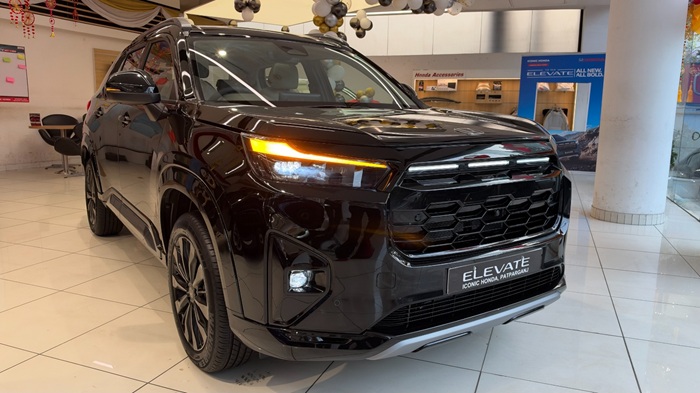
The most significant change is the new bold mesh grille with gloss-black detailing. It replaces the earlier, more conservative treatment and creates a stronger visual connection with the surrounding lighting elements. The prominent Honda H Mark has also been repositioned towards the leading edge of the bonnet, giving the front fascia a tidier and more contemporary appearance.
Above the grille sit distinctive tri-bar LED position lamps, adding a modern lighting signature without making the Elevate look like an illuminated gaming accessory. The automatic LED projector headlamps are accompanied by LED daytime running lights and useful functions including automatic high beam, light sensing, Follow Me Home and Lead Me to Car illumination.
LED projector fog lamps sit lower down, while the redesigned bumper incorporates black garnish and an under-spoiler. There is also a forward-facing camera supporting the Honda Sensing driver-assistance technology.
The overall impression is considerably more assertive than before. It is still recognisably an Elevate, which is important, but the facelift gives the SUV a visual confidence that was previously somewhat lacking.
Move around to the sides and the familiar proportions remain. The Elevate measures 4,312 mm long, 1,790 mm wide and 1,650 mm tall, with a 2,650 mm wheelbase. It occupies enough road space to feel substantial without becoming unnecessarily difficult to manage in the city.
The high bonnet line, upright cabin and pronounced wheel arches contribute to its SUV identity, while gloss-black side garnish and under-spoiler detailing bring additional visual contrast. The power-adjustable and electrically folding exterior mirrors incorporate LED turn indicators, with Honda’s LaneWatch side-view camera adding another layer of practicality.
The updated 17-inch dual-tone diamond-cut alloy wheels, finished with dark detailing, are particularly effective in giving the vehicle a more premium stance. The specified 215/55 R17 94V MRF Wanderer Ecotred steel-belted radial tubeless tyres offer a reasonably sensible compromise between appearance and everyday usability. Depending on the variant, smaller wheels and 16-inch steel-wheel options also feature in the range.
One of the Elevate’s strongest physical attributes is its 220 mm ground clearance. That is a useful figure in India, where road surfaces can occasionally resemble unfinished civil-engineering projects. Tall speed breakers, poorly constructed ramps and badly broken roads are precisely the situations in which additional underbody clearance becomes valuable.
At the rear, Honda has introduced connected LED tail lamps extending across the width of the tailgate. The arrangement adds visual width and makes the design appear more modern, particularly after dark. An emergency stop signal, rear wiper and washer remain part of the practical equipment package.
Gloss-black lower bumper detailing and the rear under-spoiler complete the changes. There is no attempt to disguise the Elevate as a high-performance machine with enormous fake exhaust outlets or unnecessarily aggressive aerodynamic attachments. It looks like an SUV intended to carry people, luggage and occasionally their unreasonable expectations.
The new Nordic Forest Pearl paint is one of the more interesting colour options and suits the Elevate’s relatively restrained design. Crystal Black Pearl, Obsidian Blue Pearl, Radiant Red Metallic, Platinum White Pearl, Meteoroid Grey Metallic and Lunar Silver Metallic provide alternatives. Selected colours can also be specified with a contrasting Crystal Black Pearl roof.
Dimensions and Practicality: Space Where It Matters
The Elevate’s sensible exterior dimensions conceal a remarkably useful amount of interior space. Its 2,650 mm wheelbase gives Honda’s packaging engineers a solid foundation for providing comfortable seating, while the tall body helps create the impression of an open, airy cabin.
At approximately 1,300 kg kerb weight, depending on specification, the Elevate is not an especially heavy vehicle by modern SUV standards. The supplied gross vehicle weight figure is around 1,700 kg, although exact load allowances depend on the particular version and equipment.
The turning radius is approximately 5.2 metres, making the SUV reasonably manageable in urban surroundings. That matters more often than many buyers imagine. A vehicle that looks impressive outside a restaurant is considerably less impressive when its driver requires a three-point manoeuvre to escape the parking space.
The boot offers 458 litres of luggage capacity, which is generous enough for family holidays, airport transfers and the inevitable collection of bags that accompanies Indian road trips. The rear seats split and fold in a 60:40 arrangement, allowing longer items to be accommodated without sacrificing every rear seating position.
A steel spare wheel is provided, a welcome inclusion for owners who regularly travel beyond major cities. A proper spare remains considerably more reassuring on a remote highway than a puncture-repair kit accompanied by optimistic instructions.
Fuel capacity is 40 litres, while seating is arranged for five occupants.
Interior: Honda Finally Discovers the Luxury Department
If the exterior facelift is about sharpening the Elevate’s appearance, the cabin update is about addressing its most obvious weaknesses.
The earlier Elevate was practical and logically arranged, but its interior was not particularly adventurous. There were sensible controls, decent visibility and a straightforward dashboard, yet several rivals offered a more expensive-looking environment. With the 2026 facelift, Honda has made a deliberate effort to close that gap.
The revised dashboard features a more premium combination of soft-touch surfaces, gloss-black accents and contrasting upholstery. The dual-tone ivory-and-black interior creates a brighter atmosphere than an entirely dark cabin, while white perforated leather or leatherette-style upholstery gives the upper variants a more luxurious appearance. Darker upholstery and fabric finishes are available elsewhere in the range.
The light-coloured seats look sophisticated, although owners with young children may discover that maintaining their appearance requires considerably more dedication than maintaining the engine.
The front seats are among the most important improvements. The driver receives eight-way electrical adjustment, while the front passenger gets four-way electrical adjustment. These features allow occupants to find a comfortable position without wrestling with manual levers beneath the seat.
Both front seats also offer ventilation, something that makes genuine sense in India’s climate. Few luxury features are more immediately appreciated after leaving a car parked in direct sunlight.
Remarkably, Honda has extended the ventilation function to the rear seats in the updated Elevate. This is a particularly significant addition because rear-seat comfort is often overlooked in vehicles that otherwise devote enormous attention to the driver.
The rear bench retains the Elevate’s practicality-led approach. Its broad cabin, elevated seating position and sensible packaging should make it comfortable for family use. Legroom and headroom benefit from the vehicle’s upright design, while the 60:40 folding backrest adds versatility.
The cabin also incorporates ambient lighting around the doors and interior trim, along with footwell illumination. These features are unlikely to transform the driving experience, but they do make the cabin feel more welcoming after dark.
Capacitive-touch rear LED spot lamps bring another contemporary touch, although traditional switches still have the advantage of being particularly straightforward to operate.
The electric sunroof includes one-touch operation, sliding and tilting functions, and pinch protection. It is a conventional single-pane arrangement rather than the enormous panoramic glass roofs offered by certain rivals. For some buyers, that will be disappointing. For others, a smaller and mechanically simpler arrangement may be perfectly sufficient.
An automatic-dimming frameless interior rear-view mirror, LED reading lights and neatly integrated storage areas contribute to the improved cabin experience.
Infotainment and Technology: Modern Without Becoming Ridiculous
The centrepiece of the dashboard is a 10.25-inch floating IPS HD touchscreen infotainment system, incorporating Optical Clear Adhesive technology for improved display clarity.
It supports wireless Apple CarPlay and Android Auto, along with Bluetooth, USB connectivity, WebLink, voice commands and other multimedia functions. Navigation through smartphone projection should satisfy most modern users without requiring them to learn an entirely unfamiliar proprietary operating system.
The display also supports Honda’s camera systems, including the assistant side-view and rear-view monitoring functions. Clock, calendar and compass displays add useful information, although most drivers are unlikely to regard the ability to check the date on their dashboard as a major engineering achievement.
Selected lower variants receive an 8-inch touchscreen system.
Behind the steering wheel sits a twin-ring instrument arrangement incorporating a 7-inch TFT multi-information display. It can present driving information including average fuel consumption, outside temperature, speed, driving range, trip readings, a G-meter, warning indicators and Honda Sensing settings.
The display strikes a useful balance between digital technology and familiar instruments. Honda has resisted the increasingly popular idea that every conventional dial must be replaced by a screen large enough to host a small cinema festival.
The leather-wrapped steering wheel offers tilt and telescopic adjustment and incorporates controls for audio, telephone functions, the instrument display, voice commands and driver-assistance systems. Adaptive cruise control and lane-keeping assistance can also be operated through dedicated steering-wheel controls.
An eight-speaker premium surround-sound arrangement, comprising speakers and tweeters, provides entertainment duties. Wireless phone charging is included, while USB-C ports are provided for front and rear occupants.
Automatic climate control comes with an Auto Clean Air function, a PM2.5 air-quality display and cabin filtration designed to reduce dust and pollen entering the passenger compartment. Given the air-quality challenges in several Indian cities, this is substantially more useful than another decorative dashboard animation.
Honda has also introduced additional sound insulation in the facelift, intended to improve refinement and reduce noise entering the cabin.
Connected-car functionality is handled through Honda Connect, which offers access to more than 37 functions and comes with a three-year complimentary subscription.
The connected features include live vehicle location, geofencing, time-fence alerts, trip history, automatic crash notifications, vehicle-status information, tow-away alerts, roadside-assistance access and selected remote operations. Smartphone and smartwatch connectivity are supported, along with Alexa integration.
Remote engine starting through the key fob adds convenience, particularly when owners want to prepare the cabin before entering the vehicle.
Not every connected function will become part of an owner’s daily routine. However, features such as vehicle location, trip records and security alerts can genuinely improve the ownership experience.
Engine and Transmission: The Naturally Aspirated Loyalist
Beneath the bonnet sits one of the Elevate’s most familiar components: Honda’s 1.5-litre, four-cylinder, naturally aspirated i-VTEC petrol engine.
This 1,498 cc unit belongs to Honda’s established L-series engine family and incorporates double overhead camshafts, 16 valves, Variable Timing Control and electronic fuel management. It is a water-cooled, BS6 RDE-compliant engine designed to operate on E20 petrol.
The engine produces 121 PS, approximately 119 bhp, at 6,600 rpm and develops 145 Nm of torque at 4,300 rpm.
Those figures are not especially dramatic in a segment where turbocharged engines can deliver substantially greater torque much earlier in the rev range. But outright torque output tells only part of the story.
A naturally aspirated engine develops its power without relying on a turbocharger to force additional air into the cylinders. The result is generally a more progressive relationship between throttle input and engine response, although it also means that maximum performance often requires the engine to work at higher speeds.
Honda’s i-VTEC and Variable Timing Control technologies help the engine manage airflow and valve timing across different operating conditions. The high-tumble intake-port design is intended to promote better air-fuel mixing inside the combustion chamber, supporting combustion efficiency.
The underlying engine family is familiar from several Honda models, including the City, Jazz, BR-V, WR-V and certain HR-V applications, although individual versions and engine calibrations differ.
For everyday driving, this engine’s appeal lies in its relatively uncomplicated character and predictable power delivery. It is unlikely to provide the effortless low-rev punch of a modern turbocharged petrol or diesel, particularly with a full passenger load. Instead, meaningful acceleration requires a willingness to use the middle and upper parts of the rev range.
That is not necessarily a disadvantage for enthusiastic drivers. Honda petrol engines have traditionally encouraged drivers to explore their rev ranges, and the Elevate retains that mechanical philosophy.
The six-speed manual gearbox should appeal to buyers who prefer direct control over gear selection and enjoy making the most of the engine’s powerband.
The alternative is a CVT automatic with seven simulated ratios, accessible through paddle shifters. Strictly speaking, the CVT does not contain seven conventional fixed gears. Instead, it varies its transmission ratio continuously and provides seven predetermined steps to simulate a more familiar shifting experience when required.
For urban driving, the principal advantage is smoothness. A CVT does not need to perform conventional gear changes every time traffic accelerates or slows, potentially making it a relaxed companion in stop-start conditions.
Under hard acceleration, however, CVTs can allow engine revs to rise noticeably before road speed catches up, producing the familiar impression of an engine working harder than the actual acceleration might suggest. Whether Honda’s calibration keeps this tendency sufficiently restrained is something that deserves assessment in a proper road test.
The supplied maximum-speed figure is approximately 160 km/h, although the Elevate’s character is clearly more focused on family transport than high-speed performance.
Ride and Handling: Engineering Before Theatrics
The Elevate’s chassis follows a conventional front-wheel-drive SUV arrangement, with MacPherson strut suspension and coil springs at the front and a U-type torsion-beam rear suspension with coil springs.
Telescopic hydraulic, nitrogen-gas-filled shock absorbers are employed, while Honda has revised the suspension geometry and damping characteristics for the updated model.
The objective is to improve the balance between ride comfort, stability and body control.
A torsion-beam rear axle is not as mechanically sophisticated as an independent multi-link arrangement, but simplicity does not automatically make it inferior for everyday use. Properly tuned, it can offer a good balance of packaging efficiency, predictable handling and reasonable durability.
Much depends on spring rates, damper calibration, suspension geometry and tyre construction. The Elevate’s 215/55 R17 tyres provide a relatively moderate sidewall height, helping balance steering response with impact absorption.
Its 220 mm ground clearance is another important consideration. Extra height is useful on damaged roads, but it also raises the vehicle’s centre of gravity compared with a conventional sedan. Managing body movement through corners and during rapid direction changes therefore becomes an important part of suspension tuning.
The Elevate is not intended to behave like a low-slung sports car. Its relatively tall driving position and family-focused chassis should prioritise predictable responses and comfort over aggressive cornering ability.
The steering employs electric power assistance and offers adjustment for both reach and rake. The higher seating position and upright body should contribute to good forward visibility, while the additional camera technology helps compensate for the limitations created by a substantial bonnet and modern SUV bodywork.
Highway stability, rough-road comfort, steering feedback and cabin noise remain areas that require direct driving assessment rather than conclusions drawn solely from specifications.
Braking hardware also deserves attention. The CVT versions now receive disc brakes at all four wheels, while manual variants use front discs and rear drums.
The additional rear disc brakes on the automatic models should improve the specification of the braking system, although stopping distances and resistance to repeated heavy braking depend on several factors, including tyre grip, vehicle loading and brake calibration.
Honda’s Vehicle Stability Assist and Agile Handling Assist systems provide additional electronic support in maintaining stability and managing traction.
Despite its substantial ground clearance and SUV appearance, the Elevate remains a front-wheel-drive vehicle. There is no low-range transfer case, no dedicated four-wheel-drive system and no locking differential.
It should therefore be regarded as a practical crossover for ordinary roads, badly maintained roads and occasional uncomplicated excursions rather than a serious off-roader.
The raised suspension may help the Elevate clear obstacles that would trouble a low sedan, but ground clearance alone does not turn an SUV into a mountain goat.
Fuel Economy: Sensible, but Not Hybrid Sensible
Honda quotes certified fuel-efficiency figures of 15.31 km/l for the six-speed manual and 16.61 km/l for the CVT automatic.
Interestingly, the CVT achieves the higher certified figure, reflecting the advantages of continuously optimising the transmission ratio under standardised test conditions.
With a 40-litre fuel tank, the Elevate offers adequate touring potential, although actual distance between fuel stops will depend heavily on traffic, driving style, passenger load, road conditions and air-conditioning use.
These figures are laboratory-certified claims rather than independently measured real-world consumption. Heavy city traffic, frequent acceleration and extensive air-conditioner use can produce considerably different results.
The absence of a strong-hybrid option becomes particularly relevant here. Buyers who spend considerable time in congested city traffic may find the efficiency advantages of a hybrid competitor difficult to ignore.
However, the naturally aspirated petrol engine has the attraction of mechanical familiarity and a relatively straightforward powertrain arrangement.
Safety: More Than Just Airbags
Honda has made safety a central part of the Elevate’s equipment package, combining passive occupant-protection measures with active electronic assistance.
The SUV uses Honda’s Advanced Compatibility Engineering body structure, incorporating high-tensile steel and engineering intended to improve crash-energy management.
Six airbags are offered, accompanied by ABS with Electronic Brakeforce Distribution, Brake Assist, Vehicle Stability Assist, traction-related intervention and Hill Start Assist.
Additional provisions include three-point ELR seatbelts, front seatbelt pretensioners and load limiters, energy-absorbing front belt arrangements, ISOFIX child-seat anchorages, seatbelt reminders, emergency stop signalling, central locking and anti-theft protection.
The equipment also includes a vehicle immobiliser, security alarm, remote keyless entry, walk-away automatic locking, speed alerts and door-open warnings.
An electronic parking brake with automatic brake hold is offered on the CVT models, reducing the need to keep a foot firmly on the brake pedal during prolonged stops.
Parking assistance now includes front and rear sensors along with a 360-degree surround-view camera. The Honda LaneWatch camera provides an additional view of the area alongside the passenger side of the vehicle, which can be useful when changing lanes or negotiating traffic.
The 360-degree camera is one of the facelift’s most welcome additions. In a market where SUVs continue to grow taller and wider, being able to see obstacles close to the vehicle is substantially more useful than trying to judge their position by instinct.
Honda Sensing brings a more sophisticated layer of active safety through its camera-based driver-assistance system.
Its functions include Collision Mitigation Braking, Adaptive Cruise Control, Lane Keeping Assist, Road Departure Mitigation, Lead Car Departure Notification and Automatic High Beam.
The CVT variants additionally benefit from Low-Speed Follow, allowing adaptive cruise control to support driving in slow-moving traffic under appropriate operating conditions.
These systems are driver-assistance technologies, not autonomous driving systems. Their effectiveness depends on road markings, visibility, surrounding traffic and operating conditions, and the driver must remain responsible for controlling the vehicle.
A verified crash-test star rating for this specific facelift has not been established here, so its safety equipment should not be confused with an independently demonstrated crash-test performance result.
Ownership: Honda’s Long-Term Argument
One of Honda’s traditional strengths has been its appeal to buyers intending to retain their cars for several years rather than changing vehicles every time a new touchscreen becomes fashionable.
The Elevate comes with a standard warranty of three years and unlimited kilometres.
Honda also offers extended-warranty options covering up to seven years with unlimited kilometres, while its Anytime Warranty programme can provide coverage up to a maximum vehicle age of 10 years or 1,20,000 km, subject to eligibility, renewal and applicable conditions.
Routine servicing is specified at intervals of one year or 10,000 km, whichever comes first.
For owners who drive relatively modest annual distances, the annual servicing schedule is straightforward. Those covering considerable highway mileage will reach the distance limit sooner.
The naturally aspirated petrol engine and conventional front-wheel-drive arrangement are familiar engineering solutions, although actual maintenance costs and long-term reliability still depend on usage, servicing and individual vehicle condition.
Honda also offers a substantial range of accessories for owners wishing to personalise their Elevate.
Exterior options include chrome and dark-chrome garnish, side spoilers, bumper protectors, fender badging, door-handle protection, side cladding, door visors and decorative trim. Interior and practical accessories include floor mats, seat covers, headrest cushions, a cargo tray, body cover and steering-wheel cover.
More functional choices include a dashcam, tyre-pressure monitoring system, anti-fog film and emergency hammer. Some of these are accessories rather than standard factory equipment, so buyers should confirm what is included in their chosen variant.
This distinction is important, particularly when comparing an already expensive top-specification SUV with its rivals. An appealing accessory catalogue is useful, but it is considerably more appealing when the most important equipment is included in the purchase price.
Rivals: A Difficult Neighbourhood
The Honda Elevate occupies one of the most aggressively contested areas of the Indian passenger-vehicle market.
The Hyundai Creta and Kia Seltos offer broad powertrain selections, including turbocharged petrol and diesel options, and place considerable emphasis on technology, comfort and interior presentation. Their stronger performance choices will appeal to buyers who find the Elevate’s naturally aspirated engine too restrained.
The Maruti Suzuki Grand Vitara brings strong-hybrid technology into the conversation, making it particularly attractive for customers prioritising urban fuel efficiency. Honda counters with its conventional petrol powertrain and straightforward approach to mechanical engineering.
The Skoda Kushaq and Volkswagen Taigun offer turbocharged petrol engines and a more performance-oriented character. Drivers who enjoy strong mid-range acceleration may prefer their approach, while the Elevate appeals to those looking for predictable power delivery and a traditional naturally aspirated engine.
Toyota’s Urban Cruiser Hyryder is another relevant alternative, particularly for buyers interested in hybrid fuel economy and Toyota’s ownership ecosystem.
What makes the Elevate different is not that it defeats every rival in every measurable category. It does not. Its petrol engine is less powerful in the mid-range than several turbocharged alternatives, and the absence of diesel, hybrid and all-wheel-drive options limits its appeal.
Instead, it offers a particular combination of cabin space, road clearance, Honda petrol engineering, improved comfort and a relatively easy-to-understand mechanical package.
The facelift’s additional equipment finally gives it a stronger answer to the question that previously troubled the original Elevate: why should someone spend premium-SUV money on a vehicle that feels less generously equipped than its competitors?
Verdict: The Same Honda, Only Better Dressed
The 2026 Honda Elevate facelift is an unusually revealing product. It shows exactly where Honda believes its original SUV needed improvement and, just as importantly, where the company believes change was unnecessary.
The exterior is more assertive without abandoning the simple proportions that made the Elevate attractive in the first place. The cabin is appreciably more premium, with better upholstery, ambient lighting, additional sound insulation and a considerably stronger technology package.
The arrival of powered front seats, ventilation for front and rear occupants, a 360-degree camera and more comprehensive driver assistance addresses several of the original model’s weaknesses. These are not merely decorative improvements. They have the potential to make everyday ownership more comfortable and convenient.
The 458-litre boot, spacious five-seat cabin and 220 mm ground clearance remain valuable practical attributes, while Honda’s familiar naturally aspirated petrol engine continues to offer a distinct alternative to the turbocharged engines dominating much of the segment.
Nevertheless, there are compromises.
The 145 Nm torque output is modest by contemporary standards, particularly for buyers accustomed to turbocharged engines. The lack of a hybrid option limits its fuel-efficiency appeal, and the CVT’s driving character may not satisfy enthusiasts who prefer a conventional automatic transmission or a more direct connection between engine speed and acceleration.
Pricing also demands consideration. At ₹18.30 lakh for the regular ZX+ CVT, or ₹18.40 lakh for the ZX+ Black CVT, the Elevate is no longer competing principally on affordability. It must justify its price through the quality of its cabin, usable features, overall refinement and ownership proposition.
For buyers seeking diesel performance, strong-hybrid efficiency or serious off-road capability, competitors offer more appropriate solutions. For families wanting a spacious, comfortable, generously equipped petrol SUV with a familiar and uncomplicated engineering philosophy, the updated Elevate makes a significantly stronger argument than its predecessor.
Perhaps the most interesting thing about this Honda is what it refuses to become. It does not pretend to be a sports SUV, an off-road expedition vehicle or an electric car from the future. It is simply a family crossover that now pays considerably more attention to what modern families actually want.
The original Elevate earned respect for its mechanical honesty but occasionally felt as though Honda had forgotten that buyers appreciate a little luxury too. The 2026 facelift corrects much of that imbalance without sacrificing the car’s underlying character.
And that, ultimately, is its appeal. The Elevate has not undergone a personality transplant. It has acquired better clothes, more thoughtful equipment and a greater appreciation of comfort while keeping the same dependable engineering philosophy underneath.
In a market where manufacturers increasingly compete to make ordinary family SUVs look and feel like spaceships, there is something rather refreshing about a Honda that still remembers how to be a car.