
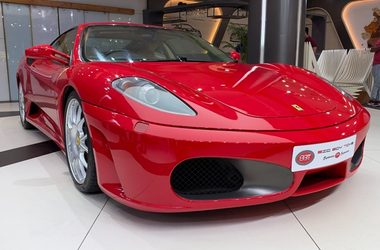
With a naturally aspirated 4.3-litre V8, Formula 1-inspired technology and one of the most charismatic exhaust notes in Ferrari history, the 2008 F430 remains a compelling reminder of an era when supercars were engineered to thrill the driver rather than impress a touchscreen.
There was a time when buying a Ferrari meant accepting a few inconveniences in exchange for something extraordinary. The steering could be demanding, the gearbox occasionally temperamental, the ride unforgiving and the running costs capable of making a wealthy person reconsider their financial decisions. But none of that mattered particularly much when you pressed the accelerator and heard a naturally aspirated Italian V8 approaching 8,500 rpm. The Ferrari F430 belongs to that wonderful era, when driving excitement was measured less by software updates and more by the speed of your heartbeat.
Introduced in 2004 as the successor to the Ferrari 360 Modena, the F430 represented a significant technological advancement for Maranello’s mid-engined sports car family. It combined unmistakably Italian design, a sophisticated aluminium chassis, electronically controlled dynamics and a magnificent 4.3-litre V8 capable of producing 483 bhp. Even more importantly, it managed to integrate substantial Formula 1-derived engineering without completely removing the mechanical character that made earlier Ferraris so rewarding.
The example under consideration is a 2008 Ferrari F430 Coupé, finished in traditional Ferrari red and equipped with the six-speed F1 automated manual transmission. Advertised by luxury pre-owned car dealership Big Boy Toyz for ₹2.49 crore, it has a listed mileage of just 8,000 km. That’s considerably more than its original Indian ex-showroom price, which says something about the enduring attraction of a properly preserved Ferrari.
And unlike many contemporary performance cars, this one does not need artificial engine noise, enormous digital displays or an electric motor to convince you that something interesting is happening.
A Ferrari With Half a Century of History Behind It
The F430’s story begins long before its 2004 debut. Its broader mid-engined sports car lineage can be traced to the Dino programme of the late 1960s, including the Dino 206 GT unveiled in 1967. The subsequent evolution through the 308, 328, 348, F355 and 360 established one of the most celebrated bloodlines in sports car history.
Viewed through that historical progression, the F430 can be regarded as approximately the seventh major chapter of Ferrari’s Dino-descended mid-engined road car family, although Ferrari has never treated these cars as conventional numbered generations.
The F430 remained in production until 2009, when the radically more modern 458 Italia replaced it. Later successors included the 488 GTB and F8 Tributo, while today’s Ferrari 296 GTB carries the mid-engined performance philosophy into the hybrid age. Priced from approximately ₹5.40 crore ex-showroom in India, the 296 swaps the old naturally aspirated V8 formula for a twin-turbocharged V6 and electric motor.
Progress, undoubtedly. But there is something rather appealing about the F430’s refusal to involve a battery in the business of making its driver smile.
Built in Ferrari’s hometown of Maranello, Italy, the F430 retained the F131 architecture associated with its predecessor. Its underlying Alcoa-developed aluminium spaceframe was an evolution of the 360’s structure, with significant improvements in rigidity and crash protection. The rear-mid-engined, rear-wheel-drive arrangement remained central to the car’s character, concentrating the mechanical components around the rear axle while keeping the front wheels primarily responsible for steering.
Development drew heavily upon lessons from Ferrari’s Gestione Sportiva Formula 1 racing division. This wasn’t simply a case of putting an F1 badge on a dashboard and charging extra for it. The knowledge influenced the engine, electronically controlled differential, transmission behaviour, suspension management and the integration of the car’s various dynamic systems.
Styling responsibilities involved the legendary Italian design house Pininfarina and acclaimed automotive designer Frank Stephenson. Their work produced a car that retained the familiar proportions of the 360 while introducing a considerably more aggressive personality.
Ferrari also offered customers extensive personalisation through its Carrozzeria Scaglietti programme. Different paint colours, leather treatments, interior finishes, racing seats and decorative elements allowed buyers to create something more individual than the familiar red-and-tan specification.
Production figures vary between historical sources, although one frequently quoted estimate places total F430 production at approximately 16,750 examples. It was successful enough to establish itself as a major chapter in Ferrari’s modern history rather than an obscure limited-production curiosity.
In India, the regular petrol-powered range consisted principally of two body styles. The F430 Coupé was listed at approximately ₹1.75 crore ex-showroom, while the open-top F430 Spider cost around ₹2.10 crore. The Coupé offered the purer fixed-roof experience, while the Spider provided an opportunity to enjoy the V8 soundtrack without having a roof intervene.
Italian Design With Formula 1 in Its DNA
Modern Ferraris tend to look as though they have been sculpted by aerodynamicists using extremely expensive wind tunnels. The F430 certainly benefited from serious aerodynamic development, but its appearance remains more traditional and arguably more elegant.
At approximately 4.5 metres long, 1.9 metres wide and just 1.2 metres tall, the F430 has the proportions of a proper mid-engined Italian sports car. The bonnet is low, the cabin sits relatively far forward and the rear bodywork contains the mechanical hardware responsible for most of the excitement.
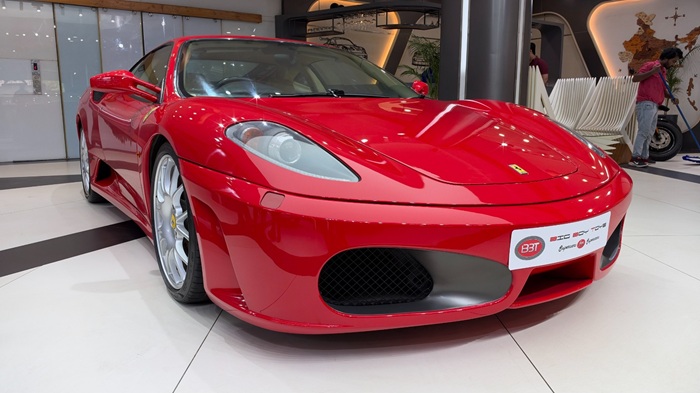
Viewed from the front, its defining features are the two substantial air intakes integrated into the bumper. Their shape pays homage to the Ferrari 156 Formula 1 racing car of 1961, famously nicknamed the Sharknose. The historical reference is appropriate, but the intakes are also functional, contributing to cooling and aerodynamic management.
The long, swept-back bi-xenon headlamps lend the front end a purposeful expression, accompanied by lighting elements and headlamp washers. Below them, carefully shaped bumper surfaces and an integrated aerodynamic lip manage airflow around and underneath the car.
There is nothing particularly subtle about the F430’s appearance, but neither does it resort to the endless wings, fins and elaborate bodywork that define many modern supercars. Its aggression comes primarily from proportion rather than decoration.
The side profile is arguably the car’s strongest angle. Its low roofline, sculpted flanks, pronounced rear shoulders and substantial side air intakes make the mid-engined configuration immediately obvious. Even standing still, it looks as though the rear wheels are impatient to get moving.
The driver’s exterior mirror carries an embossed F430 inscription, an unusual Ferrari design flourish reminiscent of earlier models. Such details might be unnecessary in strictly engineering terms, but Italian automotive design has never been an entirely practical profession.
The red paintwork of this particular example is almost inseparable from Ferrari’s identity. Buyers could also select colours such as black, yellow and silver, alongside more unusual finishes through Ferrari’s personalisation programme.
Its 19-inch alloy wheels suit the body particularly well. They appear substantial without overwhelming the design, and the staggered tyre arrangement emphasises the car’s rear-wheel-drive priorities.
The example described is fitted with Pirelli P Zero radial tubeless tyres, with a listed front size of 235/35 R19 91Y and rear size of 285/35 ZR19 103Y. The latter provides a broad contact patch for transmitting the V8’s power to the road. However, regular factory F430 Coupés were generally specified with 225/35 ZR19 front tyres, while 235-section fronts are associated with certain alternative fitments and the 430 Scuderia. The particular wheels and tyre fitment should therefore be checked against the vehicle’s specification.
During the car’s production life, Ferrari also offered tyres from manufacturers including Bridgestone, Michelin, Pirelli and Goodyear. The specially developed Goodyear Eagle F1 run-flat arrangement was among the available options.
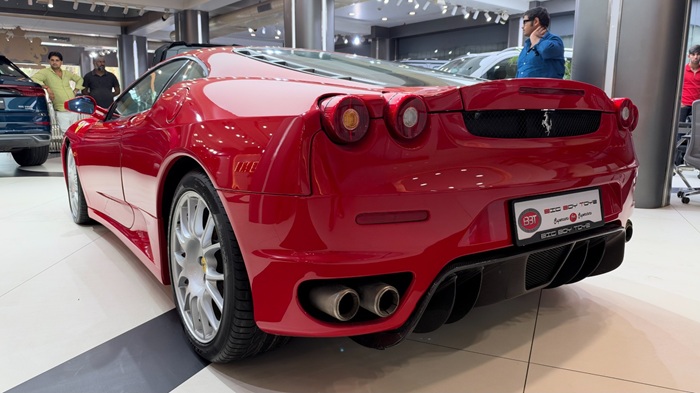
Around the back, the F430 borrows some of its visual vocabulary from the considerably more exotic Ferrari Enzo. The circular, raised tail lamps, sculpted rear surfaces and ventilation openings establish a strong family resemblance.
The rear bumper accommodates a functional diffuser, while polished stainless-steel exhaust tailpipes provide an appropriately mechanical finishing touch. The exhaust system is not merely an accessory to the design; it is a major contributor to the entire experience.
Above the engine sits a transparent cover, displaying the V8 rather than concealing it beneath an anonymous piece of plastic. It transforms the engine compartment into something approaching an exhibition, except the exhibit happens to be capable of operating at 8,500 rpm.
The overall effect is beautifully judged. The F430 looks serious without becoming theatrical, muscular without being clumsy and unmistakably Ferrari without needing an enormous badge to establish its identity.
Compact Dimensions, Wide Shoulders and Limited Practicality
Despite its formidable performance, the F430 is relatively compact by contemporary supercar standards. Its dimensions are approximately 4,512 mm in length, 1,923 mm in width and 1,214 mm in height, with a wheelbase of 2,600 mm.
Those measurements make it easier to place on an open road than many much larger modern performance cars. Nevertheless, nearly two metres of width remains a consideration when navigating Indian traffic, narrow lanes or underground parking ramps designed with considerably less exotic machinery in mind.
The quoted kerb weight is approximately 1,449 kg, with a 43:57 front-to-rear weight distribution. That rearward bias is central to the car’s dynamic character, placing greater load over the driven wheels and helping the rear tyres generate traction under acceleration.
There are just two seats, as expected, with no rear bench pretending to accommodate small children or exceptionally cooperative adults.
The principal luggage compartment is located beneath the front bonnet, providing a quoted capacity of approximately 254 litres. That is respectable for a mid-engined sports car and sufficient for a carefully planned weekend away, although large suitcases and ambitious shopping expeditions are best undertaken in something less Italian.
Ground clearance is not one of the F430’s selling points. Its low bodywork, front aerodynamic surfaces and underbody components demand caution around steep driveways and large speed breakers. Indian roads occasionally offer obstacles that would be considered ambitious even on a dedicated off-road course.
Inside the F430: Leather, Carbon Fibre and a Proper Rev Counter
Open the door and the F430 immediately reveals its priorities. Rather than attempting to recreate a luxury saloon, the cabin concentrates on the essential relationship between driver, steering wheel, pedals and engine.
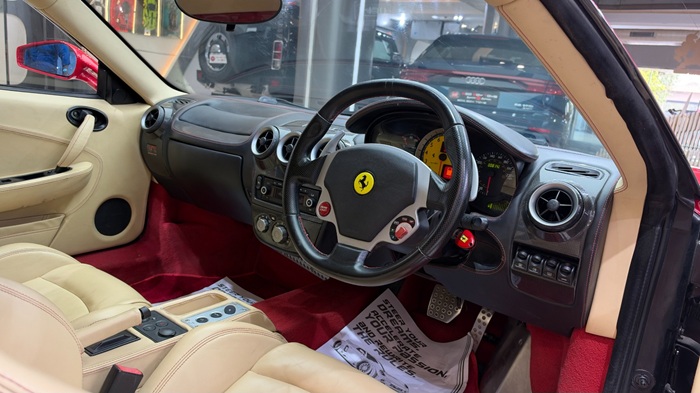
The dashboard is relatively straightforward, with a driver-focused instrument arrangement, conventional controls and a centre console that does not attempt to resemble a tablet computer.
Leather upholstery provides the expected degree of Italian luxury, covering major surfaces and contributing to a genuinely special environment. Optional carbon-fibre trim and lightweight racing seats could make the cockpit considerably more purposeful.
The driving position is low and appropriately sporting. The seat places the driver close to the road, while the steering wheel and instruments remain the primary points of attention.
The optional carbon-fibre racing seats are particularly desirable for enthusiasts seeking stronger lateral support. However, buyers intending to spend long hours behind the wheel should consider whether the more accommodating conventional seats suit their requirements better.
The instrument cluster is dominated by a large analogue rev counter, finished in yellow on this specification. A red-faced alternative was available. It is a quintessential Ferrari feature, and for good reason.
With the engine’s power concentrated near the top of its operating range, the rev counter is not simply decorative. It tells the driver exactly how much more of that glorious V8 remains available before the next gear is required.
There are smaller gauges providing essential operating information, while conventional buttons and switches control many of the cabin functions. Climate control, electric convenience features and an audio system introduce some everyday usability without dominating the experience.
Depending on specification, buyers could also order upgraded audio, navigation and communication equipment. Measured against today’s infotainment systems, the technology feels undeniably dated. But then the F430 also predates the period when every carmaker decided that adjusting the temperature should involve navigating several menus.
Material quality is generally pleasing, although age has introduced familiar concerns. Some Ferrari interiors from this period suffer deterioration of their soft-touch switch coatings, while worn leather, tired trim and ageing electronics can spoil otherwise beautiful examples.
Visibility is reasonable in the forward direction for this class of car, but the low seating position, substantial rear bodywork and limited sightlines demand concentration while parking. Optional parking assistance can be useful, particularly in crowded Indian cities.
There are no rear seats, no panoramic roof and no vast digital interface. The cabin’s greatest luxury is that the driver remains the most important component of the experience.
The Manettino: Ferrari’s Little Switch With a Big Responsibility
Perhaps the F430’s most influential interior feature is the small rotary selector mounted on the steering wheel.
Known as the Manettino, this was the first Ferrari road car to introduce the now-famous steering-wheel-mounted driving mode control.
Inspired by Formula 1 steering-wheel systems, it allowed the driver to alter several aspects of the car’s behaviour without reaching for controls scattered around the dashboard.
Five selectable settings were provided: Ice, Low Grip, Sport, Race and CST Off.
Ice and Low Grip prioritise stability and controlled power delivery under slippery conditions. Sport provides a more responsive but still manageable balance for everyday enthusiastic driving. Race permits more aggressive performance, while CST Off disables the main electronic stability and traction interventions, leaving considerably greater responsibility with the driver.
Each selection influences interconnected systems, including throttle response, traction and stability control, adaptive suspension, transmission behaviour and the electronic differential.
This was significant technology in the mid-2000s. Instead of relying on a collection of unrelated electronic systems, Ferrari developed a more integrated approach to vehicle dynamics.
The F430 also introduced the E-Diff, an electronically controlled limited-slip differential that actively adjusts the locking characteristics between the rear wheels. Information from parameters including steering angle and lateral acceleration allows the system to manage torque distribution according to the car’s operating conditions.
In practical terms, the objective is to improve traction when accelerating out of corners while maintaining stability and agility as the car changes direction.
It is the sort of technology that delivers its greatest benefit without demanding the driver’s constant attention. Unlike a screen that announces every achievement with an animation, the E-Diff quietly gets on with making the car faster and more controllable.
A Naturally Aspirated V8 Worth Celebrating
The heart of the Ferrari F430 is its magnificent 4.3-litre naturally aspirated V8.
Displacing precisely 4,308 cc, the F136 E engine belongs to the Ferrari-Maserati F136 family. It features eight cylinders arranged in a 90-degree V configuration, dual overhead camshafts, four valves per cylinder and a total of 32 valves.
Output stands at 490 metric horsepower, equivalent to approximately 483 bhp, developed at 8,500 rpm. Maximum torque is 465 Nm at 5,250 rpm.
Those figures may not appear extraordinary alongside modern turbocharged supercars, but the character of the engine is rather more important than the numbers alone.
At its core is a flat-plane crankshaft, a configuration strongly associated with Ferrari’s high-revving V8 engines. Compared with the cross-plane arrangement commonly found in many conventional V8s, the flat-plane design supports a different firing character and contributes to the engine’s remarkable willingness to rev.
Instead of producing the deep, uneven rumble traditionally associated with large American V8s, the F430 builds towards a sharper, higher-pitched mechanical howl. As engine speed increases, the soundtrack becomes increasingly intense, eventually approaching the kind of noise that could persuade a motoring enthusiast to abandon perfectly sensible plans.
The engine also employs dry-sump lubrication, allowing oil to be stored separately and circulated effectively during sustained cornering forces. Besides improving lubrication under demanding conditions, the system contributes to more compact engine packaging.
Continuously variable valve timing helps optimise performance across the operating range, while the four-valve cylinder-head design and intake trumpets draw upon Ferrari’s Formula 1 engineering knowledge.
Electronic engine management is handled by twin Bosch Motronic ME7 control units, with electronically operated throttle systems, individual ignition coils and active knock management.
This level of sophistication matters because the F430 is not simply a large engine fitted behind two seats. It is a carefully engineered high-performance powertrain intended to deliver both responsiveness and precision.
A particularly interesting aspect is its relationship with other Ferrari and Maserati products. Variations of the broader F136 engine family powered vehicles including the Ferrari California and 458 Italia, Maserati Coupé, Quattroporte, GranTurismo and GranCabrio, as well as the Alfa Romeo 8C Competizione and the extraordinary Gillet Vertigo.5.
Naturally, the engines differed substantially in displacement, crankshaft configuration, calibration and application. They were members of the same engineering family rather than identical units installed in different bodies.
The F136 family subsequently earned eight honours in the International Engine of the Year awards across various categories and versions. Its legacy eventually gave way to Ferrari’s newer turbocharged F154 V8 family, although the naturally aspirated F136 architecture continued evolving after the F430 itself had been replaced.
For enthusiasts, the appeal is straightforward. The F430’s engine rewards the driver for using its rev range. There is no turbocharger delivering a sudden mountain of low-speed torque and no electric assistance disguising the natural response of the combustion engine.
What you receive instead is an increasingly urgent mechanical experience, building progressively towards the redline.
And that is something the specification sheet cannot adequately communicate.
The F1 Gearbox: Brilliant When Driven Hard, Less Charming in Traffic
The 2008 F430 Coupé under consideration is fitted with the six-speed Graziano-built F1 automated manual transmission.
Despite sometimes being described as an automatic, it is fundamentally a conventional manual gearbox with an electrohydraulic system operating the clutch and gear-selection mechanisms.
That distinction matters.
Unlike a modern dual-clutch transmission, which can change gears with remarkable smoothness and speed, the F430’s system must disengage its clutch, select the next ratio and re-engage the clutch during each shift.
Hydraulic actuation, operating at pressures of approximately 20 bar, performs these operations under electronic control. A compact twin-plate clutch and lightweight flywheel arrangement assist with packaging and responsiveness.
The objective was to deliver rapid gear changes without requiring the driver to operate a conventional clutch pedal.
Behind the steering wheel, paddle shifters allow manual control over gear selection. The gearbox can also operate automatically, although its character remains very different from a modern torque-converter automatic.
During enthusiastic driving, the system makes sense. As revs rise and the driver requests the next gear, the resulting interruption and reapplication of power create a distinctly mechanical rhythm. It does not hide the process of changing gear; it makes the process part of the entertainment.
At low speeds, however, the compromises become more apparent. Stop-start traffic can produce hesitation and occasional abruptness, while repeated clutch engagement in congestion contributes to wear.
An F430 is unlikely to appreciate spending its entire life crawling through central Delhi in first gear. Then again, very few drivers would describe that experience as enjoyable either.
Ferrari also offered a traditional six-speed manual transmission with its celebrated open metal shift gate. These cars have become especially desirable among collectors because they offer a more direct, mechanical connection between driver and gearbox.
The F1 transmission is therefore the more technologically representative choice, while the gated manual appeals particularly to those who value a traditional driving experience.
Launch-control functionality was also associated with certain F430 specifications and markets, allowing the powertrain electronics to optimise standing-start acceleration under suitable conditions.
Performance That Still Commands Respect
When introduced, the F430 occupied serious supercar territory.
Ferrari quoted a 0–100 km/h acceleration time of approximately four seconds for the F1-equipped Coupé, while the maximum speed exceeded 315 km/h.
Even today, that remains properly fast.
What makes the figures especially interesting is the relatively modest amount of torque compared with modern turbocharged performance cars. With 465 Nm available, the F430 relies on engine speed, gearing and efficient power delivery rather than brute-force low-rpm acceleration.
At lower revs, the engine offers progressive and manageable response. Press further into the throttle and the urgency increases substantially, particularly as the tachometer moves into the upper half of its range.
The final stretch towards 8,500 rpm is where the V8’s character becomes most distinctive. The combination of induction noise, exhaust note and increasing acceleration creates the sense of an engine that genuinely enjoys working hard.
On an open highway, the available performance is far beyond what ordinary overtaking requires. The driver can exploit the gearbox to keep the V8 operating in its strongest range, with the engine responding promptly to throttle inputs.
The absence of turbocharging gives the power delivery a particularly natural character. There is no boost threshold to consider and no artificial attempt to manufacture an instantaneous response.
The F430 is exceptionally quick, but it is also interactive. It asks the driver to participate in extracting its performance rather than simply pressing the accelerator and allowing a collection of motors and computers to do everything.
Chassis Engineering: Where the F430 Earns Its Reputation
Straight-line acceleration is only part of the Ferrari experience. What made the F430 especially impressive in its day was the sophistication of its chassis and the way its mechanical and electronic systems worked together.
The aluminium spaceframe forms a rigid foundation for forged-aluminium double unequal-length wishbone suspension at the front and rear. Anti-dive and anti-squat geometry help control the car’s attitude during braking and acceleration.
Electronically controlled Skyhook adaptive dampers continuously alter their characteristics in response to driving conditions and selected dynamic settings.
The intention is to offer a degree of compliance during ordinary driving without sacrificing the control required for high-speed cornering.
In Sport mode, the F430 is intended to provide a relatively balanced configuration, allowing the suspension to absorb imperfections while maintaining the precision expected of a mid-engined Ferrari.
Select Race and the car adopts a more aggressive dynamic setup, reducing electronic intervention and prioritising responsiveness.
The hydraulic power-assisted steering is another important part of the experience. Unlike many modern electrically assisted systems, it belongs to a period when steering feel was a major component of a sports car’s personality.
A well-maintained F430 should offer direct responses and a clear sense of connection through the front axle, although tyre condition, alignment and suspension wear make a substantial difference to the result.
Through corners, the rearward weight distribution, low centre of gravity and relatively compact wheelbase contribute to the car’s willingness to change direction. The E-Diff helps the driven rear wheels manage torque as the driver accelerates out of a bend.
That combination offers tremendous potential for cornering performance, but the mid-engined layout also demands respect. When grip is exceeded, especially with the electronic safety systems reduced or disabled, corrective inputs need to be accurate and timely.
On broken Indian roads, the F430’s low ride height, short suspension travel and wide performance tyres are obvious limitations. Even with adaptive dampers, sharp potholes and uneven surfaces can deliver an uncomfortable reminder that Ferrari designed this car primarily for enthusiastic driving on suitable roads.
Highway stability is a more natural strength. Aerodynamic development substantially increased downforce compared with the 360 Modena, improving the F430’s ability to remain composed at elevated speeds.
Braking received equally serious attention. Ferrari worked with Brembo and Bosch to develop the system, incorporating ventilated discs and advanced electronic control.
The conventional brake discs used a specialised cast-iron alloy containing molybdenum to improve heat management. Carbon-ceramic composite brakes were also offered, initially as an expensive option and later becoming standard on many markets’ late-production cars.
The carbon-ceramic system offers particularly strong resistance to brake fade during repeated demanding use, although replacement costs can be considerable.
For ordinary road use, the conventional braking arrangement is already substantial. More important on a used F430 is the actual condition of its discs, pads, hydraulic components and tyres.
Ultimately, the F430’s chassis is not defined by one clever component. Its strength comes from the relationship between structure, suspension, steering, brakes, electronic differential and engine.
Ferrari managed to make advanced technology support the driving experience rather than dominate it.
Fuel Economy: Probably Best Not Discussed at Dinner
The Ferrari F430 has a 95-litre fuel tank, which is fortunate considering its appetite for petrol.
The quoted fuel economy in the supplied specification is approximately 6 km/l. Depending on driving conditions and throttle usage, actual consumption can vary considerably.
At that figure, the theoretical range from a full tank would be around 570 km, although sensible owners would refuel well before the tank approached empty.
Heavy city traffic, repeated acceleration and enthusiastic high-rev driving can all reduce efficiency.
There is no hybrid system, no electric-only mode and no regenerative braking to help recover wasted energy. Every horsepower comes from burning petrol, which the F430 does with considerable enthusiasm.
Running costs naturally extend beyond fuel. High-performance tyres, specialist maintenance, insurance and potential repairs demand a meaningful ownership budget.
The fuel bill, however, is unlikely to be the greatest concern for someone considering a nearly ₹2.5 crore used Italian supercar.
Safety Before the Age of Electronic Babysitters
For a mid-2000s performance car, the F430 carried a considerable amount of active and passive safety technology.
Equipment included two airbags, anti-lock braking, electronic brake-force distribution, traction control, Anti-Slip Regulation, stability management and tyre-pressure monitoring.
Its aluminium safety structure incorporated crash-protection provisions and side-impact protection beams, while three-point seatbelts featured pretensioners and load limiters.
The electronically controlled differential and vehicle dynamics systems also contributed to maintaining traction and stability under demanding circumstances.
However, the F430 belongs to an era before modern advanced driver-assistance systems became common. Buyers should not expect contemporary features such as adaptive cruise control, lane-keeping assistance or automated emergency braking.
Nor should its safety performance be compared directly with a modern vehicle using an assumed crash-test rating. No verified Bharat NCAP, Global NCAP or Euro NCAP result is established here for the model.
The F430 offers engineering designed to help a skilled driver maintain control, but it does not attempt to replace the driver’s judgement.
That distinction becomes especially important when nearly 500 bhp is being delivered exclusively to the rear wheels.
The F430’s Racing Pedigree Was Earned, Not Merely Advertised
Ferrari’s enthusiasm for racing has always influenced its road cars, but the F430 family also achieved meaningful success in international competition.
Specialised racing derivatives competed in GT championships and endurance events around the world, including the FIA GT Championship, European GT3 competitions, British GT Championship, FFSA GT, the 12 Hours of Sebring, Petit Le Mans, the 24 Hours of Spa and the 24 Hours of Le Mans.
One particularly significant achievement came at Le Mans, where the Ferrari F430 GT2 secured class victories in 2008 and 2009.
The racing versions were substantially modified compared with the standard road car, but they demonstrated the competitiveness of the underlying platform and Ferrari’s continued ability to translate engineering knowledge into motorsport success.
The road-going family also produced several fascinating derivatives.
The 430 Scuderia offered a lighter, more powerful and more track-focused interpretation, developed with input from Michael Schumacher. The Scuderia Spider 16M subsequently celebrated Ferrari’s 16th Formula 1 Constructors’ World Championship title with a limited-production open-top model.
A Bio Fuel concept explored alternative fuel technology, while the extraordinary Ferrari SP1 demonstrated the potential for bespoke coachbuilt creations.
The F430 Scuderia also provided the underlying engineering basis for the modern New Stratos project, a reinterpretation of another legendary Italian performance car.
Even outside the automotive world, the name achieved unexpected recognition through Dota 2 player Ferrari_430. Clearly, the combination of Ferrari and 430 has proven capable of attracting attention in rather different competitive environments.
Living With a Used Ferrari F430 in India
Buying a used Ferrari is an emotional decision, but maintaining one requires a considerably more analytical approach.
The F430 is generally regarded as one of the more usable Ferraris of its period, thanks partly to its relatively robust F136 engine and chain-driven camshafts. Unlike some earlier Ferrari V8 models, it does not require periodic replacement of conventional engine timing belts.
That is helpful, but it should not be interpreted as evidence that maintenance will be inexpensive.
The exhaust manifolds are a well-known area requiring attention. Cracking can develop over time, particularly on earlier cars, and repairs should not be postponed because of the potential consequences for adjacent exhaust and engine components.
The F1 transmission also deserves careful inspection. Clutch wear, hydraulic pump operation, actuator health and correct calibration can significantly affect both drivability and ownership costs.
Likewise, the E-Diff’s hydraulic and electronic systems should be checked for proper operation.
Suspension bushes, ball joints, dampers, engine mounts and braking components are other areas where a thorough inspection can prevent unpleasant surprises.
Cars fitted with carbon-ceramic brakes deserve particular scrutiny because replacing damaged or excessively worn components can be extremely expensive.
Service documentation is therefore far more valuable than a freshly polished exterior.
For this particular 2008 example, the advertised mileage of 8,000 km suggests limited use. But low mileage alone does not guarantee excellent mechanical condition. Long periods of inactivity can affect tyres, seals, fluids, batteries and hydraulic systems.
A prospective buyer should establish when the tyres were manufactured, whether the transmission has received the necessary maintenance, the remaining clutch life and whether the exhaust manifold and suspension concerns have been addressed.
A specialist pre-purchase inspection, supported by diagnostic checks and a complete service history, is essential.
Ownership in India introduces additional considerations. Specialist Ferrari servicing is concentrated in a limited number of major locations, parts availability may require planning and transporting a low-slung supercar across difficult roads is not always straightforward.
Insurance, registration requirements and the vehicle’s existing documentation also deserve close examination before purchase.
The original factory warranty is no longer relevant for a 2008 car, so any dealer-supported protection should be assessed according to its actual terms rather than assumed coverage.
As for resale value, the F430 occupies an appealing position between older analogue Ferraris and newer electronic supercars. Its naturally aspirated V8, attractive design and historical importance support enthusiast interest, while specification, condition, provenance and transmission choice have a substantial influence on value.
The rarity and collector appeal of the gated manual can create a considerable premium, but a well-maintained F1 Coupé remains an enticing prospect for buyers more interested in driving than collecting.
Ferrari F430 Versus Lamborghini Gallardo, Porsche 911 and Audi R8
When new, the F430 faced formidable opposition from cars such as the Lamborghini Gallardo and Porsche 911 Turbo. The first-generation Audi R8 also emerged during the later years of its production.
Each approached the supercar formula differently.
The Lamborghini Gallardo offered dramatic styling, an evocative V10 and, in many versions, all-wheel drive. It could feel more theatrical and offered substantial traction, especially in challenging conditions. However, the Ferrari’s high-revving V8 and dynamic electronics delivered a distinctive blend of agility and mechanical involvement.
The Porsche 911 Turbo was the more sensible alternative, relatively speaking. With its turbocharged performance, all-wheel-drive traction and greater everyday usability, it provided extraordinary speed with fewer compromises.
A buyer who regularly drives through traffic or uses a performance car for longer journeys might find the Porsche easier to live with. But the F430 offers a more exotic driving environment and an entirely different sense of occasion.
The Audi R8, particularly in its original V8 form, combined mid-engined proportions with comparatively approachable manners and a less intimidating ownership experience. Its quattro traction and restrained styling made it appealing to drivers who wanted serious performance without the full Ferrari ownership experience.
What the F430 provides is something harder to quantify: a concentrated combination of design, racing heritage, engine character and mechanical interaction.
More modern cars can accelerate faster, shift gears more smoothly and deliver better fuel economy. Some will also be considerably easier to use every day.
But the F430’s appeal is not based purely on efficiency or statistical superiority.
It is based on the feeling that driving should occasionally be an event rather than just a means of reaching a destination.
Verdict: The Ferrari That Reminds Us Why Engines Matter
The Ferrari F430 occupies a particularly attractive position in modern supercar history. It is old enough to preserve much of the mechanical honesty associated with traditional performance cars, yet sophisticated enough to offer genuinely impressive handling, advanced vehicle dynamics and performance that remains formidable.
Its naturally aspirated 4.3-litre V8 is undoubtedly the centrepiece. The throttle response, progressive power delivery, extraordinary high-revving character and unmistakable soundtrack provide an experience that modern turbocharged and hybrid powertrains struggle to replicate in precisely the same way.
The chassis is equally important. Its aluminium construction, double-wishbone suspension, adaptive dampers and E-Diff combine to create a sports car with depth and genuine engineering sophistication.
The F430 is not perfect. Its F1 automated manual transmission can be awkward in traffic, its ride is compromised by poor roads, its cabin technology feels dated and its appetite for petrol is considerable. Maintenance demands specialist attention, while neglected examples can become financially punishing very quickly.
At ₹2.49 crore, this 2008 Coupé is certainly not an inexpensive route into supercar ownership. It is also substantially more expensive than the car’s original quoted Indian ex-showroom price, demonstrating how the market for desirable older Ferraris operates differently from that for conventional used cars.
Whether the price is justified depends heavily on the car’s condition, documented history, specification and the buyer’s priorities. Someone seeking maximum performance per rupee will find faster, newer and easier-to-own alternatives. A driver prioritising effortless daily usability should probably consider a Porsche or a more modern grand tourer.
But for the enthusiast who appreciates naturally aspirated engines, traditional instrumentation, unmistakable Italian styling and the particular theatre of a mid-engined Ferrari, the F430 remains extraordinarily appealing.
It represents a moment when Ferrari was beginning to master sophisticated electronic vehicle dynamics without allowing technology to dilute the personality of the driving experience.
Modern Ferraris are undoubtedly faster, more intelligent and more capable. Yet the F430 possesses a different kind of brilliance. It makes the process of driving feel important, involving and occasionally gloriously excessive.
The Ferrari F430 isn’t memorable because it can reach 315 km/h. It’s memorable because of everything it makes you feel on the way there.