With Swarovski crystal headlights, a 31.3-inch private cinema, 1,100 Nm of torque and a price tag of ₹2.65 crore, BMW’s flagship limousine is a fascinating collision of traditional luxury, outrageous performance and tomorrow’s technology.
There was a time when buying a BMW 7 Series meant that you had arrived in life. The 2026 BMW i7 M70 xDrive suggests that you have arrived, purchased the building, acquired the neighbouring property and would now quite like to watch a film while being massaged on the way home.
BMW’s flagship German full-size luxury sedan has always occupied an interesting position in the automotive world. It must deliver the comfort expected by industrialists, the technology demanded by early adopters and the driving experience traditionally associated with those three famous letters from Munich. With the facelifted seventh-generation 7 Series, BMW has attempted to satisfy all three audiences while making its most powerful limousine entirely electric.
The result is a 5.4-metre-long, nearly three-tonne luxury automobile capable of accelerating to 100 km/h in 3.8 seconds. That is an extraordinary number for something designed primarily to transport people who would rather not spill their coffee.
Nearly five decades of executive authority
The BMW 7 Series first appeared in 1977, establishing itself as the company’s flagship sedan and a technological showcase for innovations that would eventually filter down to more attainable BMWs. Nearly five decades later, that responsibility has become considerably more complicated. A flagship can no longer merely introduce a clever suspension system or a particularly comfortable leather seat. It must now function as a connected digital environment, an entertainment lounge and, increasingly, an electric power station on wheels.
The 2026 model represents the facelift of the seventh-generation 7 Series, internally known as the G70. Rather than abandoning its existing architecture, BMW has extensively modernised the car by introducing design elements, battery technology and digital systems derived from its Neue Klasse programme.
Underneath remains BMW’s flexible Cluster Architecture, identified as CLAR-II/WE, from an architectural family associated with models such as the 3 Series, 5 Series and X3. The electric iX employs a dedicated architecture with compatibility with CLAR, rather than an identical platform. This underlying flexibility allows BMW to offer both combustion-powered and fully electric versions of its flagship without creating two entirely separate luxury sedans.
The facelift’s design is associated with Maximilian Missoni, whose broader automotive design portfolio and career encompass the BMW Alpina Vision concept, Polestar 1, 2, 3, 4 and 5, Volvo XC60 and Volkswagen XL1. That is quite a collection of machinery, ranging from an exceptionally aerodynamic Volkswagen to some of Scandinavia’s most distinctive modern automobiles.
BMW calls the new styling approach monolithic, and it is an appropriate description. The 7 Series looks less like a collection of individual automotive design elements and more like a substantial sculpture carved from a single block of expensive material.
Globally, the 7 Series is assembled across markets including Germany, India, Thailand, Malaysia and Indonesia, with approximate annual worldwide sales of 65,000 units. India has also gained particular significance by becoming the only country outside Germany to locally produce the electric i7.
The flagship i7 M70 xDrive, however, arrives in India as a completely built-up imported unit.
The price of being important
The 2026 BMW 7 Series range in India begins at ₹1.95 crore, ex-showroom. Interestingly, that buys either the petrol-powered BMW 740 M Sport or the fully electric BMW i7 50 xDrive M Sport.
The i7 M70 xDrive featured here sits considerably higher at ₹2.65 crore, making it both the most expensive variant in the Indian range and the most powerful 7 Series BMW has ever produced.
Internationally, the model family extends to plug-in hybrid and diesel powertrains, alongside specialised offerings such as the Protection armoured variant and Ultimate Edition. These versions are not currently offered in India.
The M70 commands a ₹70 lakh premium over the regular electric i7. That difference alone would purchase a rather respectable luxury automobile. BMW therefore has some explaining to do, although its strategy appears to involve answering most questions with considerably more horsepower.
Exterior: Subtlety has left the building
The seventh-generation 7 Series has never been particularly interested in disappearing into the background. The facelift continues that philosophy but introduces a cleaner interpretation of BMW’s increasingly distinctive luxury-car identity.
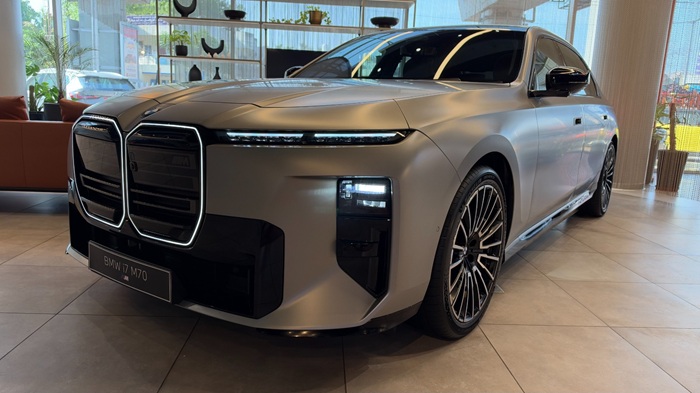
Finished here in BMW Individual Frozen Space Silver, the i7 M70 possesses the sort of presence normally associated with contemporary architectural installations. The matte finish emphasises the enormous body surfaces, allowing the restrained character lines to become more apparent.
The front remains dominated by the illuminated BMW Iconic Glow kidney grille. Whether one considers it magnificent or excessively theatrical will depend largely on personal taste. Either way, BMW has successfully ensured that nobody will mistake this car for anything else.
The redesigned bonnet introduces more clearly defined sculpting, while the M-specific front apron incorporates larger air-deflector elements. These provide a more purposeful appearance, distinguishing the M70 from its less powerful siblings without covering every available surface in unnecessary aerodynamic decoration.
Lighting is an important part of the visual drama. The adaptive LED headlights incorporate cornering illumination and a matrix High-Beam Assistant with a claimed maximum illumination range of 600 metres. That is an impressive distance, particularly on poorly illuminated Indian highways.
Above the primary lighting units sit the BMW Individual Iconic Glow crystal headlights, featuring smoke-black Swarovski crystal elements. These produce shimmering visual effects and elaborate welcome and farewell sequences.
Most cars simply unlock when their owners approach. The i7 appears to organise a small opening ceremony.
The Ceremonial Light Carpet continues this theatrical welcome by projecting illumination onto the ground beside the vehicle. It is hardly essential automotive technology, but neither is much of what happens at this end of the luxury-car market.
The electrically adjustable exterior mirrors integrate cameras and turn indicators, while their M-specific Seehaus stripes provide another visual distinction. An M badge positioned within BMW’s traditional Hofmeister kink identifies the performance model from the side, complemented by prominent side skirts and newly designed door handles.
The broad side surfaces and lengthy roofline give the i7 an unmistakably formal limousine profile. Climate-comfort laminated glass, including the windscreen, is intended to improve acoustic and thermal isolation, a particularly welcome feature during Indian summers.
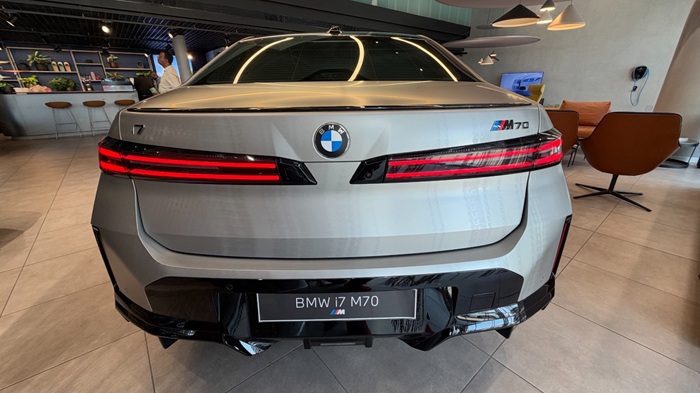
At the rear, the redesigned LED tail lamps introduce a slimmer and more contemporary lighting signature. The M-specific rear apron incorporates a substantial diffuser, while a discreet lip spoiler adds a sporting touch without making the entire vehicle resemble an oversized touring car.
BMW Individual offers more than 200 exterior colour possibilities across shades of blue, black, red, green, grey and white, along with various bespoke dual-tone finishes. At this price, choosing a paint colour could quite easily become a separate afternoon’s work.
A limousine of rather considerable proportions
Measuring approximately 5.4 metres in length, 1.9 metres in width and 1.5 metres in height, the i7 M70 is an enormous automobile by almost any conventional standard.
Its kerb weight is 2,845 kg, with a gross vehicle weight of 3,310 kg. That leaves a nominal difference of 465 kg for occupants and luggage, subject to the applicable vehicle loading definitions.
The weight is perhaps the most revealing statistic. BMW is attempting to make a substantial luxury limousine accelerate and change direction with the enthusiasm of a sports car while carrying an enormous battery, elaborate seating mechanisms, acoustic insulation and enough electronics to equip a small office.
Physics has not been consulted about whether this is sensible.
The featured car wears 21-inch M Individual light-alloy wheels, although 20-inch alternatives are available. The larger 22-inch wheels offered internationally are not available in India.
The staggered tyre configuration comprises 255/40 R21 102Y Michelin Pilot Sport EV tyres at the front and wider 285/35 R21 105Y rubber at the rear. These Hungary-manufactured tyres are extra-load, radial and tubeless, designed to contend with the substantial weight and immediate torque delivery of a high-performance electric vehicle.
Disc brakes are fitted at both ends.
Despite the presence of a large electric drivetrain and an exceptionally elaborate rear cabin, the i7 provides 500 litres of luggage capacity. This should comfortably accommodate airport luggage and everyday executive duties, although buyers expecting the versatility of an equally expensive luxury SUV may find the conventional sedan boot less accommodating.
BMW also offers accessories including a rear luggage box, bicycle carrier, tow bar and model-badge deletion. The last option is especially amusing considering that the enormous illuminated grille is unlikely to preserve anybody’s anonymity.
The rear cabin: Business class has been demoted
The i7 makes a compelling argument for abandoning the driver’s seat altogether.
Access is provided through automatic doors incorporating radar technology to detect obstacles during operation. BMW’s Comfort Access System and soft-close functionality further reduce the considerable inconvenience of having to close a door manually.
Illuminated scuff plates welcome occupants into an interior upholstered here in brown BMW Individual Merino leather, with black and white alternatives also indicated in the broader upholstery choices.
The material combination is appropriately extravagant. Leather, ambient illumination, metallic detailing and optional carbon-fibre trim introduce contrasting textures, while the Neue Klasse-inspired interior concept places technology at the centre of the cabin experience.
The electrically adjustable rear seats incorporate ventilation, heating, lumbar adjustment and massage functions. These would be impressive enough in most luxury vehicles, but the Executive Lounge seating arrangement takes things considerably further.
With the front passenger seat folded forward, the rear occupant can recline to an angle of up to 43 degrees, supported by a gap-free calf rest and heel support. Memory settings and massage functionality complete the experience.
It is a particularly convincing arrangement for buyers who spend their lives travelling between offices, airports and meetings. The cabin becomes less of a transportation device and more of a private recovery room.
Electric roller sunblinds provide privacy, while 5.5-inch Touch Command displays integrated into the rear doors allow passengers to operate relevant comfort and entertainment functions without asking the driver for assistance.
Wireless charging is available in both the front and rear compartments. USB ports and hooks behind the front seats provide additional everyday convenience.
The generous proportions and reclining arrangement are clearly designed around long-distance rear-seat comfort, although actual headroom, legroom and shoulder-room measurements are not available in the supplied specification.
Then there is the cinema.
A 31.3-inch television in a BMW
The automatically folding BMW Theatre Screen is a 31.3-inch ultra-wide display with 8K resolution. Descending from the roof, it transforms the rear passenger compartment into something resembling a particularly expensive private screening room.
Its capabilities include Amazon Fire TV, video conferencing through an integrated camera, HDMI connectivity, video games, Wi-Fi, eSIM connectivity and two headphone jacks.
The ability to attend a video conference from the back of a ₹2.65 crore BMW may be tremendously convenient, although it does rather remove the traditional excuse that one is travelling and cannot attend the meeting.
Entertainment is accompanied by a 35-speaker Bowers & Wilkins Diamond Surround Sound System producing 1,965 watts and supporting Dolby Atmos.
To put that into perspective, there are perfectly respectable small cinemas with less ambitious audio equipment.
The Panorama Glass Roof Sky Lounge features approximately 40 LED light graphics, complementing the extensive ambient lighting throughout the cabin. Together with the electric blinds, reclining seats and enormous display, the overall arrangement makes a persuasive case for employing a chauffeur.
There is, however, an unavoidable question about complexity. Motorised screens, automatic doors, adjustable seating mechanisms and multiple interconnected entertainment systems are wonderful when everything works. Their long-term reliability and ease of repair will be important considerations once these cars begin approaching the end of their warranty coverage.
Up front: Welcome to the Neue Klasse
The driver’s compartment has received one of the most significant changes introduced by the facelift.
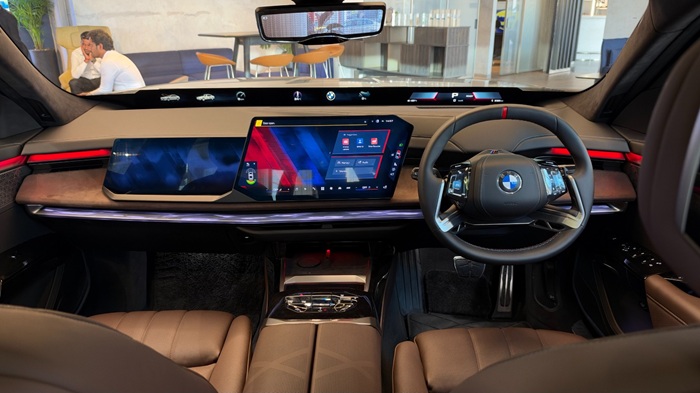
Instead of merely enlarging the previous curved display, BMW has adopted an entirely new digital architecture based around BMW Panoramic iDrive and Operating System X.
The 17.9-inch central infotainment touchscreen features a distinctive free-cut shape and matrix backlight technology. It functions as the primary interface for navigation, entertainment, vehicle settings and connectivity.
Supported services include BMW’s Personal Assistant, wireless smartphone integration, the My BMW App, Remote Services, three-dimensional navigation, real-time traffic information, Bluetooth, USB connectivity, Teleservices, BMW Digital Key Plus and conventional FM radio.
The latter is rather reassuring. Among all this technological sophistication, somebody at BMW remembered that occasionally a person simply wants to listen to the radio.
Making its debut is a separate 14.6-inch Full HD touchscreen for the front passenger, also incorporating matrix backlight technology. It supports content streaming, third-party applications and BMW ID-related functionality, with camera-based monitoring intended to prevent the entertainment display from distracting the driver.
Occupant detection is part of the screen’s operation, while BMW also specifies that the display can darken if the driver looks towards it. This is a sensible precaution given that the person responsible for steering nearly three tonnes of automobile should probably not be following a television series.
BMW Panoramic Vision replaces the conventional instrument-display arrangement with a projection extending across the lower portion of the windscreen. Navigation, telephone, media and personal-assistant information can be presented across this expansive digital surface.
A separate BMW 3D Head-up Display projects relevant driving information directly into the driver’s field of vision.
The idea is to keep important information closer to the road while permitting considerable personalisation. Whether this interface proves more intuitive than traditional instruments and physical controls will ultimately depend on its responsiveness and the simplicity of frequently used functions.
The three-spoke M leather steering wheel incorporates controls for Sport Boost, M modes, telephone functions, volume, voice commands, the head-up display and active cruise control with Stop & Go functionality. Heating is also provided, alongside the Integral Active Steering system.
The front seats match the rear compartment’s generosity with electrical adjustment, heating, ventilation, lumbar support and massage. Four-zone automatic climate control allows occupants to select individual temperature settings.
The centre console incorporates BMW’s CraftedClarity glass elements, while an Alcantara-covered wireless charging tray features a magnetic holder to keep a compatible smartphone securely in position.
All of this creates a cabin that is technically fascinating and visually sophisticated. The potential disadvantage is that luxury increasingly depends on software. A beautiful physical switch remains intuitive after twenty years; a complicated touchscreen menu may not remain intuitive after its next update.
Powertrain: The electric equivalent of a sledgehammer
The i7 M70 xDrive is powered by a 112.5 kWh lithium nickel manganese cobalt oxide, or NMC, battery incorporating newer cylindrical-cell technology.
Energy is delivered to two BMW eDrive Separately Excited Synchronous Electric Motors, with one motor driving each axle. This creates an electric xDrive all-wheel-drive arrangement governed by M-specific control software.
Unlike a conventional mechanical all-wheel-drive system, the electric configuration can manage the contribution of each motor electronically according to traction requirements and driving conditions.
Combined maximum output is approximately 670 hp in mechanical horsepower terms, equivalent to 680 metric horsepower. Torque reaches an extraordinary 1,100 Nm when Sport Boost or M Launch Control is activated, while maximum system torque in Sport mode is 1,015 Nm.
Power is transmitted through a single-speed automatic transmission arrangement. There are no conventional gear changes, no multi-speed transmission waiting to select a lower ratio and no combustion engine needing to build revs before delivering its maximum effort.
The claimed 0–100 km/h time is 3.8 seconds, with a maximum speed of 250 km/h.
Those numbers would be impressive in a compact two-seat sports car. In a limousine equipped with a massage system and a fold-down television, they border on the absurd.
The M70’s powertrain should make rapid highway overtaking remarkably effortless, with immediate torque delivery and uninterrupted acceleration. The absence of conventional gear changes also suits the limousine’s executive character, promising the smoothness that chauffeur-driven occupants value.
What it cannot reproduce is the mechanical theatre of a traditional high-performance BMW engine. There is no rising straight-six soundtrack, no V8 crescendo and no satisfying gearshift accompanying a hard acceleration run.
Electric performance exchanges those sensations for immediacy. The experience is different rather than necessarily inferior, although enthusiasts accustomed to BMW’s combustion engines may miss some of their character.
Ride and handling: Making 2,845 kg behave itself
The defining engineering challenge of the i7 M70 is not producing 670 hp. It is controlling the considerable mass attached to that horsepower.
BMW addresses this with M-specific adaptive two-axle air suspension capable of automatically adjusting the vehicle’s ride height. The system can lower the body at higher speeds to improve stability and aerodynamic performance, while additional height adjustment provides greater flexibility when required.
Adaptive M Chassis Control Professional incorporates electronically controlled dampers and active roll stabilisation. The latter is particularly important because a car of these dimensions naturally generates substantial body movement when changing direction.
The suspension’s objective is to provide the isolation expected of a flagship limousine without allowing the body to behave like a yacht whenever the road becomes interesting.
Integral Active Steering introduces rear-axle steering, with the rear wheels capable of turning by up to 3.5 degrees in the opposite direction to the fronts during appropriate low-speed manoeuvres.
This effectively reduces the perceived wheelbase and improves manoeuvrability, an especially important consideration in Indian cities where parking spaces frequently appear to have been designed around hatchbacks.
At higher speeds, coordinated rear-wheel steering is intended to improve directional stability and make lane changes feel more composed.
The staggered Michelin Pilot Sport EV tyres should provide substantial traction, while the electronically managed xDrive system can distribute power between both axles according to available grip.
Nevertheless, no chassis-control system can entirely eliminate the consequences of weight. Tight corners, rapid transitions and heavy braking must contend with the considerable inertia of a 2.8-tonne vehicle.
The M70 should therefore be approached as a tremendously capable performance limousine rather than an oversized substitute for a BMW M3.
The 21-inch wheels also introduce a potential compromise. Their relatively low-profile tyres are appropriate for the car’s performance ambitions and visual character, but the optional 20-inch wheels may be the more sensible choice for buyers regularly encountering broken Indian roads, potholes and ambitious speed breakers.
Actual steering feedback, brake-pedal consistency, low-speed ride quality, body control and high-speed refinement remain matters for a comprehensive road test. The chassis specification is exceptionally ambitious, but the hardware alone cannot establish how successfully BMW has balanced comfort against agility.
The alternatives within the 7 Series family
Buyers who do not require the acceleration of a supercar can consider the BMW i7 50 xDrive M Sport.
It uses the same 112.5 kWh NMC battery and dual-motor synchronous electric configuration but produces approximately 449 hp and 660 Nm. BMW claims a 0–100 km/h time of 5.5 seconds, a maximum speed of 210 km/h and an impressive WLTP range of up to 728 km.
These figures make the regular i7 anything but slow. More importantly, its superior claimed range and considerably lower purchase price make it a compelling proposition for chauffeur-driven buyers.
The traditional alternative is the BMW 740 M Sport, powered by a 3.0-litre inline-six BMW B58 TwinPower Turbo petrol engine incorporating variable valve control and a 48V mild-hybrid system.
The engine produces approximately 394 hp and 540 Nm, paired with an eight-speed Steptronic automatic transmission. Acceleration to 100 km/h takes a claimed 5.4 seconds, while maximum speed is 250 km/h.
The supplied fuel-economy figure is approximately 10 km/l, with a 74-litre fuel tank.
For buyers undertaking frequent long-distance journeys through regions where reliable high-speed charging infrastructure remains limited, the petrol-powered 740 retains considerable appeal. BMW’s decision to offer traditional and electric powertrains within essentially the same luxury-car family remains one of the model’s greatest strengths.
Range and charging
BMW claims a WLTP driving range of up to 686 km for the i7 M70 xDrive.
Considering its performance, dimensions and weight, that is an impressive certified figure. However, real-world range will inevitably depend on driving speed, ambient temperature, climate-control usage, traffic conditions and the enthusiasm with which the Sport Boost function is employed.
A car possessing 1,100 Nm of torque naturally encourages occasional behaviour that may not be entirely compatible with maximum energy efficiency.
Using a compatible 250 kW DC fast charger, the i7 can replenish its battery from 10 to 80 per cent in approximately 28 minutes under suitable conditions.
A 22 kW AC charging system can recharge the battery from empty to full in approximately six hours. BMW supplies a complimentary 22 kW-capable BMW Wallbox charger with installation, although achieving the maximum AC charging speed requires an appropriate electrical supply.
For owners with private parking and suitable home-charging infrastructure, this arrangement should make daily ownership particularly convenient. The vehicle can be replenished overnight without visiting a conventional fuel station.
Long-distance travel requires more planning, especially when moving beyond India’s established highway charging corridors. The advertised maximum charging rate should also not be interpreted as a constant rate throughout the charging session.
Safety: A second pair of digital eyes
BMW equips the i7 M70 with seven airbags and an extensive collection of active safety and driver-assistance technologies.
Driving Assistant Plus incorporates steering assistance, lane-control assistance and active cruise control, complemented by Lane Change Warning, Blind Spot Assistant, Rear Crossing Traffic Warning and Rear Collision Prevention.
Dynamic Stability Control and Dynamic Traction Control help manage available grip, while Active Protection incorporates an Attentiveness Assistant. Auto Hold, Tyre Pressure Monitoring and ISOFIX child-seat mounting points contribute to everyday safety and convenience.
Parking Assistant Professional combines with the Surround View Camera and Reversing Assistant Professional to make low-speed manoeuvring more manageable.
Remote parking via a compatible smartphone allows the vehicle to manoeuvre into suitable parking spaces without the driver remaining inside. For a limousine stretching 5.4 metres, this is one of the more genuinely useful technologies rather than merely a demonstration of electronic wizardry.
BMW Drive Recorder and Remote Interior View provide additional monitoring capabilities, while acoustic pedestrian protection generates an external warning sound to improve the awareness of pedestrians around the otherwise quiet electric vehicle.
These technologies are intended to assist the driver rather than replace responsible supervision.
No independent crash-test rating for this specific facelifted Indian-market variant is established by the supplied information.
Ownership: The cost of complicated luxury
BMW provides an eight-year or 1.60 lakh km high-voltage battery warranty, alongside a two-year vehicle warranty. Extended vehicle-warranty coverage is available for up to ten years, subject to applicable terms and eligibility.
The ownership package also includes two years of 24-hour roadside assistance.
BMW Condition Based Service monitors maintenance requirements, helping owners schedule servicing according to the vehicle’s operating condition rather than relying exclusively on conventional fixed intervals.
The electric drivetrain eliminates several traditional combustion-engine maintenance requirements, but that does not necessarily make the M70 an inexpensive automobile to maintain.
Its substantial Michelin tyres, complex suspension, radar-equipped automatic doors, elaborate lighting systems and multiple high-resolution displays all represent sophisticated and potentially expensive components.
Insurance, depreciation and replacement-part costs deserve consideration. Anyone buying a ₹2.65 crore electric limousine should probably regard an appropriate extended-warranty package as considerably more useful than another decorative carbon-fibre accessory.
The competition
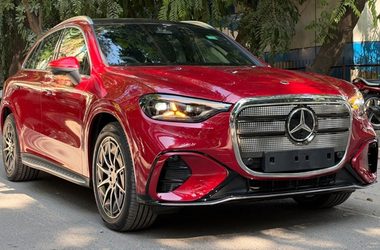
The Mercedes-Benz EQS is the i7’s most obvious electric luxury-sedan rival. Its aerodynamic styling and technology-focused cabin offer a different interpretation of executive electric motoring. Buyers prioritising electric efficiency, a more understated exterior or a lower entry price may find the Mercedes particularly attractive.
The BMW counters with its more traditional limousine proportions, extensive rear-seat entertainment system, Executive Lounge seating and distinctive M Performance identity.
For owners intending to spend considerably more time behind the steering wheel, the Porsche Taycan presents an equally interesting alternative. Its sports-car-oriented architecture and driver-focused character make it an obvious consideration for buyers who regard driving involvement as the primary attraction of an expensive electric sedan.
The Porsche, however, approaches luxury from the perspective of a performance car. The i7 approaches performance from the perspective of a luxury limousine. That distinction matters enormously when deciding which seat will be occupied most frequently.
The Audi e-tron GT follows a similarly sporting philosophy, combining dramatic grand-touring proportions with electric performance. Its appeal lies more in its relatively athletic character than in attempting to replicate a chauffeur-driven executive lounge.
Meanwhile, the Mercedes-Benz S-Class remains an important traditional luxury benchmark for customers who are not yet convinced that their flagship sedan needs to be electric. Its established emphasis on comfort and conventional executive elegance offers a persuasive alternative to BMW’s more expressive technological approach.
Verdict: A magnificent machine with an identity crisis worth celebrating
The 2026 BMW i7 M70 xDrive is an automobile that appears determined to eliminate the need for compromise by incorporating several completely different automobiles into one enormous package.
It wants to be a chauffeur-driven limousine, a high-performance electric sedan, a mobile cinema, a connected executive office and an exhibition of everything BMW knows about modern automotive engineering.
Its greatest strengths are evident in its specification: formidable electric performance, an extraordinarily comprehensive rear cabin, impressive claimed range, sophisticated chassis technology and exceptional opportunities for personalisation.
Its weaknesses are equally apparent. It is exceptionally heavy, visually divisive, mechanically and electronically complex, and considerably more expensive than the already accomplished i7 50 xDrive. Its sheer dimensions make it less naturally suited to congested Indian cities, regardless of how clever its rear-wheel steering and automated parking systems may be.
For buyers primarily interested in being chauffeured, the ₹1.95 crore i7 50 xDrive arguably represents the more rational purchase. It offers greater claimed range, abundant performance and much of the flagship experience without demanding an additional ₹70 lakh.
The M70 is for somebody rather different. Somebody who enjoys being transported in extraordinary comfort but occasionally wishes to dismiss the chauffeur, activate Sport Boost and remind themselves why they bought a BMW in the first place.
Whether that dual personality justifies the ₹2.65 crore asking price is ultimately a question of priorities. A Porsche Taycan is the more natural choice for an enthusiastic driver, while a conventional S-Class appeals to buyers seeking traditional limousine elegance. The i7 M70 occupies the extravagant territory between them.
In 1977, the BMW 7 Series represented the summit of Munich’s engineering ambitions. Nearly half a century later, it still does. The difference is that the flagship now illuminates the driveway with Swarovski crystals, carries its own cinema, runs on electricity and can reach 100 km/h before its rear passenger has finished adjusting the massage setting.
Completely necessary? Absolutely not.
Wonderfully ambitious? Without question.
The BMW i7 M70 xDrive is what happens when German engineers are given an enormous budget, an even bigger battery and remarkably few instructions to exercise restraint.