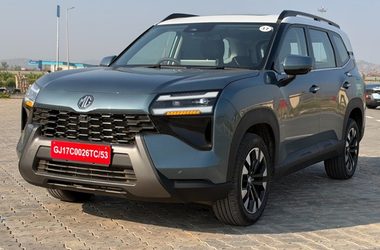
There was a time when buying a seven-seater SUV involved choosing between petrol, diesel and financial regret at the fuel station. Electric SUVs subsequently arrived with their silent motors, enormous screens and a rather unfortunate tendency to turn long-distance journeys into exercises in logistical planning. The 2026 MG Hector Tomahawk Plug-in Hybrid attempts to resolve this dilemma by combining the convenience of a petrol-powered SUV with the efficiency and refinement of an electric vehicle. And with a claimed combined driving range exceeding 1,100 km, it makes a particularly compelling argument for Indian motorists who enjoy driving considerably further than the nearest shopping mall.
The Tomahawk is not simply another interpretation of the familiar Hector. It represents a new generation of electrified MG products, bringing together a sophisticated hybrid powertrain, substantial proportions, seven-seat practicality and enough digital technology to make some consumer electronics companies feel slightly uncomfortable.
More importantly, during our Delhi-to-Ahmedabad journey, the Tomahawk comfortably delivered approximately 1,000 km of driving range. Suddenly, MG’s ambitious efficiency claims don’t seem quite so ambitious.
A fighter pilot’s name and an international pedigree
Launched in 2026, the Hector Tomahawk is a first-generation crossover SUV whose name draws inspiration from the Curtiss P-40 Tomahawk fighter-bomber aircraft associated with the Second World War. It is an appropriately aggressive name for something that will, in all likelihood, spend much of its life transporting schoolchildren, suitcases and occasionally unreasonable quantities of groceries.
Internally designated F520S, the Tomahawk is based on the Wuling Starlight 560, which is also marketed internationally as the Wuling Xingguang 560 and Wuling Eksion. It has been developed by SGMW, the joint venture involving SAIC Motor, General Motors and Wuling Motors, with assembly operations in India, China and Indonesia.
In several international markets, the vehicle has effectively succeeded the MG Hector and Chevrolet Captiva, making it a significant product within the group’s global SUV portfolio.
Underneath its muscular exterior sits MG’s new Advanced Drive Architecture Platform Technology, rather conveniently abbreviated to ADAPT. Also known internationally as the Tianyu platform, the architecture underpins several related vehicles, including the Wuling Starlight 730, Starlight S, Starlight, Baojun Yunhai and Baojun Xiangjing.
MG describes ADAPT as India’s first Multi-New Energy Vehicle platform, engineered to accommodate different electrified powertrain configurations. Internationally, the Tomahawk is also offered with a conventional petrol engine, although whether that version eventually reaches India remains to be seen.
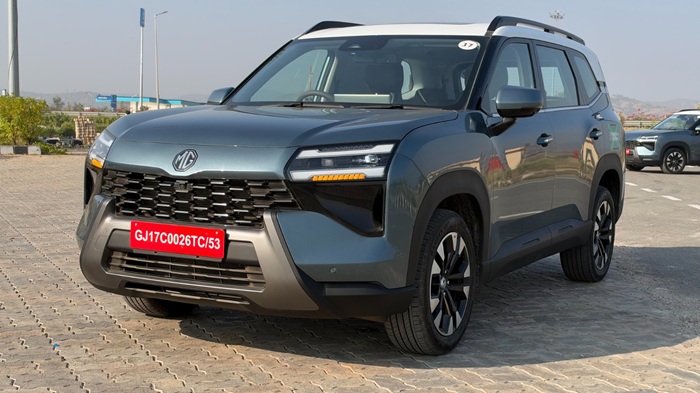
The Indian plug-in hybrid range comprises the Exclusive and Essence variants, priced at ₹25.69 lakh and ₹27.79 lakh respectively, ex-showroom. The vehicle featured here is the range-topping Essence, finished in Celadon Blue. A fully electric Tomahawk is also available, with prices starting at ₹20.24 lakh.
MG additionally offers a Battery-as-a-Service ownership model, with prices starting at ₹21.79 lakh and a battery rental charge of ₹3.20 per kilometre. There is an assured buyback programme as well, introducing another dimension to the ownership proposition.
Exterior: Muscular without becoming ridiculous
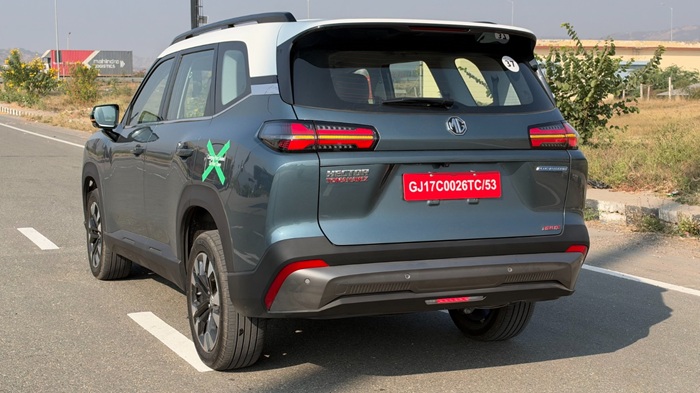
MG calls the Tomahawk’s styling philosophy Muscular Flowline Design, and the description is reasonably appropriate. This is a substantial-looking crossover with broad shoulders, pronounced bodywork and a confident stance. It possesses the visual authority expected of a large modern SUV without looking as though its designers were exclusively inspired by military equipment.
Dominating the front end is the 3D Hawk X honeycomb grille, accompanied by an illuminated MG logo and automatic X-shaped Beacon LED projector headlamps. The lighting arrangement incorporates LED daytime running lights, Intelligent Headlamp Control and a follow-me-home function.
The distinctive lighting signature gives the Tomahawk considerable personality, particularly after dark. Unlike some contemporary SUVs that appear to have been designed around an illuminated light bar, the MG retains a recognisable and fairly conventional front-end identity.
The bonnet and broad frontal proportions contribute to its muscular character, while the side body cladding provides a degree of visual ruggedness. It is worth remembering, however, that this is fundamentally a front-wheel-drive crossover rather than a traditional expedition vehicle. The aggressive styling should not be mistaken for an invitation to cross the Himalayas without a road.
The Essence rides on 18-inch Precision Cut Aeronautic alloy wheels, fitted with 225/55 R18 102V JK Tyre Ranger HP Extra Load steel radial tubeless tyres. Red brake calipers add a sporting touch, with disc brakes fitted at both ends.
The 55-profile tyres are a sensible choice for Indian conditions, where excessively large wheels and fashionable low-profile rubber frequently discover that municipal infrastructure has a rather different understanding of performance motoring.
The power-adjustable and electrically folding outside mirrors incorporate turn indicators and cameras. MG has also provided acoustic and UV-cut glass for the windscreen and front door windows, alongside rain-sensing wipers and a front defogger.
At the rear, LED tail lamps, an LED fog lamp, a rear wiper with washer and a rear defogger complete the functional equipment.
Besides Celadon Blue, buyers can choose silver, gold, white, green or black exterior colours. Dual-tone configurations are available exclusively with a white roof, an interesting departure from the industry’s seemingly unconditional affection for black contrast roofs.
A large SUV with genuinely useful space
At approximately 4.7 metres long, 2.1 metres wide and 1.8 metres tall, the Tomahawk occupies a considerable amount of road space. Its proportions provide the presence buyers expect from a seven-seat SUV, although navigating older Indian city streets and particularly ambitious parking spaces will demand some attention.
The 230 mm ground clearance is especially relevant for Indian buyers. It gives the Tomahawk a useful margin when negotiating poorly constructed speed breakers, uneven rural roads and those mysterious urban excavations that appear overnight without warning.
Fortunately, the 360-degree HD surround-view camera system incorporates a transparent chassis view and wheel view, making it possible to monitor obstacles around and beneath the vehicle. In an SUV of this size, such technology is more than a novelty. It has genuine everyday value.
With all three rows in use, luggage capacity stands at 192 litres. That is sufficient for several smaller bags, although seven adults departing for a lengthy holiday may need to negotiate their packing arrangements beforehand.
Fold the third row and capacity increases to a much more useful 528 litres. The third-row seats feature a 50:50 split-folding arrangement, while the second row offers a 60:40 split, sliding adjustment and tip-and-tumble functionality.
MG has also provided a 17-inch spare wheel, a reassuring inclusion at a time when several expensive vehicles expect owners to repair significant tyre damage using a small bottle of sealant and optimism.
Interior: Somewhere between an SUV and a digital lounge
The Tomahawk’s interior follows the contemporary approach to premium automotive design, combining restrained colours, extensive digital interfaces and generous equipment levels.
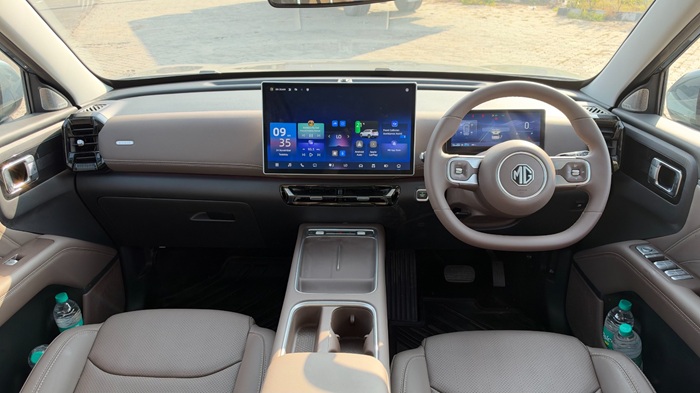
Brown artificial leather upholstery introduces a warmer atmosphere than the all-black cabins increasingly favoured by manufacturers. The interior also features 256-colour ambient lighting, allowing owners to select an appropriate cabin atmosphere for everything from a relaxing evening drive to an unnecessarily elaborate trip to the supermarket.
The electrically assisted steering wheel is wrapped in artificial leather and offers tilt and telescopic adjustment. Integrated controls handle the digital instrument cluster, infotainment system, telephone, volume and voice functions, alongside the adaptive cruise control interface.
Ahead of the driver sits an 8.8-inch digital instrument cluster, while the centre of the dashboard is occupied by an enormous 15.6-inch Grand View touchscreen. Lower variants receive a comparatively modest 12.8-inch infotainment display, although describing a screen of that size as modest illustrates just how dramatically automotive interiors have changed.
The six-way electrically adjustable driver’s seat incorporates memory and auto-retract functions, while the front passenger receives four-way electrical adjustment. Both front seats are ventilated, a feature considerably more valuable during an Indian summer than several dozen additional ambient lighting colours.
Automatic climate control incorporates a PM2.5 filter, while an auto-dimming interior rear-view mirror, automatic up-and-down power windows with anti-pinch protection, rear window sunshades and a Dual Pane Cockpit Sunroof contribute to the cabin’s comfort.
The sliding second-row seats allow occupants to distribute available legroom between the second and third rows, improving flexibility when travelling with a full complement of passengers. As with most three-row crossovers, buyers intending to carry seven adults regularly should assess third-row comfort personally.
A fast wireless phone charger with integrated cooling addresses the familiar problem of smartphones becoming small portable heaters while charging and simultaneously running navigation applications.
For music enthusiasts, the Essence features a 10-speaker Infinity audio system, complete with a dedicated subwoofer and amplifier. MG has certainly not approached the entertainment department with any particular sense of restraint.
Technology: More intelligent than strictly necessary
The infotainment system is arguably the Tomahawk’s most ambitious interior feature. Wireless Android Auto and Apple CarPlay are supported alongside USB connectivity, FM radio, Bluetooth, Wi-Fi and the MG i-Smart ecosystem.
There is also a generative AI-powered advanced voice assistant with conversational chat capability and support for more than 30 Hinglish voice commands.
MG’s I-Swipe interface enables two-, three- and five-finger gesture controls for functions including air conditioning, temperature, fan speed, music and volume. It is an interesting attempt to make touchscreen operation more intuitive, although a conventional rotary knob remains remarkably difficult to improve upon when travelling along a particularly uneven road.
The infotainment system incorporates personalised memory settings, an i-Smart Quick Access Phone Widget, Siri Shortcuts, valet mode, quiet mode, wallpapers, preloaded greeting messages and birthday wishes.
There are also Pro Pet Mode, Nap Mode, Camp Mode, Smoking Mode and Energizing Mode. Apparently, the modern automobile must now accommodate every conceivable emotional, recreational and biological requirement of its occupants.
Entertainment is handled through the StarManch karaoke application, Jio’s integrated applications, JioSaavn, Jio Games, JioSphere, children’s content, internet radio and a Home-to-Car music library comprising more than 8,000 songs. Shopping and food-related services, document storage and an MG App Store further expand its capabilities.
More meaningful functions include scheduled charging, service booking, over-the-air software updates and the EcoTree interface, which displays information about carbon dioxide savings.
Through the MG i-Smart mobile application, owners can remotely access more than 80 vehicle functions. These include remote climate control, remote locking and unlocking, vehicle location, vehicle status checks, vehicle start alarms, geofencing, speeding alerts and smart driving information.
Electric vehicle-related functions include charging station searches, full-charge notifications and low battery alerts. Critical tyre-pressure voice alerts, anti-theft immobilisation, live location sharing and vehicle tracking further enhance the connected ownership experience.
A digital Bluetooth key is available, alongside walk-away automatic locking and approach-based automatic unlocking. Even the horn arrangement consists of a dual-horn system.
There is considerable technology here, some of it genuinely useful and some of it arguably answering questions that nobody had previously thought to ask. The real challenge for MG is ensuring that all this functionality remains accessible without overwhelming the driver.
The powertrain: Efficiency rather than theatrics
The most interesting aspect of the Tomahawk lies beneath its bodywork, where MG has employed a sophisticated plug-in hybrid powertrain rather than a conventional petrol engine with a small electrical assistance system.
At its heart is a 1.5-litre, inline-four-cylinder SGMW LBG petrol engine belonging to the Daewoo S-TEC engine family. It operates on the Atkinson cycle and is paired with a permanent magnet synchronous electric motor and a 20.5 kWh Magic lithium iron phosphate, or LFP, battery.
The engine is particularly notable for its exceptionally high 15.5:1 compression ratio and claimed thermal efficiency of 43.2 per cent.
Thermal efficiency refers to the proportion of energy contained within the fuel that is converted into useful mechanical work. Achieving a figure exceeding 40 per cent is an impressive engineering accomplishment for a production petrol engine and demonstrates the extent to which this particular unit has been developed around efficiency.
The Atkinson-cycle operating principle prioritises fuel economy over outright specific power output, with the electric motor helping compensate for the characteristics of an efficiency-focused combustion engine.
Related applications of the petrol engine include the Wuling Starlight S, Xingguang S, Starlight 730, Starlight L, Chevrolet Captiva and Baojun Yunhai.
The combined powertrain specification is quoted at 198 hp and 237 Nm, with power delivered to the front wheels through a Dedicated Hybrid Transmission. The system is also compatible with E20 petrol.
Four selectable driving modes are provided: Eco, Normal, Sports and Custom. Behind the scenes, the hybrid system automatically manages six operating configurations, consisting of pure electric driving, series hybrid operation, parallel hybrid boost, regenerative operation, pure engine operation and simultaneous engine propulsion and battery charging.
In series hybrid operation, the combustion engine can generate electricity to support the electric propulsion system. Parallel hybrid operation allows both power sources to contribute towards driving the vehicle, while pure engine operation becomes available when the system determines that it is appropriate.
The intelligent management of these operating configurations is central to the Tomahawk’s appeal. Drivers are not expected to spend every journey wondering whether the engine should be charging the battery or assisting the wheels. That is precisely the sort of decision the hybrid control system is supposed to make for them.
Performance: Sensibly quick
MG quotes a 0–100 km/h acceleration time of nine seconds and a top speed of 178 km/h for the Tomahawk Plug-in Hybrid.
For a seven-seat crossover designed principally around family transport and long-distance efficiency, those are respectable numbers. This is not intended to be a performance SUV, but its acceleration figures suggest sufficient reserves for expressway merging and routine overtaking.
The electric motor’s ability to provide torque without waiting for the combustion engine to build revs should prove particularly beneficial in stop-start traffic. Electrically assisted propulsion also offers the potential for smoother initial acceleration than a conventional efficiency-oriented petrol engine operating alone.
The Dedicated Hybrid Transmission is an important component here, allowing the system to prioritise the most appropriate combination of electrical and mechanical propulsion.
The greatest attraction, however, is not the prospect of reaching 100 km/h in nine seconds. It is the ability to undertake an extraordinarily long journey without constantly considering where the next fuel station or charging point might be.
For most Indian buyers, that is a far more useful interpretation of performance.
Ride and handling: Engineering for Indian conditions
The Tomahawk employs MacPherson strut suspension at the front and an independent multi-link arrangement at the rear.
An independent multi-link rear suspension is a welcome inclusion in a large family crossover. Its design allows engineers greater flexibility in controlling individual wheel movement, potentially improving the balance between ride comfort, stability and handling precision.
The substantial ground clearance and sensible tyre sidewalls also suggest an approach that acknowledges the realities of Indian roads rather than assuming every journey takes place on freshly surfaced European asphalt.
However, a vehicle measuring approximately 1.8 metres in height and more than two metres across inevitably brings compromises. Its physical dimensions are likely to be more noticeable in tight urban environments than on open highways, and the elevated body requires careful suspension tuning to control weight transfer through corners.
The front-wheel-drive layout is appropriate for an efficiency-focused road-going crossover, reducing some of the mechanical complexity associated with all-wheel-drive systems. Nevertheless, buyers seeking serious off-road ability, low-range gearing or locking differentials should consider a purpose-built four-wheel-drive SUV instead.
The Tomahawk’s 230 mm ground clearance is primarily a practical advantage for broken roads and difficult surfaces rather than evidence of comprehensive off-road capability.
Electric power steering, four-wheel disc brakes, electronic stability management and regenerative braking form the basis of its dynamic package. The acoustic front glass should also help suppress wind and external road noise, particularly during extended highway journeys.
The important unanswered questions concern the precise steering feedback, suspension compliance over sharp imperfections, body control under hard cornering and the consistency of brake pedal response as regenerative and friction braking interact. Those characteristics require more detailed dynamic testing than the available journey observations establish.
On paper, however, the Tomahawk’s mechanical priorities appear entirely appropriate for an SUV intended to transport families over considerable distances.
Fuel economy: The Tomahawk’s strongest argument
The plug-in hybrid offers a claimed electric-only driving range of 115 km from its 20.5 kWh battery. That is particularly significant because it potentially allows many owners to complete their regular daily commutes without consuming petrol at all, provided they have convenient access to charging.
MG quotes fuel economy of 40 km/l in hybrid operation and 17 km/l when running on the petrol engine. Combined with a 52-litre fuel tank, the company claims a total driving range exceeding 1,100 km with a fully charged battery and full fuel tank.
MG also describes the Tomahawk as India’s first plug-in hybrid to offer such a combined range.
During our drive from Delhi to Ahmedabad, we comfortably achieved approximately 1,000 km of range. That observation is arguably more meaningful to prospective owners than the laboratory figures.
It demonstrates the practical advantage of a plug-in hybrid in a country where charging infrastructure is improving but still cannot offer the same geographical convenience as conventional fuel stations.
Of course, the claimed 40 km/l figure should not be interpreted as guaranteed fuel economy under every driving condition. Plug-in hybrid consumption depends heavily on battery charge, charging frequency, traffic conditions, driving style, speed and how the vehicle manages its different propulsion systems.
Owners who regularly recharge the battery and undertake shorter journeys could substantially reduce petrol consumption. Those who rarely plug in will experience a different ownership equation.
The Tomahawk therefore makes the greatest sense when its owner treats it as an electric vehicle during everyday use and allows the petrol engine to provide flexibility during longer journeys.
Charging and the ability to power more than itself
MG supplies a complimentary 3.3 kW portable charger with the Tomahawk.
The company quotes a charging time of seven hours and 50 minutes to reach 90 per cent using 3.3 kW AC charging. With a 25 kW DC charger, it quotes approximately 35 minutes for 50 per cent charging.
DC charging capability adds welcome flexibility to a plug-in hybrid, particularly when owners want to replenish the battery during a longer journey without committing to an extended stop.
The vehicle also offers 3 kVA AC Vehicle-to-Home output, Vehicle-to-Load functionality and Vehicle-to-Vehicle charging capability.
These features allow the Tomahawk to function as a mobile source of electrical energy for compatible equipment and other applications. For camping, outdoor activities or certain emergency power requirements, this capability could prove particularly useful.
It is an amusing development in the evolution of the automobile. Cars once required electricity merely to start their engines. They can now potentially help power the equipment in your house.
What about the fully electric Tomahawk?
For buyers prepared to abandon petrol entirely, MG offers the Tomahawk EV with a substantially larger 69.2 kWh Magic LFP battery and a permanent magnet synchronous electric motor.
The electric version produces 201 hp and 310 Nm, completing the 0–100 km/h sprint in a claimed 8.2 seconds before reaching a top speed of 160 km/h. Its claimed driving range stands at 517 km.
Interestingly, the fully electric version is quicker to 100 km/h than the plug-in hybrid, thanks in part to its greater quoted torque output.
The choice between the two ultimately depends on usage. The EV makes considerable sense for buyers with reliable home charging and predictable travel requirements, while the plug-in hybrid provides greater flexibility for frequent intercity travel and journeys through regions where charging infrastructure remains less developed.
Safety: A comprehensive electronic safety net
MG has employed high-strength steel in the Tomahawk’s body structure, alongside six airbags, ABS with EBD, Electronic Stability Program, traction control, hill hold, brake assist and auto hold.
Additional equipment includes a direct tyre-pressure monitoring system, ISOFIX child-seat mounting points, high-speed warning, seat-belt reminders, speed-sensing automatic door locking and impact-sensing automatic door unlocking. Three-point seat belts are provided, with pretensioners and load limiters for the front seats.
Front and rear parking sensors complement the HD surround-view camera system.
The Level 2 advanced driver assistance package incorporates Bend Cruise Assistance, Traffic Jam Assist, Lane Keep Assist, Lane Departure Prevention, Lane Departure Warning, Forward Collision Warning, Automatic Emergency Braking and Intelligent Hydraulic Braking Assistance, alongside adaptive cruise control.
These systems can reduce driver workload, particularly on longer highway journeys, although their usefulness depends on road markings, traffic conditions and the driver’s continued supervision. Level 2 assistance is not autonomous driving.
MG says the battery has undergone more than 2,000 bench tests, over 490 vehicle validations and testing under extreme environmental conditions.
The equipment and validation programme are encouraging, although an independently verified crash-test rating would provide a more complete assessment of the vehicle’s crash protection.
Ownership: Making hybrid technology less intimidating
MG offers a lifetime battery warranty, subject to the applicable warranty conditions, alongside a three-year, unlimited-kilometre vehicle warranty that can be extended to five years with unlimited kilometres.
Three years of roadside assistance and three labour-free services are also included.
The lifetime battery warranty is particularly relevant because concerns surrounding battery degradation and eventual replacement costs remain significant considerations for prospective electrified vehicle owners.
The Battery-as-a-Service programme reduces the initial purchase price, although buyers should carefully evaluate the ₹3.20-per-kilometre rental charge against their annual driving distances and intended ownership period.
The assured buyback programme may also help address uncertainty surrounding future resale values, depending on its contractual terms.
As a newly introduced model, the Tomahawk has yet to establish a long-term reliability record in India. The sophistication of its hybrid powertrain and extensive electronics makes warranty coverage particularly important.
The competition
The Tata Safari appeals to buyers who prefer a more conventional large SUV experience and a muscular road presence. The Hyundai Alcazar offers an alternative for those prioritising urban usability, family comfort and familiar technology.
The Toyota Innova Hycross is arguably a more relevant philosophical rival. Its hybrid approach similarly prioritises efficiency and family practicality, although its MPV-oriented character differs from the MG’s crossover SUV personality.
The Tomahawk’s distinctive advantage is its ability to combine substantial electric-only driving capability with the convenience of a petrol-powered long-distance vehicle.
Buyers seeking conventional mechanical simplicity, an established ownership record or serious off-road capability may find alternatives more appropriate. Those interested in electrification without becoming entirely dependent on public charging infrastructure, however, have a particularly interesting proposition in the MG.
Verdict: An SUV for a country still transitioning to electric mobility
The MG Hector Tomahawk Plug-in Hybrid is compelling because it addresses a genuine problem rather than simply adding more technology for the sake of appearing technologically advanced.
Its seven-seat configuration, substantial ground clearance, flexible seating, comprehensive equipment and sophisticated hybrid powertrain make it particularly relevant to Indian families who regularly combine city driving with long-distance travel.
The ability to travel a claimed 115 km on electricity alone, followed by hundreds of additional kilometres using petrol, is arguably more meaningful than the enormous infotainment screen, karaoke application or 256 available ambient lighting colours.
At ₹27.79 lakh, the Essence is not inexpensive. Its imposing dimensions will occasionally prove inconvenient, the third row compromises luggage capacity, and the sheer volume of digital functionality risks making simple operations unnecessarily complicated. Long-term reliability and more detailed dynamic assessments remain important considerations.
Nevertheless, the price becomes easier to understand when considering the breadth of its mechanical capabilities, equipment and ownership package.
The Tomahawk will particularly appeal to buyers who want the quietness and efficiency associated with electric motoring but are unwilling to surrender the freedom of conventional long-distance travel.
It is neither an old-fashioned petrol SUV reluctantly entering the electric age nor a battery-powered vehicle demanding that its owner reorganise their entire lifestyle around charging.
Instead, it occupies the increasingly fascinating territory between the two.
And in a country where the next 1,000 km might involve expressways, village roads, mountains, traffic jams and several entirely unnecessary diversions, an SUV that offers the freedom to keep going without constantly checking its remaining range makes an exceptionally persuasive case for itself.
The Tomahawk may have borrowed its name from a fighter aircraft, but its greatest achievement is considerably less dramatic: making long-distance motoring wonderfully uneventful.