

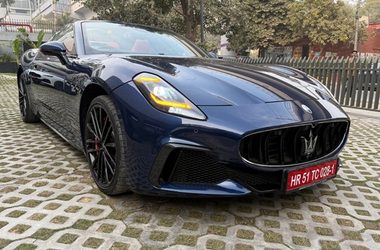
With 542 horsepower, a twin-turbo Nettuno V6, four seats and an intoxicatingly beautiful Italian silhouette, the Maserati GranCabrio Trofeo makes a compelling case for enjoying the journey rather than merely reaching the destination.
There are cars you buy because they make sense, cars you buy because they are extraordinarily fast, and then there are cars like the Maserati GranCabrio. It belongs to that wonderfully irrational corner of the automotive universe where practicality takes a comfortable back seat, financial calculations become somewhat inconvenient, and the simple act of lowering the roof can justify an entire afternoon of driving. This is not a car designed to conquer every racetrack or dominate every performance comparison. It is designed to make the journey feel like an occasion. The fact that it can also exceed 300 km/h is a rather entertaining bonus.
The second-generation Maserati GranCabrio Trofeo is an Italian grand tourer in the traditional sense, albeit one equipped with enough computing power, sophisticated chassis technology and motorsport-derived engineering to make its predecessor seem decidedly analogue. It occupies the territory between an out-and-out supercar and an extravagantly luxurious convertible, offering serious performance without abandoning the elegance, comfort and theatre that have long defined Maserati.
An Italian tradition, reinvented
The original GranCabrio was unveiled in 2009 before reaching customers in 2010, bringing the elegant proportions of the GranTurismo coupé into the world of open-air motoring. Its naturally aspirated V8 became an important part of its identity, producing the sort of soundtrack that could make driving through a tunnel feel like attending an Italian opera.
The second generation, internally designated M190, was unveiled in 2024, and the car featured here is the 2025 Trofeo. Developed under the design leadership of Klaus Busse, it retains the fundamental visual identity of its predecessor while embracing a dramatically different mechanical and technological philosophy.
Its name is appropriately straightforward. GranCabrio combines the idea of grand touring with cabriolet motoring, essentially describing a sophisticated convertible intended for covering considerable distances in considerable style.
Mechanically related to the M189 GranTurismo, the GranCabrio employs a highly specialised modular architecture developed by Maserati. It has links to the broader Giorgio engineering family associated with vehicles such as the Alfa Romeo Giulia and Stelvio, Maserati Grecale and Jeep Grand Cherokee, although Maserati describes the GranTurismo and GranCabrio architecture as a dedicated development rather than a straightforward transplant of an existing platform.
Production of the second-generation model initially took place at the Mirafiori facility in Turin, with Maserati announcing the return of GranTurismo and GranCabrio manufacturing to its historic Modena plant from late 2025. There is something particularly appropriate about a Maserati returning to Modena, a city where automotive performance is practically a local language.
Pricing: Exclusivity comes at a price
The GranCabrio occupies a suitably exclusive position in the Indian luxury-car market. Pricing references for the earlier model place it around the ₹3 crore to ₹3.18 crore mark, although published launch and subsequent pricing figures have varied.
Maserati introduced the facelifted range in India in October 2026, with the updated GranCabrio 490 priced at ₹2.91 crore, the Trofeo at ₹3.10 crore and the all-electric Folgore at ₹3.30 crore, ex-showroom. Its GranTurismo coupé counterpart now starts at ₹2.62 crore.
The distinction is important because the car discussed here is the earlier 542 hp Trofeo, rather than the subsequently updated version.
At these prices, the GranCabrio is hardly an exercise in financial restraint. But then, nobody has ever walked into a Maserati showroom looking for the most economical way to travel between two points.
Exterior: Italian design without the unnecessary shouting
Modern performance cars have developed a curious obsession with looking angry. Enormous grilles, excessively complicated bumpers and aerodynamic appendages have become increasingly common, often resulting in cars that resemble particularly irritated kitchen appliances.
The GranCabrio takes a more sophisticated approach.
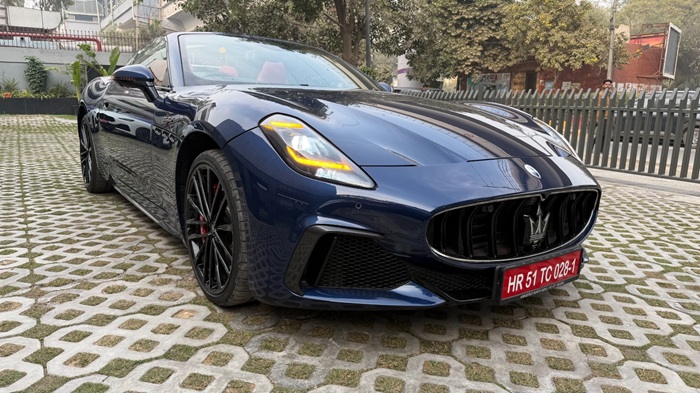
Its defining characteristics are its long bonnet, low-slung body, muscular rear haunches and beautifully balanced proportions. There is an unmistakable sense of movement even when the car is stationary, and the absence of a fixed roof arguably makes its silhouette even more elegant than that of the GranTurismo.
At the front, Maserati’s signature grille houses a prominent three-dimensional Trident emblem, ensuring there is little ambiguity about the car’s origins. The vertically arranged full-LED headlamps represent a departure from the horizontally stretched lighting assemblies of earlier Maseratis, introducing a contemporary expression without compromising the brand’s identity.
The enormous cofango bonnet is another particularly distinctive detail. The term combines the Italian words for bonnet and fender, reflecting an integrated body-panel design that contributes to the clean appearance of the front end. It stretches dramatically towards the windscreen, visually reinforcing the car’s front-mid-engine configuration.
An optional carbon-fibre front splitter adds a more purposeful edge, complemented on this specification by carbon-fibre side skirts. Fortunately, the aerodynamic detailing does not overwhelm the fundamental elegance of the design.
The GranCabrio’s body construction is equally sophisticated. Aluminium accounts for more than 65 per cent of its construction, accompanied by magnesium and high-performance steel in areas requiring particular structural characteristics. The aerodynamic drag coefficient quoted in the supplied specifications is 0.28, an impressive target for a large performance-oriented convertible.
Along the sides, Maserati’s traditional three air vents remain present, providing a visual connection to generations of Trident-badged machinery. The electrically adjustable electrochromic exterior mirrors incorporate turn indicators and cameras, helping the driver negotiate a body that is considerably wider than it might initially appear.
The car’s stance is strengthened by staggered alloy wheels measuring 20 inches at the front and 21 inches at the rear. They are wrapped in German-made Goodyear Eagle F1 SuperSport extra-load radial tubeless tyres, sized 265/30 ZR20 94Y at the front and 295/30 ZR21 102Y at the rear.
The rear tyres, in particular, possess the sort of dimensions traditionally associated with small steamrollers.
Behind the wheels sit Brembo disc brakes with red calipers. Buyers can alternatively specify black, yellow, blue, green or white calipers, while the wider wheel catalogue offers another 16 designs.
At the rear, the GranCabrio combines boomerang-shaped LED tail-lamps with harpoon-inspired detailing, muscular bodywork and chrome-plated exhaust outlets. An optional carbon-fibre spoiler introduces additional sporting character without turning the rear deck into an exhibition of aerodynamic furniture.
It is a handsome car from virtually every angle, but the side profile with the roof lowered is where the design makes its strongest argument.
A convertible tailored to your personality
The blue exterior of this particular GranCabrio works especially well with its red leather interior and black fabric roof. It is a bold combination, but Italian grand tourers are among the few cars that can wear such contrasting colours without appearing to have suffered a disagreement between their interior and exterior designers.
Maserati’s extensive personalisation catalogue encompasses approximately 45 paint choices, including shades of yellow, grey, silver, white, blue, orange, red, green, brown, purple and black, alongside various matte finishes.
There are coloured badges, alternative wheels, different brake-caliper finishes and numerous carbon-fibre details. Through Maserati’s Fuoriserie personalisation programme, customers can go considerably further, creating a car that reflects their individual preferences rather than simply choosing from a conventional list of factory options.
The electrically retractable fabric roof can be specified in black, grey, beige, red or blue. It takes approximately 14 seconds to open and 16 seconds to close, and can be operated at speeds of up to 50 km/h.
In an era when complicated folding metal roofs occasionally make convertibles look rather awkward, the traditional fabric roof is a particularly welcome choice. It preserves the elegant roofline and helps limit the weight and complexity associated with the conversion mechanism.
Size and practicality: A grand tourer in every sense
Do not mistake the GranCabrio’s sleek appearance for compact dimensions. At 4,966 mm long, 1,957 mm wide excluding mirrors and 1,365 mm tall, with a 2,929 mm wheelbase, this is a substantial automobile.
Include the mirrors and the width increases to 2,113 mm. That figure becomes particularly relevant when navigating narrow Indian streets, underground parking facilities or enthusiastic motorcyclists attempting to occupy the same piece of road.
The official European homologated weight is 1,895 kg. Despite its extensive aluminium construction, the additional reinforcement required by a convertible body, together with all-wheel drive, luxury equipment and the roof mechanism, inevitably contributes to its mass.
A turning circle of 12.4 metres further emphasises that the GranCabrio is better suited to sweeping roads than complicated three-point turns in crowded residential neighbourhoods.
Its four-seat configuration is an important advantage over conventional two-seat roadsters and supercars. Maserati has designed the rear accommodation as two proper individual seats rather than treating them solely as upholstered luggage shelves.
Nevertheless, rear-seat access requires some cooperation from the front occupants, and tall passengers would be wise to assess legroom and headroom before embarking on a particularly ambitious road trip.
The boot accommodates 172 litres in its larger configuration, reducing to 131 litres when the roof-storage arrangement occupies additional space. A pair of soft weekend bags makes considerably more sense than large, rigid suitcases.
The GranCabrio may be a grand tourer, but it encourages its occupants to develop an admirably minimalist approach to packing.
Interior: Italian craftsmanship meets the digital age
Maserati describes the interior design philosophy as the “Balance of the Opposites”, an attempt to combine traditional Italian luxury with modern technological sophistication, sporting intent with relaxation, and handcrafted materials with a heavily digital operating environment.
The red leather upholstery of this example provides a wonderfully dramatic atmosphere. White, grey, black and brown alternatives offer more restrained interpretations, while the carbon-fibre trim introduces a contemporary sporting element.
The dashboard is sculpted rather than simply assembled around a collection of screens. Its layered architecture, pronounced central console and carefully positioned displays create a cockpit that feels visually appropriate for a luxury performance car.
Details such as the “Since 1914” engraving serve as reminders of Maserati’s heritage. They are relatively small touches, but at this price, details matter considerably.
The leather-wrapped, heated sports steering wheel incorporates controls for the instrument cluster, telephone and voice functions, while gearshift paddles and sporting pedals reinforce the Trofeo’s performance credentials.
The front seats feature ventilation, a genuinely useful addition in India. A heated steering wheel may not be quite as essential in Delhi during June, but the ability to circulate air through the seats is likely to be appreciated considerably more often.
The low seating arrangement suits the car’s character, placing occupants close to the road and behind that expansive bonnet. With the roof lowered, outward visibility benefits from the absence of roof pillars above shoulder level, although the long nose and considerable width still demand care in confined spaces.
The frameless digital rear-view mirror, surround-view cameras and parking sensors are therefore more than technological indulgences.
Material selection is appropriately ambitious, with leather and carbon fibre forming the centrepiece of the specification. Whether every switch, secondary surface and concealed piece of trim meets the expectations associated with a ₹3 crore automobile would require a more extensive physical assessment.
Technology: Enough screens to keep everyone occupied
The GranCabrio’s 12.3-inch Maserati Intelligent Assistant, or MIA, infotainment system supports wireless Android Auto and Apple CarPlay, navigation, FM radio, Amazon Alexa functionality, over-the-air updates and the Maserati Intelligent Voice Assistant.
Below it sits an 8.8-inch comfort display responsible for several secondary vehicle functions, including climate-control operation.
The driver receives a configurable 12.2-inch digital instrument cluster and a head-up display, allowing important driving information to remain within the natural field of vision.
The centrepiece of the dashboard, however, is Maserati’s digital clock. Traditionally a distinctive feature of the brand’s interiors, it has evolved from a conventional timepiece into a configurable display capable of showing a compass, G-force meter, accelerator information and stopwatch.
Quite why anyone needs to consult a G-force meter while driving to dinner is debatable, but Maserati owners are unlikely to complain about the option.
Multicolour ambient lighting and wireless smartphone charging add contemporary convenience, while the Maserati Connect application provides remote access to vehicle information, location, protection functions and valet-mode features.
The digital architecture is comprehensive, but it raises a familiar criticism of modern luxury cars. Adjusting climate settings through a touchscreen is rarely as intuitive as turning a physical dial, especially on a moving vehicle or when sunlight is pouring directly into an open cabin.
The GranCabrio compensates with voice controls and a well-equipped driver information system, although traditionalists may still miss the tactile simplicity of earlier Maseratis.
Entertainment is provided by an available 16-speaker Sonus faber High Premium audio system producing 1,060 watts. The Italian audio specialist has developed the system specifically to suit the cabin’s acoustic environment, which is particularly challenging in a convertible.
Of course, there is another Italian sound system beneath the bonnet, and it does not require Bluetooth.
The Nettuno V6: Neptune’s contribution to motoring
The mechanical centrepiece of the GranCabrio Trofeo is Maserati’s 2,992 cc Nettuno V6, a twin-turbocharged petrol engine producing 542 hp and 650 Nm of torque.
Nettuno is the Italian name for Neptune, the Roman god associated with the sea and the Trident that inspired Maserati’s emblem. It is a particularly fitting name for an engine that represents the modern technological identity of the company.
Variants of the Nettuno engine family also power the MC20, Grecale Trofeo, MCXtrema and GT2 Stradale, although their outputs, internal specifications and applications differ.
The engine employs Maserati’s pre-chamber combustion technology, derived from motorsport engineering principles. It uses a small combustion chamber positioned above the conventional combustion chamber, with ignition spreading through carefully engineered openings to promote faster and more effective combustion.
A second spark plug supports conventional combustion under appropriate operating conditions. This twin-spark arrangement allows the engine to adapt its combustion strategy according to the demands placed upon it.
It is an unusually sophisticated solution for a road-going petrol engine, illustrating that the Nettuno’s significance extends beyond simply attaching two turbochargers to six cylinders.
Unlike the mid-engined MC20 application, the GranCabrio uses a front-mid-engine layout, positioning the engine to contribute towards a near-even distribution of mass. Maserati’s official technical documentation quotes a 51:49 front-to-rear weight distribution for the Trofeo.
Power is transmitted through ZF’s 8HP75 Gen2 eight-speed automatic gearbox to all four wheels, with an electronically controlled self-locking rear differential helping manage traction.
The combination of all-wheel drive and 650 Nm is particularly appropriate for a grand tourer intended to perform in varying weather and road conditions rather than exclusively on dry racetracks.
Performance: Extremely quick, effortlessly so
Maserati claims that the 2025 GranCabrio Trofeo accelerates from 0–100 km/h in 3.6 seconds, reaches 200 km/h in 12.2 seconds and continues to a maximum speed of 316 km/h.
Those figures place this luxurious four-seat convertible firmly within serious performance-car territory.
Peak torque arrives at around 3,000 rpm, with maximum power delivered at 6,500 rpm. The broad spread of performance suggests that the Nettuno should be equally comfortable delivering relaxed highway progress or considerably more urgent acceleration when called upon.
The availability of 650 Nm means overtaking should require little more than an appropriately judged application of the accelerator. There is no particular need to chase the upper reaches of the rev counter every time a slower vehicle appears ahead.
The ZF eight-speed automatic is well suited to this dual personality. Its closely spaced lower ratios facilitate acceleration, while the taller upper gears help reduce engine speeds during sustained cruising.
Four driving modes are available: Comfort, GT, Sport and Corsa. Comfort prioritises relaxation, GT is intended for everyday grand touring, Sport sharpens the responses, and Corsa takes the car towards its most focused dynamic configuration.
Launch control is also available for appropriate closed-course use.
The inevitable question concerns the soundtrack. The original GranCabrio’s naturally aspirated V8 remains a particularly difficult act to follow. A turbocharged V6 cannot reproduce its exact mechanical character, and traditional Maserati enthusiasts may regard the loss of two cylinders as a significant emotional compromise.
Nevertheless, the Nettuno compensates with considerably more sophisticated engineering, immense torque and genuinely formidable performance. It represents a different generation of Maserati, rather than an attempt to recreate the past.
Ride and handling: The science behind the elegance
The GranCabrio’s suspension arrangement is considerably more sophisticated than its elegant exterior initially suggests.
At the front, Maserati employs a double-wishbone suspension incorporating a semi-virtual steering axis, air springs and electronically controlled damping. The rear features a multi-link arrangement, air suspension, electronic damping control and the electronically managed self-locking differential.
The semi-virtual steering axis is intended to improve steering geometry and help manage unwanted forces transmitted through the steering system, particularly important in a powerful all-wheel-drive vehicle.
The adaptive suspension allows the GranCabrio to alter its behaviour according to the selected driving mode and prevailing conditions. This flexibility is essential in a car attempting to combine relaxed touring comfort with the ability to manage substantial speed and cornering loads.
At the heart of the electronic architecture is Maserati’s Vehicle Domain Control Module, or VDCM. Rather than allowing the engine, transmission, chassis, all-wheel-drive system and brakes to operate as largely independent entities, the VDCM coordinates their behaviour.
The advantage is a more integrated approach to vehicle dynamics, particularly when the driver changes modes or when the car encounters varying grip conditions.
Its low centre of gravity, near-balanced weight distribution and generous rear tyre footprint should contribute to reassuring high-speed stability and considerable cornering traction. However, the GranCabrio’s nearly 1.9-tonne mass means it cannot realistically be expected to possess the instantaneous agility of a lightweight, dedicated sports car.
Nor should the adaptive suspension be confused with immunity from poor road surfaces. Those extremely low-profile tyres offer limited cushioning, and sharp potholes, broken tarmac and ambitious Indian speed breakers deserve considerable respect.
Precise conclusions about steering feedback, body roll, wind noise, structural rigidity and low-speed ride quality would require a dedicated road test. On engineering grounds, the GranCabrio appears configured to favour a blend of stability, progressive handling and long-distance comfort over outright track-focused aggression.
Braking hardware is appropriately substantial, with ventilated Brembo discs measuring 380 mm at the front and 350 mm at the rear, accompanied by six-piston and four-piston fixed calipers respectively. Maserati quotes a 100–0 km/h stopping distance of less than 37 metres.
Fortunately, the engineers appear to have devoted almost as much attention to stopping the GranCabrio as they have to making it go.
The alternatives within the Maserati family
The standard petrol GranCabrio employs the same 3.0-litre twin-turbo Nettuno V6, producing 483 hp and 600 Nm. Its official 0–100 km/h acceleration time is four seconds, accompanied by a maximum speed of 300 km/h.
It makes a compelling argument for buyers who prioritise the styling and grand-touring experience over extracting every last fraction of a second from the performance figures.
Then there is the GranCabrio Folgore, an entirely different interpretation of the same fundamental design.
Its 92.5 kWh lithium-ion battery powers three permanent-magnet synchronous electric motors, delivering approximately 751 hp and 1,350 Nm. The electric convertible reaches 100 km/h in 2.8 seconds, 200 km/h in 9.1 seconds and has a maximum speed of 290 km/h.
The 2025 European specification quotes a WLTP range of 441 km. Its 800-volt electrical architecture supports DC charging at up to 270 kW, allowing a claimed 20–80 per cent recharge in 18 minutes under suitable conditions, alongside 22 kW AC charging capability.
The Folgore is quicker to conventional road speeds, but the petrol Trofeo retains a particular emotional advantage. In an open-top Italian performance car, the interaction between accelerator, transmission, engine and exhaust remains an important part of the experience.
Fuel efficiency and everyday usability
The quoted fuel economy in the original specification is approximately 9 km/l, applicable to both petrol variants.
With a 70-litre fuel tank, that translates to a theoretical range of around 630 km. Actual consumption will depend considerably on traffic, driving style, ambient conditions and the amount of time spent exploring the Nettuno’s more enthusiastic operating characteristics.
The GranCabrio is E10 compliant, although Indian owners should confirm the manufacturer’s requirements before using petrol with higher ethanol concentrations.
Fuel economy is unlikely to be the decisive consideration for a buyer in this segment. Tyre replacement, insurance, servicing, depreciation and the occasionally adventurous price of specialist components will probably occupy considerably more space in the ownership spreadsheet.
Safety and driver assistance
The GranCabrio incorporates a comprehensive safety package, including six airbags, ABS, electronic brakeforce distribution, electronic stability control, roll stability control, collision mitigation, autonomous emergency braking and side-impact protection.
Its Level 2 driver-assistance package includes Active Lane Management, Active Blind Spot assistance, lane-keeping assistance, blind-spot monitoring and Drowsy Driver Detection.
Adaptive cruise control with Stop & Go functionality is particularly relevant for long journeys and congested traffic conditions.
Front and rear parking sensors, a surround-view camera, tyre-pressure monitoring, an alarm system, central locking and child-safety provisions complete the supplied equipment specification.
These technologies are welcome additions, particularly given the car’s performance potential and substantial dimensions. Nevertheless, driver-assistance systems remain exactly that: assistance, rather than a replacement for an attentive driver.
No independently verified crash-test star rating is quoted here.
Ownership: More than simply purchasing a car
Maserati offers customers the opportunity to arrange factory delivery, adding a particularly memorable dimension to the ownership experience. Owners can also explore membership of official Maserati clubs, providing opportunities to participate in events and connect with fellow enthusiasts.
The accessories catalogue is extensive, covering everything from wind deflectors, dedicated luggage sets, child seats and protective vehicle films to carbon-fibre accent packages, floor mats, car covers, sunshades and steering-wheel covers.
There are also microfibre cleaning cloths, emergency kits, battery chargers, screen-protection films, cushions, bags, key covers, illuminated logo projection, valve caps, hub caps, ashtrays and smokers’ kits.
Maserati will seemingly sell you almost everything required for a continental road trip apart from the continent itself.
Indian buyers would be well advised to investigate local servicing facilities, warranty and extended-warranty coverage, replacement-part availability, tyre costs and the proximity of authorised support before placing an order. Exotic-car ownership away from major metropolitan centres can present logistical challenges that deserve consideration alongside the more romantic aspects of the purchase.
The competition: Germany, Britain and Italy
The Porsche 911 Turbo S Cabriolet represents the more overtly performance-focused alternative. Its reputation for precision, accessible speed and dynamic sophistication makes it a formidable benchmark for anyone who prioritises the driving experience above traditional grand-touring character.
The Aston Martin DB12 Volante offers a similarly compelling combination of elegant proportions, substantial performance and British craftsmanship. It is perhaps the closest philosophical rival to the Maserati, appealing to buyers who appreciate a grand tourer with an individual personality.
The Bentley Continental GTC takes the luxury argument further, placing greater emphasis on opulent accommodation and effortless long-distance travel. The GranCabrio, by comparison, presents a more visually athletic and deliberately sporting interpretation of open-air motoring.
Mercedes-AMG’s SL offers a more technology-intensive German alternative, while Ferrari’s open-top sports cars appeal to buyers seeking an even more exotic and performance-oriented experience.
What differentiates the Maserati is its particular combination of Italian design, four-seat accommodation, sophisticated V6 engineering and a character that sits comfortably between a luxury convertible and a thoroughbred sports car.
Verdict: Grand touring with an Italian accent
The Maserati GranCabrio Trofeo is a fascinating reminder that the luxury performance car does not need to devote its entire existence to lap times, acceleration records or the pursuit of increasingly absurd horsepower figures.
Its greatest strengths are its elegant proportions, distinctive personality, sophisticated Nettuno engine, near-balanced chassis architecture and the ability to offer open-air motoring without completely abandoning passenger practicality.
Its shortcomings are equally apparent. The boot is small, the body is wide, the low-profile tyres demand care on broken Indian roads, and the extensive use of touchscreen controls occasionally sacrifices traditional ergonomics in the name of modernity.
Some enthusiasts will also miss the theatrical naturally aspirated V8 of the original GranCabrio. There are certain things that additional turbochargers and clever combustion technology cannot entirely replace.
At approximately ₹3 crore, the GranCabrio is difficult to justify through conventional measures of value. But its engineering, exclusivity, design and versatility give it a credible position among the world’s most desirable luxury convertibles.
Buyers seeking outright precision may gravitate towards Porsche. Those pursuing maximum luxury may prefer Bentley, while Aston Martin provides an equally persuasive interpretation of the grand-touring philosophy.
The Maserati, however, is for someone who wants the drive itself to be the occasion. Someone who appreciates the craftsmanship, the long bonnet, the evening air and the mechanical complexity beneath the bodywork as much as the numbers on the speedometer.
The GranCabrio Trofeo is not simply a GranTurismo without a roof. It is an automobile that celebrates the freedom a roofless grand tourer can provide, combining Italian elegance with the deeply entertaining knowledge that 542 horsepower is waiting beneath your right foot.
In a world increasingly obsessed with arriving sooner, the Maserati GranCabrio makes a rather beautiful argument for taking the longer route home.