



Monterey (USA): Ferrari has unveiled the CZ26, a new one-off supercar developed for a US client through the Italian marque’s Special Projects programme, combining the technical foundations of the SF90 Stradale with an entirely new exterior and interior design.
Created by the Ferrari Design Studio under the direction of Flavio Manzoni, the CZ26 retains the technical specifications of the SF90 Stradale while giving the plug-in hybrid supercar a substantially different visual identity. Ferrari describes the project as a contemporary reinterpretation of the high-performance berlinetta, built around a more essential and technical design language.
The project began with the SF90 Stradale’s architecture and performance capabilities, but the design team sought to give the CZ26 an immediately recognisable character of its own. Strength, precision and what Ferrari calls “formal purity” shaped the overall brief.
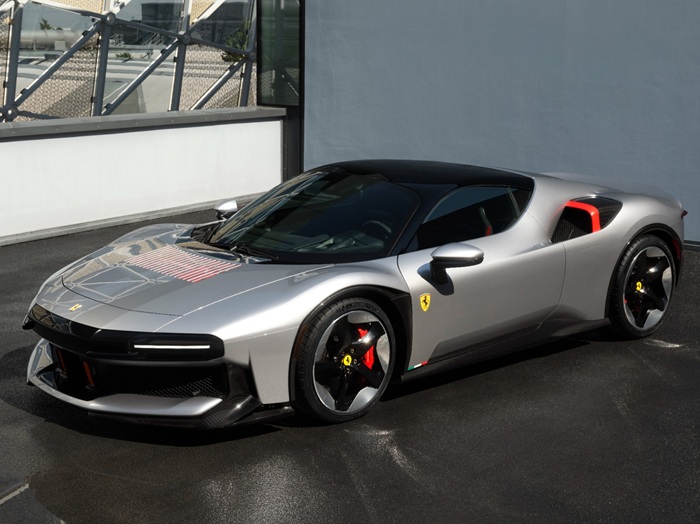
A radically different shape for familiar underpinnings
One of the CZ26’s defining features is its strongly horizontal design and distinctive two-box silhouette.
Ferrari says the body is arranged around a pure central mass resembling a capsule, supported visually by four muscular sections surrounding the wheel arches. The form appears to extend rearwards from the front fascia as a single element before terminating in a clean, truncated tail.
It is a considerably different visual interpretation of an SF90-based supercar — proof, perhaps, that even familiar mechanical ingredients can look remarkably different when the bodywork gets a completely new wardrobe.
The front features a full-width functional grille incorporating ultra-slim concealed-effect lighting modules alongside brake-cooling intakes, sensors and other technical components.
An unusual vertical leading edge gives the nose a particularly upright appearance compared with Ferrari’s current series-production models.
At the opposite end, the CZ26 receives a truncated tail, cantilevered taillights and a strongly horizontal diffuser. Together, these elements are intended to visually widen the car and give it a more planted stance.
Functional elements become part of the design
Rather than separating aerodynamic and cooling components from the main surfaces, Ferrari has integrated them into the CZ26’s overall styling.
The side cooling intakes, front fascia, rear diffuser, cantilevered light clusters and carbon-fibre elements extending around the wheel arches are all treated as parts of the same design theme.
Ferrari says the approach takes inspiration from significant examples of Italian industrial design from the 1970s, although the principles have been reinterpreted using contemporary proportions, materials and engineering requirements.
The roof and pillars are finished in black, visually separating the cabin from the body and creating the impression of a cockpit inserted into the main structure of the car.
Argento Veloce paint with Rosso Lampante detailing
Ferrari developed a bespoke colour and materials combination for the CZ26, led by an exclusive Argento Veloce exterior finish.
The silver paint has a liquid-like appearance intended to emphasise the body surfaces and precision of the car’s lines.
Contrasting Rosso Lampante accents highlight selected technical and functional elements, while pigmented carbon fibre is used across the exterior to draw attention to the more complex sections of the bodywork.
The wheels were designed specifically for the CZ26 and combine gloss-black paint with a shot-peened surface treatment. Ferrari says the latter is created by blasting the surface with microscopic beads to achieve a polished effect.
Natural-finish titanium exhaust tailpipes complete the exterior treatment.
Bespoke materials inside the cabin
The CZ26’s exterior theme continues inside, where Ferrari has used a specially developed black technical fabric as one of the main materials.
The seats feature inserts produced using additive manufacturing, with their pattern designed specifically for the CZ26. Rosso Lampante accents repeat the exterior colour theme, while an embroidered CZ26 logo adds another model-specific detail.
Matte technical fabric is paired with satin-finish carbon fibre, while another gloss carbon-fibre material incorporates metallic filaments woven into its structure.
Body-coloured elements are also used on the door panels and upper portion of the dashboard.
Aerodynamics extensively redesigned
Although the CZ26 retains the SF90 Stradale’s technical specifications, Ferrari says its aerodynamic package required extensive redevelopment to accommodate the new body.
At the front, the cooling layout and airflow management system were completely redesigned. Engineers reoriented the central radiator pack and introduced dedicated bypass ducts, changes intended to improve cooling efficiency while also increasing downforce over the front axle.
Ferrari also redesigned the underbody and vortex-generator arrangement to optimise aerodynamic balance.
The outer sections of the front bumper incorporate an air-curtain system designed to control the wake generated by the front wheels and reduce aerodynamic drag.
At the rear, a large upper spoiler and dedicated diffuser have been developed to increase downforce while preserving aerodynamic efficiency.
A redesigned rear engine cover incorporates dedicated vents to improve heat dissipation from the engine compartment under different operating conditions.
SF90 Stradale provides the technical foundation
Underneath its bespoke bodywork, the CZ26 is based on the SF90 Stradale, one of the most technically significant production cars in Ferrari’s recent history.
The SF90 Stradale became Ferrari’s first series-production model to use a plug-in hybrid electric vehicle, or PHEV, architecture.
Its name commemorates the 90th anniversary of the founding of Scuderia Ferrari and reflects the connection between Ferrari’s motorsport experience and its road-car engineering.
The SF90 Stradale combines a twin-turbocharged V8 engine with three electric motors, producing a combined maximum output of 1000 cv.
Its architecture was developed around the combination of high performance, aerodynamic efficiency and sophisticated vehicle-dynamics systems, while also introducing a new design direction for Ferrari’s electrified supercars.
The SF90 family subsequently expanded with the SF90 Spider, SF90 XX Stradale and SF90 XX Spider. Ferrari also identifies the 849 Testarossa and 849 Testarossa Spider as part of the segment established by the SF90 Stradale.
Ferrari Special Projects: roughly two years for one car
The CZ26 was developed under Ferrari’s Special Projects programme, which allows selected clients to commission unique cars — referred to by the company as “One-Offs”.
Each project begins with an idea proposed by the client and is developed in collaboration with designers at Ferrari’s Styling Centre.
After the proportions and principal forms are established, detailed design blueprints and a styling buck are produced before manufacturing begins.
Ferrari says the complete process takes around two years on average, with the client closely involved during both the design and verification stages.
The CZ26 demonstrates how far that process can depart visually from the donor car while retaining its engineering foundations. For Ferrari, the result is not simply another derivative of the SF90 Stradale, but an example of how its Special Projects operation can use an existing high-performance platform as the starting point for an entirely individual design — one that, by definition, will not be parked next to another identical example.