

There are two ways to design a compact electric SUV. You can smooth every surface, hide every crease and make it resemble a particularly aerodynamic computer mouse. Or you can do what Kia has done with the Syros EV: stand it upright, give it a face full of LEDs, borrow a little visual attitude from the Soul and EV9, and make absolutely no attempt to disappear into a crowded car park. Launched in 2026, the Syros EV is the first-generation electric version of Kia’s Indian crossover, positioned as a more technology-heavy alternative to the petrol and diesel Syros while retaining the same deliberately unconventional personality.
The regular petrol and diesel Syros starts at ₹8.41 lakh, but electrification naturally moves the financial goalposts. The Syros EV range begins at ₹13.49 lakh ex-showroom and stretches to around ₹20 lakh for the top model. The car here is that flagship version, the X-Line Extended Range, which bundles the larger battery with the more lavish side of Kia’s equipment cupboard.
And there is quite a lot in that cupboard.
Yet the Syros EV is more interesting than a collection of large screens, cameras and electrically operated conveniences. Underneath its upright crossover body sits the Hyundai-Kia K1 BEV platform, an architecture also associated with the Hyundai Casper Electric and Inster. The Syros EV is assembled in Andhra Pradesh, giving Kia an Indian-manufactured electric crossover aimed squarely at buyers who want EV running characteristics without surrendering the elevated seating position, family practicality and visual presence that have made small SUVs the default Indian car-buying setting.
Its name has travelled rather farther. “Syros” comes from the Greek island of Syros, which is certainly more romantic than naming an SUV after an internal engineering project number. The design was created by Teck-koun Kim, whose portfolio includes work on the Kia EV2, EV3, EV5, EV9 and PV5, along with previous experience involving Mercedes-Benz and Daihatsu. That CV goes some way towards explaining why the Syros looks unlike the cautiously styled appliance that an affordable electric crossover could easily have become.
Design: a baby EV9 with a streak of Soul
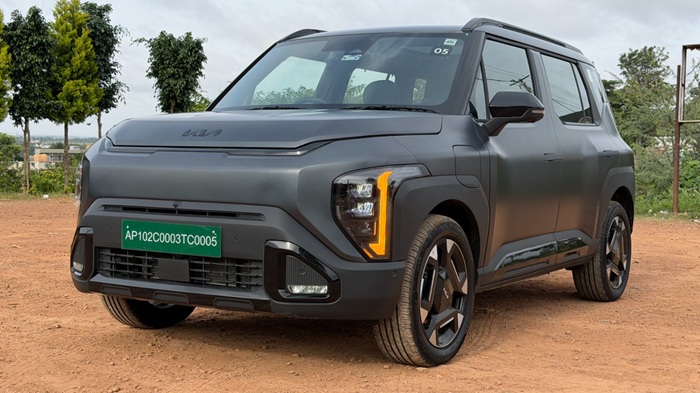
Kia openly draws inspiration from the Soul and EV9, and you do not need a design degree to spot the family connection. The Syros EV has the same fascination with upright geometry, strong vertical elements and lighting signatures that do much of the visual talking.
At roughly 4 metres long, 1.8 metres wide and 1.7 metres tall, it is compact in footprint but surprisingly upright in proportion. The height gives it a substantial stance without requiring the sort of dimensions that make navigating a crowded Indian market feel like manoeuvring a small container ship.
The front adopts Kia’s Signature Digital Tiger Face, its modern interpretation of the familiar tiger-nose identity for an era when electric cars no longer need a large combustion-engine grille gulping in air. Instead, lighting and surface treatment become the main characters.
Automatic Ice Cube Multi-Focal Reflector LED headlamps are accompanied by Star Map LED daytime running lights, while headlamp escort functionality and high-beam assist add useful technology rather than merely decorative theatre. LED fog lamps sit lower down, and the gloss-black front skid plate adds a touch of pseudo-ruggedness. There is another gloss-black skid plate at the rear, because apparently no urban crossover is allowed to leave the factory without at least pretending it might one day encounter a mountain.
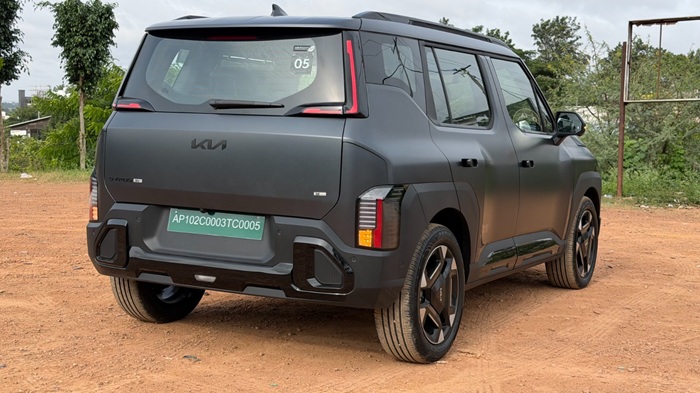
The bonnet and upright nose make the Syros look taller than its footprint suggests, while the side profile continues the deliberately square theme. Kia fits Auto Streamline door handles, keeping the surfacing cleaner, while the electrically adjustable and automatically folding outside mirrors contain LED indicators, cameras and puddle lamps. They also project the Kia logo onto the ground, which is the sort of feature nobody desperately needs but everybody will demonstrate to relatives during the first week of ownership.
The X-Line Extended Range shown here is finished in Matte Graphite, a colour that suits the Syros particularly well because the shape is already doing enough shouting. Matte silver, blue, grey, olive, red, white, gloss silver and black are also available.
The wheel design is another example of function trying to shake hands with fashion. This version wears 17-inch crystal-cut dual-tone aerodynamic alloy wheels, although 16-inch alloys are also available. The 17s are wrapped in 215/55 R17 94V MRF Wanderer Ecotred steel-belted radial tubeless tyres at both ends. Disc brakes are fitted front and rear, a reassuring detail on an EV that combines considerable mass with strong regenerative braking capability.
Move around to the back and the Star Map theme reappears through the LED combination tail lamps, incorporating LED indicators and an Emergency Stop Signal. There is a rear defogger, wiper and washer, along with an LED high-mounted stop lamp. Taken together, it creates a rear end that is recognisably Kia without looking like the company simply photocopied one of its larger SUVs at 75 per cent scale.
The design will divide opinion, but that is arguably preferable to inspiring no opinion at all. The Syros looks chunky, futuristic and slightly mischievous. Nobody is going to mistake it for a traditional three-box family saloon, which is presumably the entire point.
Small outside, remarkably serious about practicality
Despite measuring only about four metres in length, the Syros EV has been packaged with family use firmly in mind. The main boot offers 390 litres of luggage space, enough to make this a realistic everyday family EV rather than one in which the charging cable ends up occupying half the luggage compartment.
There is also a 16-litre front trunk, or frunk, capable of carrying up to 10 kg. That makes it an obvious place for charging cables, cleaning equipment or various miscellaneous objects that otherwise roll around the boot producing mysterious noises for months.
Kia supplies a 16-inch steel spare wheel, another detail Indian buyers will appreciate, particularly those who remain unconvinced by the modern industry theory that a puncture-repair kit provides the same emotional comfort as an actual wheel.
More significantly, the Syros does not sacrifice rear-seat flexibility in pursuit of battery packaging. The rear bench is split 60:40, and the seats can both slide and recline. That allows owners to choose between additional passenger space and additional luggage room rather than accepting whatever fixed compromise the engineers selected for them.
Interior: screens, ventilation and some distinctly un-small-car ideas
If the exterior takes inspiration from Kia’s larger electric products, the cabin attempts much the same trick. Step aboard and the Syros EV does not feel like a basic electric runabout wearing an SUV costume. The dashboard is technology-heavy without requiring every basic function to be buried six menus deep.
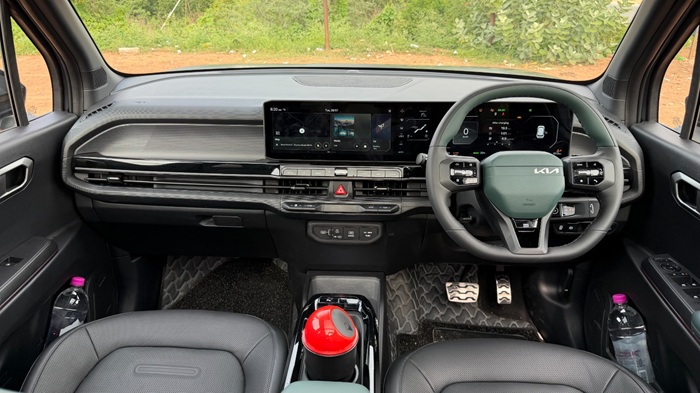
The flagship cabin shown here uses a black-and-green leatherette upholstery combination. White-and-black upholstery is also available, along with blue-and-grey semi-leatherette trim. The colours give the interior a youthful feel, although Kia has resisted the temptation to make the cabin resemble a gaming chair convention.
The steering wheel is one of the more distinctive pieces. It is a double D-cut, dual-tone leatherette-wrapped unit, complete with controls for infotainment, volume, telephone and voice functions. Electric Power Steering is standard with tilt adjustment, while regenerative braking is controlled through steering-mounted paddles.
That is one of those features that sounds minor until you begin using an EV every day. Instead of repeatedly hunting through a touchscreen to adjust regeneration, the paddles allow the driver to alter the level while keeping attention on the road. Technology is at its best when it quietly removes inconvenience rather than introducing a new password.
The instrument cluster is a 12.3-inch HD display, matched by another 12.3-inch HD touchscreen infotainment system. The latter supports navigation, over-the-air software updates, wireless Android Auto and Apple CarPlay, multilingual voice recognition, USB connectivity, FM and radio.
Sitting between all that digital acreage is a separate 5-inch touchscreen display dealing with the fully automatic climate-control system. It means the Syros EV effectively surrounds the driver with screens but at least attempts to divide responsibilities logically. Modern cars increasingly appear terrified that owners might encounter an uncovered square centimetre of dashboard.
The transmission selector has been moved away from the centre console. A column-type Shift-by-Wire automatic selector handles forward and reverse duties, leaving more usable space between the front occupants. There is no conventional gearbox here, of course; “automatic transmission” in this context describes the EV’s electronic drive selection rather than a multi-ratio torque-converter unit.
The centre area includes a wireless phone charger, while controls are provided for traction control, the electric parking brake, Auto Hold and lighting functions. Sporty metal pedals remind you that the 169 hp flagship is supposed to possess at least a mildly enthusiastic side.
The front seats are ventilated, which in an Indian summer is more valuable than many pieces of equipment that consume considerably more space in a brochure. The driver’s seat receives four-way electric adjustment.
More unusually, the Syros EV also provides ventilated rear seats. That is the sort of feature traditionally associated with significantly more expensive machinery and could prove a genuine selling point for owners who spend much of their time being driven—or for children who have discovered that complaining about the temperature is an Olympic discipline.
Rear-seat practicality is strengthened by the ability to slide and recline the bench. LED reading lamps and footwell lighting are provided, while the cabin gets 64-colour ambient lighting. You could simply choose one colour and leave it there, although manufacturers seem determined to ensure that every owner has enough lighting combinations to recreate a small nightclub.
Above is a dual-pane panoramic sunroof, bringing more light into an otherwise fairly upright cabin. It is another feature with obvious showroom appeal, though in peak Indian summer the sunshade may become rather more popular than the glass itself.
Audio comes through an eight-speaker Harman Kardon Premium HD sound system, while the auto-dimming inside rear-view mirror incorporates Kia Connect 2.0 controls. One-touch automatic up/down functionality is provided for the power windows, along with anti-pinch protection.
There is also a 250-volt power outlet, supplemented by the EV’s Vehicle-to-Load, or V2L, capability. V2L allows the battery to supply external electrical devices, turning the car into an enormous mobile power bank. Laptop, camping equipment or other compatible devices can therefore run from the vehicle’s battery. It is one of those EV technologies that sounds slightly gimmicky until the first occasion you actually need electricity somewhere a wall socket does not exist.
Connectivity: your smartphone may know more about the car than you do
Kia Connect 2.0 forms a major part of the Syros EV’s technology package, offering access to more than 95 connected functions through a smartphone.
Among them are a digital key, remote window operation, vehicle start/stop, remote air-conditioning control, locking and unlocking, vehicle-status checks, Find My Car, surround-view monitoring, smartwatch connectivity, scheduled charging and live tracking.
Some buyers will use nearly all of that. Others will use remote air-conditioning twice, show it enthusiastically to friends, then return to unlocking the car in the conventional manner. But the connected functionality does have genuine practical value in an EV, particularly for checking charging and preparing the cabin before driving.
The Syros EV is also offered with smart cruise control featuring Stop & Go, together with manual speed-limit assistance.
Interestingly, Kia specifies a dual-camera dashcam for the HTX+ Extended Range variant, which can connect to a mobile application. That equipment is variant-specific rather than something to assume automatically on every Syros EV derivative.
Two batteries, same torque, rather different personalities
Kia offers the Syros EV with two liquid-cooled NMC lithium-ion battery packs supplied by LG Energy Solution.
The standard battery has a capacity of 42 kWh and is paired with an electric motor producing 132 hp and 255 Nm. Kia claims a driving range of 443 km.
The Extended Range version tested here increases battery capacity to 51.4 kWh and motor output to 169 hp, while torque remains unchanged at 255 Nm. Its claimed range rises to 526 km.
That identical torque figure is significant. The cheaper version should still deliver the immediate low-speed response buyers expect from an EV, even if the larger motor has more power in reserve as road speed increases.
The X-Line Extended Range can accelerate from 0-100 km/h in 8.1 seconds. In the age of 600 hp electric SUVs, that number will not attract many YouTube thumbnails containing flames, shocked faces and eleven exclamation marks, but for a family crossover it is properly brisk.
More importantly, 255 Nm from an electric motor arrives without waiting for a turbocharger, downshift or combustion engine to clear its throat. In urban traffic that means the sort of immediate response that makes squeezing into a gap effortless, while the additional 169 hp of the Extended Range gives it useful headroom for highway overtaking.
Drivers can select between Eco, Normal and Sport modes. Eco is the sensible setting for extracting range, Normal should cover most everyday use, and Sport exists for those occasions when you would like your upright family EV to remember that electricity can be used for something other than efficiency.
There is also a Virtual Engine Sound System, giving pedestrians an audible warning at low speeds. It is less about pretending the Syros has an engine than ensuring somebody looking at their phone while crossing the road has a chance of noticing a near-silent EV approaching.
Chassis: conventional hardware underneath the digital wardrobe
Under the front end is a MacPherson strut suspension with coil springs, while the rear uses a coupled torsion-beam axle with coil springs.
That is conventional compact-car engineering rather than something exotic, and in this class there is nothing inherently wrong with that. A well-tuned torsion beam is compact, predictable and leaves valuable room for passengers, batteries and luggage.
The challenge lies in calibration. Electric cars carry considerable battery mass low in the chassis, which can aid stability but also forces the suspension to manage substantial weight over broken surfaces. The Syros’s tall 1.7-metre body further means the dampers must strike a careful compromise between controlling roll and maintaining low-speed comfort.
The 17-inch wheels on the X-Line give it the visual attitude the design deserves, though the available 16-inch setup is likely to appeal to buyers prioritising additional tyre sidewall over showroom drama.
Disc brakes at both ends work alongside regenerative braking, and the steering-wheel paddles allow the driver to vary how aggressively the car recovers energy while slowing. Learn to use regeneration well and urban driving can become notably smoother, with less dependence on the physical brakes.
Kia also provides the Syros EV with Battery Heating System hardware and IP67-certified battery-pack protection, useful reassurance given the unpleasant combination of electricity, dust, waterlogged roads and Indian monsoons.
Charging and range
The headline figure for the Extended Range version is 526 km, compared with 443 km for the smaller 42 kWh battery. These are manufacturer-claimed figures, not a promise that every owner will see exactly that distance in traffic with the air-conditioning running, four people aboard and the accelerator being treated like an on/off switch.
As with every EV, real-world range will vary with speed, weather, driving style, climate-control usage and terrain. What the 51.4 kWh version does provide is a useful theoretical buffer for owners who routinely travel beyond city limits.
With a 7.4 kW AC charger, Kia quotes 7 hours 15 minutes to reach 90 per cent charge. An 11 kW AC charger cuts the quoted 90 per cent charging time to 4 hours 50 minutes. Using a 100 kW DC fast charger, Kia quotes 39 minutes to add 70 per cent charge.
A 3.3 kW charging cable is supplied free with the vehicle, giving owners a basic home-charging solution from the outset.
Kia is also supporting Syros EV ownership with access to more than 20,000 charging points, an EV route planner, live-streaming support, mobile charging assistance, video consultation and doorstep accessory delivery. These services matter because buying an EV is still partly about buying into an ecosystem. A brilliant range figure becomes less comforting at midnight if the charger you planned to use has disappeared from the map.
There is also an unusual financial element. Kia quotes a Battery-as-a-Service cost of ₹8 lakh, with battery EMI pricing starting from ₹3.3 per km. Buyers considering that route would sensibly want to examine the exact contractual terms and usage pattern carefully, because per-kilometre battery plans can make very different financial sense depending on annual mileage.
Safety: substantial hardware and Level 2 ADAS
Kia has fitted the Syros EV with a lengthy safety package, though no crash-test rating has been supplied here and one should not be assumed.
Passive safety equipment includes six airbags, three-point seatbelts, seatbelt reminders, ISOFIX child-seat mounts, child locks and rollover sensors.
Electronic systems include ABS, Brake Assist, Electronic Stability Control, Vehicle Stability Management, hill-start assist and a high-line tyre-pressure monitoring system. There is also Auto Hold, an immobiliser, central locking, a burglar alarm, speed-sensing automatic door locking and impact-sensing automatic unlocking.
Parking assistance is unusually comprehensive, with front, rear and side parking sensors, plus a 360-degree camera. In a four-metre car this is arguably overqualified assistance, but anybody who has watched a shopping trolley migrate towards a freshly painted bumper will not complain.
The Level 2 ADAS package includes Forward Collision Warning, Forward Collision-Avoidance Assist, Lane Departure Warning, Lane Keeping Assist, Lane Following Assist, Driver Attention Warning and Leading Vehicle Departure Alert. Parking Collision Avoidance Assist is included too, along with a Blind View Monitor.
The usefulness of these systems will depend heavily on calibration. ADAS that quietly catches a genuine mistake is excellent. ADAS that repeatedly objects to perfectly normal Indian road positioning can become the electronic equivalent of a nervous passenger grabbing the dashboard. The hardware is comprehensive; real value comes from how intelligently it behaves in local traffic.
Ownership: Kia has gone unusually long on the battery
The standard private-owner vehicle warranty is three years with unlimited kilometres, and Kia allows it to be extended to five years. Commercial users receive a three-year/1 lakh km vehicle warranty.
The battery warranty is particularly noteworthy: Kia offers 15 years/unlimited kilometres for the battery for the original owner. If the vehicle changes hands, battery warranty coverage becomes eight years/1.60 lakh km for the second owner.
That distinction is important for used-car buyers, but even the secondary warranty is substantial enough to answer one of the most common questions surrounding long-term EV ownership: what happens to the enormously expensive battery after a few years?
Kia also includes 24×7 roadside assistance and offers an 80 per cent assured buyback after three years under the stated customer programme. Again, the fine print and eligibility conditions will matter, but the existence of such a programme directly tackles another EV concern: future resale value.
Where does the Syros EV fit?
At ₹13.49 lakh to around ₹20 lakh, the Syros EV sits in one of the increasingly crowded parts of the Indian electric-car market. Buyers around this price are no longer choosing between “an EV” and “not an EV”; they are choosing among several electric crossovers with different approaches to range, cabin space, performance and charging infrastructure.
The Syros’s strongest argument is its blend of compact exterior dimensions and a surprisingly elaborate cabin. A 390-litre boot, sliding and reclining rear seat, rear-seat ventilation, panoramic sunroof, Harman Kardon audio, large digital displays and extensive connected functionality make it feel more ambitious than its four-metre footprint suggests.
Some rivals may appeal more strongly to buyers who prefer conventional styling. Others may offer a larger physical footprint or a different balance between battery capacity and price. At the upper end of the Syros EV range, buyers will inevitably begin comparing it not only with similarly sized electric crossovers but also with entry versions of larger EVs.
That is the problem with a ₹20 lakh compact crossover: once the price climbs, the neighbours become rather more interesting.
But the Syros has an answer. It gives you much of the technology and cabin theatre associated with larger electric SUVs without giving you their parking dimensions.
Verdict
The Kia Syros EV is a curious combination of sensible engineering and deliberately unsensible styling, and that is largely why it works.
Underneath, the formula is straightforward: front-wheel-drive electric propulsion, a choice of 42 kWh and 51.4 kWh LG Energy Solution NMC battery packs, MacPherson struts at the front, a torsion beam at the back and enough regenerative braking intelligence to make urban commuting easy.
Around that conventional foundation, however, Kia has built something far more characterful.
The X-Line Extended Range’s 169 hp, 255 Nm, 8.1-second 0-100 km/h time and 526 km claimed range give it enough performance and theoretical endurance to function as more than a second car for city errands. The 390-litre boot and adjustable rear seats make it properly usable for a family, while the 16-litre frunk gives charging cables somewhere sensible to live.
Inside, it goes almost comically hard on equipment. Front and rear ventilated seats, dual 12.3-inch displays, a separate climate touchscreen, 64-colour ambient lighting, an eight-speaker Harman Kardon system, panoramic sunroof, V2L, connected-car functionality and Level 2 ADAS make the Syros EV feel like a considerably more expensive car has been compressed into a compact crossover shell.
Not everything is equally essential. Logo-projecting mirrors will not improve your morning commute. Sixty-four ambient-lighting colours will not make a traffic jam move faster. And the sheer quantity of connected features ensures that many owners will probably discover something new in the Kia Connect app six months after taking delivery.
But the genuinely useful equipment is equally abundant: a 360-degree camera, plentiful parking sensors, ventilated rear seats, sliding and reclining second-row seating, wireless smartphone integration, regenerative-braking paddles and a proper spare wheel.
The ownership package may be just as important as the gadgets. A 15-year/unlimited-kilometre battery warranty for the original owner, 24×7 roadside assistance, access to more than 20,000 charging points and an assured-buyback programme all attempt to remove the little anxieties that continue to follow EV ownership around like an overprotective relative.
The smaller 42 kWh version will make more sense for primarily urban buyers, particularly because it retains the same 255 Nm torque output. But the 51.4 kWh Extended Range is the more complete interpretation of the Syros EV idea. Its additional power and 526 km claimed range make it considerably easier to imagine as the household’s main car rather than merely the electrically powered one.
At around ₹20 lakh for this flagship X-Line Extended Range, it is not inexpensive. Buyers who simply want the cheapest route into an electric crossover will find less extravagant ways of doing it, and those seeking maximum physical size for their money may be drawn elsewhere.
Yet the Syros EV is not really trying to win by being the cheapest or the biggest. Its appeal lies in squeezing an unusual amount of personality, technology and practicality into a footprint that remains friendly to Indian cities.
It looks like a shrunken EV9 that has spent a weekend with a Kia Soul. It carries enough screens to run a small control room, ventilates almost everybody who sits inside and can even power external equipment through V2L. And underneath all that theatre is a family-friendly electric crossover with useful range and unusually strong battery-warranty backing.
The result is an EV with something many electrically powered crossovers struggle to manufacture: character. The Syros EV is sensible where it needs to be, eccentric where it can afford to be, and sufficiently well equipped that your smartphone may become jealous.
For buyers who want their electric family car to vanish politely into the background, there will be subtler options.
For everybody else, the Syros EV rather enjoys being noticed.