
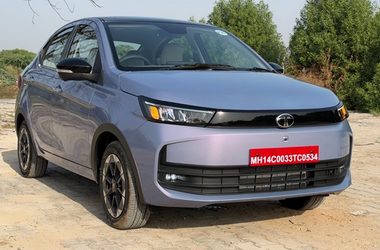
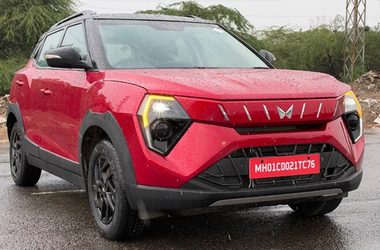

Mahindra has spent the past few years rediscovering something it probably should never have forgotten: people do not buy SUVs purely because they need SUVs. They buy them because they like what SUVs say about them. Capability matters, certainly, but so do stance, character, theatre and the faint suggestion that you might abandon the office car park on Friday evening and reappear somewhere without mobile reception by Sunday morning. The Mahindra Vision.SXT understands that psychology rather well. It is a compact, muscular lifestyle-pickup concept that looks suspiciously like a glimpse into the future of the Thar family — although Mahindra has stopped short of confirming that particular family connection.
And that distinction matters. The Vision.SXT is not a production Thar pickup with its camouflage removed early. It is one of four concepts — Vision.SXT, Vision.T, Vision.X and Vision.S — created to preview Mahindra’s next generation of SUVs on its new NU_IQ modular, multi-energy architecture. Mahindra says production vehicles derived from this programme are scheduled to begin arriving from 2027, while also making clear that the show cars themselves are concepts rather than confirmed replacements for today’s Thar, Scorpio or XUV models.
That makes this less a conventional road test and more an examination of Mahindra’s next chapter. There is no 0–100 km/h number to analyse, no official fuel economy figure to complain about and no ex-showroom price over which to perform the traditional Indian automotive ritual of declaring everything simultaneously too expensive and excellent value. Instead, there is something potentially more interesting: a new platform, four distinctly different SUV personalities and a fairly clear indication that Mahindra intends to make its future products work much harder globally.
A pickup-shaped clue to Mahindra’s future
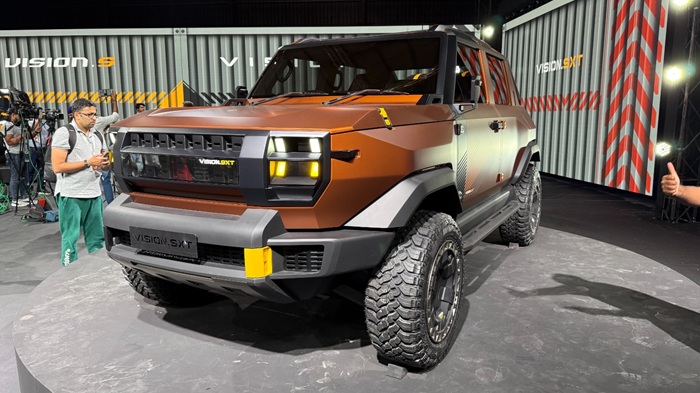
The Vision.SXT is perhaps the most intriguing of the quartet because it takes a formula India has traditionally treated rather cautiously — the lifestyle pickup — and packages it with the emotional vocabulary of a Thar.
If a production version follows the concept closely, this could become the sort of machine that appeals to somebody who wants Thar-style attitude but also likes the idea of throwing muddy equipment, bicycles, camping gear or other objects unsuitable for cream upholstery into a separate rear load area. Naturally, most examples would probably spend rather more time carrying laptop bags than kayaks, because reality has never prevented the lifestyle-SUV market from having a vivid imagination.
The concept was developed under Mahindra’s evolving HEARTCORE design philosophy, with the Vision.SXT and Vision.T representing what the company describes as its “Born Iconic” spirit. Mahindra’s own Vision 2027 material also characterises the SXT through the idea of “Iconic Versatility” — an appropriate description for something trying to combine a compact SUV, an off-roader and a pickup without looking as though three separate product-planning departments collided in a corridor.
Design chief Pratap Bose and the teams at the Mahindra India Design Studio in Mumbai and Mahindra Advanced Design Europe in Banbury, UK, are responsible for the broader visual direction. Engineering work has been carried out at Mahindra Research Valley. That combination is important because these are no longer vehicles conceived purely around the requirements of India. Mahindra is openly designing NU_IQ for both right- and left-hand-drive markets and therefore for a considerably larger stage.
The idea behind the new design philosophy is what Mahindra calls “Opposites Attract” — combining contrasting visual ideas to create stronger emotional appeal. Marketing departments have invented considerably more painful phrases over the years, and in this case there is at least something tangible beneath it. The four Vision concepts are deliberately different from one another rather than simply being the same family face photocopied onto four wheelbases.
Small enough for India, tough enough to look serious
At up to roughly 4.3 metres long, the Vision.SXT is surprisingly compact by pickup standards. That matters enormously in India, where the average parking space appears to have been dimensioned around a Maruti 800 and then left untouched for several decades.
Yet the SXT does not rely on sheer length for presence. Its proportions, upright SUV attitude and substantial off-road footwear do most of the visual work. The concept sits on 18-inch alloy wheels wearing chunky 255/60 R18 112Q Falken Wildpeak MT radial tubeless tyres. These are steel-belted, extra-load tyres manufactured in Thailand, and they tell you almost everything you need to know about the SXT’s intended personality before you have studied a single technical drawing.
Those tyres are not the sort of thing one chooses because the school run contains a particularly vicious painted speed breaker.
They fill the arches properly and give the SXT the visual credibility expected from something carrying the Thar’s conceptual DNA. There is also a practical argument for resisting the temptation to fit enormous 21- or 22-inch wheels simply for motor-show photographs. An off-road-inspired vehicle looks better when there is actually some tyre between the wheel rim and the planet.
The concept uses disc brakes front and rear, while the underlying NU_IQ architecture has been designed to provide as much as 227 mm of ground clearance. For Indian conditions, that figure has relevance far beyond recreational off-roading. Between cratered monsoon roads, improvised ramps and speed breakers built with the ambition of minor hill ranges, generous clearance is often less an adventurous luxury than basic emotional security.
Its geometry is equally purposeful. NU_IQ has been engineered around an approach angle of 28 degrees and a departure angle of 34.9 degrees, with published information around the platform also indicating a 28.2-degree breakover capability. In simple terms, the architecture is intended to permit respectable obstacle clearance without sacrificing the everyday usability expected of a monocoque SUV.
And that last point is crucial.
The NU_IQ platform may matter more than the SXT itself
Underneath the theatrical bodywork is the real story: NU_IQ.
Mahindra describes it as a new-generation modular, multi-energy platform, capable of accommodating multiple body styles and propulsion systems. Petrol and diesel engines can be supported, alongside electric powertrains, while the architecture has been conceived for front-wheel drive and all-wheel drive, as well as right-hand-drive and left-hand-drive configurations.
That flexibility gives Mahindra considerably more freedom than designing separate architectures for every model or market. One common foundation can underpin relatively urban SUVs, rugged off-roaders and potentially something as specialised as the Vision.SXT pickup.
More unusual is the flat-floor philosophy. Flat floors are relatively straightforward with dedicated EV skateboard architectures because there is no conventional exhaust system or transmission tunnel to work around. Mahindra says NU_IQ is engineered to extend the concept to internal-combustion SUVs as well, creating a genuinely flat cabin floor in petrol and diesel derivatives.
That may sound less exciting than talking about horsepower, but live with a vehicle for five years and you might care more about a usable middle-rear seat than an extra 15 bhp.
Packaging is therefore one of NU_IQ’s central promises. Mahindra is targeting what it calls Command Seating, combined with a spacious cabin and generous luggage capacity. The architecture is intended to provide as much as around 450 litres of boot space in relevant configurations, while simultaneously pursuing lighter construction and high safety standards.
Exactly how those numbers translate to the production SXT remains to be seen, particularly because a pickup-style body creates different cargo requirements from a conventional SUV. But the broader engineering intention is obvious: compact exterior dimensions should not automatically mean a cramped interior.
What will the cabin be like?
This is where restraint is required, because Mahindra has not yet released the sort of production cabin specification that would allow us to discuss seat cushioning, plastic quality, USB-port placement or whether the climate-control interface requires a postgraduate degree in touchscreen studies.
What has been announced is the philosophy underpinning it.
NU_IQ vehicles are being developed around an electronic ecosystem called NU_UX, described as a next-generation Integrated Domain Architecture. The objective is to bring the various digital functions of the vehicle together rather than operating them as a collection of isolated modules. Mahindra has also spoken of intuitive human-machine interfaces as part of the platform’s technology strategy.
That could translate into sophisticated connected features, digital instrumentation and extensive vehicle control when production cars arrive. Hopefully Mahindra remembers that an interface being capable of doing 900 things is not the same as making the three things you use every day easy to find.
The flat floor, meanwhile, should be a more immediately useful innovation. Rear passengers ought to gain from reduced intrusion into the centre seating position, while the platform has been designed to combine that packaging advantage with an elevated, commanding seating position — still one of the fundamental reasons buyers migrate from hatchbacks and sedans into SUVs.
Mahindra is also pursuing lightweight construction. That is welcome because modern SUVs have developed an unfortunate habit of gaining kilograms every time an engineer adds another screen, powered motor or layer of sound insulation. Weight matters everywhere: acceleration, braking, efficiency, tyre wear, suspension tuning and agility all improve when a vehicle does not have the mass of a small bungalow.
The suspension is particularly interesting
The specification that should make keen drivers pay attention is not the tyre size or even the ground clearance. It is the chassis hardware.
NU_IQ features a five-link rear suspension arrangement, an unusually sophisticated solution for vehicles in this size class. Multi-link designs allow engineers greater control over wheel movement than simpler rear suspension layouts, potentially improving the difficult compromise between ride comfort, handling and rough-road behaviour.
Then there is Mahindra’s DAVINCI damper technology, designed to improve body control while maintaining ride quality.
It is worth pointing out that DAVINCI is no longer merely an abstract future promise: Mahindra subsequently introduced DAVINCI damping technology in its production XUV 7XO, describing the system as being intended to improve ride and handling through frequency-selective damping.
On something like the Vision.SXT, that technology could be particularly valuable. Pickups traditionally present suspension engineers with a miserable compromise. Tune the rear end heavily enough to cope with carrying loads and the unladen vehicle can hop and fidget. Make it supple enough for passengers and serious payloads can expose the softness.
The SXT’s combination of a five-link rear arrangement and sophisticated damping suggests Mahindra wants this to behave more like an SUV than an agricultural vehicle with an expensive infotainment system attached.
There is also variable-pitch steering, intended to alter steering response according to how far the wheel is turned. In principle, this can give relaxed stability around the straight-ahead position while making tighter manoeuvres require less arm-twirling.
Until a production car is available to drive, however, that remains engineering potential rather than a verdict. We cannot yet tell you whether the steering talks, whispers or communicates primarily through formal email.
Petrol, diesel and electric — from the same family
The biggest strategic advantage of NU_IQ is that Mahindra is not forcing customers into one propulsion technology.
The architecture has been designed around multiple energy sources, and the Vision.SXT programme points towards petrol, diesel and electric possibilities. The electric version is intended to use an LFP — lithium iron phosphate — battery configuration according to the concept information available.
There are no confirmed production engine capacities, outputs, torque figures, battery capacities, charging speeds, claimed ranges or acceleration figures for the Vision.SXT yet. Inventing them would transform an interesting concept story into fan fiction, so they can wait.
What we do know is that NU_IQ has been designed to accommodate FWD and AWD layouts. For a rugged vehicle like the SXT, all-wheel drive is obviously the configuration enthusiasts will care about most, although the availability of front-wheel drive demonstrates the platform’s broader commercial purpose.
That may initially sound strange to anyone whose mental image of Mahindra involves a transfer case and mud up to the door handles, but scalable platforms survive by serving several kinds of customer. An urban crossover does not necessarily need the cost and weight of AWD. A serious off-road derivative probably does. NU_IQ is designed to cover both.
The possibility of diesel is particularly relevant in India, where long-distance SUV users still value its range and torque characteristics. Petrol will suit lower-mileage and refinement-focused buyers, while an EV version could offer the instant low-speed torque that is naturally useful in both urban driving and carefully controlled off-road situations.
Whether the eventual SXT offers all three is another question. Platform capability and production planning are not the same thing.
Safety has been engineered in rather than added later
NU_IQ also introduces a unified hot-formed door-ring structure, intended to create a strong structural safety cell around the passenger compartment.
Mahindra’s stated objective for the architecture is to combine lighter construction with top-tier safety standards, which is a much healthier engineering philosophy than treating crash protection as a pile of electronic features to be applied after the body shell has been signed off.
No production Vision.SXT has yet undergone an applicable consumer crash test, so there is no legitimate Bharat NCAP, Global NCAP or Euro NCAP star rating to quote. Any such score would currently be speculation.
Likewise, detailed production specifications for airbags, ADAS, cameras, parking sensors and other active-safety equipment remain to be announced. The sensible conclusion for now is simply that the architecture has been engineered around ambitious structural-safety targets; whether a showroom version fulfils them will be established only when the finished vehicle is tested.
And then there is the Vision.T
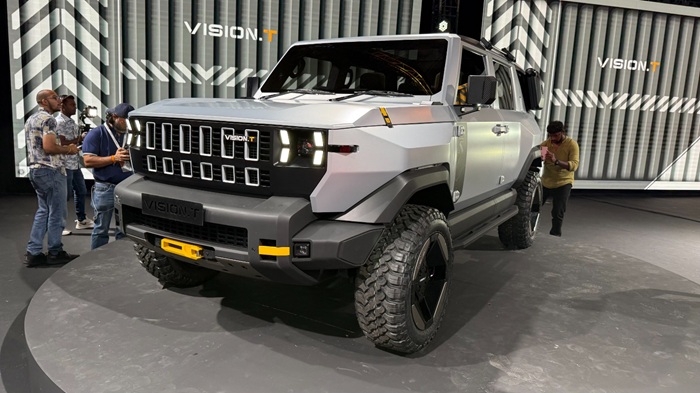
If the Vision.SXT looks like somebody has taken Thar philosophy and added a cargo bed, the Vision.T is the cleaner interpretation of a future rugged Mahindra SUV.
This is the concept most readily associated with the next stage of the Thar story, although, again, Mahindra says the Vision concepts do not constitute confirmed replacements for today’s models.
The Vision.T shares the Born Iconic philosophy with the SXT and stretches to roughly 4.3 metres in concept form. It too sits on 18-inch alloy wheels fitted with 255/60 R18 112Q Falken Wildpeak MT tyres, with disc brakes at both ends.
The important difference is philosophical. Where SXT adds the utility and visual drama of a pickup-style rear section, T is the purer SUV proposition. If Mahindra manages to carry the concept’s character into production while exploiting NU_IQ’s better packaging, flat floor and sophisticated suspension, it could produce something that feels recognisably Thar without simply remanufacturing yesterday’s formula with larger screens.
And that is harder than it sounds. Heritage-heavy vehicles frequently become trapped by their own design history. Change them too much and enthusiasts complain that the soul has disappeared; change them too little and everybody else complains that the engineering has.
Vision.T suggests Mahindra intends to attempt the difficult middle ground.
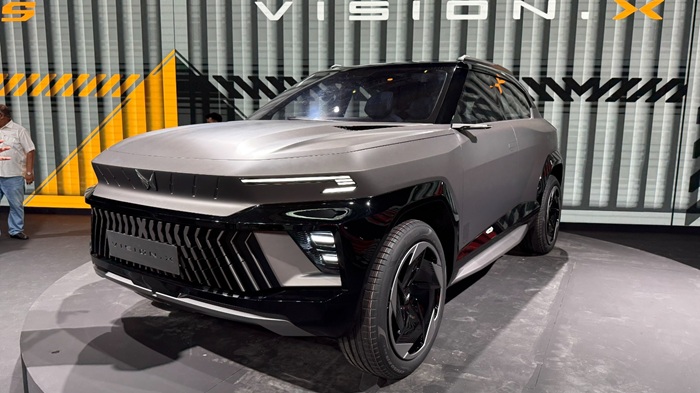
Vision.X: the urban athlete
At the opposite end of this little family gathering sits the Vision.X, a concept that appears to hint at what Mahindra’s compact urban SUV line could eventually become.
It is natural to regard it as a possible future interpretation of the XUV 3XO formula, but Mahindra has not officially identified it as the next 3XO. The company calls the concept’s design philosophy “Sculptural Athleticism”, which essentially translates into a more road-focused, energetic character than the mud-loving Vision.T and SXT.
The Vision.X is designed around the crucial sub-four-metre envelope, measuring up to around 4 metres. That alone tells you its intended battlefield: dense Indian cities, compact-SUV buyers and people who would quite like SUV presence without needing to negotiate parking spaces like a harbour pilot docking a container ship.
Its wheel-and-tyre package tells an equally clear story. Instead of the Falken mud-terrain tyres of the SXT and T, Vision.X uses huge 19-inch alloy wheels with 235/50 R19 99V Pirelli P Zero radial tubeless tyres, again with front and rear disc brakes.
P Zeros on a compact Mahindra concept are a fairly emphatic way of saying this one is more interested in tarmac than trails.
Whether 19-inch wheels survive unchanged on an India-spec production compact SUV is another matter. They look excellent beneath motor-show lighting; potholes tend to offer rather less enthusiastic reviews.
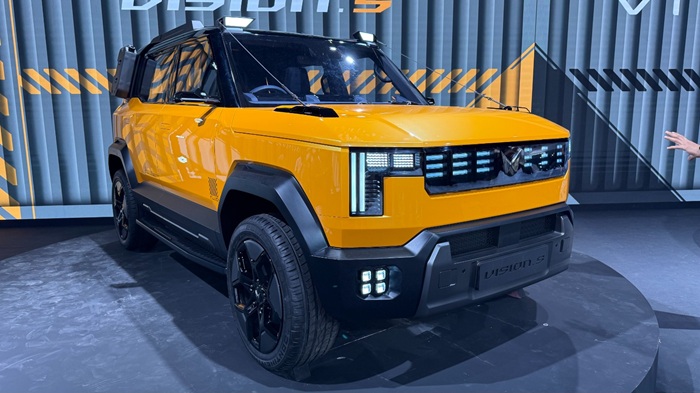
Vision.S: perhaps the next Scorpio philosophy
Then there is Vision.S, potentially the most important concept for traditional Mahindra loyalists.
Its upright, muscular positioning makes it easy to interpret as a glimpse at a future Scorpio-like SUV, but Mahindra has not confirmed it as a direct next-generation Scorpio. Officially, Vision.S represents “Sporty Solidity”, which may be design-language vocabulary but rather accurately describes what a modern Scorpio successor would need to achieve.
The concept is again approximately 4.3 metres long and uses 19-inch alloy wheels, but its tyre choice differs dramatically from the Vision.X. Here you get 255/50 R19 107Y Continental CrossContact radial tubeless tyres, together with disc brakes front and rear.
That combination suggests a road-biased SUV that retains greater visual and functional toughness than the lower, sportier X.
The interesting part is how NU_IQ could alter the character of such a vehicle. Mahindra’s traditional rugged SUVs have earned their reputations through strength, mechanical durability and road presence. A lighter monocoque architecture with sophisticated rear suspension, a flat floor and contemporary electronics could produce a very different type of machine — still recognisably Mahindra, but more globally polished.
Some diehards may consider that sacrilege until they drive one. Diehards generally consider most improvements sacrilege until approximately six months after buying them.
Four SUVs, one very ambitious platform
Taken individually, these concepts are attractive glimpses of possible future products. Taken together, however, they reveal something more significant.
Mahindra is attempting to build one architecture capable of stretching from an approximately four-metre urban SUV such as Vision.X to 4.3-metre rugged vehicles such as Vision.T and SXT, accommodating petrol, diesel and electric propulsion, front- or all-wheel drive and both sides of the steering-column argument.
That is not merely an engineering exercise. It is an export strategy.
The ability to create right- and left-hand-drive vehicles from the same architecture gives Mahindra access to markets where its previous products have often required more compromises. The concepts themselves were deliberately developed through both Mumbai and Banbury, reinforcing the idea that these cars are being designed with more than the Indian showroom in mind.
Mahindra’s official roadmap says the first production SUVs from this programme will start appearing in 2027. Precisely which concept reaches showrooms first, what each one will ultimately be called and how faithfully production cars will resemble these dramatic prototypes remain questions for another day.
So, should you be excited about the Vision.SXT?
Yes — with the usual concept-car-sized asterisk.
The Vision.SXT has the raw ingredients for something India receives far too rarely: a genuinely desirable lifestyle pickup designed not as a commercial vehicle dressed for Saturday night, but as an SUV from the beginning.
Its compact 4.3-metre-or-thereabouts footprint, chunky Falken Wildpeak tyres, up to 227 mm ground clearance, useful approach and departure geometry, five-link rear suspension, sophisticated damping, multi-energy compatibility and potential AWD give the project genuine mechanical substance. The flat-floor NU_IQ architecture could also solve one of the familiar compromises associated with compact rugged vehicles: giving them serious exterior presence without sacrificing passenger space.
Yet the production questions are enormous.
Will the adventurous proportions survive crash regulations and manufacturing budgets? Will an SXT actually appear as a Thar-family pickup? How large and useful will its eventual load bed be? Will diesel survive into the final product mix? How much of the sophisticated suspension hardware will reach affordable variants? And, perhaps most importantly in India, what will it cost?
There is currently no confirmed Indian ex-showroom price, variant structure, production engine specification, performance figure, fuel-economy rating, EV range figure or final equipment list for the Vision.SXT. That makes any attempt to declare it good value rather premature.
Likewise, there is no rival comparison that can yet be made with complete fairness. A production SXT could eventually cross-shop with lifestyle pickups, serious off-road SUVs and premium compact 4x4s simultaneously, depending on its body layout and price. Its strongest advantage could be exactly that ambiguity: something smaller and more lifestyle-focused than a conventional pickup, yet more practical than a traditional off-roader.
The eventual buyer, if Mahindra delivers on this concept, will probably not be somebody seeking maximum litres of cargo volume per rupee. It will be someone who already likes the theatre and toughness of a Thar but wants greater versatility — perhaps with just enough genuine off-road ability to justify those tyres when somebody asks why they were necessary.
And that is the central appeal of the Vision.SXT.
Mahindra’s future could easily have consisted of smoother versions of its existing SUVs, each with another touchscreen, another LED strip and another acronym nobody remembers after leaving the showroom. Instead, NU_IQ suggests something considerably more ambitious: redesigning the foundations so radically different products can share the same engineering intelligence without sharing the same personality.
The Vision.X wants to be the athlete. The Vision.S wants to be the solid, commanding SUV. The Vision.T carries the strongest traditional off-road spirit. And the Vision.SXT is the mischievous one — the SUV that arrives at the family gathering wearing hiking boots and carrying two spare tyres just in case somebody suggests taking the sensible route home.
If the production version preserves that personality while delivering the promised space, ride quality, safety and multi-energy flexibility, Mahindra may have more than a future Thar pickup on its hands.
It may have created the most interesting member of its next SUV generation before that generation has even reached the road.