There are fast cars, there are supercars, and then there are machines that make the laws of physics look like polite suggestions. The Ferrari 849 Testarossa belongs firmly to the third category.
This is Ferrari’s new flagship series-production berlinetta, replacing the already extraordinarily rapid SF90 Stradale. It combines a heavily reworked twin-turbocharged V8 engine with three electric motors, four-wheel drive and enough computing power to make a gaming laptop feel underqualified.
The result is a combined 1,050 cv—or approximately 1,036 bhp—and a claimed 0–100 km/h time of under 2.3 seconds. In practical terms, by the time you have finished saying “Testarossa”, the car is already travelling at a speed at which most Indian motorists begin blaming the wheel alignment.
Ferrari unveiled the 849 Testarossa internationally on September 9, 2025, with customer deliveries beginning during 2026. Therefore, this is not the second generation of a model launched in 2020. It is the first generation of the 849 Testarossa and the direct successor to the SF90 Stradale. It is assembled in Maranello, Italy, as any proper flagship Ferrari should be—because “Made somewhere near an industrial estate” would not look equally romantic on the specification sheet.
In India, the 849 Testarossa coupé has been introduced at approximately ₹10.37 crore ex-showroom before options. And with Ferrari’s famously comprehensive personalisation catalogue, the words “before options” deserve to be printed in bold, underlined and accompanied by a financial adviser.
The model is also available internationally as the 849 Testarossa Spider, featuring a retractable hard-top that can open in around 14 seconds. Mechanically, the Spider follows the same basic 1,050 cv plug-in-hybrid formula, although its additional roof mechanism brings the usual small weight and performance differences.
What Does “849 Testarossa” Mean?
Ferrari’s naming system occasionally sounds as though engineers were allowed to name the car before the marketing department arrived.
In this case, the number “8” represents the engine’s eight cylinders, while “49” refers to the approximately 499 cc displacement of each cylinder. The complete engine displaces 3,990 cc, so the mathematics is almost as serious as the car.
The Testarossa name carries considerably more emotion. “Testa Rossa” means “red head” in Italian, referring to the red-painted cylinder heads or cam covers associated with some of Ferrari’s celebrated racing engines. Ferrari traces the name’s heritage to its 1950s competition cars, including the legendary 250 Testa Rossa.
The original story is delightfully mechanical rather than carefully focus-grouped. Ferrari used red-painted engine components to distinguish a more powerful evolution of its racing engine. The colour made the special motor easy to identify and eventually gave the car its famous name.
It proves that great automotive names do not always require a branding agency. Sometimes you only need an exceptional engine and a tin of red paint.
Exterior Design: Retro-Futurism Without Becoming a Costume
The 849 Testarossa was created by Ferrari’s in-house design team under Flavio Manzoni. His portfolio includes some of the most significant modern Ferraris, including the F12berlinetta, Purosangue, 12Cilindri and F80.
The 849 does not attempt to copy the wedge-shaped 1980s Testarossa. There are no pop-up headlights, no giant horizontal side strakes and no direct Miami Vice impersonation. Instead, Ferrari has taken references from its racing and prototype history and interpreted them through a much more technical, aerodynamic design language.
The nose carries the bridge-like horizontal fascia seen on newer Ferrari models such as the F80 and 12Cilindri. Slim LED lighting elements sit within a dark horizontal band, visually lowering and widening the front.
The headlights incorporate advanced lighting technology, while the deeply sculpted air intakes, front splitter and aerodynamic channels immediately reveal that nearly every surface is working for a living. Nothing appears to be present merely because a designer thought it looked handsome during lunch.
The front treatment may divide opinion, but it gives the 849 a distinct identity. It looks less like a traditionally beautiful Italian sports car and more like a prototype that has escaped from Ferrari’s private test facility.
That is not necessarily criticism.
Traditional beauty gets admired outside a hotel. This thing looks capable of rearranging the hotel’s outdoor furniture through aerodynamic pressure alone.
The contrasting black roof and windscreen surround create a canopy-like appearance, visually separating the cockpit from the body. Depending on the configuration, customers can specify a body-coloured roof or select from Ferrari’s extensive range of painted, exposed-carbon and tailored finishes.
Electrically adjustable exterior mirrors, prominent front-wing ventilation, the Scuderia Ferrari fender shields and deep side intakes continue the technical theme.
The dramatically sculpted doors guide air towards the powertrain and rear aerodynamic surfaces. Below them, carbon-fibre side skirts may be selected to reduce visual mass and provide the obligatory reminder that ordinary plastic is apparently too emotionally uncomplicated for a ten-crore Ferrari.
Proportions and Dimensions
The 849 Testarossa is approximately 4,718 mm long, 1,999 mm wide excluding mirrors and only 1,225 mm tall, with a 2,650 mm wheelbase.
Those proportions are unmistakably exotic. It is long, extremely wide and low enough to make entering it resemble a carefully rehearsed yoga exercise.
Ferrari quotes a dry weight of around 1,570 kg in its lightest specification. Considering that the car carries a large V8 engine, three electric motors, a high-voltage battery, four-wheel-drive hardware and enough electronics to supervise a small airport, that figure represents serious engineering discipline.
Weight distribution is biased towards the rear, as expected from a mid-engined Ferrari, helping the car generate traction under acceleration while retaining a responsive front end.
The rear wheelarches have a muscular, almost architectural appearance, with some visual connection to the Purosangue’s tightly controlled surfacing. The roofline and rear deck then flow into a body that is part berlinetta, part Le Mans prototype and part highly expensive warning sign.
Wheels, Tyres and Brakes
The 849 Testarossa rides on 20-inch wheels, with several forged designs available. Carbon-fibre wheels are also offered with the Assetto Fiorano package, reducing unsprung and rotational mass.
The standard tyre dimensions are 265/35 ZR20 at the front and a substantial 325/30 ZR20 at the rear. Ferrari worked with specialist tyre manufacturers on dedicated compounds, with Pirelli, Michelin and Bridgestone solutions offered depending on market and intended use.
Behind the wheels sit large carbon-ceramic brakes. Various caliper colours are available, including traditional Ferrari shades such as red, yellow, black, silver and blue. Carbon-fibre centre caps and titanium wheel bolts can also be specified.
Titanium wheel bolts are unlikely to transform your morning commute, but they will provide tremendous satisfaction whenever someone asks why your wheel bolts cost more than a family holiday.
Rosso Fiammante and Ferrari Personalisation
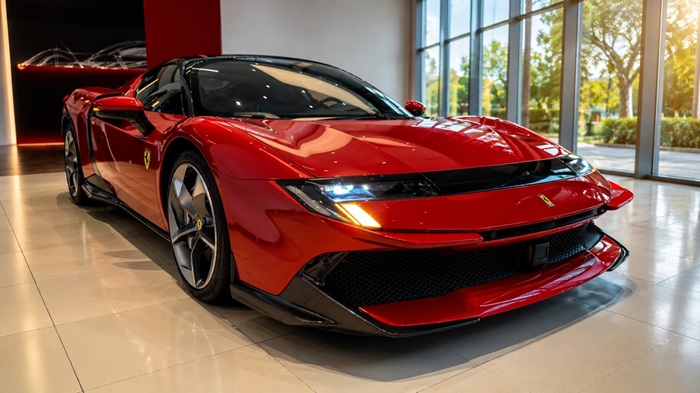
The colour seen here is Rosso Fiammante, one of the signature shades associated with the new model. It gives the body remarkable depth, especially across the sharply cut front wings, hollowed doors and rear aerodynamic surfaces.
Ferrari offers a broad colour catalogue covering reds, yellows, blues, greens, whites, blacks, greys, silvers and more unusual heritage-inspired finishes. Through Ferrari’s Tailor Made programme, customers can commission highly individual combinations of paint, upholstery, stitching, stripes and materials.
For customers who find even that level of individuality insufficient, Ferrari’s Special Projects division can develop one-off vehicles for selected clients.
In other words, if you arrive at a Ferrari gathering and discover another 849 in exactly the same specification, you have either been very unlucky or both of you have the same extremely persuasive interior designer.
Numerous racing stripes, historic liveries, contrast sections and exposed-carbon components can be selected. Buyers can make the car discreet, theatrical or visually loud enough to be located from another postcode.
Aerodynamics: The Bodywork Is Doing Mathematics
Aerodynamics are central to the 849 Testarossa’s identity.
The front intakes, splitter, side channels, wheelarch ventilation and underbody work together to manage cooling and generate aerodynamic load. Underneath the car are carefully shaped channels and multiple vortex generators, using accelerated airflow to improve stability without relying exclusively on enormous fixed wings.
At the rear is an active aerodynamic spoiler that adjusts according to speed and driving conditions. Ferrari claims the car can generate approximately 415 kg of aerodynamic load at 250 km/h—around 25 kg more than the SF90 Stradale.
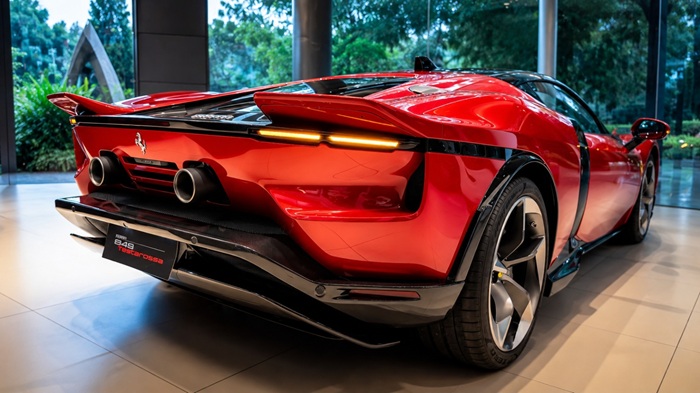
The rear design takes inspiration from Ferrari’s 1970 512 S sports prototype. The twin-tail sections are not conventional wings but separated aerodynamic forms that work with the active spoiler and rear bodywork.
The result is one of the most distinctive Ferrari rear ends in recent years.
A wide diffuser dominates the lower section, while the high-mounted exhaust outlets can be finished with titanium tips or optional dark ceramic-coated tips. The full-width diffuser and visible aerodynamic architecture make the rear look less like the end of a road car and more like the departure point of a spacecraft.
It is unquestionably dramatic. Even the air leaving this car has been given detailed instructions.
Assetto Fiorano Package
For owners who consider the regular 849 insufficiently serious, Ferrari offers the Assetto Fiorano package.
It reduces weight by approximately 30 kg through the extensive use of carbon fibre, titanium and lightweight interior components. Carbon-fibre wheels, slimmer racing seats, additional aerodynamic elements and dedicated suspension hardware are among the available upgrades.
Depending on configuration, the package can include fixed-rate Multimatic dampers intended for circuit driving. Ferrari also offers solutions that retain the semi-active suspension and front-axle lifting function, which may be the wiser choice for countries where speed breakers occasionally appear to have been designed by the defence ministry.
The Assetto Fiorano aero package modifies the front and rear surfaces, producing greater vertical load with limited additional drag.
This package is not about making the 849 Testarossa more comfortable, quieter or easier to park. It is for the customer who looks at 1,036 bhp and says, “Very good, but what have you done about my lap time?”
Engine: Ferrari’s Celebrated Twin-Turbo V8 Evolves Again
The heart of the 849 Testarossa is a 3,990 cc twin-turbocharged, 32-valve V8 petrol engine with dry-sump lubrication.
Known internally as a development of Ferrari’s F154 engine family, the V8 has been comprehensively revised for this application. It develops 830 cv on its own—50 cv more than the combustion engine used in the SF90 Stradale.
Ferrari has introduced larger turbochargers, revised cylinder heads, a redesigned engine block, new intake plenums, exhaust manifolds, fuel-system components and extensive lightweight hardware. The engine achieves a specific output of approximately 208 cv per litre, an extraordinary figure for a series-production road-car engine.
Low-friction components derived from the F80 and competition-inspired thermal-management solutions help the engine survive the enormous temperatures generated under sustained load.
The turbocharger installation uses advanced heat shielding, while the Inconel exhaust manifolds reduce weight and cope with extreme temperatures. New-generation catalyst and particulate-filter materials help the car meet emissions requirements while attempting to preserve a recognisably Ferrari exhaust character.
That is a difficult balancing act. Engineers must satisfy performance targets, emissions legislation, noise regulations and customers who expect the engine to sound as though it is personally offended by every upshift.
Ferrari has also increased its use of secondary recycled aluminium alloys for major engine castings, including components such as the cylinder heads, crankcase and sump. It is an important sustainability step, although nobody will ever describe a 330 km/h, 1,036 bhp supercar as an economical little runabout.
Three Electric Motors and Four-Wheel Drive
The combustion engine is supported by three electric motors.
Two RAC-e electric motors are positioned at the front axle. They independently control torque at each front wheel, providing on-demand four-wheel drive and highly sophisticated torque vectoring.
The third electric motor—the rear MGU-K, or Motor Generator Unit–Kinetic—is located between the engine and gearbox. It supports acceleration, recovers energy and fills torque gaps while the turbocharged V8 builds boost.
Together, the electric system contributes up to 220 cv, taking total system output to 1,050 cv.
This is not hybridisation designed primarily to win fuel-economy competitions. The electric motors sharpen response, improve traction, assist torque vectoring and deliver violent acceleration from very low speeds.
Calling it an environmentally friendly city hybrid would be like calling a fighter jet an efficient way to avoid traffic.
Battery and Electric Range
The plug-in-hybrid system uses a 7.45 kWh lithium-ion battery. With sufficient charge, the 849 Testarossa can travel for up to approximately 25 km using electric power alone.
This electric range is useful for quietly leaving residential areas, entering restricted urban zones or avoiding waking the neighbours before an early-morning drive.
Of course, the neighbours will eventually discover what you have purchased. A bright-red Ferrari costing more than ₹10 crore is not particularly skilled at keeping secrets.
Four eManettino energy modes are offered:
eDrive allows electric-only operation.
Hybrid automatically balances the engine and electric motors for everyday driving.
Performance keeps the engine operating and maintains battery energy for repeated acceleration.
Qualify extracts maximum performance from the complete hybrid system, prioritising outright speed over electrical endurance.
Qualify mode is effectively the automotive equivalent of cancelling all tomorrow’s appointments.
Performance
The combined system produces 1,050 cv, or approximately 1,036 bhp. The V8 alone delivers 842 Nm of torque, while Ferrari does not present the complete hybrid system through one simple combined torque figure because the motors deliver their output through different axles and gear ratios.
Ferrari claims:
- 0–100 km/h: under 2.3 seconds
- 0–200 km/h: approximately 6.3 seconds
- Top speed: more than 330 km/h
- Electric-only range: up to 25 km
These figures are difficult to process in ordinary-road terms.
At full acceleration, 100 km/h arrives before many drivers have fully settled their head against the seat. Two hundred arrives in the time an ordinary family car may require to complete one determined overtaking manoeuvre.
The top speed exceeds 330 km/h, although finding a legal and safe opportunity to reach it may require a racetrack, professional supervision and considerably more courage than the salesperson included in the delivery ceremony.
Ferrari quotes a Fiorano lap time of approximately 1 minute 17.5 seconds, making the 849 significantly quicker around the company’s test circuit than the SF90 Stradale.
Eight-Speed Dual-Clutch Transmission
Power is handled by an eight-speed dual-clutch automatic transmission.
The gearbox uses a revised shift strategy inspired by the SF90 XX Stradale, delivering more aggressive and emotionally engaging changes under high load. The transmission can shift with remarkable speed while still providing relatively smooth low-speed behaviour.
The centrally mounted selector is styled to resemble Ferrari’s traditional open-gate manual gear lever. It does not turn the car into a manual, but it reminds occupants of a period when changing gears required more than touching a carbon-fibre paddle.
Large fixed paddles remain mounted behind the steering wheel, allowing the driver to select gears manually without changing hand position during cornering.
Chassis, Suspension and Vehicle Dynamics
The 849 Testarossa uses an aluminium-intensive structure with numerous body panels formed using advanced single-piece manufacturing processes. The objective is to improve stiffness, reduce component count and control weight despite the complexity of the hybrid system.
The standard car uses magnetorheologically controlled semi-active suspension. These dampers continuously adjust their behaviour according to road conditions, steering inputs and selected driving mode.
A front-axle lifting system is available to help the car negotiate steep entrances and speed breakers. With a vehicle this low, the lifting system is less a luxury feature and more a close personal friend.
Ferrari’s electronically controlled E-Diff actively distributes torque across the rear axle, improving traction during acceleration and allowing the car to rotate more naturally into corners.
Electronic Power Steering provides rapid responses, while Side Slip Control coordinates the powertrain, differential, traction systems, suspension, brakes and torque-vectoring motors.
The Ferrari Dynamic Enhancer uses individual brake interventions to help control the car near the limit without making the experience feel excessively restricted.
These systems do not drive the car instead of you. Their purpose is to let an experienced driver access more of its performance while gently discouraging the kind of mistake that would become international automotive news.
Ferrari Integrated Vehicle Estimator
One of the 849 Testarossa’s most important technologies is the Ferrari Integrated Vehicle Estimator, abbreviated as FIVE.
The system creates a real-time digital estimate of the car’s behaviour. It analyses steering, acceleration, wheel movement, braking and body responses to understand what the vehicle is doing—and what it is likely to do next.
This information is shared with the braking, torque-vectoring and stability systems, allowing them to intervene with greater accuracy. Ferrari describes the technology as a virtual representation or “digital twin” of the moving car.
In simple language, the Ferrari is thinking about the corner while you are still wondering whether you entered it slightly too quickly.
FIVE works with the latest ABS Evo braking control, providing more precise braking performance across changing surfaces and driving conditions.
The impressive part is not merely that the electronics can intervene. It is that they are designed to do so without making the driver feel as though a committee has suddenly taken control of the steering wheel.
Safety and Driver Assistance
Depending on market and configuration, the 849 Testarossa offers modern driver-assistance systems including automatic emergency braking, blind-spot monitoring, lane-departure warning, lane-keeping assistance, traffic-sign recognition, rear cross-traffic alert and driver-attention monitoring.
Adaptive Cruise Control with Stop & Go may also be specified, making the car capable of handling slow traffic with surprising civility.
Additional safety equipment includes multiple airbags, electronic stability control, traction control, ABS Evo, electronic brake-force distribution, tyre-pressure monitoring, parking sensors and a surround-view camera system.
The surround-view camera is especially valuable because the car is almost two metres wide, extremely low and priced at a level where touching a concrete pillar may cause both emotional and economic instability.
An engine immobiliser, central locking and connected anti-theft functions are also offered. Ferrari’s connected services can provide vehicle information and selected remote functions through the MyFerrari ecosystem.
Interior: A Fighter-Jet Cockpit Learns Some Manners
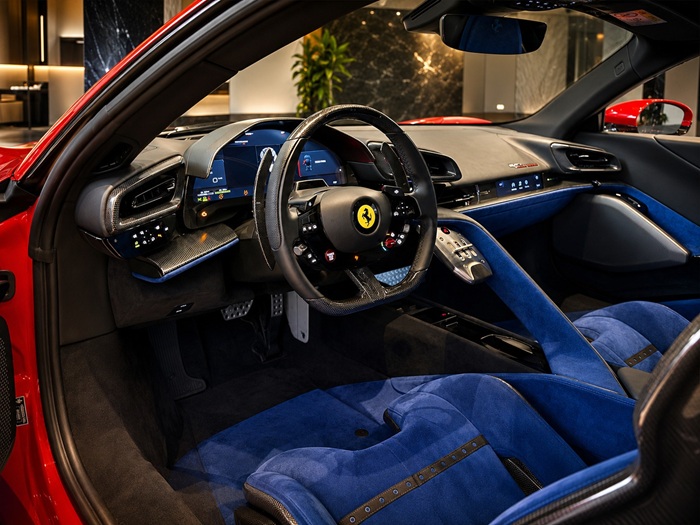
The cabin is focused completely around the driver, but Ferrari has moved away from some of the touch-sensitive steering-wheel controls used in earlier models.
Physical controls have returned, including proper buttons and rotary interfaces. This is excellent news for anyone who believes indicating should not require the concentration normally associated with defusing a small device.
The dashboard uses a bridge-like horizontal architecture, while C-shaped air vents sit within aluminium structures. A high centre console separates driver and passenger, creating two clearly defined cockpit zones.
The steering wheel houses the engine-start control, driving-mode selector and commonly used functions. Lighting, indicators, voice control and assistance-system settings are positioned within easy reach.
The eManettino controls the hybrid energy strategy, while the traditional Manettino manages the car’s dynamic driving settings.
A large 16-inch digital driver display presents instrumentation, navigation, performance data and infotainment information. A separate 9-inch passenger screen allows the person beside you to view speed and performance information—presumably so they can calculate precisely how worried they should be.
Wireless Apple CarPlay and Android Auto are supported, along with Bluetooth connectivity and a wireless smartphone charger.
A seven-speaker audio system is offered as standard in some markets, while a higher-end premium sound system is available. Whether you need an expensive audio upgrade in a Ferrari with an 830 cv V8 positioned behind your head is a personal matter.
Some owners enjoy music.
Others consider 8,000 rpm to be a perfectly acceptable playlist.
Seats and Upholstery
Ferrari offers several seat designs, ranging from electrically adjustable comfort-oriented seats to lightweight racing buckets.
Available choices include Daytona-style seats, specific-design racing seats and ultra-lightweight competition-inspired seats. Ventilation and electric adjustment may be specified on the more road-focused designs, while the lightest seats prioritise support and weight reduction.
The displayed car features blue Alcantara upholstery, creating a striking contrast with the Rosso Fiammante exterior.
Customers can choose from numerous leather and Alcantara shades, including black, brown, red, beige, yellow, orange, grey, blue and green. Seat stripes, piping, stitching, embroidered logos and central inserts can all be individually configured.
The seatbelts, carpets, dashboard, steering wheel and door panels can also be ordered in contrasting colours.
Carbon-fibre trim is available across the dashboard, centre console, door panels, sills, steering wheel and seat structures.
Ferrari will happily help you create a tasteful, coordinated cabin. It will also, should you insist strongly enough, allow you to combine enough colours to make the interior look like an argument inside an expensive tailoring shop.
Practicality
The front luggage compartment provides approximately 74 litres of capacity. That is sufficient for a soft overnight bag, a small luggage set or several carefully chosen items from Ferrari’s branded accessories catalogue.
Ferrari offers fitted luggage, garment carriers, protective car covers, paint-protection film and anti-stone-chipping solutions.
A carbon-fibre vehicle key is also available, because after buying a carbon-fibre-intensive Ferrari, being forced to carry an ordinary key would clearly be unreasonable.
This is not a grand tourer designed around large suitcases. The luggage space is for a weekend away, provided both occupants agree that shoes are optional.
Ownership and Maintenance
Ferrari provides its seven-year scheduled maintenance programme with new cars in many markets. The programme covers scheduled servicing at authorised Ferrari workshops for the specified period, helping owners maintain the vehicle according to factory standards.
This is reassuring because the 849 contains a twin-turbo V8, three electric motors, a high-voltage battery, an active aerodynamic system and several layers of sophisticated control software.
It is not the kind of vehicle for which you ask a neighbourhood mechanic to “just check the sound once”.
Verdict
The Ferrari 849 Testarossa is more than a faster SF90.
It retains the successful fundamentals of Ferrari’s plug-in-hybrid flagship architecture—a twin-turbo V8, three electric motors and four-wheel drive—but comprehensively reworks the engine, aerodynamics, electronics, chassis control and driver interface.
The result is more powerful, quicker, more visually dramatic and potentially more involving.
Its design will not please everyone. Some will love the futuristic nose, sharp surfaces and prototype-inspired rear. Others may prefer the smoother elegance of older mid-engined Ferraris.
But indifference is unlikely.
The 849 Testarossa generates 1,050 cv, reaches 100 km/h in under 2.3 seconds, produces approximately 415 kg of aerodynamic load at 250 km/h and can still travel quietly on electricity for around 25 km.
It is simultaneously a V8 supercar, a plug-in hybrid, a four-wheel-drive technical showcase and a tribute to one of Ferrari’s most evocative names.
Most importantly, the electrification has not been used to make the Ferrari apologetic. It has been used to make it faster, more responsive and more controllable.
The 849 Testarossa therefore represents Ferrari’s modern philosophy perfectly: respect the past, refuse to copy it and use every available technology to make the next car slightly more outrageous.
At ₹10.37 crore before personalisation, it is clearly not designed for ordinary buyers. Options can lift the final price substantially, and the Assetto Fiorano package will appeal mainly to owners who genuinely intend to explore the car’s abilities on a circuit.
For everyone else, the standard 849 Testarossa should be just about adequate.
After all, it only has 1,036 bhp.