Pune: Mercedes-Benz India has commenced local production of the all-new Electric GLC at its manufacturing facility in Chakan, Pune, marking a significant expansion of its electric vehicle manufacturing operations in the country. Priced at ₹78.50 lakh (ex-showroom, India), the GLC 400 4Matic offers a claimed range of up to 711 km and is scheduled to reach customers from mid-November 2026.
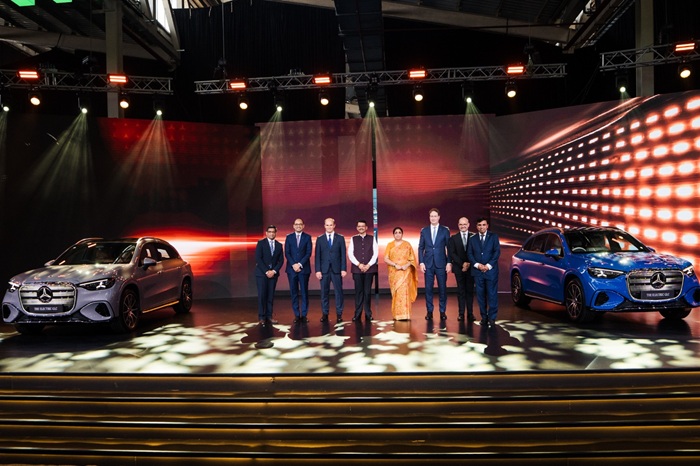
The first locally manufactured Electric GLC was rolled off the assembly line in the presence of Maharashtra Chief Minister Devendra Fadnavis, Deputy Chief Minister Sunetra Pawar and senior Mercedes-Benz executives, including Martin Brudermueller, Chairman of the Supervisory Board of Mercedes-Benz AG; Ola Källenius, Chairman of the Board of Management of Mercedes-Benz Group AG; and Dr. Joerg Burzer, Chief Technology Officer.
Also attending were Mercedes-Benz India Managing Director and CEO Santosh Iyer and Executive Director and Head of Operations Vyankatesh Kulkarni.
The development makes India one of the production locations for the next-generation Electric GLC alongside Bremen, Germany, highlighting the country’s growing importance in Mercedes-Benz’s global manufacturing network.
₹200 Crore Fresh Investment Strengthens India Operations
Mercedes-Benz has announced an additional investment of ₹200 crore in India during 2026, directed towards manufacturing operations, preparations for new products and the digitisation of production processes.
With this investment, the company’s cumulative investment in India has reached ₹3,200 crore, which Mercedes-Benz describes as the highest by a luxury automobile manufacturer in the country.
The Electric GLC is the first locally manufactured Mercedes-Benz vehicle based on the company’s next-generation MB.EA-M electric architecture.
Interestingly, the SUV is assembled on the same flexible production line as Mercedes-Benz’s internal combustion engine vehicles. This arrangement allows the Chakan facility to manufacture vehicles with different powertrains under one roof without maintaining entirely separate assembly operations.
For an automotive industry still navigating the transition between petrol, diesel and electric vehicles, manufacturing flexibility is becoming almost as important as what eventually comes out of the factory gates.
Electric GLC Offers 711 km Range and 360 kW Output
The locally manufactured Mercedes-Benz GLC 400 4Matic features a dual-motor electric powertrain producing 360 kW (approximately 483 hp) and 800 Nm of torque.
According to Mercedes-Benz, the SUV can accelerate from 0 to 100 km/h in 4.3 seconds.
A 94 kWh battery pack delivers a claimed WLTP driving range of up to 711 km. Its 800-volt electrical architecture supports DC fast charging at up to 330 kW, allowing the vehicle to gain as much as 303 km of driving range in 10 minutes under optimal conditions.
Inside, the electric SUV introduces a 39.1-inch MBUX Hyperscreen, accompanied by Mercedes-Benz’s new operating system, MB.OS.
The software architecture supports intelligent navigation, advanced driver assistance systems, over-the-air updates and personalised digital experiences.
Other highlights include an illuminated front grille incorporating 942 pixels, a Sky Control panoramic roof with illuminated stars and the use of recycled materials and components designed to reduce the vehicle’s carbon footprint.
AI, Robotics and Digital Manufacturing at Chakan
Mercedes-Benz is also expanding the use of artificial intelligence and robotics at its Pune manufacturing facility.
According to the company, more than 15 AI projects are currently operating at the plant, covering manufacturing quality, operational efficiency, decision-making, workforce development and supply-chain management.
Camera-based Vision AI systems monitor production quality in real time, while data-driven supply-chain tools help anticipate potential disruptions.
Industrial robots are employed in manufacturing operations including welding, riveting and painting.
Mercedes-Benz India has also reported a 70% expansion in its solar power capacity within a year, reflecting efforts to increase the role of renewable energy in its production operations.
The Chakan facility works with nearly 20 direct suppliers in India. Beyond its own workforce, Mercedes-Benz estimates that its operations support approximately 18,000 people employed by suppliers and service providers in the region.
Strong Initial Interest Ahead of Deliveries
The Electric GLC arrives as Mercedes-Benz marks a decade of the GLC nameplate in India.
Introduced in 2016, the combustion-powered GLC has attracted nearly 22,000 customers in the Indian market.
Mercedes-Benz says the electric version has already generated considerable interest, receiving more than 550 expressions of interest within the first 36 hours of opening the registration process.
These expressions of interest indicate prospective customer demand rather than confirmed vehicle orders.
Speaking about the development, Ola Källenius, Chairman of the Board of Management of Mercedes-Benz Group AG, said:
“India is a very important market for us, and we see tremendous potential ahead. A new generation of customers is choosing Mercedes-Benz, and we are bringing them our strongest product portfolio ever. The Electric GLC shows where we’re headed: It takes everything customers love about the GLC and brings it into the electric era: unmistakable Mercedes-Benz design, comfort and innovation, combined with electric performance. And the Electric GLC is already off to an overwhelming start. I’m convinced it will raise the bar in its segment and make electric driving even more desirable.”
Mercedes-Benz Introduces 2,500 kWh Public Charging Credits
Alongside the production announcement, Mercedes-Benz India has introduced a new charging benefit for customers purchasing its battery-electric vehicles.
Under the MB.Charge Public Charging Credits programme, eligible buyers can opt for 2,500 kWh of complimentary public charging credits instead of the complimentary AC home wall-box package.
The credits remain valid for 24 months from the activation of the MB.Charge Public service, subject to applicable terms and conditions.
Customers choosing the credits must activate their MB.Charge Public contract within seven days of vehicle retail. The credits are linked to the vehicle identification number, and customers who select this option will not receive the wall-box kit, RCBO or junction box.
Mercedes-Benz says its MB.Charge Public network now provides access to more than 22,000 charging points across India through participating charging-point operators.
The programme is intended to offer greater flexibility to electric vehicle owners, particularly those who prefer public charging over installing charging equipment at home.
A Bigger Role for India in Mercedes-Benz’s Electric Future
Mercedes-Benz has sold more than 240,000 vehicles in India since establishing its presence in the country, with locally manufactured models accounting for the majority of sales.
The commencement of Electric GLC production represents another step in the company’s efforts to integrate India into its international electric vehicle manufacturing and technology ecosystem.
With local production, expanding digital manufacturing capabilities and continued investment in charging infrastructure, Mercedes-Benz is positioning its Indian operations for a market where electric luxury vehicles are expected to play an increasingly important role.
The larger significance extends beyond a single SUV. The Electric GLC demonstrates how established luxury manufacturers are adapting their Indian factories for an era in which electric and combustion-powered vehicles will continue to share both showroom space and production lines.