
Mumbai: Mahindra & Mahindra Limited (M&M) reported a 25% year-on-year increase in consolidated profit after tax (PAT) to ₹4,588 crore for the second quarter of financial year 2026-27, supported by strong automotive sales, improving financial services performance and continued growth across its diversified businesses. Consolidated revenue from operations rose 25% to ₹57,553 crore, compared with ₹46,106 crore in the corresponding quarter last year.
The company’s Board of Directors approved the financial results for the quarter ended September 30, 2026, highlighting an uneven performance across its business segments. While the automotive division delivered substantial profit growth, the farm equipment business faced pressure from a shift in the festive season and rising commodity costs.
Mahindra reported an annualised year-to-date return on equity (RoE) of 21.0%, while year-to-date earnings per share (EPS) stood at ₹89.5.
On a sequential basis, consolidated revenue declined from ₹58,188 crore in the June quarter, while PAT eased from ₹5,455 crore. The consolidated PAT margin stood at 8.0%, unchanged from a year earlier but lower than the previous quarter’s 9.4%.
Automotive Business Drives Growth as SUV Sales Rise 26%
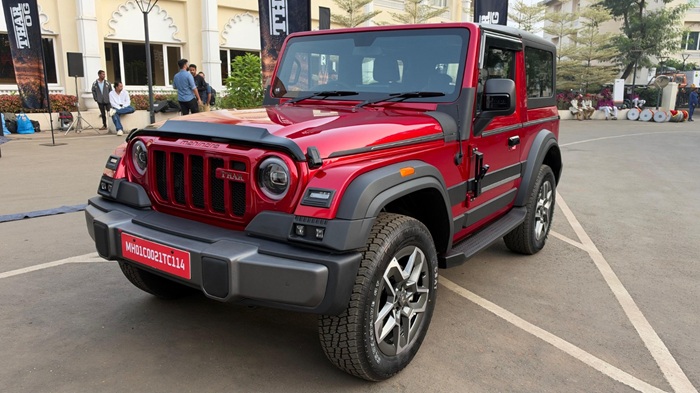
Mahindra’s automotive division remained the principal growth engine during the quarter, supported by demand for SUVs, light commercial vehicles and electric vehicles.
The company reported consolidated automotive revenue of ₹37,756 crore, representing a 39% year-on-year increase. Consolidated automotive PAT surged 55% to ₹2,388 crore.
Total vehicle sales reached 3,30,896 units, up 26% from 2,61,703 units in Q2 FY26. Utility vehicle volumes stood at approximately 1,83,000 units.
Mahindra maintained its leadership position in India’s SUV market by revenue, reporting a market share of 24.3%. Its market share in the light commercial vehicle category below 3.5 tonnes reached 52.3%, according to the company’s figures.
Electric mobility also contributed to the performance. Mahindra reported a 30.1% revenue market share in electric SUVs and a 36.2% market share in electric three-wheelers.
Battery electric vehicle sales by Mahindra Electric Automobile Limited (MEAL), included in the reported automotive volumes, increased to 22,864 units from 12,404 units a year earlier.
Despite higher sales, profitability faced some pressure. Standalone automotive profit before interest and tax (PBIT) rose 15% to ₹2,614 crore, while the PBIT margin declined to 7.7% from 9.2% a year earlier.
The consolidated automotive PBIT margin stood at 8.8%, improving by 110 basis points sequentially from 7.7%, although it remained below the 9.3% recorded in Q2 FY26.
Excluding the impact of electric SUV contract manufacturing arrangements (CMA), the company reported a standalone automotive PBIT margin of 9.1%, down 120 basis points year-on-year but 80 basis points higher quarter-on-quarter.
Farm Equipment Business Faces Festive Season Pressure
Mahindra’s farm equipment business experienced a contrasting quarter despite maintaining its leadership position in the domestic tractor market.
Tractor sales declined 6% year-on-year to 1,16,027 units from 1,22,936 units, while the company’s tractor market share stood at 41.5%.
Consolidated farm equipment revenue fell 6% to ₹9,572 crore, compared with ₹10,225 crore in the corresponding quarter last year. Consolidated PAT declined 9% to ₹1,053 crore.
Standalone farm equipment PBIT stood at ₹1,441 crore, with the margin narrowing to 16.8% from 19.7% a year earlier.
On a consolidated basis, the farm equipment PBIT margin was 14.4%, compared with 15.7% in Q2 FY26, although it improved by 20 basis points from the preceding quarter.
Mahindra attributed the moderation partly to the timing of the festive season. Higher commodity prices also presented challenges to operating margins.
The results underline how the agricultural equipment business can move to a rather different seasonal rhythm from passenger vehicles, even within the same industrial group.
Mahindra Finance, Tech Mahindra and Services Support Earnings
Beyond automobiles and tractors, Mahindra’s services businesses contributed to the group’s overall profitability.
Consolidated services revenue increased 18% year-on-year to ₹11,821 crore, while PAT attributable to M&M from these businesses rose 18% to ₹1,147 crore.
Mahindra & Mahindra Financial Services Limited (MMFSL) reported a 15% increase in assets under management (AUM), while its Stage 3 gross assets ratio (GS3) stood at 3.42%. The company’s share of PAT from Mahindra Finance increased 61% year-on-year.
Technology services company Tech Mahindra reported a 33% increase in PAT attributable to M&M. Its earnings before interest and tax (EBIT) margin reached 14.8%, improving by 260 basis points as its operational transformation continued.
The group’s real estate business, Mahindra Lifespaces, recorded residential pre-sales of approximately ₹1,100 crore, an increase of 41%. Gross development value (GDV) additions reached ₹1,500 crore.
Mahindra Holidays reported 5,762 room keys and an occupancy rate of 76%, representing an improvement of 220 basis points.
Meanwhile, Mahindra Logistics recorded revenue of ₹2,095 crore, up 24%, and reported positive PAT attributable to M&M, with a threefold year-on-year improvement.
Mahindra also stated that its portfolio of emerging businesses, referred to as Growth Gems, recorded a threefold increase in PAT.
Standalone Revenue Climbs 26% to ₹44,282 Crore
At the standalone level, Mahindra & Mahindra reported revenue of ₹44,282 crore in Q2 FY27, compared with ₹35,080 crore a year earlier, representing growth of 26%.
Standalone EBITDA increased 4% to ₹6,718 crore from ₹6,467 crore, indicating that operating earnings expanded at a considerably slower pace than revenue.
Standalone PAT grew 13% to ₹5,102 crore, compared with ₹4,521 crore in Q2 FY26.
For the first half of FY27, group consolidated revenue reached ₹1,15,741 crore, compared with ₹91,564 crore in the corresponding period last year. Consolidated PAT increased to ₹10,042 crore from ₹7,757 crore.
These figures reflect the group’s growth across the first six months of the financial year, even as quarterly margins and segment performance varied.
Mahindra Leadership Highlights Resilience Amid Economic Uncertainty
Commenting on the company’s financial performance, Dr. Anish Shah, Group CEO & Managing Director, M&M Ltd., said:
“Our Q2 F27 Consolidated PAT growth of 25% reflects the resilience of our group and underlines the disciplined execution across businesses. Auto continued to grow on the back of strong consumer demand, while Farm experienced a marginal decline on account of the festive season shift. Mahindra Finance maintained its growth trajectory, TechM displayed acceleration in its transformation journey, and our Growth Gems continued their momentum. Despite the uneven macroeconomic environment, the group remains focused on laying the foundation for consistent profitable growth.”
Mr. Rajesh Jejurikar, Executive Director & CEO (Auto and Farm Sector), M&M Ltd., highlighted the automotive division’s performance and the ability of the farm equipment business to maintain margins despite rising input costs.
“Auto Business delivered strong performance while Farm business continues to demonstrate strong resilience in Q2F27. SUV volume grew 26% YoY and retained market leadership in revenue market share. EV product range continue to show momentum with maintaining #1 position in revenue market share for the 1st half of the year. Auto consolidated PBIT margin grew to 8.8%, 110 bps up QoQ and Farm consolidated PBIT margin grew 20 bps QoQ despite significant hike in commodity prices.”
Mr. Amarjyoti Barua, Group Chief Financial Officer, M&M Ltd., said:
“Q2 F27 reflects the strength of our diversified portfolio. Our businesses are demonstrating strong operational stewardship and resilience despite significant commodity and geopolitical headwinds. The robust balance sheet and cash generation also provides us the flexibility to invest in future opportunities and deliver sustainable value.”
SUV Demand and Diversification Shape Mahindra’s Growth Outlook
Mahindra’s second-quarter results demonstrate the increasing importance of its automotive business, particularly SUVs and electric vehicles, in supporting group earnings.
The 55% increase in automotive PAT helped offset weaker farm equipment profitability, while contributions from financial services, information technology and other businesses provided additional support.
However, the relatively modest 4% growth in standalone EBITDA, alongside pressure on automotive and tractor margins compared with last year, indicates that higher revenue does not automatically translate into proportionate operating profit growth.
The group’s performance also highlights the benefits and challenges of operating across multiple industries. Strong consumer demand can lift vehicle sales, while agricultural seasonality, commodity costs and broader economic conditions can simultaneously weigh on other businesses.
For Mahindra, the coming quarters will test whether robust SUV demand, expanding electric mobility operations and improving services profitability can sustain earnings growth while margins in its traditional businesses recover.
With a 21% annualised return on equity and consolidated half-year profit exceeding ₹10,000 crore, the company enters the remainder of FY27 with considerable earnings momentum. Maintaining that progress amid fluctuating costs and uneven demand will be the more important measure of its financial resilience.
Key financials:
| Rs cr. | Q2 F27 | Q2 F26 | Growth% YoY |
| Consolidated Results | |||
| Revenue | 57,553 | 46,106 | 25% |
| PAT | 4,588 | 3,673 | 25% |
PAT is PAT after Non-Controlling Interest.