
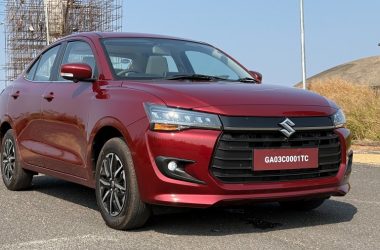
There is a certain confidence required to launch a new SUV into India in 2026. The market is already packed tightly enough to make a Mumbai parking lot look spacious, buyers expect turbocharged performance, panoramic roofs, enormous screens, ADAS, connected-car tricks and five-star safety ratings, while still wanting sensible fuel economy and a price that does not require a family meeting. Into this cheerful chaos comes the Nissan Tekton, a new 4.3-metre crossover SUV that has the considerable responsibility of replacing the Kicks and, perhaps more importantly, restoring Nissan to the centre of one of India’s most fiercely contested automotive categories.
The Tekton is not attempting this with a completely blank sheet of paper. Underneath, it shares its Renault–Nissan Common Module Family architecture and considerable mechanical DNA with the Renault Duster, while its visual identity borrows some swagger from the much grander Nissan Patrol. That makes for an interesting recipe: the bones of a sensible global crossover, some visual seasoning from a full-sized off-road icon, and enough technology to ensure nobody mistakes it for an SUV designed when Bluetooth connectivity was still considered witchcraft.
Launched in 2026, this is the first generation of the Tekton, and the name itself is rather more thoughtful than the usual alphanumeric soup. “Tekton” comes from a Greek word meaning architect, an appropriate choice for a vehicle intended to rebuild Nissan’s presence in this space. Designed by Ken Lee, it is assembled in Chennai and will also be exported from India to several overseas markets, including the Middle East and Africa. So although the Tekton has international ambitions, India is very much central to the project rather than being somewhere the car happened to arrive after everybody else had finished with it.
Prices begin at ₹10.49 lakh ex-showroom and climb to ₹18.59 lakh for the top-spec version. The car you see here is that flagship model: the Tekton T280 DCT Tekna+. It uses the stronger 1.3-litre turbo-petrol engine, a six-speed wet-clutch DCT automatic and front-wheel drive. There is no diesel, no all-wheel-drive system and no heroic low-range transfer case waiting beneath the centre console. Despite the Patrol-inspired face and skid plates, this is fundamentally a road-biased crossover with enough clearance and underbody protection to deal with the sort of terrain most Indian owners will actually encounter: broken roads, unexpected craters and speed breakers engineered with the enthusiasm normally reserved for Himalayan passes.
Patrol attitude, Duster-sized footprint
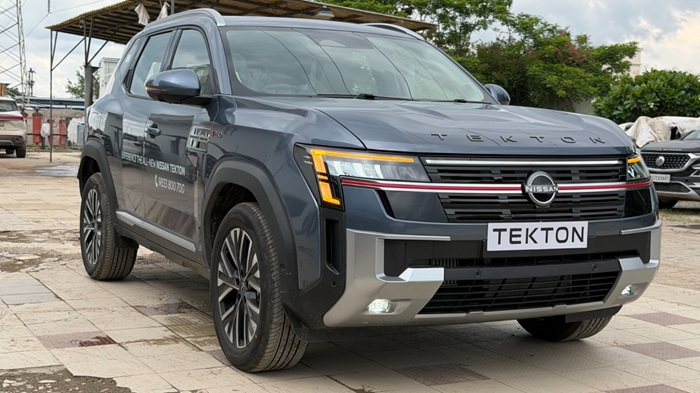
The Tekton’s design works because Nissan has resisted the temptation to simply make it shout from every possible surface. The front is clearly influenced by the Patrol, but it has been scaled to suit the dimensions of a compact crossover rather than copied wholesale. A chrome grille gives the nose some visual width, while the automatic Matrix Vision C-shaped five-chamber LED headlamp arrangement creates a distinctive lighting signature. The lamps are connected visually across the fascia and incorporate position lighting, while Automatic High Beam Assist adds useful intelligence after dark.
LED fog lamps sit lower down, and there are skid plates at both ends. Nissan has also incorporated Aero Optimised Air Curtains, which sounds like something developed for a wind tunnel rather than your neighbourhood vegetable market, but their purpose is straightforward: manage airflow around the body more efficiently. The full underbody protector is rather more immediately relevant to India, where occasionally the road simply decides it no longer wishes to be a road.
The bonnet and upright nose give the Tekton more presence than its dimensions suggest. There is also a Himalayan Crest badge, adding another small visual flourish to the exterior. Rain-sensing frameless wipers clean an acoustic windscreen, the latter helping reduce outside noise entering the cabin. It is the sort of feature that does not photograph particularly well for social media but may prove more valuable after several hours on an expressway.
From the side, the proportions are conventional but purposeful. Wheel-arch cladding gives the body some necessary visual toughness, while the Tekna+ gets handsome 18-inch five-petal diamond-cut alloy wheels. These wear 225/55 R18 98H CEAT SecuraDrive radial tubeless tyres at both ends. Lower specifications can also be equipped with 17-inch steel wheels, which are substantially less glamorous but may win some arguments when tyre replacement bills arrive.
The electrically adjustable and folding outside mirrors incorporate LED indicators, puddle lamps and cameras. Front and rear disc brakes sit behind the wheels, an encouraging specification for an SUV producing 280 Nm and weighing enough to make good brakes more than a decorative luxury.
Our Tekton is finished in Moonbow Gray, which suits its mature, slightly industrial character. White, red, blue, silver and black are also available, and buyers wanting a dual-tone finish get a black roof. The palette is broad enough without reaching the point where choosing a colour requires an interior-design consultant.
Dimensionally, the Tekton is roughly 4.3 metres long, 1.8 metres wide and 1.7 metres tall. More significant for Indian conditions is its 212 mm ground clearance. That figure should provide useful confidence over rough surfaces, and the 26.9-degree approach angle gives the front end a better chance of surviving abrupt ramps and unkind terrain. Nissan also quotes a towing capability of up to 700 kg.
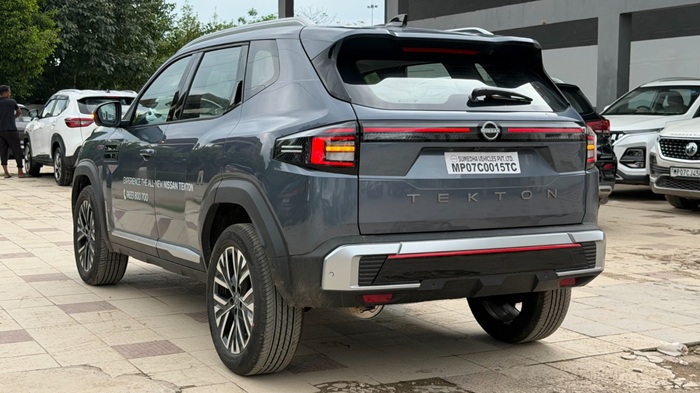
Around the rear, the SynchroFlow C-shaped connected LED tail lamps echo the lighting theme from the front and incorporate an emergency stop signal. There is an aero-tuned spoiler, rear wiper and washer, defogger and another skid plate. The overall effect is modern without being desperate for attention. It looks substantial, slightly rugged and distinctly Nissan, which is precisely what a brand replacing the Kicks needed.
A cabin that has discovered Google — and 48 colours of ambience
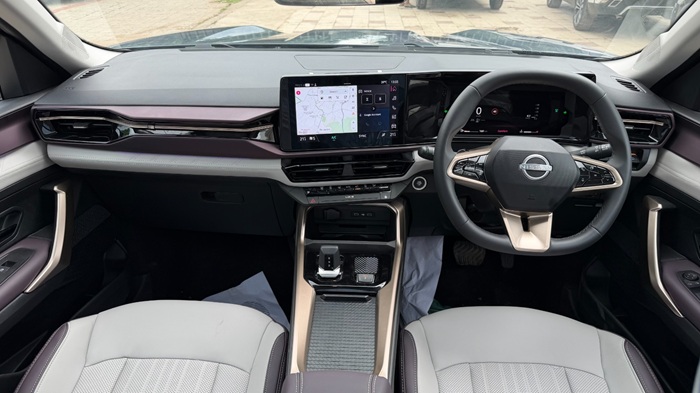
Open the door and the Tekton moves considerably further from old-school Nissan territory. The interior has been designed around a driver-centric wraparound philosophy, with the major displays and controls arranged to make the cockpit feel more integrated than simply having two tablets glued to the dashboard and hoping nobody asks difficult questions.
There is a rose-gold horizontal double-bar finisher that adds some visual warmth, while the flagship Tekna+ receives Comfort Quilted Leatherette upholstery. Other variants use semi-leatherette or fabric finishes. The top model also brings a pair of six-way electrically adjustable front seats with lumbar adjustment and ventilation. Ventilated seats have moved from novelty to near-necessity in India remarkably quickly, because once you have driven through a May afternoon with them, returning to conventional upholstery feels like voluntarily switching off the air conditioner.
The boomerang-profile headrests add another bit of design character, and the steering wheel is a leather-wrapped, double-D-cut electrically assisted unit with both tilt and telescopic adjustment. It carries controls for the phone, instrument cluster and voice functions, while the car offers two selectable steering settings, Low and High. The idea is to tailor effort depending on whether you want lighter responses or a weightier feel.
Ahead is a 10.25-inch HD digital instrument cluster capable of displaying full Google Maps. Lower variants get a 7-inch display. The larger unit means navigation directions can remain directly within the driver’s eye line instead of forcing repeated glances towards the centre screen.
That centre display is a 10.1-inch Tek-Link HD infotainment system running Google’s operating system. Native Google Assistant and Google Maps support are joined by live traffic information, access to more than 200 applications through the Play Store, car-to-home functionality, over-the-air updates, wireless Android Auto and Apple CarPlay, Bluetooth, voice recognition, USB connectivity, FM and radio. Lower variants make do with a 9-inch touchscreen.
Embedding Google services properly rather than simply relying on phone projection is useful because navigation, voice assistance and app functionality remain part of the car’s own ecosystem. Whether anybody genuinely needs 200-plus apps inside an SUV is another matter. Most drivers will probably use Maps, music and perhaps two other functions before forgetting the rest exist, much like the apps on their television.
Audio comes through a six-speaker Arkamys Auditorium 3D Surround Sound system. There is also 48-colour ambient lighting, allowing occupants to select virtually any cabin mood short of “reasonable electricity bill”.
The climate system is rather more serious. Dual-zone automatic air-conditioning is supplemented by an air purifier, Plasmacluster ioniser and an AQI display. Given the air-quality challenges of several Indian cities, this is technology with considerably more everyday relevance than yet another animated welcome graphic.
Storage has received attention too. The front armrest contains a cooled compartment, while the wireless phone charger gets its own cooling vent to prevent devices becoming miniature induction cookers during long charging sessions. One-touch power windows feature anti-pinch protection.
Overhead is an electrically operated panoramic sunroof with one-touch operation and anti-pinch functionality. India’s collective enthusiasm for enormous glass roofs appears to be alive and healthy, even if many owners spend most of the year keeping the shade closed to prevent the cabin becoming a greenhouse.
A frameless auto-dimming inside mirror adds a premium touch, LED reading lamps improve cabin illumination, and the dual-tone horn should ensure the Tekton remains culturally prepared for Indian traffic.
The rear bench has a 60:40 split-folding arrangement, and luggage capacity is one of the Tekton’s stronger practical numbers. With the seats in place, boot volume stands at 518 litres. Fold them down and the available space expands to 1,789 litres. That gives the SUV genuine family usefulness rather than merely possessing an elevated seating position and calling itself practical.
Nissan’s accessory catalogue can stretch that usefulness further, with options including a wireless charger, side steps, child seat, dash camera, illuminated sunroof elements, chrome garnishes, scuff plates, carpet mats, door visors, sunshades, cushions, seat covers, an air purifier, emergency kit, vacuum cleaner and door-edge guards. There are enough choices to personalise the Tekton considerably, although one hopes restraint survives somewhere between the chrome garnish and the cushions.
Two turbo engines, but the T280 is the one enthusiasts will want
The Tekton is petrol-only, with two turbocharged engines serving rather different buyers.
The entry powertrain is Nissan’s HRA0 T160: a 1.0-litre, three-cylinder MPFi turbo-petrol producing 98 hp and 166 Nm. Nissan quotes 0–100 km/h in 12.4 seconds and average fuel efficiency of 19 km/l. It is clearly the sensible engine, intended for buyers prioritising economy and a lower purchase price over enthusiastic acceleration.
The T280 Tekna+ tested here uses the more interesting option: Nissan’s H5HA474 T280 GDi engine. It is a 1.3-litre, four-cylinder turbocharged direct-injection petrol unit producing 160 hp and 280 Nm.
On paper, that transforms the Tekton’s personality. Nissan claims 0–100 km/h in 9.5 seconds, which puts it comfortably into brisk rather than merely adequate territory. More important than the sprint figure is that 280 Nm torque output. In everyday driving, that sort of mid-range muscle should matter far more than repeatedly demonstrating the launch time to unsuspecting passengers. It means less planning when overtaking, stronger acceleration out of slower corners and a more relaxed feel when the vehicle is loaded with people and luggage.
Our car uses a six-speed dual-clutch automatic transmission with a wet-clutch design. The wet arrangement is particularly worth mentioning because it offers better thermal management than a dry-clutch system, especially in heavy stop-start use. A six-speed manual is also available for buyers who still believe changing their own gears is part of the point of driving.
Both engines use Nissan’s Mirror Bore Coating technology derived from the GT-R. The process reduces internal friction within the engine, improving efficiency and performance. Connecting a family crossover to a GT-R inevitably makes for excellent dinner-table trivia, though nobody should assume this means the Tekton has suddenly acquired launch control and the ability to embarrass supercars.
Drive goes exclusively to the front wheels. The Tekton offers Eco and Comfort driving modes rather than an encyclopaedia of terrain settings. That tells you plenty about the car’s intended mission. This is not pretending to be a hardcore off-roader. The 212 mm clearance, skid plates, engine undercover and underbody protection give it useful rough-road credibility, but there is no AWD system to turn it into a miniature Patrol.
A 50-litre fuel tank supports both petrol engines. Nissan claims 17 km/l for the 1.3-litre with the manual gearbox and, interestingly, 18 km/l with the automatic. The 1.0-litre is rated at 19 km/l. Those figures are claimed numbers rather than guaranteed real-world results, and actual economy will naturally depend on traffic, load, driving style and how frequently the driver explores all 280 Nm.
On the road: engineered for the world most Tektons will actually inhabit
The Tekton sits on the Renault–Nissan Common Module Family, or CMF, architecture. The same broader platform family underpins vehicles including the Dacia Duster, Renault Duster, Boreal and Kardian, and the Tekton itself is closely based on the Duster.
That association should not be considered an embarrassment. The Duster name has long been associated with robust chassis tuning and an ability to deal with imperfect roads without becoming flustered. Nissan’s job has therefore been less about reinventing the mechanical foundation and more about giving it its own tuning, technology and identity.
At the front, suspension is by MacPherson struts with lower transverse links and twin-tube hydraulic dampers. A solid anti-roll bar is mounted to the front subframe and ARB links. At the rear, there is a twist-beam layout with coil springs, twin-tube hydraulic telescopic shock absorbers and an anti-roll bar integrated with the beam.
This is not the exotic multilink arrangement that engineers place on presentation slides when trying to justify very large prices, but in this class sophistication is measured by how well the suspension is calibrated rather than simply how many links it contains.
The monocoque body uses 62 per cent high-strength steel, helping provide structural rigidity without requiring the mass and complexity of a ladder-frame chassis. For urban driving and highway touring, that is exactly the correct architecture.
The 212 mm ground clearance inevitably means the Tekton has a higher centre of gravity than a conventional hatchback, so there will always be some body movement when asked to change direction aggressively. But the combination of anti-roll bars, relatively wide 225-section tyres and a stiff monocoque structure should give the chassis a stable foundation.
Two steering modes let the driver alter steering effort between Low and High. The lighter setting makes most sense while parking and threading the Tekton through congested streets, while the heavier mode should provide a more substantial feel at higher speeds. Whether extra weight translates into genuine feedback is always another question; modern electric power steering systems are often excellent at accuracy and considerably less enthusiastic about conversation.
With discs at all four corners and a substantial electronic safety net, braking hardware is appropriately specified. The 26.9-degree approach angle and full underbody protection also mean rough rural roads or steep access ramps should be less intimidating than they are in lower crossovers.
Hill descent control seems slightly optimistic for a front-wheel-drive SUV without dedicated off-road hardware, but there will certainly be situations on loose or steep surfaces where controlled low-speed descent assistance is useful. Think muddy hillside driveway rather than Moab.
Refinement also receives attention through the acoustic windscreen and aerodynamic measures. At motorway speeds, those details matter. Wind noise that appears negligible on a 15-minute test drive can become deeply irritating after four hours, so acoustic glass is the sort of invisible engineering that tends to be appreciated more with ownership than in a showroom.
Safety moves to the centre of the Tekton story
Nissan has equipped the Tekton heavily in the safety department, and the headline result is a five-star Bharat NCAP rating. That is increasingly important in India, where crash-test performance has moved from an enthusiast talking point to a mainstream purchasing consideration.
Six airbags are backed by ABS and EBD, brake assist, Electronic Stability Control, traction control, hill-start assist, Cornering Stability Control and roll-over sensors. There is also a tyre-pressure monitoring system, three-point seatbelts, front pretensioners and load limiters, seatbelt reminders and ISOFIX child-seat mounting points.
The electronic assistance goes considerably further. The Tekna+ brings Blind Spot Warning, Traffic Sign Recognition, Autonomous Emergency Braking, Lane Departure Warning, Lane Keep Assist, Driver Drowsiness Attention Warning, a speed limiter and distance warning.
Adaptive Cruise Control includes stop-and-go capability, potentially useful in dense expressway traffic where conventional cruise control spends most of its time being switched on and off.
Parking assistance covers the front, rear and sides, while a 3D Around View Monitor provides a much more useful perspective when manoeuvring than a basic reversing camera alone. On a 4.3-metre crossover it is arguably not essential, but anybody who has encountered a badly positioned concrete pillar in a basement parking lot will happily take the assistance.
There are also several less glamorous but worthwhile safeguards: speed-sensing door locks, impact-sensing unlocking, Super Locking, central locking, child locks, a speed-alert warning, immobiliser and burglar alarm. Walk Away Lock and Approach Unlock add convenience, while a tyre repair kit handles the inevitable moment when the road decides to introduce itself directly to the tyre.
Battery Saver Management is another small ownership-oriented feature designed to prevent unnecessary electrical drain.
The challenge with modern ADAS is calibration. A poorly tuned system can turn a journey into an argument between driver and electronics. A well-calibrated one simply sits quietly in the background until required. The Tekton certainly possesses the hardware; its success in day-to-day use will depend on how naturally those systems interpret India’s wonderfully improvisational lane discipline.
Connected enough to start itself before you reach it
The Tekton’s connected-car ecosystem is accessed through the MyNissan app, which comes with a three-year free subscription.
Functions include remote engine start and stop with air-conditioning, remote horn and lights, locking and unlocking, vehicle-status checks, Find My Car, alerts and service booking among numerous other connected services.
Remote engine start with climate control is particularly relevant in India. Starting the car while walking towards it so the cabin has already begun cooling is not laziness; during certain months it is basic survival.
Connected features can sometimes feel like technology developed because the engineering team ran out of physical buttons to redesign, but several of these functions are genuinely helpful. Vehicle status, location and remote locking are exactly the sort of features owners may ignore for weeks and then suddenly become very grateful for.
Ownership: Nissan tries to remove the usual anxiety
Standard warranty coverage is three years or 1 lakh km. More unusually, Nissan allows it to be extended as far as 10 years or 2 lakh km, providing buyers with the option of keeping considerable factory-backed coverage well beyond the initial ownership period.
Three years of 24×7 roadside assistance is included too.
This matters for Nissan. The Tekton is not simply another model added to an already crowded catalogue; it replaces the Kicks and arrives at a time when the brand needs to reassure buyers about long-term commitment as much as it needs to impress them with ambient lighting.
Local assembly in Chennai should help with localisation and supply, while the fact that India will also serve as an export base for markets including the Middle East and Africa gives the project a broader industrial role. A vehicle built for multiple demanding markets also needs to cope with heat, dust and difficult road surfaces — conditions India is quite capable of supplying without assistance.
Where does the Tekton fit among India’s SUV crowd?
The Tekton enters one of the least forgiving parts of the Indian market. Buyers in this price band have become exceptionally demanding, and the Nissan has to compete not just on one headline strength but across design, powertrain, safety, technology, rear-seat usability, efficiency and perceived quality.
Its obvious family connection with the Renault Duster creates an especially interesting comparison. Buyers attracted primarily by the fundamental chassis architecture and value proposition will naturally consider the Renault. The Nissan counters with its own Patrol-inspired design identity, Tekna+ equipment package, Google-based infotainment ecosystem and distinct cabin treatment.
Then there are the numerous established petrol-powered crossovers already fighting for the same households. Some rivals may offer broader powertrain choices, others could tempt buyers with stronger dealer reach, a different rear-seat experience or a more conservative ownership proposition. Nissan’s argument is that the Tekton combines a proven shared platform with a 160 hp turbo engine, extensive safety technology and a distinctly Nissan exterior without merely becoming a Duster wearing a different badge.
That last point is crucial. Platform sharing is now routine throughout the automotive industry. What matters is whether the customer can feel enough separation in design, tuning, cabin ambience, features and brand character to justify choosing one sibling over another.
On the evidence of its specification, the Tekton makes a serious effort.
Verdict
The Nissan Tekton is the sort of car Nissan needed more than it needed another niche experiment. It sits in the heart of the Indian SUV market, has useful dimensions, 212 mm of ground clearance, a genuinely large 518-litre boot, a five-star Bharat NCAP rating and, in T280 form, an engine producing enough torque to ensure highway overtaking should not become a committee decision.
Its strongest mechanical argument is the 1.3-litre turbo-petrol. With 160 hp, 280 Nm and a claimed 0–100 km/h time of 9.5 seconds, it gives the Tekton performance that should feel comfortably stronger than the 98 hp 1.0-litre alternative. Pairing it with a six-speed wet-clutch DCT also suits the flagship Tekna+’s more premium ambitions.
The chassis specification is sensible rather than exotic, the SUV remains front-wheel drive despite its rugged detailing, and anybody expecting Patrol-level wilderness capability because the headlights share some family resemblance has misunderstood the assignment. The Tekton is built for real-world crossover life: cities, highways, broken roads, family holidays, overflowing luggage and the occasional dirt track rather than cross-country expeditions requiring recovery ropes and satellite communication.
Inside, Nissan has thrown plenty at the Tekna+. Ventilated electrically adjustable seats, panoramic glass, dual-zone climate control with air purification, a 10.1-inch Google-powered infotainment system, a 10.25-inch digital cluster, Arkamys audio, cooled storage, 48-colour ambient lighting and comprehensive connected functions make it feel appropriately modern. Some of that technology will become invisible after the novelty wears off; some of it — particularly seat ventilation, native navigation, the surround-view camera and remote climate functions — could quickly become difficult to live without.
At ₹18.59 lakh ex-showroom for this T280 DCT Tekna+, however, buyers have every right to be demanding. This is no longer inexpensive territory, and the Tekton must prove that its materials, refinement, DCT calibration and long-term ownership experience are as convincing as its specification sheet. The generous possibility of extending warranty coverage to 10 years or 2 lakh km is therefore an intelligent confidence-building move.
What ultimately gives the Tekton personality is that combination of influences. It carries some visual theatre from the Patrol, its underlying architecture is closely related to the Duster, its engine borrows friction-reducing technology associated with the GT-R, and its cabin appears to have swallowed a sizeable portion of Google. On paper that sounds like the automotive equivalent of inviting four very different people to design the same house.
Yet the result is surprisingly coherent.
The Tekton does not need to become a miniature Patrol, a front-wheel-drive GT-R or merely a Nissan-badged Duster. It only needs to be a convincing Nissan SUV in its own right. With strong safety credentials, serious equipment, useful practicality and a muscular 280 Nm turbo-petrol engine, the T280 Tekna+ gives it a credible chance.
And perhaps that makes the name particularly appropriate. “Tekton” means architect. Nissan has spent years needing to rebuild its presence in this part of the Indian market. This SUV is the blueprint.