



The Mahindra Scorpio has spent more than two decades perfecting a uniquely Indian form of intimidation. It has carried politicians, families, police officers, rural entrepreneurs, mountain tourists and enough chrome accessories to affect local weather patterns. Now Mahindra is taking that familiar tough-SUV formula, stretching it to roughly 5.3 metres, attaching a proper cargo bed to the back and preparing to send it around the world. The result is the Mahindra Scorpio Lifestyler, a new-generation pickup that effectively asks a very simple question: what if a Scorpio N stopped pretending the weekly grocery run was the hardest job it would ever face?
Scheduled for an April 2027 launch, the Lifestyler is Mahindra’s attempt to return seriously to the Indian lifestyle-pickup space while simultaneously becoming a genuinely global player in the category. It will be offered with petrol and diesel powertrains, in rear-wheel-drive and four-wheel-drive configurations, and is expected to start at an ex-showroom price of ₹19.79 lakh. Mahindra has not yet announced the price of the top version, although it could stretch towards the ₹30–32 lakh region depending on specification.
That immediately puts the Lifestyler in an interesting position. This isn’t merely a commercial pickup wearing fashionable wheels and calling itself adventurous. Nor is it simply a Scorpio N with the third row removed and a metal tray welded behind it. Mahindra describes this as its global pickup truck, and the engineering brief appears correspondingly ambitious: SUV-like comfort, one-tonne carrying capability, serious towing capacity, four-wheel-drive hardware and enough technology to prevent owners of modern SUVs feeling as though they have accidentally wandered into an agricultural equipment catalogue.
There is history here, too. Mahindra launched its earlier Scorpio-based pickup in 2006, eventually familiar to many buyers as the Scorpio Getaway. The new Lifestyler represents the second generation of that basic idea, but the execution has moved on considerably. The old Getaway was a rugged utility vehicle that happened to share Scorpio DNA; the new one wants to be something more sophisticated, more international and considerably more desirable.
Internally, this generation carries the Project Z121 codename and draws heavily from Mahindra’s Global Pik Up concept. It has been designed at the Mahindra India Design Studio, or MIDS, in Mumbai, with Pratap Bose involved in its design, while development has taken place at the company’s Mahindra Research Valley in Chennai. Underneath sits Mahindra’s next-generation body-on-frame chassis, an architecture entirely appropriate for a machine expected to carry up to a tonne while towing substantially more.
And this isn’t being developed with India alone in mind. Mahindra intends to sell the Lifestyler in markets including Australia, New Zealand, South Africa, other parts of Africa, the Middle East and Latin America. In several territories it is expected to drop the Scorpio prefix altogether and simply be sold as the Mahindra Lifestyler. That tells you something about the ambition behind the programme. The Scorpio name is enormously powerful in India, but Mahindra wants this truck to establish its own identity in markets where pickups are not niche curiosities but everyday transport.
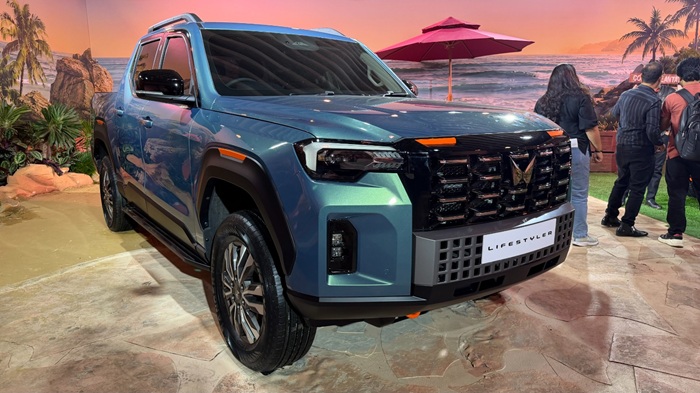
A Scorpio N that has been spending more time at the gym
The relationship with the Scorpio N is immediately important. The Lifestyler is essentially the pickup counterpart to Mahindra’s popular ladder-frame SUV, and that gives the new truck a useful starting point. Instead of developing an entirely separate family of engines, cabin electronics and chassis philosophy, Mahindra can draw on components and know-how already proven in the Scorpio N ecosystem.
Visually, though, this thing needs to perform a slightly different job. A lifestyle pickup must look tough enough for a construction site, sophisticated enough for an expensive hotel driveway and fashionable enough that someone who has absolutely no intention of transporting concrete still desperately wants one.
The proportions do much of the work. At around 5.3 metres long, approximately 1.9 metres wide and roughly 1.9 metres high, the Lifestyler is a substantial machine. Park one beside a conventional compact SUV and the latter may develop self-esteem problems.
Yet those dimensions are not gratuitous. The elongated body is necessary to combine a proper four-door passenger cabin with a usable rear load bed, while the width provides the broad stance expected of a global pickup. Mahindra currently presents the Lifestyler as a four-door pickup, although a two-door derivative may also be introduced later.
The body-on-frame construction means this isn’t trying to be a softly sprung crossover with a decorative pickup bed. Its underpinnings are intended for load-carrying, towing and off-road punishment. But Mahindra’s challenge is to make that toughness coexist with the refinement expected by buyers migrating from SUVs such as the Scorpio N and Thar.
That balancing act is crucial because the likely customer is no longer simply somebody who needs a pickup. Mahindra wants people who actively want one.
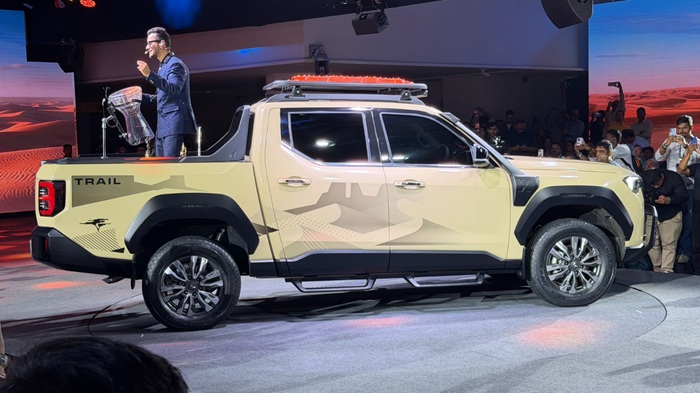
Proper pickup numbers
The Lifestyler is expected to offer a payload capacity of around 1,000 kg, which immediately gives its load bed genuine working credentials. More impressive for touring and recreational use is the quoted capability to tow up to 3,500 kg.
That sort of capacity changes the conversation. A 3.5-tonne towing rating potentially puts caravans, large trailers, boats and serious recreational hardware within its remit. Whether Indian owners will use all of that capacity is another matter. Most will probably tow nothing heavier than their own enthusiasm, but it is rather pleasant knowing the ability exists.
Wheel hardware also gives the Lifestyler the right stance. The truck uses 18-inch alloy wheels wearing 255/65 R18 111H JK Tyre Ranger HT steel-radial tubeless tyres at both ends. That’s a sensibly substantial tyre profile rather than the low-profile fashion items fitted to some SUVs, and should provide useful cushioning when roads stop behaving like roads.
More unusually for the segment, disc brakes are provided at both the front and rear. On a vehicle capable of carrying a tonne and towing 3.5 tonnes, stopping power is not the area in which one wants Mahindra to discover the joys of cost optimisation.
Exact production specifications such as ground clearance, wheelbase, kerb weight and load-bed dimensions have not been supplied yet, so there is little value pretending otherwise. Those figures will ultimately decide how easily this enormous thing negotiates off-road obstacles, urban ramps and India’s more imaginative speed breakers.
Still, one practical issue is already obvious: at roughly 5.3 metres, this is not going to be the ideal companion for a cramped multi-storey car park. If your current parking space requires three corrections in a hatchback, the Lifestyler may turn the exercise into a community event.
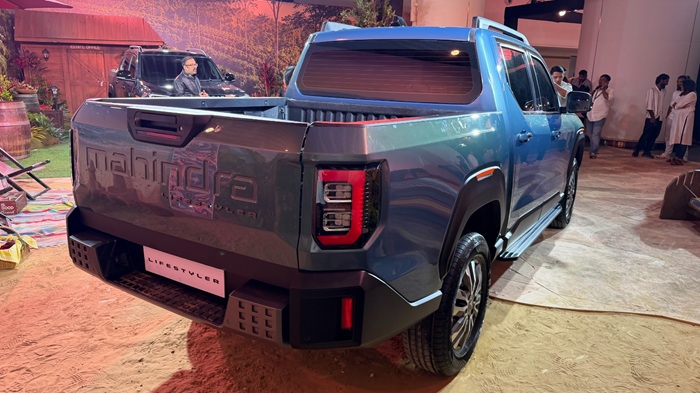
Three flavours of adventure
Mahindra plans three editions — Valley, Reef and Trail — each targeting a slightly different sort of buyer.
The Valley specification is intended for customers prioritising comfort and practicality, effectively serving as the more everyday end of the range. Think urban use, family touring and owners who like the rugged aesthetic but don’t necessarily begin Sunday morning by looking for somewhere to get stuck.
The Reef moves the focus towards customers interested in outdoor travel, making it the more recreational version. It should appeal to buyers for whom roof racks, camping equipment and a weekend disappearing into the countryside are genuine requirements rather than accessories added for Instagram.
Then comes Trail, intended for hardcore adventure enthusiasts. This is where the Lifestyler’s authentic capability ought to matter most. Mahindra has not supplied the complete production hardware list for each edition, so it would be premature to invent differential locks, specific terrain systems or off-road angles. But the positioning is clear: Trail is the one aimed at owners who regard a muddy track as an invitation rather than a warning.
It is easy to imagine existing Thar and Scorpio N customers being attracted to this truck. The Thar has helped normalise lifestyle-oriented off-road vehicles in India, while the Scorpio N has proved that rugged ladder-frame engineering need not come with agricultural cabin manners. The Lifestyler effectively extends those ideas into a larger, more versatile format.
The cabin is where Mahindra needs to get clever
Traditional pickups have often made an implicit bargain with their drivers: enjoy the capability outside and tolerate the plastics inside. That isn’t sufficient anymore, particularly once prices move north of ₹20 lakh and potentially into ₹30 lakh territory.
Mahindra therefore promises SUV-like comfort, and early interior details suggest the company understands that buyers expect a modern cabin rather than a glorified work truck.
The dashboard is expected to feature a wide, horizontally oriented infotainment display, an arrangement somewhat reminiscent of the Ford Ranger’s modern cabin philosophy, alongside a fully digital instrument cluster. Mahindra will also introduce its new flat-bottom steering wheel, giving the driving environment a distinctly contemporary appearance.
The irony of flat-bottom steering wheels in enormous pickups should never be ignored. The feature originally helped racing drivers clear their thighs while climbing into tiny competition cars; now it is equally likely to assist somebody manoeuvring a 5.3-metre Mahindra into a shopping-centre parking space. Progress comes in unexpected forms.
Even so, the direction is encouraging. A horizontally integrated screen can make a wide dashboard look more cohesive, while a proper digital cluster provides useful flexibility for navigation, vehicle information and four-wheel-drive displays if Mahindra chooses to exploit it properly.
What matters more will be the execution. The Scorpio N has already raised expectations for Mahindra interior design, and the Lifestyler cannot afford to feel dramatically cheaper simply because there is a cargo bed behind the cabin. Seat comfort, storage, switch quality, rear-seat space and overall fit and finish will matter enormously to buyers planning long-distance travel.
As a four-door pickup, rear-seat accommodation should also be treated seriously. Lifestyle-truck customers increasingly expect a machine to perform family duties Monday to Friday before pretending to be an expedition vehicle at the weekend. If rear passengers sit bolt upright merely because the vehicle has a load bed, the SUV-like comfort promise will be tested very quickly.
Familiar engines, potentially useful choices
Mahindra could offer the Lifestyler with a powertrain family broadly related to the three-engine strategy seen in the Scorpio N, although final production combinations have not yet been confirmed.
The most important option is expected to be a 2.2-litre, inline-four, common-rail direct-injection, all-aluminium mHawk diesel developing around 172 horsepower. Torque output is quoted at 370 Nm with the manual gearbox and 400 Nm with the automatic.
In a large pickup, the torque figure matters considerably more than bragging rights at a traffic signal. Four hundred Newton metres should provide the sort of muscular mid-range response necessary for overtaking with passengers and luggage aboard, climbing gradients and moving confidently when the load bed is actually being used for something heavier than a suitcase.
A claimed efficiency figure of around 14 km/l has been associated with this diesel, together with a 57-litre fuel tank. If those numbers carry over to production, it would theoretically give the Lifestyler useful touring legs, although real-world consumption will naturally depend heavily on load, drivetrain, traffic and driving style.
A second 2.2-litre inline-four mHawk diesel could offer a lower state of tune at approximately 130 horsepower and 300 Nm, with a claimed figure of around 15 km/l. Such an engine would make sense as a value-oriented choice for customers more interested in durability and utility than outright performance.
Then there is petrol power: Mahindra’s 2.0-litre inline-four turbocharged direct-injection mStallion engine, potentially producing around 200 horsepower, with 370 Nm in manual form and 380 Nm with the automatic transmission. The supplied average for this powertrain is around 12 km/l.
A 200-horsepower petrol pickup sounds rather appealing. It also sounds like something with the potential to develop a deeply personal relationship with its local fuel station. But for private buyers covering lower annual distances, the mStallion’s smoother, more eager character could make it the entertaining choice.
Again, these engine configurations remain expected rather than finally confirmed for every Lifestyler variant, so judgment must wait until Mahindra publishes the definitive production specification.
Rear-wheel drive when you want simplicity, four-wheel drive when you don’t
Mahindra intends to offer both rear-wheel drive and four-wheel drive.
That is an important distinction because not every pickup buyer needs a full 4×4 system. A rear-driven Lifestyler should be lighter, mechanically simpler and potentially more efficient, while remaining perfectly adequate for urban driving, highways and regular load carrying.
The 4WD version is where the truck’s global aspirations become more serious. Australia, South Africa, Latin America and the Middle East are markets in which pickups are routinely judged not by whether they look adventurous, but by whether they continue moving when the road has disappeared.
Mahindra has plenty of institutional experience with rugged drivetrains, and the combination of a body-on-frame chassis, diesel torque and four-wheel-drive availability gives the Lifestyler solid foundations. What we do not yet have are final production figures for approach, breakover and departure angles, water-wading depth, low-range gearing, differential locks, terrain modes or articulation, so declaring it an off-road champion now would be enthusiasm getting ahead of evidence.
Still, the ingredients are encouraging.
How should it drive?
Because the Lifestyler is not due to launch until April 2027, a definitive road-test verdict on ride, steering, braking and refinement would be premature. But its architecture and stated objectives tell us where Mahindra is aiming.
A ladder-frame pickup carrying one tonne requires robust rear suspension tuning. Historically, this is where pickups reveal their compromises: set the rear suspension up for heavy loads and the unladen ride can become busy and bouncy; soften it for family comfort and payload behaviour suffers.
Mahindra’s promise of SUV-like comfort therefore carries real weight. The benchmark is no longer an old commercial pickup. Buyers will compare the Lifestyler with sophisticated SUVs, particularly if the top model does indeed land near ₹30 lakh.
The sizeable 255/65 R18 tyres should help by putting a useful cushion of rubber between the wheel and the road. India’s broken surfaces reward sidewall more often than they reward oversized alloy wheels, so 18 inches seems like a sensible compromise for a vehicle with genuine utility ambitions.
Highway stability should benefit from the truck’s considerable footprint, although its length will inevitably make tight urban driving more demanding. The rear disc brakes are reassuring given the potential gross load and towing ability, while four-wheel-drive versions should offer additional traction away from paved surfaces.
The biggest question will be steering calibration. Mahindra needs enough weight and accuracy to make a large pickup feel secure at highway speed without turning every U-turn into a forearm workout. A 5.3-metre truck will never dance through traffic like a hatchback, but good steering can make the difference between feeling substantial and feeling like you’re captaining a small ferry.
Refinement will be equally important. Mahindra explicitly mentions refinement among the Lifestyler’s development priorities, alongside durability, safety, technology, style, capability and value. Diesel clatter, wind noise around the large mirrors and tyre noise from the substantial rubber will therefore deserve particular attention once production vehicles reach the road.
Why wait until 2027?
Mahindra’s decision to preview the truck well before its actual launch is deliberate. The company says it intends to spend roughly a year building category awareness, strengthening the necessary network and creating the right ownership experience before putting the Lifestyler on sale.
That makes sense because India remains a peculiar market for lifestyle pickups. SUVs sell in enormous numbers, but private pickups remain a much smaller niche. The customer first has to understand why a five-metre-plus vehicle with an exposed rear load bed might make sense when conventional SUVs already offer enclosed luggage space, easier parking and often superior rear-seat packaging.
Mahindra therefore has to sell not only the vehicle but the idea behind it.
The opportunity is considerable. Adventure tourism is growing, buyers increasingly spend SUV money on vehicles chosen as much for personality as necessity, and the Thar has demonstrated that Indians are perfectly willing to accept practical compromises when the emotional appeal is strong enough.
A pickup derived from the Scorpio N is therefore not as eccentric as it might have seemed a decade ago.
The global challenge
The international strategy may be even more important than India.
In markets such as Australia, New Zealand and South Africa, pickups operate in one of the industry’s toughest competitive environments. Buyers there understand towing weights, payloads, chassis behaviour and four-wheel-drive hardware with the forensic attention Indian enthusiasts often reserve for touchscreen size and claimed mileage.
The Lifestyler will therefore have to do more than look muscular.
Its 1,000 kg payload and 3,500 kg towing capability put the right numbers on the table, but global credibility will depend on durability, reliability, ride quality under varying loads, off-road performance and dealer support.
This is where Mahindra’s decision to design the truck to global engineering and safety standards becomes significant. The company wants the Lifestyler to feel like an internationally competitive product rather than an Indian-market derivative exported because somebody found spare space on a ship.
The fact that it may be sold simply as the Mahindra Lifestyler in several countries reinforces that intention. It needs to function as a stand-alone global nameplate.
Safety cannot be an afterthought
Mahindra has stated that global safety standards form part of the Lifestyler’s development programme, which is encouraging considering the performance expected of a modern double-cab pickup.
However, detailed production safety specifications — including the final number of airbags, ADAS functionality, ESC configuration, camera systems and any independent crash-test result — have not been supplied yet. No Bharat NCAP, Global NCAP or other crash rating should therefore be assumed at this stage.
What matters is that Mahindra now operates in a market where safety is increasingly a purchasing factor rather than an optional paragraph near the back of a brochure. A global pickup expected to carry families, tow 3.5 tonnes and travel in demanding environments will need a comprehensive safety package to match its ambitions.
The final production specification will tell us whether Mahindra has delivered on that promise.
The price could make or break it
The proposed starting point of ₹19.79 lakh ex-showroom is arguably one of the Lifestyler’s most interesting numbers.
At that level, it could provide an unusually accessible path into a serious double-cab lifestyle pickup, particularly if Mahindra can combine respectable equipment with proper mechanical capability.
The problem begins as you climb the range.
If the flagship reaches the expected ₹30–32 lakh region, customers will naturally become much more demanding. At ₹20 lakh, a few utilitarian surfaces can be defended as ruggedness. Near ₹32 lakh, the same plastic suddenly requires a lengthy explanation.
Mahindra will have to ensure that higher-spec models feel appropriately premium in their cabin presentation, technology, seat comfort and refinement. Fortunately, the company’s recent SUVs show that it understands the importance of perceived value better than it once did.
The three-edition strategy should help. A comparatively sensible Valley version can focus on practical value, while Reef and Trail models can justify higher prices through lifestyle and capability-oriented equipment.
A very different alternative to an SUV
The Lifestyler’s most obvious rival may not actually be another pickup. For many Indian customers, the real question will be whether to buy this or a conventional premium SUV.
An SUV offers an enclosed boot, more manageable dimensions and usually better second-row and luggage integration. A pickup counters with versatility. Dirty camping equipment, bicycles, tools, muddy recovery gear or bulky recreational kit can simply be thrown into a cargo bed without asking the beige boot carpet for permission.
That freedom is part of the lifestyle-pickup appeal.
Mahindra also has a useful advantage through its established SUV customer base. Someone upgrading from a Thar or Scorpio N already understands the brand’s rugged personality and may see the Lifestyler as a logical next step rather than an entirely alien form of transport.
The disadvantage is obvious every time you visit a crowded market. Five-point-three metres of pickup will not suddenly become compact because the parking attendant whistles confidently enough.
Verdict
The Mahindra Scorpio Lifestyler could become one of the most interesting vehicles in Mahindra’s expanding global portfolio because it isn’t merely trying to revive the old Scorpio Getaway. It is attempting something considerably more ambitious: creating an Indian-engineered, globally relevant lifestyle pickup that can combine the character of a Scorpio N with genuine working ability.
The fundamentals are promising. A next-generation body-on-frame chassis, rear- and four-wheel-drive layouts, up to 1,000 kg of payload, 3,500 kg towing capacity, muscular petrol and diesel engines, four-door practicality and an SUV-inspired digital cabin give it a credible technical foundation. The Valley, Reef and Trail editions also recognise that the person carrying camping equipment and the person deliberately driving through axle-deep mud are not necessarily the same customer.
There are questions still unanswered. At roughly 5.3 metres long, urban manoeuvrability will require commitment. The final top-end price could approach ₹30–32 lakh. We still need confirmed production equipment, complete off-road specifications, crash-test results and, most importantly, actual experience of how Mahindra has balanced one-tonne load-carrying ability with its promise of SUV-like ride comfort.
That last point will determine whether the Lifestyler becomes merely an impressive specification sheet or a genuinely convincing daily vehicle.
But perhaps the strongest thing about it is that the concept no longer feels implausible. Mahindra has spent years building the Scorpio into a cultural institution and the Thar into a lifestyle product. A global pickup sits neatly at the intersection of those two worlds.
For the traditional family-SUV buyer, the Scorpio N will remain easier to live with. For someone who never leaves the city and regards a speed breaker as off-roading, a 5.3-metre pickup is spectacular overkill. But for buyers who actually travel, tow, camp, explore, carry large equipment or simply want their next Mahindra to have substantially more presence than the neighbour’s SUV, the Lifestyler makes an increasingly persuasive case.
The old Scorpio Getaway was essentially a tough pickup derived from an SUV. The new Lifestyler wants to be something broader: part workhorse, part expedition vehicle, part family machine and part oversized declaration that your weekend plans probably involve leaving the tarmac.
If Mahindra gets the ride quality, cabin finish, four-wheel-drive hardware and pricing right when it arrives in April 2027, India may finally have a home-grown lifestyle pickup capable of being taken as seriously in Australia or South Africa as it is outside a café in Gurugram.
And if nothing else, owners will never again have to worry about whether they bought the biggest vehicle in the office parking lot.