The facelifted Hyundai Exter arrives with sharper styling, more technology, improved practicality and the familiar 1.2-litre petrol engine. But does this feature-packed little crossover have enough substance to justify its SUV ambitions? We take a detailed look at the range-topping HX10 AMT.
There was a time when buying an affordable car in India meant accepting a fairly straightforward proposition: four wheels, an engine, air conditioning if the budget allowed, and perhaps a music system that wasn’t purchased separately from a shop down the road. Those days are long gone. Today, even the smallest cars want to look like SUVs, behave like premium hatchbacks and offer enough technology to make a smartphone feel slightly underqualified. The Hyundai Exter sits right in the middle of this transformation. It is small enough to squeeze through crowded Indian streets, tall enough to offer the driving position people increasingly associate with SUVs, and sufficiently well-equipped to make considerably more expensive cars look rather modest.
Introduced in India in 2023, the Exter was Hyundai’s response to a market that had developed an extraordinary appetite for compact, rugged-looking vehicles. Three years later, the 2026 model receives its first significant facelift, bringing refreshed styling, an updated cabin, additional convenience features and a stronger safety package. Crucially, Hyundai hasn’t attempted to reinvent a successful formula. The mechanical foundations remain largely unchanged, which is probably sensible when more than two lakh Indian customers have already bought into the Exter’s particular interpretation of affordable motoring.
Its popularity is hardly accidental. The Exter was crowned the 2024 Indian Car of the Year, one of the country’s most recognised automotive awards, and has established itself as an appealing alternative to traditional hatchbacks. It offers much of the accessibility of a Hyundai Grand i10 Nios but adds an upright silhouette, crossover styling and a more adventurous personality. Whether it is genuinely an SUV is a debate best left to people with considerable spare time. What matters is whether it makes everyday driving easier, more comfortable and more enjoyable.
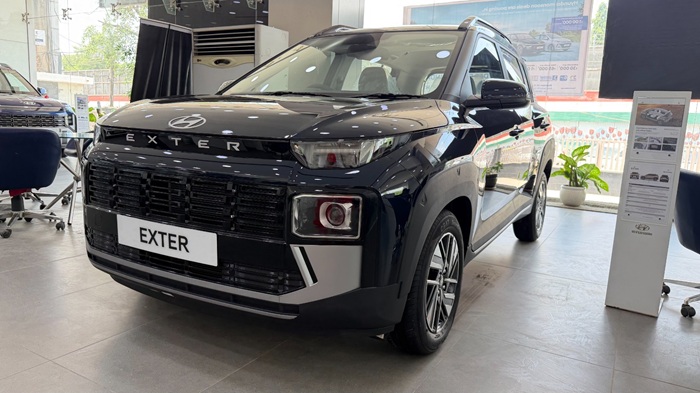
The model under consideration is the range-topping Hyundai Exter HX10, equipped with the Smart Auto AMT transmission and finished in Starry Night blue. It is the most comprehensively equipped expression of the facelifted Exter, with features including a sunroof, connected-car technology, wireless phone charging and a generous collection of electronic conveniences.
A Familiar Foundation with a Fresh Identity
Internally identified by the codename AI3 CUV, the Exter is built around Hyundai-Kia’s K1 platform architecture. Its family connections extend to vehicles including the Santro, Grand i10 Nios, Aura and the international-market Hyundai Casper, while evolved versions of the architecture also underpin the newer Hyundai Venue and Kia Syros. These are very different vehicles in appearance and character, but they demonstrate the flexibility of Hyundai Motor Group’s small-car engineering.
The Exter was designed by Cho-hee Park, whose work is also associated with the Hyundai Verna. That connection is interesting because the two vehicles approach styling from almost opposite directions. The Verna adopts a low, futuristic and overtly aerodynamic appearance, while the Exter is deliberately upright and angular. It is evidence that modern Hyundai design is less about forcing every model into an identical shape and more about giving individual products their own visual character.
The facelifted Exter was introduced in March 2026 with an ex-showroom starting price of ₹5.80 lakh. The HX10 petrol AMT, priced at ₹9,41,900 at launch, represents the opposite end of the range. Between these extremes, Hyundai offers the HX2, HX3, HX4, HX4+, HX6, HX8 and HX10 trim designations across the available petrol and CNG combinations.
Buyers can choose between petrol and petrol-CNG powertrains, although transmission availability depends on the fuel. The regular petrol engine can be paired with either a five-speed manual gearbox or Hyundai’s five-speed Smart Auto AMT, while the CNG version is exclusively manual.
The resulting range caters to two quite different audiences. There is the budget-conscious customer who wants affordable family transport with low running costs, and the buyer willing to approach the ₹10 lakh mark in pursuit of convenience, technology and equipment. The HX10 is clearly aimed at the latter.
Exterior Design: A Small Car with a Serious Expression
The Exter has never been particularly interested in looking delicate. Its styling is dominated by upright surfaces, squared-off proportions and the sort of decorative ruggedness that makes a suburban shopping trip seem vaguely adventurous. The facelift builds on that personality without altering the underlying silhouette.
At the front, the redesigned bumper introduces a more substantial appearance, supported by a new black radiator grille and revised detailing. The combination gives the Exter a slightly broader visual stance, even though its dimensions remain firmly within the city-car category. The bonnet is relatively high and flat, creating the impression of a larger vehicle when viewed from the driver’s seat.
Perhaps the most recognisable styling feature remains the H-shaped LED daytime running lights. They provide the Exter with an immediately identifiable face, particularly after dark. The automatic bi-projector headlamps sit below, incorporating an escort function that keeps the lights illuminated briefly after the vehicle has been switched off. It is a small convenience, but one that becomes surprisingly useful when returning home to a poorly illuminated parking area.
The black grille and substantial bumper treatment lend the front end a confident appearance, although the Exter’s assertiveness is understandably limited by its dimensions. This is not a miniature Land Cruiser, whatever the marketing department might wish you to imagine. It is a compact urban crossover dressed for the occasional encounter with a gravel driveway.
Move around to the side and the Exter’s proportions become clearer. At approximately 3.8 metres long, 1.7 metres wide and 1.6 metres tall, it occupies a relatively modest amount of road space. More precisely, its dimensions are around 3,815 mm in length, 1,710 mm in width and 1,631 mm in height, with a wheelbase of approximately 2,450 mm.
The tall roof and relatively upright glasshouse give it an unmistakably practical silhouette. Unlike many crossovers that sacrifice rear headroom in pursuit of a fashionable sloping roofline, the Exter prioritises usable interior space. It is a sensible decision, particularly in a country where family cars are frequently expected to accommodate five people and their luggage without much warning.
Black wheel-arch cladding provides visual muscle while offering some protection against everyday scratches. The electrically adjustable and folding outside mirrors incorporate LED turn indicators, adding a touch of sophistication to what is otherwise a fairly conventional arrangement.
The facelift introduces redesigned 15-inch diamond-cut alloy wheels, which are among its most attractive exterior details. Their geometric pattern complements the Exter’s angular bodywork without becoming unnecessarily elaborate. More affordable variants are available with steel wheels, while the Knight Edition takes the sportier approach of adding red front brake calipers.
The HX10 rides on 175/65 R15 84H CEAT SecuraDrive radial tubeless tyres at both ends. They are sensibly sized for a car of this nature, with sufficient sidewall height to provide a degree of cushioning over damaged surfaces. Huge wheels might look impressive in advertising photographs, but a modest tyre profile often makes considerably more sense when confronted with India’s unpredictable road surfaces.
With ground clearance of approximately 185 mm, the Exter also offers useful separation between its underside and the road. It is sufficient for tackling many ordinary speed breakers, uneven approaches and broken urban surfaces, although careful driving remains necessary. Ground clearance is not an invitation to drive as though every pothole were a minor geological inconvenience.
The Starry Night blue finish on this HX10 suits the Exter particularly well. It gives the compact body a mature appearance without disguising its youthful character. Other available colours include Golden Bronze, Titan Grey, Atlas White, Ranger Khaki and Titanium Black Matte, alongside Titanium Black. Customers looking for a contrasting roof can choose the Ranger Khaki and black dual-tone combination.
At the rear, the changes are equally restrained. A revised bumper with skid-plate-inspired detailing gives the Exter a slightly tougher appearance, while the updated wing-type roof spoiler adds some visual interest. The LED tail lamps retain the distinctive geometric character established at the front, maintaining consistency across the design.
There is also a rear windscreen defogger, plus a wiper and washer combination. These are particularly useful additions in monsoon conditions, when a clean rear window is worth considerably more than another piece of decorative chrome. The emergency stop signal provides an additional visual warning during sudden braking.
Overall, the Exter’s design works because it embraces its compact dimensions rather than attempting to conceal them. It looks cheerful, slightly cheeky and appropriately substantial for its purpose. Not everyone will appreciate the squared-off styling, but it certainly avoids being anonymous.
Cabin and Practicality: Where the Exter Makes Its Strongest Argument
Open the door and the Exter’s priorities become obvious. This is a car designed to make the driver feel comfortable with its controls, rather than force them to learn an entirely new operating system before leaving the driveway.
The upright cabin architecture makes entry and exit relatively straightforward, while the tall seating position provides a useful view of the road ahead. The driver’s seat includes height adjustment, allowing occupants to find a more suitable position behind the wheel. Combined with the substantial glass area and compact exterior dimensions, the arrangement makes the Exter particularly approachable for inexperienced drivers.
The facelift introduces a more contemporary dual-tone Navy and Grey interior theme, replacing some of the visual austerity associated with the original model. A new 3D carbon-pattern finish across the dashboard adds texture, although nobody is likely to mistake it for genuine carbon fibre. At this price, that would be an unreasonable expectation anyway.
Material quality is consistent with the Exter’s affordable positioning. The emphasis is on durability, tidy assembly and visual variety rather than expensive soft-touch surfaces. There are still hard plastics around the cabin, particularly in less prominent areas, but the overall layout is logical and the major controls are placed conveniently.
One welcome addition is the redesigned D-cut steering wheel, finished in leatherette. It gives the driver’s environment a slightly sportier character and incorporates controls for phone functions, audio volume, infotainment, voice commands and cruise control. The flat-bottom styling is unlikely to improve your cornering speeds, but it does help the interior feel more contemporary.
Behind the steering wheel sits a digital instrument cluster accompanied by a TFT multi-information display. Rather than offering unnecessary visual theatrics, its main responsibility is to present essential driving information clearly. Speed, vehicle data and trip-related information are easy to access, while the steering-mounted controls reduce the need to reach across the dashboard.
The seats receive new semi-fabric upholstery, with full-fabric options elsewhere in the range. The material choices are practical for Indian conditions, where summer heat can make leatherette upholstery feel less luxurious than its appearance suggests. The cushioning and seat shape are suitable for everyday use, although earlier Exter road tests have found the seats somewhat firm during longer journeys.
The new folding driver’s armrest is another modest but meaningful addition. On a car likely to spend much of its life crawling through city traffic, somewhere comfortable to rest an elbow is hardly a luxury. The driver’s power window also gets an automatic down function.
The centre console houses the AMT gear selector, complete with a leatherette gear knob, while metallic pedals add an unexpected touch of sportiness. The combination is slightly amusing in a car with a modest naturally aspirated engine, but there is no harm in giving everyday transport a little personality.
The eight-inch HD touchscreen infotainment system forms the centrepiece of the dashboard. It supports navigation, over-the-air updates, Bluetooth connectivity, USB functions, FM radio, Apple CarPlay and Android Auto. The HX10’s wireless smartphone integration uses a wired-to-wireless adapter arrangement rather than an entirely native wireless system.
The screen is reasonably sized for a car in this category. It provides the connectivity most buyers genuinely use without turning the dashboard into a wall of illuminated glass. In an era when manufacturers appear to compete over who can install the largest television in a moving vehicle, a properly integrated eight-inch display feels refreshingly proportionate.
The infotainment system also supports an extensive library of embedded voice commands, with approximately 300 functions listed. Voice operation can be convenient when it works reliably, especially for simple tasks that would otherwise require taking a hand off the steering wheel.
Hyundai’s Bluelink connected-car technology expands the functionality further. Through a compatible smartphone application, owners can access connected services and vehicle-related information, while Alexa home-to-car integration adds another layer of convenience. It is useful technology for people who enjoy having their car integrated into their digital routines, although the fundamental driving experience remains perfectly understandable without it.
The wireless phone charger eliminates one of the daily irritations of modern motoring: cables trailing across the centre console. There are also USB charging provisions, including a rear Type-C connection, which should help reduce arguments among passengers over whose phone deserves electricity first.
The fully automatic temperature control system is another welcome inclusion. In India’s climate, dependable air conditioning is considerably more important than most decorative features, and the Exter treats it accordingly. A cooled glovebox adds further practicality, offering a suitable place to keep small items cooler during journeys.
Footwell lighting adds a little atmosphere after dark, while the electric sunroof provides the feature that many Indian buyers now regard as an essential symbol of automotive progress. Its actual usefulness depends on weather conditions and personal preference, but it certainly makes the cabin feel more airy and premium.
An interior rear-view mirror with day-and-night adjustment is provided, alongside telematics switches for SOS assistance, roadside assistance and Bluelink functions. These controls have a more serious purpose than the decorative features, allowing access to assistance when needed.
Rear-seat accommodation benefits from the Exter’s tall roofline and upright proportions. Headroom is one of its more encouraging qualities, and the relatively long wheelbase for such a small vehicle helps make reasonable use of available cabin space.
There is, however, an important limitation. The Exter is a relatively narrow car, and accommodating three adults across the rear bench is not its strongest talent. Two adults should find the arrangement more comfortable, while three passengers are better considered an occasional necessity rather than the ideal long-distance configuration.
The available knee room is respectable for the vehicle’s footprint, although buyers who regularly carry particularly tall rear passengers should compare the Exter directly with larger alternatives.
Boot capacity is a notable strength. The petrol version offers 391 litres of luggage space, a generous figure for something this compact. It is enough to make the Exter genuinely useful for shopping trips, airport runs and weekend journeys with a small family.
The CNG version provides 225 litres of boot space, helped by its dual-cylinder arrangement and underbody spare-wheel packaging. While that is a substantial reduction compared with the petrol model, it remains useful by the standards of many CNG-powered small cars.
A 14-inch steel spare wheel is included, an important detail in a country where a puncture can occur a considerable distance from the nearest tyre shop. It might not be glamorous, but practical equipment rarely needs to be.
Engine and Performance: An Old-School Approach That Still Makes Sense
Beneath the bonnet is Hyundai’s familiar 1.2-litre Kappa II naturally aspirated petrol engine. Displacing approximately 1,200 cc, it uses an inline four-cylinder configuration and develops around 81 hp and 113 Nm of torque.
There is no turbocharger, no complex hybrid system and no attempt to manufacture dramatic performance from an exceptionally small engine. Instead, the Exter relies on an established mechanical package that prioritises smoothness, predictable throttle response and everyday usability.
Versions of Hyundai’s Kappa petrol engine family have also been employed in the Grand i10 Nios, Aura, i20 and Venue, giving the Exter access to an extensively used powertrain architecture.
Its four-cylinder layout is particularly relevant in this price category, where three-cylinder engines are common. Four cylinders do not automatically guarantee refinement, but Hyundai’s familiar 1.2-litre unit has earned a reputation for smooth and relatively quiet operation at ordinary engine speeds.
For urban driving, the modest power output is less of a problem than the figures might suggest. The engine’s predictable response makes it well suited to gradual acceleration, stop-start traffic and routine journeys. It does not deliver a sudden surge of torque, but neither does it require the driver to manage turbo lag.
The five-speed Smart Auto AMT fitted to the HX10 is a convenience-oriented transmission rather than a performance automatic. Mechanically, it is based on a manual gearbox, with the clutch and gear changes operated automatically. That keeps complexity and cost relatively low, although it also introduces the characteristic pauses associated with automated manual transmissions.
In everyday traffic, the ability to leave clutch operation to the car is a considerable advantage. The gearbox suits relaxed driving, particularly when the driver uses smooth throttle inputs and allows it time to complete its shifts.
Push harder, however, and the limitations become clearer. An AMT cannot reproduce the seamless operation of a conventional torque-converter automatic or the rapid shifts of a sophisticated dual-clutch transmission. During urgent acceleration, the brief interruption in power delivery can make progress feel less polished.
The Exter’s gearbox therefore rewards a little patience. It is designed to reduce the effort of commuting rather than deliver sporting satisfaction.
The manual version offers a more direct connection between the driver and the engine. Buyers who regularly travel through hilly regions or prefer complete control over gear selection may find it more satisfying, although the convenience advantage of the AMT is difficult to ignore in congested cities.
On the open road, the Exter’s 1.2-litre engine is capable of maintaining ordinary highway cruising speeds, but overtaking requires more anticipation than it would in a turbocharged rival. With several passengers and luggage on board, the engine needs to work harder, especially on inclines.
There is enough performance for sensible motoring, but little surplus power for enthusiastic driving. Accelerating rapidly from moderate highway speeds may require the gearbox to select a lower ratio, accompanied by the familiar rise in engine noise.
The engine is generally at its happiest when driven smoothly rather than aggressively. Its appeal lies in refinement and accessibility, not outright speed.
Hyundai has not provided a verified 0–100 km/h acceleration figure or top-speed measurement in the information considered here, so quoting precise performance numbers would serve little purpose. The Exter is not a car whose character is best explained with a stopwatch.
What About the CNG?
The alternative powertrain uses the same basic 1.2-litre, inline four-cylinder Kappa II engine configured for petrol and CNG operation. Running on CNG, output falls to approximately 67 hp and 95 Nm of torque.
That reduction is noticeable on paper and should be considered by customers who frequently drive fully loaded or encounter steep gradients. The CNG version is intended primarily for economical transportation rather than spirited acceleration.
A five-speed manual transmission is the only gearbox option for the CNG model. The dual-fuel arrangement includes a 37-litre petrol tank and CNG cylinder capacity of approximately 60 litres, giving owners the flexibility to use petrol when CNG refuelling facilities are unavailable.
The HX10 AMT, however, remains the more attractive option for buyers prioritising convenience over the lowest possible running costs.
Ride and Handling: Built for the Reality of Indian Roads
The Exter uses a fairly conventional suspension arrangement, with MacPherson struts and coil springs at the front and a coupled torsion-beam axle with coil springs at the rear. It is a common layout in compact front-wheel-drive cars, offering a sensible balance between packaging efficiency, cost and predictable handling.
The facelift retains the established mechanical setup, so the original Exter’s road-test characteristics remain a useful guide. Earlier evaluations have praised its easy manoeuvrability and generally composed response to individual bumps, while also identifying a firmer, sometimes unsettled ride over repeated road imperfections.
That combination makes sense for a tall, relatively short vehicle. There is enough suspension compliance to handle ordinary potholes and uneven surfaces, but the chassis cannot completely disguise sharp impacts or continuous broken tarmac.
At low speeds, the compact dimensions and light steering are valuable assets. Navigating narrow streets, making tight turns and positioning the car in crowded parking areas should be relatively straightforward. Compared with larger SUVs, the Exter places far fewer demands on the driver when space becomes limited.
The steering is tuned primarily for convenience rather than detailed feedback. It provides manageable effort at parking speeds and sufficient directional control for normal driving, but this is not a car intended to communicate every change in road surface through the steering wheel.
Around corners, its tall body inevitably introduces some movement. The Exter is not excessively cumbersome, but neither does it invite the driver to explore the limits of available grip. Smooth steering inputs and measured speeds suit its character.
The 175-section tyres provide an appropriate compromise between rolling efficiency, ride comfort and grip for the performance available. Their modest width also reinforces the vehicle’s practical priorities.
Highway stability is respectable within the car’s intended operating envelope, although earlier road tests have noted a tendency towards vertical movement or bounce over uneven surfaces at higher speeds. With a full complement of passengers, this characteristic may become more noticeable.
Noise, vibration and harshness are generally well managed at gentle engine speeds, benefiting from the refinement of the four-cylinder powerplant. Under hard acceleration, however, engine noise naturally becomes more prominent as the relatively modest motor works to deliver the requested performance.
Braking is handled by discs at the front and drums at the rear, supported by electronic braking systems. This is an entirely conventional arrangement for a small, affordable crossover. The hardware is appropriate for its performance requirements, although braking feel and stopping distances cannot be judged definitively without an instrumented test.
Despite the rugged exterior, the Exter is emphatically not an off-road vehicle. It uses front-wheel drive and does not offer a low-range transfer case, locking differentials or a specialised four-wheel-drive system.
Its additional ground clearance can be useful on rough tracks and damaged roads, but serious off-roading, deep water crossings and heavily rutted terrain fall outside its remit. The Exter can handle the occasional imperfect road; it is not designed to conquer the Himalayas before breakfast.
Fuel Efficiency: Sensible Numbers, with Familiar Reservations
The petrol Exter carries a claimed fuel-efficiency figure of approximately 19 km/l, while the CNG model is rated at around 27 km/kg. Both figures highlight the vehicle’s emphasis on affordable running costs.
With a 37-litre petrol tank, the standard version offers a useful theoretical driving range. Real-world consumption, however, will depend heavily on traffic conditions, driving style, vehicle load and air-conditioning use.
Independent tests of the earlier, mechanically similar Exter have shown that actual city fuel economy can fall substantially below the claimed figure, particularly in demanding hot-weather conditions. Buyers should therefore treat the official mileage as a reference point rather than a guaranteed daily result.
The CNG variant has the potential to deliver significantly lower fuel expenditure where CNG is competitively priced and readily available. That advantage must be weighed against reduced power, the manual-only transmission and the smaller luggage compartment.
For someone covering substantial daily distances, those compromises may be entirely worthwhile. For a buyer with shorter commutes who values convenience, the petrol AMT remains a compelling alternative.
Safety: More Substance Than the Dimensions Suggest
Safety equipment is an important part of the Exter’s appeal. The 2026 facelift strengthens the package with six airbags, electronic stability control and hill-start assist included as standard equipment across the range.
Six airbags provide frontal and side-impact protection provisions, while ABS and electronic brakeforce distribution help maintain braking control in demanding conditions. Electronic stability control and vehicle stability management provide additional assistance when the vehicle begins to deviate from its intended path.
Traction management and hill-start assistance are particularly relevant in wet conditions and on inclined roads. The latter reduces the risk of rolling backwards when moving away from a standstill on a slope.
The broader equipment package includes a highline tyre-pressure monitoring system, seatbelt reminders, three-point seatbelts and ISOFIX child-seat anchorages. These are important provisions for a car intended to serve as everyday family transport.
Parking assistance is provided through rear sensors and a rear-view camera, with additional driver rear-view monitoring functionality. Considering the Exter’s compact dimensions, these systems should make it easier to manoeuvre in confined spaces and avoid low-level obstacles.
A dashboard camera is another useful feature, particularly in unpredictable urban traffic. It can provide recorded evidence in the event of an incident and is more practically relevant than many cosmetic accessories fitted to modern cars.
Additional security and convenience equipment includes central locking, speed-sensing automatic door locking, impact-sensing door unlocking, an engine immobiliser, burglar alarm and keyless entry.
Taken together, these features form a reassuringly comprehensive package for an affordable vehicle. Nevertheless, the presence of electronic safety equipment should not be confused with a verified independent crash-test result. A specific Bharat NCAP or Global NCAP rating for this facelift has not been established in the material used for this review, and no rating should be assumed.
Safety is strongest when protective equipment, structural performance and responsible driving work together.
Ownership: Hyundai’s Familiar Strength
One of the Exter’s less glamorous but potentially most persuasive advantages is the ownership proposition.
Hyundai provides a three-year, unlimited-kilometre standard warranty, with extended coverage options available up to seven years or 1.40 lakh km, subject to the selected programme’s terms. Three years of roadside assistance is also included.
For customers buying their first car, such support can be particularly reassuring. The availability of extended protection also helps buyers plan their ownership expenses over a longer period.
Hyundai’s established Indian dealership and service network adds another dimension to the appeal. A relatively familiar, naturally aspirated petrol engine and conventional gearbox options should also be attractive to customers who prioritise predictable maintenance over mechanical sophistication.
That said, service costs, insurance premiums and resale values depend on the chosen variant, location and usage. They should be checked individually rather than assumed from the brand’s reputation.
The Exter’s presence in export markets further illustrates Hyundai’s intention to treat it as more than a narrowly targeted domestic product, although Indian buyers will understandably be more interested in local service support and parts availability.
Competition: Plenty of Alternatives, Very Different Priorities
The Exter faces serious competition in India, beginning with the Tata Punch. The Punch offers a similarly upright appearance and, following its 2026 facelift, a broader choice of powertrains, including a turbo-petrol option. Buyers seeking stronger acceleration or additional high-end technology may find it more appealing. The Hyundai counters with its smooth four-cylinder petrol engine, user-friendly driving manners and thoughtfully packaged cabin.
The Nissan Magnite and Renault Kiger occupy a slightly different position. Both offer larger exterior footprints and turbo-petrol alternatives, which may be more attractive for buyers who regularly undertake highway journeys. The Kiger also offers a particularly generous boot, while the Magnite presents a strong value argument. The Exter’s main defence is that it feels less cumbersome in crowded urban environments and places considerable emphasis on convenience equipment.
The Maruti Suzuki Fronx is another alternative worth examining. Its more streamlined crossover design, larger footprint and available turbo-petrol engine give it a different personality. It may better suit buyers who want something with a sportier road presence and stronger performance, while the Exter’s upright shape and compact dimensions offer practical advantages in urban use.
There is also the Citroën C3, which appeals to buyers who value ride comfort and a distinctive, less conventional approach to small-car design. However, differences in equipment, dealer accessibility and powertrain availability may influence the final decision.
The most difficult question for the HX10 comes from within the wider market rather than any one specific rival. At an ex-showroom price approaching ₹9.5 lakh at launch, buyers can begin considering lower or mid-level variants of larger vehicles. Those alternatives may offer greater space, stronger engines or a more substantial feel.
The Exter answers by delivering a high level of equipment within a smaller, easier-to-manage package. Whether that is the better use of the money depends on how much importance the customer places on features versus physical size.
Verdict: The Art of Being Small Without Feeling Basic
The 2026 Hyundai Exter HX10 is a reminder that an enjoyable everyday car does not necessarily need enormous power, complicated engineering or a price tag capable of causing financial distress.
Its appeal comes from the way its individual qualities work together. The upright styling gives it a distinctive personality, the compact proportions make it easy to manoeuvre, the 391-litre petrol boot adds useful practicality and the well-equipped interior makes the daily commute more pleasant. The familiar four-cylinder petrol engine provides a degree of refinement that suits the vehicle’s relaxed character.
The facelift improves the package in meaningful areas without interfering with what made the original successful. Revised exterior detailing gives it a fresher appearance, while the updated dashboard, folding armrest, enhanced connectivity and additional safety equipment contribute more to everyday satisfaction than any dramatic styling exercise would have done.
There are compromises, of course. The naturally aspirated engine lacks the effortless mid-range performance of turbocharged alternatives, the AMT gearbox cannot match the smoothness of more sophisticated automatics, and the narrow rear bench limits comfort for three adults. Ride quality over repeatedly broken surfaces can also be less settled than ideal.
Then there is the price. The HX10 offers an impressive amount of equipment, but approaching the ₹10 lakh ex-showroom territory inevitably invites comparisons with larger and more powerful alternatives. Customers who frequently travel fully loaded, spend considerable time on highways or prioritise driving excitement should explore those options carefully.
For urban families, first-time buyers, commuters and anyone seeking a compact automatic with a generous list of conveniences, however, the Exter makes a persuasive case. The petrol AMT is particularly suited to congested cities, while the CNG manual provides an economical option for those with substantial daily mileage.
The Exter’s greatest strength is that it understands the realities of Indian motoring. Most journeys do not involve mountain trails, high-speed corners or heroic acceleration figures. They involve office commutes, school runs, crowded markets, unpredictable potholes, narrow parking spaces and the occasional family trip with more luggage than initially agreed.
The Exter is designed around precisely those circumstances.
It may wear the styling of an SUV, but beneath the squared-off bodywork lies something arguably more useful: a well-packaged, accessible and thoughtfully equipped small car that knows where its priorities should be.
The Hyundai Exter doesn’t pretend to be the most exciting vehicle in its class, and that is precisely why it makes sense. It brings a little theatre to ordinary driving without allowing that theatre to interfere with everyday practicality. Sometimes the smartest car isn’t the one that promises to take you anywhere. It’s the one that makes getting everywhere you actually need to go considerably easier.