
The third-generation Audi Q3 arrives in India with sharper styling, sophisticated lighting technology, a luxurious digital cabin and a 201 hp turbocharged petrol engine. But at ₹56 lakh for the flagship Zenith variant, can Audi’s smallest SUV deliver a sufficiently big luxury experience?
There is something rather appealing about a luxury SUV that doesn’t feel obliged to occupy half the road to establish its importance. The 2026 Audi Q3 is precisely that sort of machine. It offers the design language, technology and premium aspirations of Audi’s larger SUVs in a package that remains manageable in Indian traffic. Following the discontinuation of the Q2, the Q3 is now the smallest SUV in Audi’s Indian portfolio, although there is very little entry-level about its ambitions, equipment or pricing. This third-generation model is more sophisticated, more digitally focused and visually more assertive than its predecessors. It also arrives in a market where a premium badge alone is no longer enough to justify an expensive purchase.
The Q3 has been part of Audi’s global portfolio since 2011, when the original model established itself as an accessible route into the German manufacturer’s expanding SUV family. Fifteen years later, the third-generation version has grown into a substantially more mature proposition. Internally identified by the codename Typ FJ, the latest Q3 takes inspiration from the third-generation Audi Q5, adopting a more confident interpretation of the company’s contemporary SUV design language. It is a familiar formula, but one that has become increasingly important as buyers expect compact luxury cars to offer the same visual drama and technological sophistication as much larger machines.
The exterior was designed by Ramon Sellers and Seulah Park, and their work reflects Audi’s continuing preference for precise surfacing, structured proportions and instantly recognisable lighting signatures. The latest Q3 doesn’t attempt to reinvent what an Audi SUV should look like. Instead, it refines the established identity with bolder detailing and a more contemporary expression. Think of it as the familiar Audi suit, only with sharper tailoring and rather more expensive electronic accessories.
Underneath, the Q3 is based on the Volkswagen Group’s Modular Transversal Toolkit, specifically the MQB Evo architecture. This forms part of the broader MQB family of transverse-engine platforms, a modular engineering strategy associated with an extensive range of vehicles across the Volkswagen Group. That wider family includes models such as the Audi A3 and Q6, Cupra Formentor, Jetta VS8, Škoda Superb, Octavia and Kodiaq, SEAT Leon, Volkswagen Atlas, Caddy, Golf, T-Roc, Tayron, Tiguan, Tavendor, Multivan and Passat. Not every vehicle uses an identical platform specification, but the shared architectural philosophy allows different brands to develop distinct products around common engineering principles.
For the Q3, the result is a compact crossover intended to balance interior packaging, structural sophistication, road manners and manufacturing efficiency. Assembly operations for the model span India, Hungary and China, reflecting its importance beyond the European market.
Its Indian history is significant, too. Audi has sold more than 26,000 examples of the Q3 in India since its introduction, helping establish the nameplate among buyers seeking a practical German luxury SUV without committing to the dimensions or cost of a larger Q5 or Q7. Audi has also sold more than 55,000 quattro-equipped vehicles in the country, an indication of how strongly its all-wheel-drive branding has become associated with the company’s premium identity.
Price and Positioning: Premium Doesn’t Come Cheap
The third-generation Audi Q3 is offered in India exclusively with a petrol engine, across two variants. The entry-level Nova carries an ex-showroom price of ₹52 lakh, while the higher-specification Zenith costs ₹56 lakh. The vehicle featured here is the range-topping Audi Q3 Zenith, representing the most comprehensively equipped version currently offered to Indian customers.
That ₹4 lakh difference places considerable expectations on the flagship model. Buyers at this price are entitled to demand much more than attractive alloy wheels and an additional screen. Fortunately, the Zenith’s equipment includes advanced digital lighting, a sophisticated display arrangement, extensive comfort features and several technologies intended to make daily driving easier.
Internationally, the Q3 family is more extensive. Audi offers the sportier Sportback coupé-style body, diesel engines and plug-in hybrid powertrains in certain markets. Higher equipment and styling specifications, including S Line, Black Edition and Vorsprung, are also part of the wider Q3 range, but these have not been introduced in India.
That leaves Indian buyers with a relatively straightforward decision between two petrol-powered variants. Simplicity is welcome, although the absence of diesel and electrified options limits the Q3’s appeal among drivers seeking either stronger long-distance fuel efficiency or an alternative powertrain.
Exterior: A Small SUV with a Confident Expression
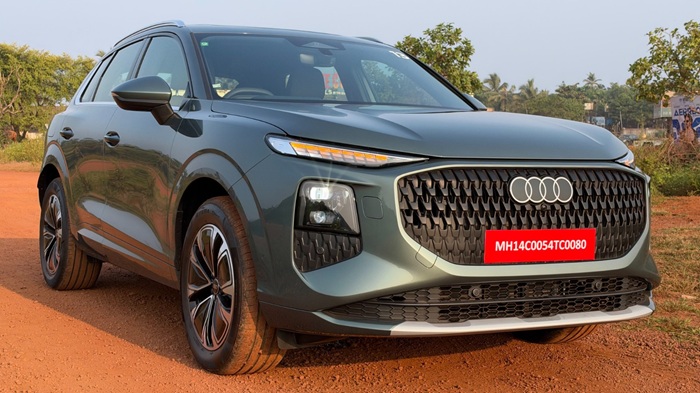
The first thing you notice about the new Q3 is how thoroughly it has adopted the appearance of Audi’s larger SUVs. The front end is dominated by an imposing Singleframe grille, which gives the vehicle a broad, purposeful expression despite its relatively compact dimensions. Its surface treatment is complemented by the Gloss Package, contributing to a more polished visual character.
The Audi rings now appear in a flatter, two-dimensional form, reflecting the brand’s updated identity. It’s a relatively minor detail, but on a vehicle where so much attention has been paid to lighting, surfaces and visual precision, even the badge has been subjected to a redesign.
The headlamps are considerably more interesting. The Q3 features digital matrix LED technology incorporating an extraordinary 25,600 micro-LEDs, together with configurable digital light signatures, headlamp washers and advanced illumination functions. These aren’t simply expensive-looking lights designed to impress pedestrians outside an upscale restaurant. Their purpose extends to improving how the driver understands the road ahead.
The Lane Light function uses camera-derived lane information to illuminate the vehicle’s current lane, while the Orientation Light projects visual references that help indicate the car’s position. Such systems illustrate how modern automotive lighting is evolving beyond the basic requirement of making darkness less inconvenient.
The daytime running lights also offer configurable signatures and incorporate the turn indicators. This ability to customise a vehicle’s light signature is increasingly becoming a defining element of Audi design, allowing owners to alter part of the car’s visual personality without changing a single piece of bodywork.
The bonnet and front bumper maintain the strong horizontal emphasis expected of a contemporary Audi SUV, helping the Q3 appear wider and more substantial than its position in the range might suggest.
From the side, the Q3 has the proportions of a conventional premium crossover rather than an aggressively styled coupé-SUV. Its relatively upright body provides a useful balance between visual presence and practical cabin space. There is no attempt to sacrifice rear headroom merely to create a dramatic roofline, which should be reassuring to buyers who occasionally carry passengers taller than a fashion model.
At approximately 4.5 metres long, 2.1 metres wide and 1.6 metres tall, the Q3 occupies a useful middle ground between everyday urban usability and family-sized practicality. The width figure deserves particular attention when considering narrow parking spaces and crowded Indian streets. It may be Audi’s smallest SUV, but that doesn’t mean every basement parking entrance will welcome it with open arms.
The car weighs 1,735 kg in kerb condition, while its gross vehicle weight is 2,260 kg. Those figures underline how much equipment, structural engineering and electronic technology are packaged into a modern compact luxury SUV.
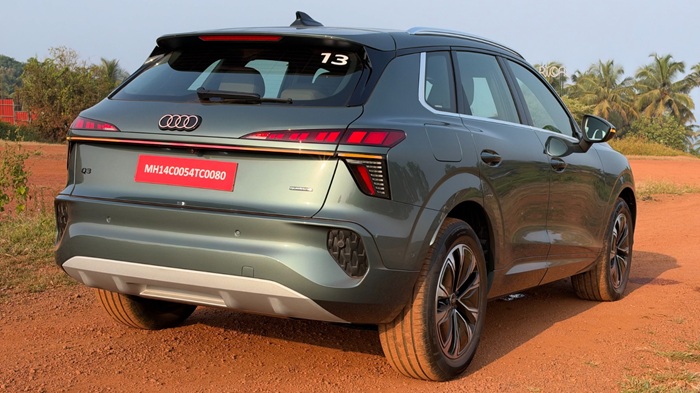
The wheel design helps establish the Zenith’s character. This particular specification features 18-inch, five-arm aero alloy wheels finished in gloss black. Another wheel design is also available, giving buyers some freedom to adjust the exterior appearance. The wheels are fitted with 235/55 R18 100V Nexen N’Fera Sport radial tubeless tyres at both ends, with the tyres on this example manufactured in the Czech Republic.
The 235-section width gives the Q3 a substantial tyre footprint, while the 55-profile sidewalls provide a reasonable amount of rubber between the wheel rim and the road. For Indian conditions, that is a sensible combination on paper. The enormous wheels favoured by modern designers can look wonderful under showroom lighting but are less charming when confronted with a poorly maintained road.
Disc brakes are fitted at both the front and rear.
The exterior mirrors are similarly well equipped, offering electrical adjustment, power folding, heating and automatic dimming, along with memory, integrated turn indicators and light projection. The windscreen incorporates heat-reflecting glass, while the front door windows benefit from acoustic glazing to help reduce outside noise entering the cabin.
The example featured here is finished in Sage Green, a colour that suits the Q3’s relatively sophisticated design. It offers an alternative to the traditional German luxury-car preference for black, white and the various shades of grey that exist between them.
Indian buyers can also select grey, black, blue and white. Other colours offered in certain international markets, including red, silver, yellow, beige, purple, brown, matt finishes and Audi exclusive paint options, are not currently available in India.
At the rear, LED Pro tail lamps feature an animated light-staging function, continuing the emphasis on digital illumination. The illuminated Audi rings provide another distinctive touch, especially after sunset. The overall effect is intended to give the Q3 a recognisable identity even when viewed among the increasingly crowded collection of SUVs on Indian roads.
The emphasis here is clearly on precision and sophistication rather than outright visual aggression. That should appeal to buyers who prefer their luxury vehicles to look expensive without appearing desperate to announce the fact.
Practicality: Compact Outside, Sensible Inside
The Q3’s practical credentials are more impressive than its position at the bottom of Audi’s SUV hierarchy might suggest. The luggage compartment offers 488 litres of space with the rear seats in place, making it suitable for ordinary family duties, airport journeys and weekend luggage.
Fold the rear seats and luggage capacity expands to 1,386 litres, providing considerably more flexibility for larger objects. The rear bench uses a 40:20:20 split-folding arrangement, allowing occupants to carry longer items while retaining some rear seating positions.
The rear seats can also slide and recline, features that make a genuine difference in everyday ownership. Sliding seats allow occupants to trade some rear legroom for additional luggage space, while the reclining backrests provide flexibility on longer journeys.
A space-saving spare wheel is provided, an important consideration in India, where damaged tyres and unpredictable road conditions are not exactly rare occurrences.
The Q3 also supports a roof load of up to 75 kg and has a quoted towing capability of up to 2,000 kg, subject to the appropriate equipment and operating conditions. Few Indian Q3 owners are likely to tow a substantial trailer regularly, but the capability adds another dimension to its practical credentials.
Ultimately, the Q3 appears designed for buyers who want a premium compact SUV that can comfortably deal with ordinary family responsibilities rather than merely perform the role of an expensive fashion accessory.
Interior: Audi’s Digital Living Room
Open the door and the latest Q3 introduces a cabin conceived around what Audi describes as a human-centric living-room ambience. That phrase could easily sound like the creation of an enthusiastic marketing department, but the underlying idea is sensible. The cabin aims to blend contemporary technology with comfort, warmth and intuitive usability.
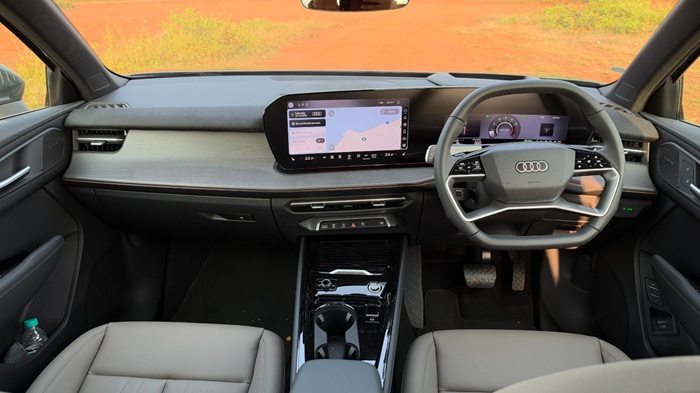
The dashboard is dominated by Audi’s Digital Stage panoramic display arrangement, which combines an 11.9-inch Audi Virtual Cockpit Plus digital instrument cluster with a 12.8-inch central touchscreen infotainment system. Together, they create the impression of a continuous, driver-oriented digital environment.
The presentation is modern and suitably technical without abandoning the familiar Audi emphasis on orderly design. Rather than covering every available surface with buttons, the Q3 integrates many functions into the display system and steering-wheel controls.
The infotainment system supports navigation, USB connectivity, wireless smartphone integration, Apple CarPlay, Android Auto, FM and radio functions. Wireless charging is provided, reducing the need for another cable to join the collection that inevitably accumulates in a car’s centre console.
A separate 10.9-inch passenger display is offered in some international versions of the Q3, but it has not been included in the Indian specification. Whether that constitutes a meaningful omission depends on how much importance one attaches to giving the front passenger another screen. There is, after all, a limit to how many displays are necessary for a journey to the supermarket.
The cabin’s digital sophistication extends to the head-up display, which projects relevant information into the driver’s field of vision. It can show vehicle speed, warnings, driver-assistance information, navigation instructions and media details, reducing the need to divert attention from the road.
The steering wheel is another distinctive element. Audi has adopted a twin-spoke sport leather design with flat upper and lower sections, together with progressive steering. Controls for the digital instrument cluster, head-up display, audio volume, telephone, infotainment and voice functions are incorporated into the steering-wheel arrangement.
Perhaps the most unusual ergonomic feature is the integrated switch module, which brings together controls for the lighting, indicators, windscreen wipers and washers. It represents a departure from more conventional layouts and contributes to the cabin’s cleaner design.
There is a trade-off, however. Unfamiliar switch arrangements can require an adjustment period, particularly for drivers who have spent years relying on traditional stalks and instinctive hand movements. Clever design is valuable, but only when it remains convenient once the novelty has worn off.
Material selection is an equally important part of the luxury experience. The Zenith features artificial leather upholstery in brown, with beige offered as an alternative. The warm colour scheme works with the cabin’s living-room theme, giving the interior a more inviting appearance than the uniformly dark environments found in many performance-oriented SUVs.
American Whitewood decorative trim adds another layer of visual interest, while aluminium trim is offered as an alternative for buyers who prefer a more technical, understated atmosphere.
The front comfort seats feature electrical adjustment, four-way lumbar support and heating. The driver’s seat also includes a memory function, making it easier to restore the preferred seating position after another person has driven the vehicle.
Three-zone deluxe automatic climate control allows separate temperature settings for different cabin areas, an especially useful feature in Indian families where arguments over the ideal air-conditioning temperature can become surprisingly passionate.
The automatically dimming frameless interior rear-view mirror contributes to the premium detailing, while the electrically operated two-part panoramic sunroof introduces additional light into the cabin. Its large glass area should be particularly appealing to rear-seat occupants, although appropriate sun protection and effective climate control remain important under the Indian summer sun.
Ambient Lighting Package Plus offers a choice of 30 colours, allowing the cabin’s atmosphere to change according to preference. Some owners will favour restrained illumination; others may decide that their SUV should resemble a particularly expensive nightclub. Audi has thoughtfully left that decision to the customer.
Rear-seat flexibility remains one of the cabin’s strongest practical attributes. The combination of sliding, reclining and individually folding sections gives the Q3 a degree of adaptability that is particularly useful for family ownership. Although exact headroom and legroom figures have not been provided, the conventional SUV roofline and flexible rear seating arrangement suggest that passenger accommodation has received meaningful attention.
The audio system is another highlight on the equipment list. Audi has partnered with American audio specialist Sonos to provide a premium sound system featuring 12 speakers, a 420-watt output, subwoofer and amplifier.
For drivers who spend substantial amounts of time in traffic, a good audio system can be more valuable than an additional fraction of a second shaved from an acceleration time. Whether listening to classical music, podcasts or particularly enthusiastic Bollywood soundtracks, the Sonos system is intended to make the Q3 feel like a sophisticated entertainment space rather than merely a means of transportation.
Engine and Performance: Two Litres of Familiar German Confidence
Beneath the bonnet is a 2.0-litre TFSI turbocharged, inline-four-cylinder petrol engine. TFSI stands for Turbo Fuel Stratified Injection, Audi’s designation for its turbocharged petrol direct-injection technology.
In this specification, the engine produces 201 horsepower and 320 Nm of torque, driving through a seven-speed S tronic dual-clutch automatic transmission. Power is delivered through Audi’s quattro all-wheel-drive system.
The combination is thoroughly modern but reassuringly conventional in an automotive world increasingly dominated by electrification. There is no elaborate plug-in charging routine, no need to calculate battery state of charge before leaving home and no artificial requirement to learn an entirely new way of driving. You fill the tank, select Drive and get on with the journey.
Audi quotes a 0–100 km/h acceleration time of 7.1 seconds and a top speed of 229 km/h. Those are respectable figures for a luxury crossover weighing 1,735 kg, although the Q3 is clearly intended to be a swift everyday SUV rather than a dedicated performance machine.
The 320 Nm torque output is particularly relevant to everyday driving. Torque is what gives an engine the muscular response needed when accelerating away from a junction, climbing a gradient or overtaking slower traffic. A turbocharged petrol engine with a healthy mid-range torque output should be well suited to these situations, reducing the need to chase high engine speeds for every burst of acceleration.
The seven-speed S tronic transmission is equally important to the driving experience. A dual-clutch gearbox uses two clutches to manage alternating gear sets, allowing the next ratio to be prepared before the previous one is disengaged. The objective is rapid, efficient shifting with minimal interruption to power delivery.
In everyday use, the real measure of such a transmission is not simply how quickly it changes gears under hard acceleration, but how smoothly it manages low-speed manoeuvres, heavy traffic and repeated stop-start conditions. These are areas where calibration matters just as much as the underlying mechanical design.
The Q3’s quoted acceleration figure suggests that motorway overtaking should be comfortably within the engine’s abilities. It offers sufficient performance for brisk progress without drifting into the territory of high-powered SUVs whose performance capabilities are difficult to exploit responsibly on public roads.
Perhaps more importantly, the 2.0-litre petrol engine provides an appealing middle ground between the efficiency ambitions of a smaller motor and the effortless performance expected from a luxury vehicle.
Quattro: Traction Is Part of the Identity
Audi’s quattro system remains one of the Q3’s defining mechanical features. In this application, electronically controlled multi-plate clutch technology continuously adapts torque distribution according to driving conditions, helping the vehicle maintain traction and stability as road surfaces and grip levels change.
The system is designed to respond to changing demands rather than rely on an inflexible front-to-rear torque split. During ordinary driving, torque distribution can be managed for efficiency and stability, while additional traction can be provided when conditions require it.
The advantages should be particularly relevant on wet roads, slippery surfaces and during acceleration on uneven tarmac. All-wheel drive cannot rewrite the laws of physics, of course, but an intelligently managed system gives the chassis another tool with which to maintain composure.
The Q3 also includes Audi Drive Select with five driving modes: Balanced, Dynamic, Comfort, Efficiency and Offroad+.
These settings allow the driver to choose different operating characteristics according to driving requirements. Balanced is intended for ordinary everyday use, while Dynamic prioritises a more responsive driving character. Comfort focuses on relaxed progress, and Efficiency is designed to encourage more economical operation.
Offroad+ provides an additional setting for conditions where traction becomes more challenging. Its presence should not be interpreted as a promise that the Q3 can follow a hardcore four-wheel-drive vehicle across difficult terrain. This remains a road-focused luxury crossover, not a body-on-frame expedition machine.
It is useful, however, that Audi has considered occasional travel beyond smooth tarmac. Indian journeys have a habit of including roads that alternate between fully paved and seemingly abandoned halfway through construction.
Ride and Handling: Comfort Before Theatre
The Q3 features comfort suspension, reflecting Audi’s intention to deliver a composed and refined ride rather than overtly sporting chassis behaviour.
That emphasis makes considerable sense for the vehicle’s intended audience. A compact luxury SUV is expected to deal with city traffic, uneven surfaces, speed breakers, highway journeys and family travel, often during the same day. Suspension that feels impressively stiff during a short demonstration can become rather less appealing after several hours on imperfect roads.
The combination of comfort-oriented suspension, 18-inch wheels and 235/55-section tyres provides a sensible technical foundation. The relatively generous tyre sidewalls offer some additional compliance compared with lower-profile performance tyres, while the broad footprint should contribute to road grip.
Nevertheless, the Q3’s considerable weight remains a factor. At 1,735 kg, this is not a lightweight crossover, and controlling that mass through corners, under braking and over uneven surfaces requires careful chassis tuning.
Its progressive steering is designed to vary steering response according to input, allowing greater agility during manoeuvres while retaining a more measured character around the straight-ahead position. That is particularly valuable in a vehicle required to negotiate both tight parking spaces and higher-speed roads.
The key questions for a proper road test would be how effectively the suspension absorbs sharp impacts, how much body movement is permitted over undulating surfaces and how naturally the steering responds through successive bends. The specification points towards a comfortable, secure touring character, but those finer qualities can only be established through driving.
Similarly, the effectiveness of the acoustic front glazing and the overall cabin insulation should be judged at a variety of speeds and over different road surfaces. Refinement is one of the strongest reasons for purchasing a luxury vehicle, and the suppression of tyre noise, wind noise and suspension vibration is often more important than an impressive dashboard display.
The Q3’s disc brakes, broad tyres, all-wheel-drive system and substantial electronic safety equipment provide a comprehensive mechanical foundation. But ultimately, the quality of a chassis is determined by how naturally these elements work together rather than by the number of technologies listed in the specification sheet.
Fuel Efficiency: Performance Has a Price
Audi quotes a fuel-efficiency figure of approximately 12 km/l for the 2.0-litre petrol Q3. With a 60-litre fuel tank, the mathematical range at that claimed efficiency would be approximately 720 km.
That figure is a calculation, not a demonstrated real-world driving range. Actual consumption will depend on traffic, speed, driving style, passengers, terrain, climate control usage and road conditions.
In congested urban environments, especially where traffic involves frequent acceleration and braking, drivers should anticipate different consumption from the quoted figure. The combination of a relatively powerful turbocharged petrol engine, automatic transmission, all-wheel drive and a substantial kerb weight makes fuel expenditure an unavoidable part of ownership.
The engine is E20 compliant, allowing compatibility with petrol containing up to 20 per cent ethanol in accordance with the applicable fuel specification.
For buyers covering significant annual distances, the absence of an Indian-market diesel or plug-in hybrid alternative may be a consideration. The standard petrol engine offers a straightforward ownership proposition, but it is not intended to deliver the running costs of a small-displacement economy car.
Then again, buyers spending ₹56 lakh on a compact German luxury SUV are probably not expecting fuel bills comparable to those of a modest city hatchback.
Safety: A Thorough Electronic Safety Net
Safety equipment is one area where the Q3’s extensive technology appears particularly well justified.
The latest Q3 has received five-star assessments from both Euro NCAP and the Australasian New Car Assessment Program, ANCAP, according to the supplied model information. These are important credentials, although buyers should always consider the precise tested configuration and its relationship to the Indian-market specification.
The India-specification Q3 is equipped with nine airbags and a comprehensive collection of active and passive safety features. Proactive occupant protection is provided across the front, rear and side protection functions, while front emergency brake assist is intended to help reduce the risk or severity of certain frontal collisions.
Audi has also incorporated driver-assistance technology tailored for Indian conditions. Adaptive cruise control supports more convenient driving, particularly over extended highway journeys, while driver attention and fatigue monitoring can warn when signs of reduced concentration are detected.
Hill-hold assist is included for easier starts on gradients, and downhill assistance provides additional support on descending roads. A tyre-pressure-loss indicator helps alert the driver to potentially problematic changes in tyre condition.
Family-oriented safety equipment includes i-Size child-seat mounting provisions, rear-seat alert functionality and front three-point seatbelts with pretensioners and height adjustment.
There is also an electronic immobiliser and anti-theft wheel bolts, helping protect against unwanted interference when the vehicle is parked.
The parking equipment is particularly relevant to Indian conditions. Park Assist Plus, together with the parking system and rear-view camera, is designed to make positioning and manoeuvring the Q3 easier.
This is not merely a convenience issue. Modern luxury SUVs have become increasingly wide, while parking spaces in many older Indian residential and commercial buildings have remained stubbornly unchanged. Assistance that helps the driver negotiate confined spaces can be genuinely useful.
As with any ADAS-equipped vehicle, the driver remains responsible for monitoring the road and maintaining control. Cameras and assistance systems can improve safety, but they do not transform the Q3 into a self-driving car.
Living with the Q3: Luxury for the Owner-Driver
Audi’s own customer research provides an interesting insight into the Q3’s character. According to the company’s study, approximately 14 per cent of Q3 customers are repeat owners, while 85 per cent of owners drive their vehicles themselves.
That second figure is particularly significant in India, where a substantial portion of the larger luxury-car market has traditionally included chauffeur-driven buyers.
The Q3 clearly appeals to individuals who want to enjoy the driving experience personally rather than simply occupy the rear seat. Its compact dimensions, comfortable driving position, responsive powertrain and extensive convenience technology fit that profile.
Features such as heated front seats, driver’s memory, keyless convenience access, the panoramic sunroof, three-zone climate control and sophisticated audio equipment are aimed at making everyday journeys feel more special.
Practicality has not been forgotten either. The sliding rear bench, useful luggage capacity and flexible seat-folding arrangement make the Q3 suitable for smaller families who require a single vehicle to perform several different roles.
Ownership support is another important consideration. Audi offers a range of packages associated with the Q3, including roadside assistance, Service Value plans, extended warranty options, assured buyback arrangements and long-duration financing extending up to ten years.
These can help buyers plan their expenses and future vehicle replacement, although the value of each package will depend on its actual terms, coverage, exclusions and pricing.
An extended warranty or service package can be especially relevant for a technologically sophisticated luxury vehicle, where repairs outside the standard warranty period may be considerably more expensive than those of a mainstream family car.
The availability of an assured buyback option also deserves consideration, particularly for customers who prefer replacing their vehicles at predictable intervals.
Competition: A Difficult Corner of the Luxury Market
At ₹52 lakh to ₹56 lakh ex-showroom, the Audi Q3 faces serious competition from other established European premium compact SUVs.
The BMW X1 is among its most obvious rivals. It offers BMW’s distinctive interpretation of a practical compact luxury SUV and appeals to buyers who value spaciousness, a commanding appearance and the brand’s traditionally driver-oriented character. Customers considering the Q3 should compare rear-seat accommodation, powertrain configurations and equipment carefully, because the competing models approach the segment with different priorities.
The Mercedes-Benz GLA is another natural alternative, particularly for buyers attracted by expressive styling and the prestige associated with the three-pointed star. The GLA places considerable emphasis on design and cabin presentation, while the Audi attempts to distinguish itself through its lighting technology, digital interface and quattro drivetrain.
The Volvo XC40 is also worth considering where available, especially for customers who appreciate Scandinavian design, restrained luxury and a strong emphasis on safety.
Choosing between these vehicles involves more than comparing quoted horsepower or counting touchscreen inches. Driving position, seating comfort, suspension calibration, dealership accessibility, after-sales costs and personal design preference can have a greater influence on long-term satisfaction.
The Q3’s most obvious strengths are its strong turbocharged petrol engine, sophisticated all-wheel-drive system, advanced lighting technology and carefully equipped cabin. It also benefits from a relatively conventional SUV body style that prioritises practical usability over the fashion for exaggerated coupé-like rooflines.
Its limitations are equally clear. The Indian range is restricted to petrol power, several international variants and features remain unavailable, and the pricing brings it into direct competition with some particularly capable luxury alternatives.
Whether the Zenith justifies its ₹4 lakh premium over the Nova will depend on how much buyers value the additional equipment and which features matter most to them.
Verdict: Smallest Audi SUV, but Far from a Small Ambition
The third-generation Audi Q3 represents a significant evolution of a model that has played an important role in making the four-ringed badge accessible to Indian luxury-car buyers. It has become more sophisticated in appearance, more ambitious in its technology and more comprehensive in its approach to comfort and everyday practicality.
The exterior now carries the visual confidence of larger Audi SUVs, while the digital matrix lighting system and configurable illumination functions provide genuine points of distinction. Inside, the combination of Audi’s Digital Stage, Sonos sound system, refined trim options, ambient lighting and flexible seating gives the Q3 the equipment expected of a contemporary luxury vehicle.
Mechanically, the 201 hp 2.0-litre TFSI engine, seven-speed S tronic transmission and quattro all-wheel drive promise an appealing combination of performance, security and everyday usability. The quoted 7.1-second acceleration time confirms that this is not merely a premium-looking family crossover with modest mechanical ambitions.
The compromises deserve attention. Its kerb weight is substantial, the claimed 12 km/l fuel economy will require realistic expectations in everyday conditions, and the Indian range lacks the diesel, hybrid and alternative body styles available internationally. Some cabin technology may also require familiarisation, particularly the unconventional switch arrangement.
At ₹56 lakh ex-showroom, the flagship Zenith cannot rely on the Audi badge alone. It must convince buyers through its overall quality, comfort, refinement and driving experience. The specification makes a persuasive case, although a proper road test remains essential before passing final judgement on its ride, handling, gearbox calibration and real-world economy.
For buyers seeking a compact luxury SUV with sophisticated design, substantial technology, all-wheel-drive capability and genuine family practicality, the Q3 Zenith deserves serious consideration. Those prioritising maximum cabin space, a different driving character or greater powertrain choice should investigate its rivals before making a decision.
What ultimately defines the Audi Q3 is its refusal to behave like a bargain-basement version of a larger luxury SUV. Instead, it brings much of the brand’s modern technology and design philosophy into a more manageable package.
The Q3 may be the smallest SUV wearing Audi’s four rings in India, but its ambition is considerably larger than its footprint. And in a luxury market increasingly obsessed with size, that might be one of its most appealing qualities.


