The Tata Sierra returns with an unmistakable silhouette, a luxurious triple-screen interior, three engine choices and an ambitious price tag. But can this modern interpretation of an Indian automotive icon deliver more than a generous helping of nostalgia?
The Return of an Indian Legend
Some cars are remembered for their performance, some for their reliability, and others because they looked unlike anything else on Indian roads. The original Tata Sierra belonged firmly to the third category. Introduced in 1991, at a time when Indian motorists were still getting accustomed to the idea of privately owned SUVs, it arrived with a remarkably distinctive shape, an enormous glasshouse and a personality that was difficult to mistake for anything else. It was adventurous, slightly unconventional and rather ahead of its time. Three decades later, Tata Motors has decided that the name deserves another chapter.
The second-generation Tata Sierra made its comeback in November 2025, with the 2026 model representing an entirely different interpretation of the original concept. This is no longer a rugged, three-door lifestyle vehicle with the priorities of a bygone era. Instead, it is a thoroughly modern, five-door, five-seater crossover SUV designed to compete in one of India’s most fiercely contested automotive segments. It has to attract nostalgic enthusiasts who remember the original while convincing younger buyers who regard three digital screens and wireless smartphone connectivity as basic necessities of modern civilisation.
And Tata has not approached the assignment conservatively. The new Sierra combines dramatic retro-inspired styling, an exceptionally feature-rich interior, sophisticated electronics and multiple powertrain options. The range begins at ₹11.49 lakh, while the flagship Accomplished+ Dark diesel automatic featured here commands ₹21.59 lakh, both ex-showroom. That is quite a spread, but then the Sierra is attempting to appeal to everyone from practical family buyers to customers who would ordinarily consider larger and more expensive SUVs.
Even its name carries an appropriate geographical connection. Sierra is a Spanish word meaning mountain range, a fitting identity for a vehicle originally associated with adventure and exploration. Interestingly, the new-generation SUV is also destined for South Africa under the Styzor name, with its introduction planned for 2027.
The question is whether the new Sierra has retained enough of the original’s individuality to justify reviving such an evocative badge. After all, nostalgia is a powerful marketing tool, but it is considerably less useful when negotiating a badly maintained road at 80 km/h.
Heritage Meets a Completely Modern Foundation
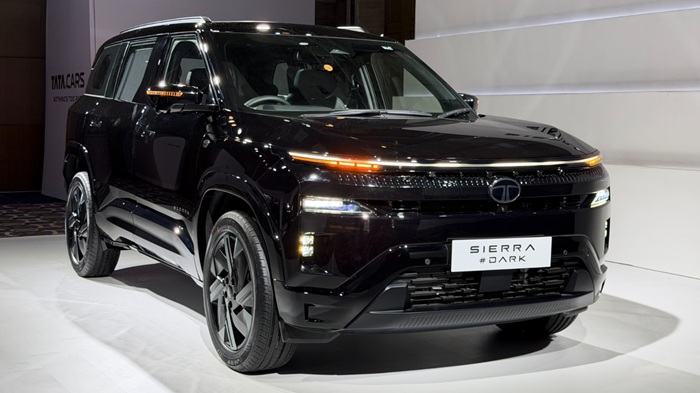
The new Sierra has been designed under the direction of Martin Uhlarik, whose automotive design background includes work associated with models such as the Skoda Fabia and Nissan Qashqai, alongside Tata vehicles including the Nexon, Curvv, Harrier and Safari. His challenge here was particularly interesting: create something recognisably related to the 1991 Sierra without producing a retro imitation.
The result is an SUV that shares the original’s visual confidence while adopting Tata’s contemporary design language. Its bold interpretation of the Sierra identity earned it a 2025 Red Dot Design Award, recognition that reflects just how important styling has been to this revival.
Beneath the bodywork lies Tata Motors’ new ARGOS architecture, short for All Terrain Ready Omni Energy and Geometry Scalable Architecture. It has been developed as a flexible foundation capable of supporting different powertrain configurations. The combustion-powered Sierra is assembled in Gujarat, with Tata’s Sanand manufacturing facility playing an important role in the model’s identity. The cabin design even references the geographical coordinates of the factory.
There is now an electric counterpart too. The Sierra EV starts at ₹18.79 lakh ex-showroom and uses a separate electrified architecture, expanding the revived nameplate beyond conventional petrol and diesel engines.
For customers who prefer the familiar experience of stopping at a fuel station rather than calculating charging stops, the combustion-powered Sierra remains particularly relevant.
Exterior Design: Nostalgia Without the Costume Party
The first thing you notice about the new Sierra is its shape. At a time when many crossover SUVs appear to have been designed by stretching the same basic silhouette in different directions, the Sierra possesses something increasingly uncommon: a recognisable identity.
Its upright proportions, high bonnet, strong shoulder line and nearly continuous glasshouse create a purposeful stance. The most important connection with the original is the wrap-around glass effect. Tata has recreated the visual impression through the positioning of the rear glass, signature blacked-out B-pillars and carefully integrated window surrounds. The hidden waist seals further clean up the side profile, helping the windows appear almost continuous.
It is an intelligent piece of automotive nostalgia. The original Sierra’s enormous wrap-around rear windows were among its defining features; the new car manages to evoke that visual signature without sacrificing the practicality of conventional rear doors.
The front is considerably more futuristic. Tata’s Light Saber LED daytime running lights produce a strong horizontal visual signature, incorporating sequential indicators and welcome-and-goodbye animations. The Night Saber Bi-LED Booster automatic headlamps sit within a distinctive front-end arrangement, supported by High Beam Assist and follow-me-home functionality.
LED fog lamps with cornering assistance improve illumination when negotiating tight turns, while front parking sensors acknowledge the realities of driving a broad-shouldered SUV through crowded Indian streets.
The grille treatment is modern and relatively restrained, although the surrounding surfaces and lighting give the nose enough attitude to announce its arrival well before the horn becomes necessary.
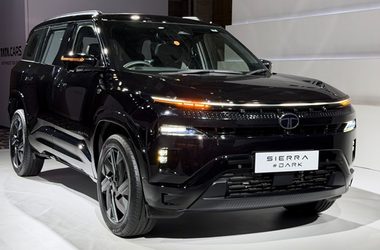
The Dark edition adds another layer of visual drama. Its Friesian Black exterior finish, blacked-out details and distinctive Dark mascot create a considerably more serious appearance than the brighter versions. Purple Chrome accents supply subtle contrast, preventing the entire vehicle from looking like a shadow that has somehow acquired number plates.
Buyers who prefer something less theatrical can choose from lighter and more colourful finishes across the broader Sierra range, including white, grey, green, red and yellow-toned options.
From the side, the 19-inch dark-themed alloy wheels complement the square-shouldered body beautifully. They are fitted with 225/55 R19 99H MRF Wanderer EcoTred steel-belted radial tubeless tyres, providing a suitably substantial contact patch without making the SUV look excessively modified.
Other versions are available with 18-inch and 17-inch alloy wheels, while more affordable variants can be specified with 17-inch steel wheels. A 17-inch steel spare wheel is also provided.
The electrically adjustable, auto-folding outside mirrors incorporate LED indicators and cameras, while flush-fitting door handles with welcome illumination contribute to the smooth appearance. Puddle lamps provide a useful touch of theatre when approaching the car after dark.
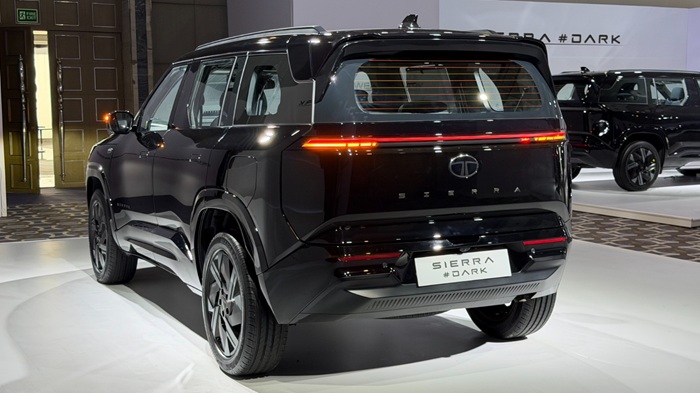
At the rear, the Light Saber LED tail lamps provide another horizontal lighting signature, while the concealed rear wiper and washer preserve the uncluttered tailgate design. A rear defogger, rear fog lamp and neatly integrated roof spoiler complete the arrangement. The shark-fin antenna houses GPS-related connectivity hardware.
Crucially, the Sierra does not depend entirely on enormous fake air intakes, exaggerated exhaust decorations or pointless pieces of shiny plastic to appear expensive. There is enough visual character in the basic proportions.
The Dark edition simply turns that character up a notch.
Dimensions and Practicality: More Space Than You Might Expect
The Sierra measures approximately 4.3 metres long, 1.8 metres wide and 1.7 metres tall, making it a conventional midsize SUV on paper. Visually, however, its upright styling makes it appear larger and more substantial than those dimensions suggest.
Ground clearance is an impressive 205 mm, while the approach angle measures 26.5 degrees. That should be useful for steep ramps, badly designed speed breakers and uneven rural roads. It does not automatically make the Sierra a serious rock crawler, but it provides reassuring clearance for everyday Indian conditions.
Depending on the specification, kerb weight is around 1,600 kg, which is worth remembering when considering the smaller petrol engine.
The Sierra’s practicality becomes particularly apparent at the back. The claimed 622-litre luggage compartment is exceptionally generous for this class, and folding the 60:40 split rear seats increases the available luggage volume to approximately 1,257 litres.
That gives the Sierra genuine family-holiday potential. Several suitcases, shopping bags and the miscellaneous objects Indian families consider essential for a weekend away should fit without turning luggage loading into a complicated engineering problem.
The powered tailgate can also be opened using a foot gesture beneath the rear bumper. This is particularly useful when carrying bags in both hands, although performing the correct movement at the first attempt can sometimes require the confidence of a professional dancer.
Inside the boot, there is a multipurpose safety light that can be used when the tailgate is open, along with practical hooks rated to carry up to 3 kg.
The Sierra is fundamentally a five-seater rather than a compact seven-seater pretending that the final row is suitable for adults. Its emphasis is therefore on passenger comfort and generous luggage space rather than maximising the number of occupants.
Interior: Three Screens and an Ambition to Feel Expensive
Open the door and the Sierra reveals how dramatically Tata’s interior design philosophy has evolved.
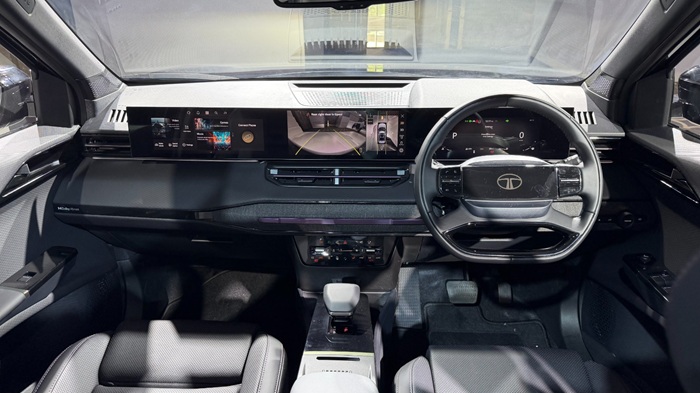
The dashboard adopts what Tata calls a Natural Tone Soft Touch design, with a clean horizontal layout and a strong emphasis on digital technology. In this Accomplished+ Dark edition, black leatherette upholstery combines with the Violet Eclipse interior treatment, creating a considerably moodier atmosphere than the lighter cabin options.
White leatherette and black fabric upholstery are also offered elsewhere in the range, depending on variant.
The most obvious attraction is the Horizon View triple-screen arrangement stretching across the dashboard. The central touchscreen measures 12.3 inches, while a second 12.3-inch display is positioned ahead of the front passenger. The driver receives a 10.25-inch digital instrument cluster.
It is an enormous amount of screen real estate for a midsize Indian SUV. Whether three displays are essential to the simple business of driving from home to work is another question entirely, but the arrangement certainly creates a distinctive cockpit.
The digital instrument cluster presents information including vehicle speed, engine rpm and navigation instructions. Lower variants employ a smaller 4-inch instrument display, while other configurations use a 10.25-inch infotainment screen instead of the flagship arrangement. A head-up display also appears in the equipment information for selected versions.
The steering wheel is wrapped in leatherette and features an illuminated Tata emblem, along with integrated controls for phone functions, volume, voice commands and infotainment. Tilt and telescopic adjustment allows drivers to fine-tune their seating position.
The six-way electrically adjustable driver’s seat includes memory and a welcome function, making it easier for different drivers to share the vehicle. Front-seat ventilation is another welcome inclusion, particularly in Indian summers, and extendable thigh supports should benefit taller occupants on longer journeys.
Height-adjustable front seatbelts contribute to comfort, while the leatherette-wrapped gear selector gives the centre console a more premium appearance.
The Sierra also includes an eight-way extendable sunvisor arrangement, an auto-dimming interior rear-view mirror, a cooled glovebox and a dedicated umbrella holder. These are precisely the sorts of small conveniences that can become more valuable over several years of ownership than an elaborate startup animation.
There is even a small utility hook rated for 2 kg.
The floating door armrests create another interesting design element, while the driver’s one-touch up-and-down power window includes anti-pinch protection. The dual-tone horn, meanwhile, ensures that Tata has not neglected one of the most frequently exercised functions in Indian traffic.
Material quality and switch operation will ultimately matter just as much as the visual presentation. Large screens and soft-touch surfaces create a strong first impression, but long-term satisfaction depends on how consistently the controls, trim pieces and electronics withstand everyday use.
Rear Seats: A Surprisingly Important Part of the Sierra Experience
For an SUV attempting to serve as both a fashionable lifestyle vehicle and a sensible family car, rear-seat comfort is critical.
The Sierra provides two-stage reclining rear backrests, allowing passengers to choose a more comfortable seating angle on longer journeys. Rear window sunshades help reduce heat and glare, while the broad glasshouse contributes to a particularly open-feeling environment.
The panoramic sunroof adds to that impression. It is voice-assisted, and Tata describes it as one of the largest offerings in its segment. Regardless of the exact comparative claim, it contributes to the cabin’s sense of space, especially for rear passengers.
There is also a Boss Mode function that allows additional space to be created for a rear occupant by adjusting the front passenger seat.
This is a welcome feature in a vehicle that could frequently be chauffeur-driven in urban India, even if the Sierra is not attempting to replace a traditional executive sedan.
The generous luggage compartment, reclining rear backrests and practical cabin details reinforce the fact that the new Sierra is designed to be considerably more useful than its adventurous styling might initially suggest.
Infotainment and Connectivity: Almost Too Much Technology?
If the original Sierra belonged to an era of cassette players and comparatively simple instrumentation, the new one has arrived with enough electronic equipment to make a small office nervous.
The 12.3-inch central touchscreen supports wireless Android Auto and Apple CarPlay, Amazon Alexa, Mappls Auto built-in navigation, USB connectivity, FM radio and extensive media applications. Tata also includes more than 250 native voice-assistance commands across six languages.
The system incorporates Harman AudioworX technology, 13 JBL audio modes, over-the-air software updates, five personalised Me Space profiles and a collection of entertainment applications under the Arcade Suite and Theater Pro functions.
More than 30 applications are available for gaming, streaming and other entertainment purposes. Birthday Celebration Mode and personalised welcome voice messages add a playful side to the technology, although not every owner will necessarily want their SUV to become the most enthusiastic person at a birthday party.
The dedicated passenger display allows the front passenger to enjoy entertainment independently, including gaming with a compatible controller and listening to music through headphones.
The sound system deserves particular attention. The Sierra offers a 12-speaker JBL Black audio setup with a dedicated subwoofer and 5.1 Dolby Atmos support. A SonicShaft soundbar arrangement contributes to the cabin’s audio-focused design.
In a vehicle intended for long-distance travel, a high-quality sound system is far more than a decorative feature. It can genuinely improve the experience of spending several hours behind the wheel.
There is also a sophisticated electronic architecture beneath the screens. Tata’s Intelligent Digital Architecture Layer, or TiDAL 2.0, incorporates 5G capabilities, 10 electronic control units and a Snapdragon Auto 5G SA 522 chipset.
This technology supports the connected features, infotainment processing and electronic systems that increasingly define modern vehicle ownership.
The Sierra uses Tata’s iRA 2.0 connected-car platform, offering access to more than 73 vehicle functions through a smartphone, with a one-year complimentary subscription included.
These functions include remote engine starting where supported, scheduled cabin preconditioning, cabin cooling, overspeed alerts, time fencing and connected telematics.
Dual-zone fully automatic climate control allows the driver and front passenger to select individual temperature settings. Express Cooling is particularly relevant in a country where a parked vehicle can become an extremely effective greenhouse within minutes.
The BreatheIQ air purifier adds an air-quality index display, a useful feature for motorists frequently travelling through polluted urban environments.
Ambient mood lighting provides further customisation, while three Relax Modes — Water, Fire and Space — change the cabin atmosphere according to the selected theme.
The underlying idea is appealing, although the Sierra’s generous collection of digital menus also raises a familiar question: how much technology does a driver actually want to navigate while driving?
The best modern interfaces make complex features feel simple. The less successful ones merely move every conventional control onto a touchscreen and call it progress.
Three Engines, Three Different Personalities
The Sierra’s broad appeal is supported by three 1.5-litre four-cylinder engine choices: a naturally aspirated petrol, a turbocharged direct-injection petrol and a turbocharged diesel.
The entry-level petrol is Tata’s 1.5-litre Revotron unit, developing approximately 104 hp and 145 Nm of torque. It is available with a six-speed manual gearbox or a seven-speed DCA dual-clutch automatic transmission, depending on variant.
This is the straightforward option intended primarily for buyers who value affordability and everyday usability. With roughly 1.6 tonnes to move in some versions, however, it is unlikely to deliver particularly enthusiastic acceleration when fully loaded. Buyers who regularly travel with several passengers and luggage may find the more powerful engines better suited to their needs.
The more interesting petrol option is Tata’s 1.5-litre Hyperion turbocharged engine, which uses gasoline direct injection, dual variable cam timing and an intelligent lubrication system.
Its fuel-injection system operates at a stated pressure of 50 bar, while output reaches approximately 157 hp and 255 Nm.
Those figures move the Sierra into a considerably more energetic category. The substantial torque should provide useful mid-range acceleration, making highway overtaking less dependent on careful planning than with the naturally aspirated engine.
A claimed top speed of around 190 km/h is quoted for the Hyperion version, although such a figure has little relevance to everyday Indian driving conditions. What matters considerably more is its ability to accelerate confidently between normal highway speeds.
The Hyperion is paired with a six-speed automatic transmission.
The third choice is the 1.5-litre Kryojet turbo-diesel, producing around 116 hp. Torque stands at 260 Nm with the six-speed manual transmission and increases to 280 Nm with the six-speed automatic.
That additional pulling power is important in a vehicle designed for family travel. Diesel engines are particularly effective when maintaining speed with several passengers aboard, climbing gradients or accelerating without requiring frequent high-rpm operation.
The Accomplished+ Dark diesel automatic featured here combines the stronger 280 Nm version with the six-speed automatic gearbox.
It is an attractive mechanical combination for buyers who prioritise relaxed progress over outright performance. The diesel’s power delivery should be particularly suitable for long highway journeys, although its refinement and engine note will naturally differ from the smoother petrol alternatives.
Two driving modes, City and Sport, allow the driver to alter the vehicle’s response. City is intended for more relaxed everyday driving, while Sport prioritises sharper responses.
The Sierra also offers three terrain modes: Normal, Wet and Rough. These adapt vehicle systems to suit different surface conditions, but they should not be confused with the mechanical hardware of a dedicated four-wheel-drive off-roader.
The combustion-powered Sierra uses front-wheel drive, without the low-range transfer case or locking differentials associated with traditional hardcore SUVs.
Ride and Handling: Comfort Before Cornering Heroics
The Sierra’s suspension arrangement reveals a great deal about its intended character.
At the front, it uses an independent MacPherson-strut layout with lower wishbones and coil springs. At the rear, there is a semi-independent twist-beam arrangement with coil springs and shock absorbers.
While some enthusiasts may instinctively prefer a more sophisticated independent rear suspension, suspension geometry alone does not determine ride quality. The quality of the damping, spring calibration, tyre selection and overall chassis tuning matters considerably more in everyday driving.
Tata calls the system Superglide Suspension, incorporating Frequency Dependent Damping technology.
The dampers vary their response according to the frequency of suspension movement, helping the chassis respond differently to minor road imperfections and larger disturbances. Unlike a fully electronic adaptive suspension system, the arrangement is intended to provide its variable characteristics through the damper design itself.
This is especially relevant on Indian roads, where a vehicle might encounter smooth expressway tarmac, deep potholes and abrupt concrete speed breakers within the same journey.
Road tests of the new Sierra have highlighted its composed ride quality, with the suspension absorbing many smaller imperfections effectively while maintaining reassuring stability at highway speeds. Larger potholes can still make their presence felt, which is hardly surprising given the vehicle’s substantial wheels.
The 19-inch alloys are visually excellent, but their tyre sidewalls leave less cushioning than smaller-wheel alternatives. Anyone regularly travelling on severely damaged roads should consider whether the less dramatic 17-inch or 18-inch configurations offer a more sensible balance.
Steering responses are geared towards accessibility rather than aggressive sports-car precision. This is an SUV designed to feel manageable in traffic and stable at speed, not something intended to chase hot hatchbacks through mountain bends.
With a relatively tall body and substantial kerb weight, some body movement during rapid directional changes is inevitable. The Sierra’s priority is to manage that movement predictably rather than eliminate every trace of roll.
All-wheel disc brakes provide stopping power, with numerous electronic braking assistance functions operating in the background.
The 205 mm ground clearance and 26.5-degree approach angle provide additional confidence on rough roads, steep inclines and awkward entrances.
Hill Descent Control and rough-surface terrain programming further extend its usefulness beyond smooth urban roads. Nevertheless, the front-wheel-drive Sierra remains better described as an adventurous family crossover than a serious expedition vehicle.
There is nothing wrong with that distinction. Most Indian SUVs spend considerably more time negotiating parking ramps and monsoon-damaged streets than exploring remote mountain trails.
Safety: Five Stars and a Very Long List of Electronic Assistants
Safety is an important part of the Sierra’s appeal.
The new-generation model has earned a five-star Bharat NCAP safety rating, with the crash-testing programme reporting 31.14 points out of 32 for adult occupant protection and 44.73 out of 49 for child occupant protection.
It is a significant achievement in a market where buyers are increasingly examining crash-test performance alongside equipment and fuel economy.
The Sierra provides six airbags, ABS with electronic brakeforce distribution, electronic stability control, traction control, ISOFIX child-seat mounting points and tyre-pressure monitoring.
There is also a 360-degree HD surround-view camera, front and rear parking assistance, central locking, an electronic parking brake with auto-hold and a rear occupant sensor.
The latter is particularly valuable as a reminder that children or other occupants may still be inside the vehicle after a journey.
The Level 2+ ADAS package adds an extensive collection of driver-assistance functions. These include Intelligent Speed Assist, Forward Collision Warning, Autonomous Emergency Braking, Lane Departure Warning, Lane Keep Assist, Lane Centering, Traffic Sign Recognition and adaptive cruise control with stop-and-go capability.
Adaptive Steering Assist contributes additional support during assisted driving.
Blind Spot Detection, Lane Change Alert, Rear Cross Traffic Alert, Rear Collision Warning, Door Open Alert and a Blind Spot View Monitor help address situations where surrounding traffic or pedestrians may not be immediately visible.
Overspeed alerts provide another layer of warning, although their usefulness depends heavily on accurate speed-limit recognition and sensible calibration.
The chassis electronics go considerably further, incorporating Rollover Mitigation, Vehicle Dynamic Control, Corner Stability Control, Dynamic Torque Vectoring and Hill Ascend Control.
Additional braking technologies include Hydraulic Brake Assist, Hydraulic Brake Fade Compensation, Electronic Brake Pre-Fill, Brake Disc Wiping, Engine Drag Torque Control, Controlled Dynamic Deceleration, Panic Brake Alert, Dynamic Braking Support and After Impact Braking.
Dynamic Steering Torque provides another layer of electronic assistance.
Most owners will never consciously notice many of these systems operating, which is exactly how well-integrated safety electronics should behave.
Nevertheless, ADAS remains driver assistance rather than autonomous driving. Lane markings, unpredictable traffic behaviour and inconsistent road conditions can affect performance, particularly in India.
The technology is valuable, but an attentive driver remains the most important safety feature in any car.
Fuel Economy and Ownership: Choosing the Right Engine Matters
With three distinct powertrain options, running costs will vary considerably.
The figures supplied for the Sierra suggest approximately 17 km/l for the naturally aspirated petrol, 13 km/l for the Hyperion turbo-petrol and 19 km/l for the diesel, although actual economy will depend on variant, driving conditions, transmission and traffic.
These figures should be treated as quoted estimates rather than independently established real-world results.
The diesel’s 50-litre fuel tank and stated 19 km/l efficiency suggest a theoretical range of approximately 950 km under favourable conditions. Real-world range will naturally be lower or higher depending on usage, and drivers should not expect laboratory-style efficiency from a fully loaded SUV navigating congested roads.
For high-mileage users, the diesel is arguably the most logical option. Its strong torque delivery and potentially lower fuel consumption make it well suited to regular highway journeys.
The Hyperion petrol should appeal to buyers who value stronger performance and smoother petrol-engine characteristics, while the naturally aspirated Revotron provides the lowest-cost entry into Sierra ownership.
Tata offers a standard warranty of three years or 1,00,000 km, whichever comes first.
Long-term reliability, electronic-system durability and dealership service quality will be important considerations, especially given the number of connected features and sophisticated components fitted to higher variants.
The Sierra also comes with an unusually extensive accessories catalogue, covering everything from door-edge protectors, floor mats, 3D ceramic coating kits and dash cameras to mobile holders, wireless chargers, vehicle trackers and additional ambient lighting.
Owners can choose comfort accessories such as neck rests, seat massagers, humidifiers, heated blankets, pet-seat covers and umbrella-friendly travel items. Bicycle carriers, portable vacuum cleaners, car washers, Rockford audio upgrades and various cleaning products are also offered.
Then there are smaller accessories including tissue boxes, air fresheners, religious idols, logo projectors, valve caps, microfibre cloths, trash bins and car-care kits.
It is an accessories catalogue sufficiently extensive to make the average automotive aftermarket shop slightly uncomfortable.
More Than a Car: Tata Wants the Sierra to Become a Lifestyle
Tata is clearly attempting to position the Sierra as something more culturally significant than another family SUV.
Owners can become part of the SOUL community, which organises adventure-oriented experiences and events. The intention is to preserve some of the exploratory spirit associated with the original Sierra.
There have also been several lifestyle collaborations connected with the revived nameplate.
Delhi Watch Company has produced a Sierra-themed watch, while the SUV has appeared in a musical collaboration involving rapper DIVINE. Gully Labs has developed Sierra-inspired sneakers, and HUEMN has worked on apparel including T-shirts, jackets and caps.
Nappa Dori has contributed travel-related accessories, while a Starbucks Sierra tumbler extends the branding into everyday lifestyle merchandise.
Some of these collaborations are genuinely interesting. Others demonstrate just how determined Tata is to turn the Sierra into a recognisable cultural identity.
Whether the average buyer requires matching footwear and drinkware is debatable, but it does underline the emotional value Tata believes the nameplate still possesses.
Rivals: A Difficult Segment to Conquer
The Sierra enters a segment populated by several thoroughly competent competitors, including the Hyundai Creta, Kia Seltos, Maruti Suzuki Grand Vitara, Toyota Urban Cruiser Hyryder, Honda Elevate and Skoda Kushaq.
The Creta remains a formidable all-rounder, balancing family practicality, refinement, modern equipment and a familiar ownership proposition. Buyers who want a less visually dramatic alternative may find its approach more reassuring.
The Kia Seltos is similarly technology-focused, with a wide engine and transmission selection and an interior designed to appeal to customers who enjoy premium-looking equipment.
The Grand Vitara and Urban Cruiser Hyryder are especially relevant for efficiency-conscious buyers, particularly in their strong-hybrid versions. Those whose driving is dominated by congested city traffic may find their petrol-electric powertrains more attractive than the Sierra’s conventional engines.
The Skoda Kushaq offers a different personality, with turbocharged petrol engines and an emphasis on engaging driving characteristics. Enthusiasts who prioritise responsive handling over cabin spectacle may prefer its more focused approach.
The Honda Elevate remains appealing for its relative simplicity, straightforward ergonomics and naturally aspirated petrol engine. It lacks some of the Sierra’s elaborate technology, but that restraint can be an advantage for buyers who prefer conventional controls.
The Sierra’s answer to these competitors is a combination of distinctive styling, substantial boot capacity, an elaborate interior, a diesel option, strong safety credentials and the emotional appeal of a familiar Indian nameplate.
The Accomplished+ Dark also asks buyers to make a financial decision. At ₹21.59 lakh ex-showroom for the diesel automatic, it is positioned towards the expensive end of the midsize SUV category.
That premium is easier to justify if the buyer genuinely values the advanced equipment, distinctive styling, comfort features and generous practical space. Those who simply need an efficient, reliable family crossover may find better value in a lower Sierra variant or one of its established competitors.
Verdict: The Sierra Has Grown Up, but It Hasn’t Become Ordinary
The most impressive thing about the new Tata Sierra is not its triple-screen dashboard, 12-speaker sound system or enormous catalogue of electronic assistance systems.
It is the fact that Tata has successfully revived the personality of a distinctive old SUV without making the new one look like an imitation.
The original Sierra was memorable because it was different. The modern version understands that lesson. Its upright silhouette, wrap-around glass treatment, broad stance and restrained but unmistakable lighting design give it a visual identity that many contemporary crossovers struggle to achieve.
Inside, the emphasis has shifted from rugged adventure to comfort, connectivity and technology. The spacious rear seats, reclining backrests, generous boot and practical convenience features make it a credible family vehicle rather than merely a stylish object.
The Accomplished+ Dark adds an appropriately dramatic visual treatment, and the diesel automatic powertrain makes sense for buyers who travel frequently and value relaxed, torque-rich performance.
Not everything is perfect. The 19-inch wheels may be less forgiving on particularly rough surfaces than smaller alternatives. The enormous amount of technology introduces additional complexity, while some buyers may prefer more physical controls and fewer menus. The combustion-powered Sierra’s front-wheel-drive configuration also means its adventurous appearance should not be mistaken for serious off-road hardware.
And at ₹21.59 lakh, the flagship version needs to deliver a consistently premium ownership experience to justify its position.
Buyers seeking outright efficiency should investigate the strong-hybrid alternatives, while enthusiasts wanting sharper handling may prefer a sportier turbo-petrol rival. Those interested primarily in the Sierra’s design and practicality should also examine the more affordable variants before committing to the flagship.
But for someone who appreciates automotive character, wants an exceptionally well-equipped family SUV and remembers a time when the Sierra was one of the most distinctive vehicles on Indian roads, the appeal is immediately understandable.
The new Sierra is no longer the unconventional three-door adventurer that first appeared in 1991. It is bigger in ambition, richer in technology and considerably more sophisticated in its approach to everyday life.
Fortunately, beneath all the screens, software and blacked-out trim, there is still something recognisably Sierra about it.
And in an automotive market increasingly crowded with competent but occasionally anonymous crossovers, having a genuine personality is a rather valuable thing.