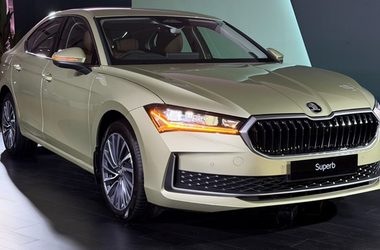
There was a time when arriving in a large, elegant European sedan was considered the ultimate expression of automotive success. Then the world discovered SUVs, and suddenly everyone wanted to sit higher, look tougher and pretend that the occasional pothole required the capabilities of a mountain expedition vehicle. The Škoda Superb, thankfully, never received that particular memo. It has remained one of the most convincing arguments for the traditional executive car: spacious, sophisticated, understated and rather more intelligent than its modest badge might suggest. Now in its fourth generation, the 2026 Superb returns with sharper styling, a more technologically sophisticated cabin and the sort of long-distance comfort that could make a business-class airline seat feel unnecessarily complicated.
For India, the story is particularly interesting. The new Superb is expected to arrive in 2027, with the proposed line-up consisting of a single, fully equipped Laurin & Klement (L&K) TDI diesel variant, priced at approximately ₹55 lakh ex-showroom. That is serious money for a Škoda, particularly in a market obsessed with SUVs. Yet the Superb has never been a car for buyers interested in making the loudest entrance. Its appeal lies in offering substantial space, comfort and engineering without feeling the need to announce its price tag to the entire neighbourhood.
The fourth-generation model, identified in the supplied specification as B9, Typ 3Y, represents the latest chapter in a nameplate that returned to the modern Škoda portfolio in 2001. The Superb name itself stretches much further back, to the original luxury sedan introduced in 1934 by ASAP Škoda. It is a remarkable piece of automotive heritage, connecting a modern Czech executive liftback with an era when luxury motoring involved polished metal, substantial bodywork and rather fewer touchscreens.
Today’s Superb is a thoroughly international creation. Developed within the Volkswagen Group, it is assembled in Bratislava, Slovakia, and shares its fundamental engineering with the Volkswagen Passat. Both cars are closely related, with extensive architectural and component commonality, including shared body engineering. The Superb uses an extended application of the Volkswagen Group’s MQB Evo platform, an architecture associated with an extensive family of vehicles, including the Škoda Octavia and Kodiaq, Audi A3, Q3 and Q6, Cupra Formentor, Jetta VS8, Volkswagen Atlas, Caddy, Golf, Multivan, Passat, Tayron, Tiguan and T-Roc, although individual applications differ considerably in their engineering.
The important point is that the Superb benefits from the Volkswagen Group’s enormous technical resources while retaining a distinct personality. It has never tried to become a bargain-basement luxury car. Instead, it takes the fundamentals of a well-engineered executive machine and adds something increasingly rare: common sense.
A Design That Understands the Value of Restraint
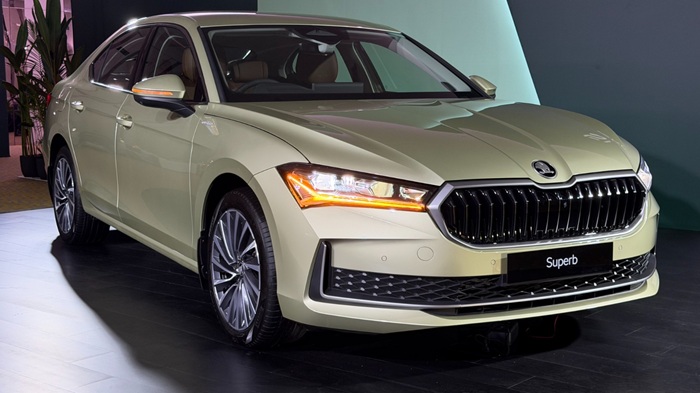
The fourth-generation Superb adopts Škoda’s newer Modern Solid design philosophy, bringing cleaner surfaces, more deliberate detailing and a stronger visual identity. Unlike several modern vehicles that appear to have been designed by committees competing to install the largest grille, the Superb relies on proportion rather than theatrical aggression.
The front end is dominated by a traditional octagonal grille finished in dark chrome, giving the car a sophisticated and suitably expensive appearance. The sculpted bonnet flows towards the grille with restrained precision, while the bumper incorporates air curtains designed to manage airflow around the front wheels. An active shutter system further contributes to aerodynamic efficiency by regulating airflow through the front openings when cooling requirements permit.
Lighting plays a significant role in the car’s appearance. Automatic Crystal LED Matrix beam headlamps combine a distinctive daytime running light signature with adaptive illumination technology. The system incorporates a cornering function, vehicle-detection-based high-beam management, dynamic headlamp range control and a welcome lighting effect. The objective is not simply to make the Superb look expensive after sunset, but to provide better illumination while limiting glare for other road users.
Rain-sensing windscreen wipers and a heated windscreen add another layer of convenience. The latter should be particularly useful in colder conditions, although its benefits will be somewhat less dramatic during a Delhi summer.
The exterior mirrors are equally well equipped, featuring electrical adjustment, power folding, heating and automatic dimming. They also incorporate memory functions, integrated turn indicators, cameras and logo projection. The illuminated welcome projection is a small theatrical flourish on an otherwise restrained car, but even sensible executives are entitled to a little entertainment.
In profile, the Superb reveals one of its greatest strengths: proportions. Measuring approximately 4.9 metres in length, around 2.1 metres in overall width as specified, and roughly 1.5 metres in height, this is a substantial vehicle. Its long body, sweeping roofline and extended rear overhang give it the presence of a proper executive saloon, although the reality is considerably more practical.
That is because the Superb is not technically a conventional three-box sedan. It employs a liftback configuration, meaning the rear windscreen rises together with the boot lid to create a generously sized cargo opening. Visually, it has the dignity of a traditional saloon; practically, it offers much of the convenience of a hatchback. It is an elegant solution that deserves to be more popular.
The reviewed specification rides on 18-inch Belatrix anthracite aerodynamic alloy wheels, wrapped in 235/45 R18 94W Pirelli Cinturato P7 radial tubeless tyres at both ends. These wheels strike a sensible balance between appearance and everyday usability. They fill the arches convincingly without resorting to the enormous wheel diameters that often make modern luxury cars ride like shopping trolleys over broken roads.
Depending on the eventual market specification, 17-inch and 19-inch wheel options may also be available. Anti-theft wheel bolts provide additional security, while ventilated disc braking hardware is represented by disc brakes at the front and rear, an appropriate arrangement for a vehicle of this size and performance.
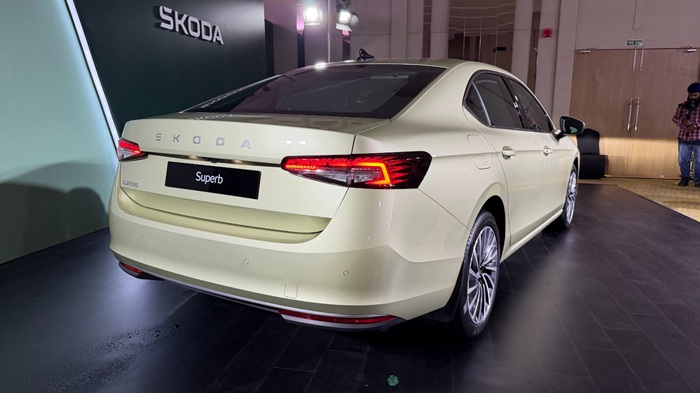
The example described here wears Ice Tea Yellow, an unusually interesting colour for a car otherwise devoted to discretion. It lends the Superb a warm, distinctive appearance without pushing it towards visual excess. More conventional blue, white, silver, black, grey and red finishes may also be offered, subject to the final Indian colour palette.
At the rear, crystalline-design LED tail lamps provide the strongest visual signature. Animated directional indicators and a welcome lighting sequence bring some contemporary drama, while the sculpted tailgate maintains the car’s broad, planted stance. The rear bumper is relatively restrained, avoiding unnecessary imitation diffusers or comically oversized exhaust embellishments.
One unusual detail is that the rear wiper is not expected to be included in the Indian specification, despite the liftback body making it a potentially useful feature. It may be offered in other markets or as an accessory, but Indian buyers should not assume it will be standard equipment.
From almost every angle, the Superb demonstrates that a premium car does not need to shout. It looks mature, confident and appropriately substantial. The overall effect is closer to a well-tailored business suit than an expensive tracksuit, which is precisely the point.
Nearly Five Metres of Sensible Engineering
The Superb’s dimensions have consequences beyond visual presence. Its approximately 4.9-metre length places it firmly in the large executive-car category, while its specified 11.1-metre turning-circle diameter suggests that manoeuvrability has not been completely sacrificed in pursuit of cabin space.
Nevertheless, this remains a sizeable vehicle for congested Indian cities. Tight basement parking, narrow residential streets and badly positioned concrete pillars will require some attention. The Superb may possess sophisticated parking technology, but its physical dimensions are not something software can negotiate away.
The quoted kerb weight is 1,667 kg, rising to a gross vehicle weight of 2,210 kg. That represents a substantial difference between the unladen and maximum permissible vehicle weights, although the precise homologated payload should be confirmed from the Indian specification.
A maximum towing capacity of up to 2,000 kg is also specified, illustrating the underlying versatility of the platform. An optional electrically operated tow bar may be available in certain configurations, although towing capability in India will depend on local homologation and equipment availability.
The real revelation, however, is luggage space.
With the rear seats upright, the Superb offers a cavernous 645 litres of boot capacity. Fold the 60:40 split rear backrest, and that figure expands to an enormous 1,795 litres. These are figures that would make several SUVs look rather embarrassed, particularly those that sacrifice luggage space for oversized rear-wheel arches or fashionable coupe-style rooflines.
The liftback opening makes loading suitcases, boxes or bulky objects considerably easier than with a conventional sedan boot. Family holidays, airport transfers and long-distance business travel should therefore be natural territory for the Superb.
Škoda’s traditional approach to practical details remains visible too. An integrated ice scraper is one of those wonderfully sensible features that sounds almost comically specific until you actually need it. India may not frequently require one, but it captures the brand’s philosophy rather neatly.
A screen cleaner, optional tablet holder, blankets, umbrellas and a range of storage accessories further reinforce the idea that someone involved in designing the Superb has genuinely thought about how people use cars.
An Interior Designed Around the People Inside It
Open the door, and the Superb presents a cabin that aims to combine traditional executive-car comfort with the digital technology expected of a modern premium vehicle.
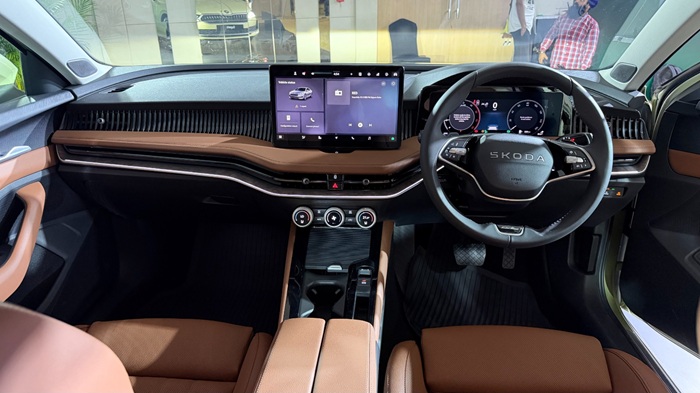
The dashboard architecture is comparatively clean, dominated by a large central touchscreen rather than an excessive collection of decorative shapes. The design appears deliberately horizontal, helping emphasise the width of the passenger compartment and creating a calm environment.
The reviewed specification features brown artificial-leather upholstery, bringing warmth to the cabin and providing an alternative to the endless black interiors that dominate today’s premium-car market. Other possible upholstery choices include black finishes, suede microfibre and fabric, although their availability in India remains to be confirmed.
Material selection and perceived build quality will be particularly important given the expected pricing. Škoda has generally approached cabin design with an emphasis on solidity and ergonomics rather than extravagant decoration, and the Superb follows that philosophy in its overall layout. Whether every surface feels appropriate for a ₹55 lakh car will require a closer examination of the final Indian-specification model.
The front seats are among the strongest elements of the equipment package. Electrically adjustable through 14 directions, these sport comfort seats incorporate four-way lumbar support, heating, ventilation and massage functions.
That is a serious amount of adjustment for a car designed to spend substantial time on highways. The ability to fine-tune lumbar support and seating position should be especially valuable during long journeys, while ventilation could prove considerably more useful than heating in many Indian cities.
Massage functions, meanwhile, have progressed from an extravagant luxury-car gimmick to a surprisingly desirable feature for motorists who regularly encounter long traffic jams. If you must spend two hours moving eight kilometres, the least your seat can do is offer some consolation.
The driving position benefits from a two-spoke, leather-trimmed, heated multifunction steering wheel. Its controls provide access to infotainment functions, audio volume, voice commands and instrument-cluster information. Adaptive cruise-control operation is also integrated into the driver’s control environment.
The two-spoke design is a distinctive Škoda feature, offering a cleaner appearance than some of the heavily sculpted steering wheels found in sportier rivals. It suits the Superb’s personality: functional, elegant and unconcerned with pretending to be a racing car.
Ahead of the driver sits a 10.25-inch Virtual Cockpit digital instrument display. It replaces conventional analogue instruments with configurable digital information, allowing the driver to monitor speed, vehicle status and other relevant data without constantly referring to the central touchscreen.
The infotainment system itself measures 13 inches and supports USB connectivity, Wireless SmartLink, Apple CarPlay, Android Auto, satellite navigation, digital radio and FM reception.
It is a comprehensive arrangement, but the important question with any large touchscreen is usability. A display can have remarkable resolution, beautiful graphics and enough computing power to run a small space programme, yet still become irritating if adjusting the air conditioning requires navigating through several menus.
Fortunately, Škoda has retained an element of physical interaction through three multifunction rotary dials. These provide access to functions including climate settings, audio volume and driving modes, combining traditional tactile operation with digital flexibility.
This is a welcome approach. Proper rotary controls remain easier to use while driving than repeatedly prodding a glass screen, particularly on uneven roads. Technology should reduce the driver’s workload, not turn adjusting the fan speed into a minor software engineering exercise.
Tri-zone automatic climate control allows separate temperature management for the front occupants and rear passengers. Wireless smartphone charging, an automatic-dimming interior rear-view mirror, multicolour ambient lighting and illuminated footwells add convenience and atmosphere.
A 15-speaker Canton surround-sound system promises substantial audio capability. In a cabin equipped with acoustic side windows, this should create favourable conditions for music reproduction while helping reduce external noise intrusion. Actual sound quality and cabin refinement, of course, will need to be judged on Indian roads.
The head-up display offered in certain international configurations is not expected to be included in the Indian model. That is a slightly disappointing omission in a vehicle positioned near ₹55 lakh, particularly when some less expensive cars are becoming increasingly generous with display technology.
Rear-Seat Comfort Remains the Main Attraction
Although the driver’s environment is sophisticated, the Superb has always understood that a substantial proportion of its appeal lies behind the front seats.
Its long body and extended passenger compartment promise the generous rear legroom traditionally associated with the nameplate. The upright seating position, substantial cabin width and carefully considered roofline also suggest a comfortable environment for adults travelling long distances.
The broad rear bench should accommodate three passengers when necessary, although, as with most executive cars, the experience is likely to be most agreeable with two occupants enjoying the available space.
Rear passengers benefit from the tri-zone climate-control system, while available accessories such as tablet holders can improve convenience during longer journeys. The 60:40 folding rear seat arrangement adds flexibility when unusually long luggage needs to be carried.
Škoda’s approach is refreshingly straightforward. Instead of attempting to turn the rear compartment into a nightclub with excessive lighting and distracting gimmicks, the Superb concentrates on room, comfort and practical usability.
That makes it particularly relevant for buyers who alternate between driving themselves and being chauffeured. It is equally suited to business travel and family duties, a combination that many fashionable SUVs do not execute quite as efficiently as their imposing dimensions might suggest.
A Diesel Engine Built for Distance, Not Drama
The proposed Indian Superb will be powered exclusively by a 2.0-litre TDI diesel engine in the L&K specification. This inline-four-cylinder, turbocharged diesel unit develops 148 horsepower and 360 Nm of torque, paired with a seven-speed DSG automatic transmission.
Those figures are not particularly dramatic by modern performance-car standards, especially when several turbocharged petrol sedans and electric vehicles now produce considerably more power. But judging a large diesel executive car purely on peak horsepower would be missing the point.
The attraction is torque.
With 360 Nm available from a relatively compact engine, the Superb should deliver the kind of flexible mid-range performance that makes diesel powertrains appealing for long-distance driving. Rather than demanding constant high engine speeds, a torque-rich diesel is designed to maintain useful pulling power through everyday acceleration and highway overtaking.
The seven-speed dual-clutch automatic gearbox should complement this character by providing closely spaced ratios and efficient cruising. DSG transmissions are known for their ability to execute quick gear changes, although low-speed smoothness and calibration remain important considerations in heavy Indian traffic.
The supplied performance figures suggest a 0–100 km/h acceleration time of 9.2 seconds and a top speed of 225 km/h.
A little over nine seconds to 100 km/h is entirely respectable for a 1,667 kg executive liftback, even if it will not trouble dedicated sports sedans. More importantly, the torque output promises the kind of effortless acceleration useful when merging onto highways or overtaking slower vehicles.
The Superb is not attempting to provide neck-snapping acceleration or a theatrical exhaust soundtrack. It is intended to cover large distances quietly, comfortably and efficiently, with enough performance available whenever required.
The 66-litre fuel tank and quoted average fuel consumption of approximately 20 km/l make for an interesting combination. Based purely on those figures, a theoretical driving range of around 1,320 km is possible from a full tank.
Real-world range will inevitably depend on traffic, driving style, road conditions, vehicle load and climate-control use, so that calculation should not be mistaken for a tested figure. Nevertheless, it illustrates the central appeal of the diesel Superb: substantial cruising range without constant fuel stops.
For buyers who regularly drive between cities, this may be more valuable than having an additional hundred horsepower that rarely gets used.
Internationally, the fourth-generation Superb is also available with petrol engines, plug-in hybrid powertrains, all-wheel-drive configurations and an estate body style. These versions broaden its appeal considerably overseas, but none is currently expected to form part of the Indian launch plan.
The Indian line-up is therefore likely to be unusually simple: one diesel engine, one automatic transmission and one high-specification L&K variant. The absence of a petrol or hybrid option may disappoint some buyers, but the diesel configuration arguably suits the Superb’s long-distance personality particularly well.
The Chassis Has a More Interesting Story Than the Power Figure
Beneath its restrained bodywork, the new Superb incorporates a number of technologies designed to improve the balance between ride comfort and handling.
The most significant is Dynamic Chassis Control, equipped with two independently controlled valves. The system adjusts damping characteristics according to road conditions and driving requirements, allowing the suspension to respond to changing demands rather than relying on a single fixed compromise.
In principle, this should allow the Superb to maintain a comfortable ride during relaxed cruising while offering tighter body control when driven more enthusiastically.
That versatility is especially important for Indian conditions, where a single journey can include smooth expressways, concrete expansion joints, patched asphalt, deep potholes and speed breakers apparently designed for vehicles with agricultural suspension systems.
A well-calibrated adaptive damping system can make a meaningful difference in such circumstances. However, the actual success of the Superb’s suspension will depend on the Indian-specification calibration, tyre pressures, wheel selection and the condition of the roads encountered.
The 18-inch wheels and 235/45-section Pirelli tyres appear to offer a reasonable compromise between responsive handling and ride comfort. Choosing larger 19-inch wheels, if available, may improve visual presence but could also reduce the cushioning provided by the tyre sidewalls.
Progressive dynamic steering is another important feature. The system is intended to vary the steering response according to steering input, potentially allowing relaxed directional control on highways while reducing the effort required during tight manoeuvres.
The quoted 11.1-metre turning-circle diameter also suggests that parking and U-turns should remain manageable despite the Superb’s substantial length.
On paper, the relatively low-slung liftback configuration has inherent advantages over taller SUVs. A lower centre of gravity can help reduce body movement during cornering, while the long wheelbase and substantial footprint provide a suitable foundation for stable high-speed cruising.
That said, the Superb is fundamentally a comfort-oriented executive car, not a disguised performance saloon. Its 148-horsepower diesel engine, generous proportions and equipment emphasis clearly prioritise relaxed progress over aggressive driving.
The front and rear disc brakes must manage a substantial vehicle, particularly when passengers and luggage are aboard. Braking feel, stopping performance and resistance to repeated heavy use remain aspects that require proper road testing.
Acoustic side glass should help control wind and traffic noise, while the diesel engine’s refinement and vibration characteristics will be especially important. Four-cylinder diesels can be efficient and muscular without being particularly melodious, and the Superb’s premium positioning creates high expectations for noise isolation.
Ultimately, the most convincing measure of this chassis will not be how quickly it can attack a mountain road. It will be how composed, quiet and relaxed it remains after several hours on an imperfect Indian highway.
Safety Technology Takes Centre Stage
The fourth-generation Superb carries a five-star safety rating from both Euro NCAP and Australasian NCAP (ANCAP), providing a reassuring foundation for its safety credentials. These ratings relate to vehicles assessed under the respective testing programmes; the exact applicability of those results to the final Indian-specification model should be considered alongside its local equipment and homologation.
The proposed safety package is extensive, beginning with 10 airbags, electronic safety assistance and an active tyre-pressure monitoring system.
Advanced driver assistance systems are expected to play a significant role, with features including blind-spot detection, turn assist, lane assist, park assist, door-exit warning, traffic-sign recognition and forward-collision warning.
Blind-spot detection can help when changing lanes, while lane assistance and traffic-sign recognition can provide additional support during long highway journeys. Door-exit warning is particularly relevant in busy urban environments, where an unexpectedly opened door can create a serious hazard for passing cyclists or two-wheeler riders.
A driver-monitoring camera system adds another level of supervision, intended to help detect signs of inattention or other relevant driver conditions.
The equipment list also includes a 360-degree camera system, front and rear parking sensors, remote parking assistance and hill-hold assist. Considering the Superb’s length, the camera and parking technology could prove genuinely useful rather than merely decorative additions to the specification sheet.
Other safety and security provisions include an anti-theft alarm, interior monitoring, a backup horn, towing protection, pedestrian-protection measures, ISOFIX child-seat mounting points and rear-door child locks.
Keyless entry adds convenience, while the broader electronic security systems aim to protect the vehicle when parked.
It is a comprehensive package, but advanced driver assistance is most valuable when it operates predictably and without unnecessary intervention. The calibration of warning systems, lane assistance and automated parking functions will matter considerably in India’s complex traffic conditions.
Importantly, none of these technologies eliminates the driver’s responsibility. The Superb may be capable of monitoring several things at once, but it still cannot anticipate every unpredictable manoeuvre made by the vehicle immediately ahead.
Connected Convenience and the Škoda Philosophy
The Superb also incorporates Škoda Connect functionality, allowing compatible smartphone access to selected vehicle information and remote services.
Functions described for the system include remote door locking and unlocking, vehicle location tracking and access to vehicle data. These can be useful when checking whether the vehicle has been secured, finding it in a large parking facility or monitoring selected vehicle information without physically entering the cabin.
Actual feature availability will depend on the Indian connected-services package and its operating conditions.
Perhaps more interesting is Škoda’s approach to accessories. The Superb’s international accessory catalogue extends well beyond conventional floor mats and decorative trim.
Potential options include an electric tow bar, alternative alloy wheels, locking wheel bolts, valve caps, mud flaps, roof boxes, snow chains, a rear wiper and a head-up display. Practical additions may include an umbrella, cleaning brush, cooling box, LED lamp, portable coffee maker, storage bags, floor mats, clothes hanger, dog safety belt, child seat, number-plate holder, tow rope, safety vest, dashboard camera, scuff plates, USB cables and car-care products.
The catalogue even extends into lifestyle merchandise such as towels, badminton equipment, headbands, shoes, raincoats, power banks, laptop sleeves and suitcases.
It is difficult to imagine someone buying a nearly five-metre executive car primarily because a matching badminton accessory is available, but the range demonstrates how extensively Škoda has developed the ownership ecosystem. Indian availability, naturally, is likely to be more limited than the international catalogue.
The more useful accessories remain those that enhance the car’s natural strengths: luggage organisation, long-distance comfort, protection and convenience.
Ownership: Premium Pricing, Practical Reassurance
The expected ₹55 lakh ex-showroom price positions the Superb in a demanding part of the Indian market. At this level, buyers will inevitably compare it not only with similarly priced sedans but also with premium-brand vehicles and large SUVs.
Škoda’s proposed ownership package provides some reassurance. The Superb is expected to come with a four-year/100,000 km vehicle warranty, accompanied by four years of roadside assistance.
Additional protection includes a six-year corrosion warranty and a three-year paint warranty. Four labour-free services are also expected to form part of the package.
These provisions should help reduce some of the uncertainties associated with owning a relatively sophisticated imported executive car. However, labour-free servicing does not necessarily mean that all maintenance items, fluids, parts or consumables are included, so buyers should examine the final terms carefully.
The long-term cost of maintaining advanced electronic systems, adaptive dampers, Matrix LED headlamps and a dual-clutch transmission also deserves consideration. Sophisticated technology improves the driving and ownership experience, but it can make repairs expensive once warranty protection expires.
Resale value is another factor. Large conventional sedans occupy a relatively specialised niche in India, and the Superb’s expected high price may restrict its potential second-hand audience compared with more popular SUVs.
On the positive side, annual global Superb sales of approximately 70,000 units suggest that the model remains a meaningful part of Škoda’s international line-up rather than an obscure limited-production exercise.
The established Volkswagen Group mechanical architecture and international component commonality are useful attributes, although they do not automatically guarantee inexpensive servicing or immediate parts availability in India.
For anyone planning to retain the car for several years, the warranty, dealership experience and availability of specialist support will be important parts of the purchase decision.
Should You Buy a Superb Instead of an SUV?
This is perhaps the most important question facing the new Superb in India.
At approximately ₹55 lakh, it will encounter competition from several directions. Premium compact executive sedans such as the BMW 2 Series Gran Coupé, Mercedes-Benz A-Class Limousine and Audi A4 may appeal to buyers who place greater value on a luxury badge or a more overtly premium showroom experience.
The Superb’s counterargument is straightforward: space, practicality and equipment.
Where some entry-level luxury sedans prioritise brand prestige and compact dimensions, the Superb offers a significantly larger body, an exceptionally versatile liftback boot and a cabin designed with genuine rear-seat usability in mind.
Large SUVs such as the Toyota Fortuner present an entirely different proposition. The Fortuner’s high seating position, rugged construction and suitability for difficult terrain may appeal to buyers travelling over demanding roads or requiring more adventurous capability.
The Superb, by contrast, is better understood as a dedicated road car. It promises lower-slung comfort, more car-like handling, sophisticated suspension control and a particularly spacious, well-equipped cabin.
The decision ultimately depends on lifestyle rather than showroom prestige. If your daily routine involves rough rural tracks, frequent off-road travel or a preference for towering driving positions, an SUV may be the more appropriate choice.
But if most of your journeys involve highways, cities, airports and family travel, there is a strong argument that a well-engineered executive liftback makes considerably more sense.
The Superb’s biggest challenge may therefore be persuading Indian buyers to value its strengths over the image associated with an SUV or a German luxury badge.
Verdict: An Executive Car for People Who Think Beyond the Badge
The fourth-generation Škoda Superb L&K TDI presents a compelling proposition, at least on the basis of its proposed specification. It combines elegant European styling, a remarkably practical liftback body, generous passenger accommodation and a substantial technology package with the promise of efficient diesel-powered long-distance motoring.
Its strongest qualities are not difficult to identify. The 645-litre boot is enormous, the interior offers the sort of seating and comfort equipment normally associated with more expensive machinery, and the combination of a 2.0-litre diesel engine, seven-speed DSG gearbox and 66-litre fuel tank makes considerable sense for buyers covering serious distances.
The adaptive suspension, progressive steering, acoustic glazing, Matrix LED lighting and comprehensive safety systems also suggest that Škoda has concentrated its engineering effort on the things that matter during everyday ownership.
There are compromises, of course. The anticipated ₹55 lakh price is substantial, the 148-horsepower diesel engine offers respectable rather than exciting performance, and the absence of alternative powertrains will limit the car’s appeal. The expected omission of a head-up display and rear wiper is also disappointing, while the long-term ownership costs of a technologically complex imported vehicle deserve careful consideration.
Most importantly, the final judgement on ride quality, refinement, gearbox behaviour and driving dynamics must await a proper test of the Indian-specification car. An impressive specification cannot substitute for experience on actual roads.
Nevertheless, the Superb’s underlying philosophy remains remarkably appealing. It does not attempt to disguise itself as an SUV, imitate a sports car or persuade everyone that a large illuminated grille is a substitute for good engineering.
Instead, it offers an increasingly unfashionable combination of space, practicality, comfort and quiet sophistication.
For the buyer who values the driving experience, travels long distances, appreciates thoughtful design and has no particular desire to impress strangers at traffic lights, the Superb could be one of the more interesting alternatives to the conventional luxury-car choices.
It may not have the badge prestige of a Mercedes-Benz or the commanding image of a Fortuner, but it has something arguably more satisfying: a clear understanding of what a large executive car is supposed to do.
The new Škoda Superb is not trying to be the centre of attention. It is trying to be the best part of a long journey. And in a world where so many cars are desperate to make a statement, that kind of confidence is rather refreshing.