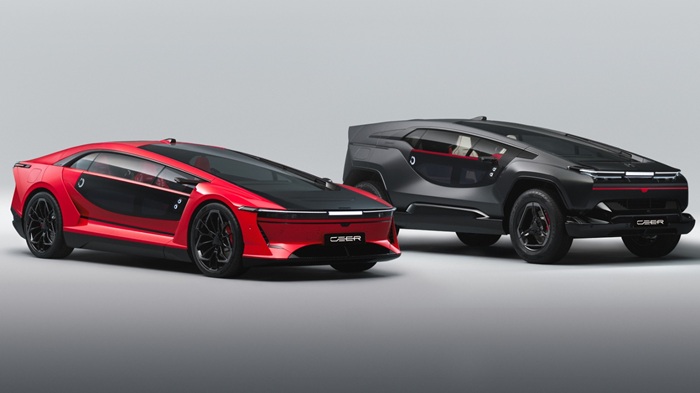
JEDDAH, Saudi Arabia: Saudi electric vehicle manufacturer Ceer has unveiled its first flagship models, the Exobot sedan and SUV, marking the beginning of a planned seven-model portfolio by 2030. The vehicles were officially revealed by His Royal Highness Prince Mohammed bin Salman bin Abdulaziz Al Saud, Crown Prince, Prime Minister and Chairman of the Board of Directors of the Public Investment Fund, followed by a detailed presentation at the Ceer Manufacturing Complex.
The all-electric Exobot range will be produced at Ceer Manufacturing Complex in King Abdullah Economic City, Saudi Arabia. Ceer said future additions to its line-up will include mid-size and compact vehicles with different propulsion options aimed at a broader range of customers.
The Exobot sedan and SUV are positioned in the large passenger-vehicle segment and have been designed and engineered with Saudi Arabia and the wider region in mind, including extreme heat, high solar exposure and long-distance driving conditions.
At the top of the range, Ceer says the Exobot’s tri-motor all-wheel-drive electric powertrain can produce as much as 1,111 horsepower and 1,500 Nm of torque.
The sedan is claimed to accelerate from 0-100 km/h in 2.1 seconds and reach a top speed of 250 km/h, while the SUV is said to complete the same sprint in 2.4 seconds and reach 210 km/h.
Those figures place the Exobot firmly in high-performance EV territory — an increasingly crowded part of the market where electric cars appear determined to make the traditional stopwatch slightly nervous.
Large Dimensions and Saudi-Inspired Styling
The Exobot sedan measures 5.26 metres long, 2.1 metres wide and 1.43 metres high, while the SUV is 5.02 metres long, 2.1 metres wide and 1.69 metres high.
Ceer says the design combines sharp front and rear surfaces with a more fluid central section, drawing inspiration from the ancient architecture of Hegra.
A horizontal front lighting signature is intended to emphasise the vehicle’s width, while 32 individual lighting bars reference 1932, the year Saudi Arabia was unified as a kingdom.
The cars also feature forged aluminium wheels with a triangular motif influenced by Al-Lahuj-style architectural openings found across Saudi Arabia.
Among the most unusual exterior features is a 2.4-metre windshield, which Ceer describes as the largest ever produced. The glass is positioned at a 15-degree inclination and incorporates a reflective coating designed to reduce solar heat entering the cabin.
Nearly Three-Metre ‘Shahin Wing’ Doors
Exobot also introduces what Ceer calls Shahin Wing Doors, named after the Shahin falcon.
The doors measure nearly three metres in length and can be operated remotely through the key fob or using controls mounted on the doors. According to Ceer, they open through a 60 cm arc to provide access for front and rear occupants.
Inside, the dashboard and cockpit are angled towards the driver, while a compact steering yoke houses key controls and allows the driver to switch between multiple driving modes.
The lower sections of the door glass can also switch between tinted and opaque settings at the touch of a control, giving occupants the choice between improved outward visibility and additional privacy.
Designed for Saudi Arabia’s Extreme Heat
Thermal management is one of the areas Ceer is placing particular emphasis on.
The company says its Halo Cooling system has been designed specifically for high-temperature environments and can reduce cabin temperature from 65°C to 32°C within 10 minutes under conditions representative of Saudi Arabia.
Special foils, triple silver-coated glass and airflow management around the roof are intended to limit solar heat gain, while separate front and rear air-conditioning systems are designed to cool the cabin more evenly.
The focus on cooling reflects a practical challenge for EVs and conventional cars alike in Gulf markets, where a parked vehicle’s interior can become considerably less welcoming than its brochure photographs suggest.
Steer-by-Wire and Rear-Wheel Steering
Exobot uses steer-by-wire technology, eliminating the conventional mechanical steering column.
Ceer says the system reduces steering movement from 400 degrees to 160 degrees, with the aim of providing quicker responses and a sportier feel.
Rear-wheel steering is also included, intended to reduce the turning circle at lower speeds while improving stability during high-speed driving and cornering.
The tri-motor drivetrain is supported by continuous torque vectoring and active chassis systems designed to distribute power and maintain vehicle stability.
48-Inch 8K Dashboard Display
Technology occupies a significant portion of the Exobot cabin.
The dashboard incorporates a 48-inch pillar-to-pillar curved Digital Horizon Display with 8K resolution, accompanied by a 10.4-inch Central Control Screen and an 8-inch Rear Occupant Display.
Ceer says the interface was inspired by the visual character of the Riyadh skyline.
An AI-based Virtual Voice Assistant can understand and respond in both Arabic and English.
Drivers will also be able to use the Ceer App to monitor charging, pre-condition the cabin and operate remote parking functions.
Despite the extensive digital interface, Ceer has retained physical controls for commonly used functions including gear selection, climate control and audio volume.
Digital Key, Immersive Audio and Fragrance System
Vehicle access will include a digital key with smartwatch integration.
Exobot’s SoundStage Audio system uses exciters to turn parts of the vehicle’s interior surfaces into acoustic elements, working together with conventional speakers to create what Ceer describes as a 360-degree sound environment.
The cabin also includes a personalised fragrance system capable of carrying three scents at a time.
While scented interiors are hardly the most critical issue facing the automotive industry, it does underline just how far luxury carmakers are now travelling in search of another feature for the specification sheet.
OTA Updates and Autonomous Driving Functions
Exobot will support over-the-air software updates, allowing Ceer to modify vehicle software, introduce new functions and make changes to certain vehicle characteristics remotely.
The company also says the vehicle will offer a range of driver-assistance and automated-driving technologies, including hands-free driving support, automated lane changes and point-to-point navigation-based autonomous driving on highways.
Ceer has not provided further technical details in the announcement about the exact operational conditions or regulatory classification of these functions.
Safety Systems Include Seven Airbags
Ceer says Exobot has been developed with both active and passive safety technologies.
The vehicle incorporates cell-to-pack battery construction, seven specially designed airbags, and aluminium casting and extrusion technology integrated into the body structure and doors.
The company says the system has been developed with demanding regional operating conditions in mind.
Exobot First Edition Gets 850 HP
The Exobot range will initially launch with the Exobot First Edition, followed later by the Exobot PLUS.
Available as both a sedan and SUV, the First Edition uses a tri-motor electric drivetrain producing 850 horsepower and 1,000 Nm of torque, with all-wheel drive.
Ceer claims the First Edition sedan can accelerate from 0-100 km/h in 2.6 seconds, while the SUV takes 2.9 seconds.
Both versions use a 112 kWh battery.
The company claims a driving range of up to 670 km for the sedan and 560 km for the SUV.
An 800V electrical architecture enables DC fast charging from 10% to 80% in under 30 minutes, according to Ceer.
The First Edition receives red-painted brake calipers, a Black Color Pack and black-and-red Nappa leather seats.
Each vehicle will carry a numbered First Edition plaque corresponding with its VIN.
Two exterior colours have been announced: Harrat Grey and White Musk.
Ceer Targets 45% Local Materials by 2034
Ceer says production in Saudi Arabia is expected to help reduce delivery times, with the company targeting an order-to-delivery period measured in weeks rather than months.
The manufacturer is also aiming for 45% locally sourced materials in its vehicles by 2034, supported by a domestic supplier network intended to improve parts availability and aftersales service.
The Exobot models will be built at the Ceer Manufacturing Complex in King Abdullah Economic City, which the company describes as the largest automotive manufacturing facility in the Middle East and one of the world’s most technologically advanced.
The launch represents a significant step in Saudi Arabia’s effort to establish a domestic automotive manufacturing industry rather than remaining primarily an importer of vehicles. With production localisation, high-performance electric powertrains and a seven-model roadmap now on the table, Ceer’s larger test will come after the unveiling: turning an ambitious flagship into a competitive production car for customers both within the Kingdom and, potentially, beyond it.