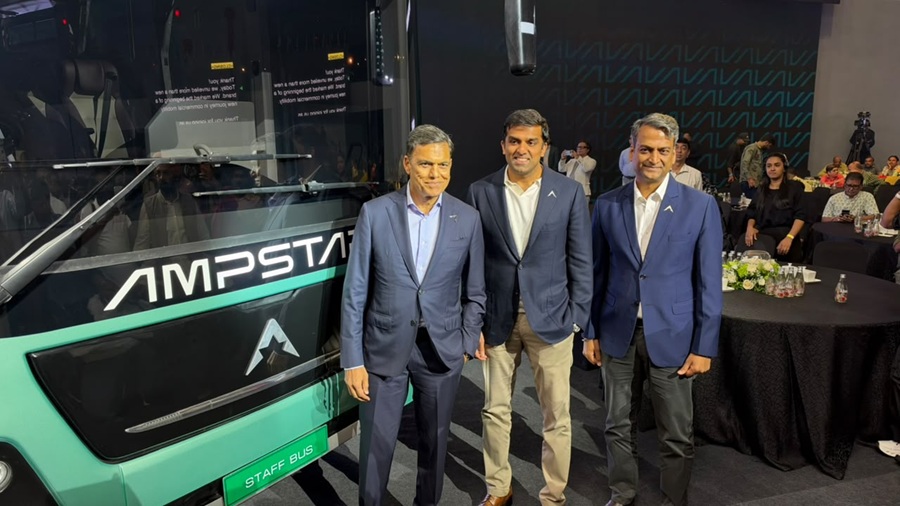
Mumbai: JSW Group has entered India’s electric commercial vehicle market with the launch of Ampstar, a new brand under JSW Greentech Limited that will design, manufacture and sell electric buses and trucks while also offering charging, financing and after-sales solutions.
The company said Ampstar, which will carry the endorsement “powered by JSW,” has been conceived as a full-stack commercial mobility platform rather than simply a vehicle brand.
Along with electric buses and trucks, JSW Greentech plans to offer charging infrastructure, operating solutions, financing options and after-sales support. Customers will also be able to choose between outright purchase, leasing, Battery as a Service, or BaaS, and other ownership and operating models.
The company said vehicles will be available with power configurations ranging from 150 kW to 500 kW, allowing specifications to be tailored to different commercial applications.
15,000-Vehicle Annual Capacity Planned in Maharashtra
Ampstar vehicles will be manufactured at JSW Greentech’s upcoming integrated electric vehicle facility at AURIC in Chhatrapati Sambhajinagar, Maharashtra.
Spread across 90 acres, the plant will have an annual production capacity of 15,000 electric buses and trucks, according to the company.
JSW Greentech said the facility will include what it described as India’s first pre-treatment and electro-deposition, or PT-ED, process for bus manufacturing, along with an automated truck-cabin production line and an integrated battery ecosystem.
The manufacturing setup reflects JSW’s attempt to control a larger portion of the electric commercial vehicle value chain — useful in an industry where the vehicle itself is only one part of the electrification puzzle.
Vehicles Engineered for Indian Conditions
JSW Greentech said its electric commercial vehicles are being engineered in-house for Indian operating conditions.
The company has developed the base logic, software and algorithms for the electric drivetrain, allowing vehicles to be configured according to customer requirements.
The vehicles will also feature a double-cooling battery system and a high-strength monocoque chassis, which JSW Greentech said have been designed with India’s climate and road conditions in mind.
Speaking at the launch, Sajjan Jindal, Chairman, JSW Group, said:
“When we decided to enter electric commercial mobility, I saw it as an act of nation-building – moving India’s people and goods on power generated within India, rather than fuel sourced from outside. We cannot control global oil prices. But we can control how much we depend on them. If I had to put our ambition for Ampstar in one sentence, it’s this: we want Ampstar to be a catalyst for changing the way India moves. That’s no longer just a business question. It’s a question of who we want to be as a country. But for every customer to make bold choice of electric bus & truck, the economics have to make the case – not sentiment. When they do, the impact goes far beyond the vehicle itself: energy security, lower logistics costs & greater global competitiveness for Indian industry, a stronger manufacturing ecosystem built here in India, and cleaner future for the next generation. That’s the journey Ampstar begins today mile by mile, disrupting the way India moves.”
Bus Range From 7 Metres to 18 Metres
Ampstar plans to offer electric buses ranging from 7 metres to 18 metres, covering applications such as staff transport, city buses, intercity operations and school mobility.
On the truck side, the company will initially enter the market with a 55-tonne tractor-trailer. JSW Greentech said it intends to expand the line-up with tippers and fixed-body dumpers in the coming months.
Parth Jindal, JSW Group, said the company developed Ampstar after discussions with customers and other stakeholders highlighted barriers to electric vehicle adoption beyond the purchase of the vehicle itself.
He said:
“Ampstar brings the full strength of JSW into commercial mobility, with one ambition: to change how India moves its people and its goods. We spent months listening to customers and stakeholders, and one thing was clear, real barriers to adoption go well beyond the vehicle itself. That is when we started designing around the complete customer journey and created full stack electric commercial mobility solution. Ampstar brings together two powerful ideas: ‘Amp,’ comes from Ampere – the unit of electric current, representing technology that amplifies performance. ‘Star’ represents aspiration, leadership and progress. The brand identity reflects that same ambition – modern, forward-moving, built to stand out. This is our promise: to go the distance with every customer, making the transition to electric simpler, more reliable, and more rewarding.”
The company is positioning its broader service ecosystem as an important part of the business case for fleet operators, for whom charging availability, financing and vehicle uptime can be as significant as specifications on a brochure.
JSW Developing Electric Drivetrain and Software In-House
Sumit Mittal, CEO, JSW Greentech Limited, said the company was developing the vehicles, drivetrain and software in India.
He said:
“Ampstar is our vision for electric commercial mobility, and today marks its beginning. We are designing, engineering and building these vehicles in India, from the ground up – our own drivetrain, our own software, using the best of technologies available, and built for Indian roads and operating conditions. Our range is built to cover the full spectrum. On the bus side, our portfolio will span 7 meter to 18 metre buses, serving diverse applications including staff transportation, city, intercity and school mobility. On the truck side, we are starting with the 55-tonne tractor-trailer — one of the most demanding vehicle architectures with plans to expand into tippers and fixed-body dumpers in the months ahead. India deserves world-class buses and trucks on its own roads, and Ampstar is how we deliver that.”
The launch places JSW Group in a commercial vehicle segment where electrification is increasingly extending beyond passenger cars and into buses, freight transport and fleet operations.
For Ampstar, the larger test will be whether its combination of locally engineered vehicles, charging support and flexible ownership models can make electric commercial vehicles economically attractive to operators. In commercial transport, after all, the transition to electric will ultimately be measured not only in kilowatts and batteries, but also in uptime, operating costs and kilometres covered.