
With Tonka-toy styling, rear-wheel drive, a 215 km claimed range and an irresistible appetite for customisation, the VinFast VF 3 proves that an electric SUV doesn’t need to be enormous, enormously powerful or enormously expensive to make an impression.
There is something wonderfully refreshing about the VinFast VF 3. At a time when electric SUVs are becoming increasingly enormous, increasingly complicated and increasingly obsessed with accelerating faster than supercars, here comes a little Vietnamese machine that appears to have misunderstood the entire assignment. It has just 40 horsepower, a top speed of 100 km/h, steel wheels and enough boot space for a modest shopping expedition. Yet, somehow, it is one of the most interesting electric cars to emerge from Southeast Asia.
The VF 3 is not trying to reinvent luxury motoring or convince its occupants that they are travelling aboard a spacecraft. Its ambitions are considerably more sensible. It wants to make electric mobility affordable, fashionable, practical and, perhaps most importantly, desirable. Judging by its popularity on Vietnamese roads, VinFast seems to have understood something that many established manufacturers are still struggling to comprehend.
Spend some time travelling through Vietnam and the VF 3 becomes a remarkably familiar sight. You can encounter one almost every kilometre, often wearing a different colour scheme, custom wheels, additional bodywork or accessories that reflect the personality of its owner. Calling it Vietnam’s unofficial national car would hardly seem unreasonable.
Vietnam’s four-wheeled phenomenon
Launched in 2024, the VF 3 is currently in its first generation and represents one of VinFast’s most significant attempts at democratising electric mobility. It has become Vietnam’s bestselling car and has collected several Car of the Year awards along the way.
Its appeal is remarkably easy to understand. A compact footprint, four-seat accommodation, relatively affordable pricing and the prospect of low maintenance costs make it an attractive proposition for urban households. Unlike some affordable electric vehicles that seem determined to remind their owners how much money they have saved, the VF 3 has a distinctive personality of its own.
Assembly takes place in Vietnam and Indonesia, reflecting VinFast’s broader ambitions across Southeast Asia. Its platform also underpins the VinFast EC Van, demonstrating that the little architecture has applications beyond personal transportation.
The design comes from Gomotiv Design Studio, whose portfolio includes work on the VinFast VF Wild, VF 6, VF 5 and VF 7, as well as the Nissan Warrior and Ford F-150. That experience with tougher-looking vehicles goes some way towards explaining why the VF 3 resembles a traditional off-roader that has accidentally been left in the washing machine on a particularly aggressive spin cycle.
In Vietnam, the VF 3 is offered exclusively with an electric powertrain in two variants. The entry-level Eco costs the equivalent of approximately ₹10.23 lakh, while the range-topping Plus featured here comes in at approximately ₹10.63 lakh. These are Vietnamese ex-showroom prices expressed in Indian currency, rather than indicative Indian launch prices.
The VF 3 is currently unavailable in India, although its size, character and urban-oriented engineering make it a particularly interesting proposition for Indian metropolitan environments.
Exterior design: A miniature SUV with maximum personality
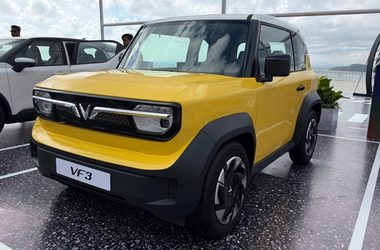
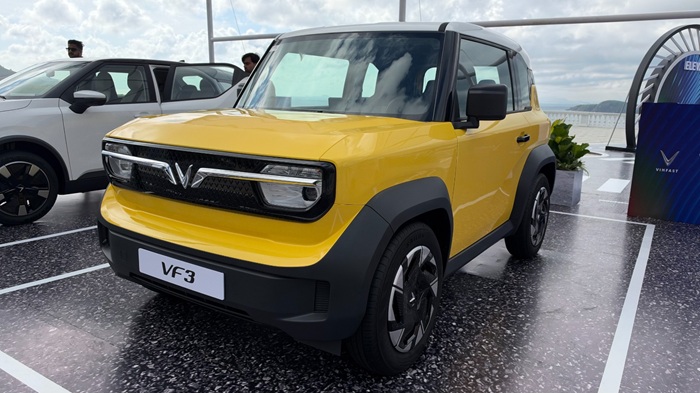
The VF 3’s design is minimalist, compact, contemporary and deliberately playful. Rather than pursuing the aerodynamic, jellybean-like silhouette favoured by numerous modern electric vehicles, VinFast has opted for an almost unapologetically upright design.
Its squared-off proportions, short overhangs, pronounced wheel arches and relatively tall body give it the appearance of a miniature adventure vehicle. There is a suggestion of the Suzuki Jimny in its overall character, although the VinFast possesses its own visual identity and is designed around an entirely different mechanical philosophy.
The front end is dominated by a compact bonnet, chunky bumper treatment and a distinctive lighting arrangement. Interestingly, VinFast employs projector halogen headlamps rather than expensive LED units. It is a reminder that this is ultimately an affordable electric vehicle, and that not every piece of automotive technology needs to resemble something borrowed from a science-fiction film.
The side profile is arguably where the VF 3 looks most convincing. Its two-door configuration, upright roofline and substantial wheel-arch treatment create a sense of ruggedness that belies its modest dimensions. The electrically adjustable and folding outside mirrors are welcome conveniences, particularly given the sort of narrow parking spaces for which this vehicle seems destined.
The Plus variant wears 16-inch steel wheels wrapped in 175/75 R16 91H Sailun Atrezzo SH29 radial tubeless tyres manufactured in Vietnam. Steel wheels might sound rather utilitarian in an era of elaborately machined alloys, but they suit the VF 3’s character surprisingly well. More importantly, those generously proportioned tyre sidewalls have a practical role on imperfect roads.
The Summer Yellow paintwork of the featured car complements its cheerful personality particularly well. Pink, blue, green, grey, white, red and black are also available, alongside the option of a contrasting white roof.
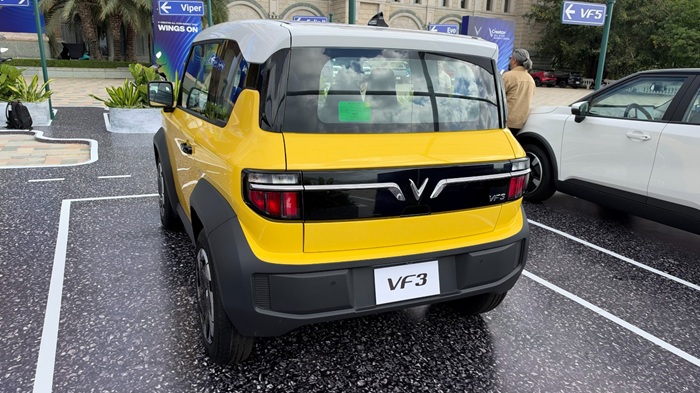
At the rear, the design continues the squared-off theme, with halogen tail lamps incorporating an emergency signalling system. The styling remains relatively uncomplicated, allowing the vehicle’s distinctive proportions to do most of the talking.
What makes the VF 3 especially fascinating, however, is what happens after it leaves the showroom. Vietnam has developed a substantial aftermarket ecosystem around this little EV, with owners personalising everything from wheels and paintwork to body kits and exterior accessories.
VinFast actively encourages this enthusiasm by organising an annual customisation competition for VF 3 customers. It is an unusually effective way of turning an inexpensive city car into something closer to a lifestyle product. In an industry increasingly dominated by visually interchangeable crossovers, that individuality deserves recognition.
Dimensions and practicality: Small by every sensible measure
The VF 3 measures approximately 3.2 metres in length, 1.7 metres in width and 1.6 metres in height. These dimensions make it exceptionally compact, even by the standards of small Indian hatchbacks.
Its 175 mm ground clearance is particularly relevant. Although the VF 3 looks like a miniature off-roader, that clearance is arguably more valuable when negotiating badly designed speed breakers, uneven urban surfaces and steep parking ramps than when contemplating an expedition into the wilderness.
The turning circle diameter is just nine metres, making tight manoeuvres considerably less intimidating. In congested city streets, where parking spaces often appear to have been designed for motorcycles rather than cars, the VF 3’s compact dimensions could prove more useful than an elaborate suite of automated parking technologies.
Kerb weight stands at just 857 kg, with a gross vehicle weight of 1,157 kg. The difference gives it a nominal payload capacity of 300 kg. With four adults aboard, however, there may not be a great deal of capacity remaining for luggage.
The roof can accommodate a load of up to 50 kg, providing an additional means of carrying equipment when necessary, subject to the appropriate loading limits.
The boot is, admittedly, rather ambitious in its interpretation of practicality. With all four seats occupied, there are just 36 litres of luggage space. That is sufficient for a few small bags, but a family airport run may require considerable diplomatic negotiations over who gets to bring a suitcase.
Fortunately, the second-row seats fold completely, increasing luggage capacity to 285 litres. In two-seat configuration, the VF 3 becomes a considerably more useful urban runabout.
It is a car best understood as compact personal transportation with occasional four-seat flexibility rather than a conventional family SUV.
Interior: Simplicity with a digital twist
The VF 3’s interior follows much the same philosophy as its exterior. There is little attempt to disguise the fact that this is an affordable electric car, although VinFast has made an effort to ensure that affordability does not necessarily translate into an entirely joyless cabin.
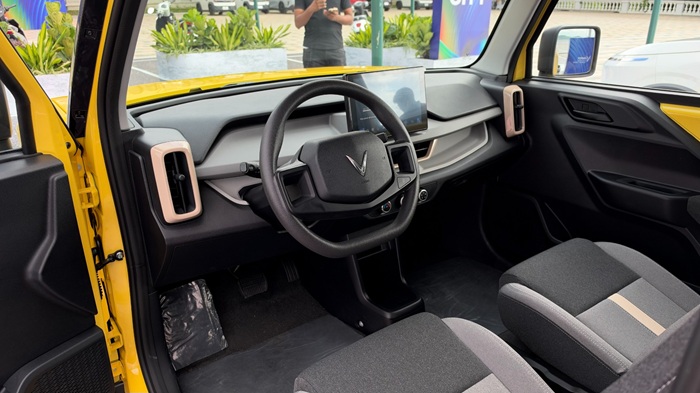
The dashboard adopts a minimalist layout, with a prominent 10-inch touchscreen infotainment system providing the technological centrepiece. The D-cut multifunction steering wheel introduces a welcome element of sportiness, even if the performance figures suggest that the steering wheel is rather more enthusiastic than the electric motor.
Fabric upholstery is standard, while both front seats feature four-way manual adjustment. There are no elaborate massage functions, electrically adjustable bolsters or twenty different seating profiles. You simply find a comfortable position and get on with the business of driving. There is something appealing about that simplicity.
Air conditioning is manually operated and incorporates a cabin dust filtration system. Considering the heat, humidity and urban pollution encountered across Southeast Asia, this is arguably a more useful feature than many of the technological gimmicks appearing in considerably more expensive cars.
The upright bodywork should help provide a relatively commanding driving position for such a small vehicle. Its compact bonnet and short exterior dimensions should also make judging the car’s extremities relatively straightforward.
Rear-seat accommodation is intended for two passengers. However, the two-door configuration inevitably compromises accessibility, particularly for elderly occupants or families regularly carrying young children. The VF 3 is better suited to couples, individual commuters and small households than buyers expecting the versatility of a conventional five-door hatchback.
Technology: Small car, surprisingly big ambitions
The VF 3’s infotainment system is considerably more sophisticated than its mechanical simplicity might suggest. The 10-inch touchscreen supports Apple CarPlay and Android Auto, alongside Bluetooth, Wi-Fi, USB connectivity, FM radio and an integrated eSIM.
There is also a web browser, driving statistics, vehicle self-diagnosis functionality and support for over-the-air software updates. The latter allows certain aspects of the car’s software to be updated without requiring a conventional workshop visit.
Camp Mode is another interesting inclusion. The idea of incorporating camping-related functionality into a vehicle measuring just 3.2 metres long is wonderfully optimistic, although it could prove useful for owners spending extended periods inside the stationary vehicle.
The audio system consists of just two speakers. Audiophiles accustomed to counting their speakers in double digits might wish to look elsewhere, but for listening to music, podcasts or navigation instructions during an urban commute, it should be adequate.
There is a pleasing contrast between the VF 3’s connected technology and its otherwise uncomplicated nature. VinFast has retained conventional cost-saving measures in areas such as seat adjustment, lighting and wheel construction while recognising that modern buyers increasingly expect smartphone integration and connected services regardless of how much their car costs.
Powertrain: Forty horses and no unnecessary drama
Underneath the VF 3’s compact bodywork sits a rather interesting electric powertrain. An 18.64 kWh lithium iron phosphate (LFP) battery supplies energy to a permanent magnet synchronous electric motor developing 40 horsepower and 110 Nm of torque.
The motor is mounted at the rear and drives the rear wheels. Yes, the VF 3 is rear-wheel drive, a configuration traditionally associated with sports cars, luxury saloons and enthusiastic discussions among automotive journalists. Here, however, the objective is efficient packaging rather than establishing a new lap record at the Nürburgring.
The lithium iron phosphate battery chemistry is a sensible choice for an affordable urban EV. LFP batteries are generally valued for their durability, thermal stability and relatively economical construction, although they typically offer lower energy density than certain alternative lithium-ion chemistries.
VinFast employs an air-cooled battery thermal management system. Compared with more elaborate liquid-cooled arrangements, this offers a simpler approach, although its ability to manage battery temperatures during repeated fast charging and particularly hot operating conditions would warrant closer examination.
Power delivery is managed through a shift-by-wire system, eliminating the need for a conventional mechanical connection between the drive selector and transmission.
There are two driving modes, Eco and Normal. Eco is intended to prioritise efficiency, while Normal allows the motor to operate with its regular performance characteristics. A creep function is also provided, allowing the car to move gradually at low speeds without significant accelerator input, much like a conventional automatic vehicle.
For a car intended to spend much of its life navigating congested streets, parking spaces and traffic junctions, creep functionality is a particularly sensible inclusion.
Performance: More traffic lights than racetracks
The VF 3 accelerates from 0 to 50 km/h in a claimed 5.3 seconds, while 0 to 100 km/h takes 19 seconds. Maximum speed is limited to 100 km/h.
Nobody will confuse those figures with the specifications of a performance car, although they make considerably more sense when viewed in the context of the VF 3’s intended environment.
With 110 Nm available from its electric motor and a kerb weight of just 857 kg, the little VinFast should feel reasonably responsive at typical urban speeds. Electric motors generally deliver their torque more immediately than small naturally aspirated petrol engines, which should help the VF 3 negotiate traffic junctions and short gaps in slow-moving traffic without excessive effort.
The 0–50 km/h figure is arguably far more relevant than its considerably less impressive 0–100 km/h time. In a crowded city, opportunities to reach triple-digit speeds tend to be about as common as finding an empty parking space outside a popular shopping centre on a Sunday evening.
Beyond urban speeds, however, the limitations of 40 horsepower become apparent on paper. Highway overtaking would require considerable planning, particularly with four occupants aboard. Its maximum speed also leaves little performance reserve for faster-moving expressway traffic.
The VF 3 makes considerably more sense as a dedicated city car, where predictable power delivery, compact dimensions and ease of operation matter more than outright acceleration.
Electric propulsion also eliminates conventional engine vibration and gear changes, although the actual levels of road noise, wind noise and motor whine would need to be assessed through a comprehensive road test.
Ride and handling: Properly engineered for everyday chaos?
Mechanically, the VF 3 combines independent MacPherson strut suspension at the front with a rigid rear axle supported by a Panhard rod.
It is a relatively straightforward suspension arrangement that prioritises simplicity and cost efficiency. The independent front suspension should allow each front wheel to respond individually to road imperfections, while the rigid rear axle provides a robust, uncomplicated solution at the back.
There are inevitable compromises. A rigid axle can transmit disturbances across the vehicle when one rear wheel encounters a significant bump. Combined with the VF 3’s short overall length and lightweight construction, sharper road imperfections could potentially produce a somewhat busy ride.
Its 175/75 R16 tyres, however, provide generously proportioned sidewalls, which should help absorb smaller surface irregularities before they reach the suspension. This is precisely the sort of sensible engineering decision that matters on roads where potholes occasionally appear to have been granted permanent residential status.
The rear-wheel-drive configuration separates propulsion from steering duties at the front wheels. Together with its nine-metre turning circle diameter, this should contribute to manoeuvrability in confined urban environments.
Its relatively tall body, however, suggests that enthusiastic cornering is unlikely to be its natural habitat. The VF 3’s priorities are clearly urban agility and convenience rather than high-speed chassis sophistication. Steering feedback, body roll, suspension damping and directional stability at highway speeds would require actual driving assessment before definitive conclusions could be drawn.
Braking duties are handled by disc brakes at the front and drum brakes at the rear. While rear drum brakes might seem rather old-fashioned, they are not an unreasonable choice for an inexpensive electric vehicle weighing less than 900 kg.
The VF 3’s rugged appearance should not be mistaken for serious off-road engineering, either. Its ground clearance is useful for rough surfaces, but the rear-wheel-drive layout and absence of confirmed dedicated off-road hardware make it fundamentally an urban vehicle dressed in adventure clothing.
Think difficult parking ramps and broken roads rather than the Camel Trophy.
Range and charging: Making smaller batteries work
VinFast claims a driving range of 215 km from the VF 3’s 18.64 kWh battery pack. For a vehicle primarily designed around urban commuting, that represents a potentially useful amount of mobility without requiring a particularly large or expensive battery.
The decision to keep battery capacity modest brings several advantages. It helps control vehicle weight, manufacturing costs and charging requirements. There is little point in carrying several hundred kilograms of additional battery capacity if your typical daily journey consists of travelling to work, visiting a supermarket and returning home.
Using a 3 kW AC charger, the VF 3 can replenish 60 percentage points of its battery capacity in a claimed five hours. A 24 kW DC charger reduces the quoted time for an equivalent charge to approximately 36 minutes.
These are partial-charging figures rather than full zero-to-100 per cent charging times. Actual charging duration will depend on battery temperature, starting charge level and charger performance.
The DC charging capability is particularly welcome in this class, where some inexpensive electric vehicles rely heavily on relatively slow AC charging.
For buyers with access to overnight home charging, the VF 3 could potentially make the traditional weekly visit to a petrol station entirely unnecessary. Its small battery should also make routine charging relatively affordable, depending on local electricity tariffs.
Real-world range will inevitably vary according to speed, passenger load, air-conditioning usage, traffic conditions and ambient temperature. The quoted 215 km remains a manufacturer claim rather than an independently verified road-test result.
Safety: The most significant compromise
The VF 3 incorporates ABS, electronic brakeforce distribution, traction control and hill-start assist. There is also a rear-view camera, rear parking assistance and speed-sensitive automatic door locking.
Front seat belts feature pretensioners and load limiters, while additional equipment includes a seat-belt reminder, theft alarm and immobiliser.
An acoustic vehicle alerting system helps warn pedestrians of the vehicle’s presence at low speeds, an important consideration given the relative quietness of electric propulsion.
However, the most disappointing aspect of the VF 3’s safety package is the provision of just one airbag.
Affordability is certainly important, but occupant protection is an area where cost-cutting deserves considerably greater scrutiny than the absence of alloy wheels or an elaborate sound system. A more comprehensive airbag package would make the VF 3 a significantly more reassuring proposition for families.
No independently verified crash-test rating is provided in the supplied vehicle information. Consequently, its structural crashworthiness and overall occupant protection cannot be conclusively assessed here.
It is an area where VinFast has considerable scope for improvement, particularly if the VF 3 is eventually introduced into additional international markets.
Ownership: A small car with a substantial warranty
One of the VF 3’s strongest ownership propositions is its warranty coverage.
VinFast offers a seven-year or 1.60 lakh km vehicle warranty, alongside an impressive ten-year or two lakh km battery warranty, subject to the applicable terms and conditions.
Such extensive coverage could help reassure buyers concerned about the long-term durability of electric vehicle batteries and the potential cost of major component replacement.
The relatively straightforward mechanical construction, absence of a conventional combustion engine and modest battery capacity should also contribute to manageable routine maintenance requirements.
However, long-term reliability, replacement-part availability, battery degradation and resale values will ultimately depend on actual ownership experiences over several years.
The VF 3’s popularity in Vietnam could prove advantageous in this regard. A substantial owner community creates demand for accessories, replacement parts, independent servicing expertise and aftermarket support.
In many respects, the customisation culture surrounding the VF 3 may become just as important to its long-term appeal as the vehicle itself.
Could the VF 3 work in India?
India presents an intriguing potential market for the VinFast VF 3. Congested metropolitan roads, limited parking infrastructure, rising urban transport costs and growing interest in affordable electric vehicles make its basic philosophy particularly relevant.
Its most obvious potential competitor would be the MG Comet EV. Both vehicles embrace compact proportions, four-seat accommodation and city-focused electric mobility. The MG adopts a more futuristic urban appearance, whereas the VinFast delivers considerably more visual ruggedness and a miniature SUV personality.
The Tata Tiago EV offers a different proposition altogether. Its conventional hatchback architecture makes it better suited to buyers seeking a primary family car, while its more powerful motor options provide greater flexibility beyond city limits. The VF 3 counters with its distinctive styling, compact footprint and stronger emphasis on individuality.
At its Vietnamese equivalent price of ₹10.23 lakh to ₹10.63 lakh, the VF 3 would face meaningful competition from established Indian-market EVs. Competitive local pricing, comprehensive safety equipment and a dependable service network would therefore be crucial to its prospects.
Its biggest opportunity might lie among households looking for a second car, young professionals, urban commuters and buyers who appreciate distinctive automotive design but have little need for a full-sized SUV.
Verdict: Small car, big character
The VinFast VF 3 is one of those rare modern automobiles that manages to be interesting without relying on enormous horsepower figures, extravagant luxury features or a price tag resembling the deposit on an apartment.
Its charm comes from its compact proportions, cheerful styling, straightforward engineering and refreshingly clear sense of purpose. The rear-wheel-drive layout, 215 km claimed range, connected infotainment system, extensive warranty and enthusiastic customisation community give it a personality considerably larger than its physical dimensions.
It is far from perfect. The single airbag is a significant disappointment, luggage capacity with four passengers aboard is extremely limited, rear-seat access is compromised and highway performance is modest. Nor should its chunky exterior fool anyone into believing that this is a miniature Land Rover Defender.
At approximately ₹10.63 lakh in Vietnam, the Plus variant makes the strongest case for itself as a fashionable, compact urban EV rather than an all-purpose family vehicle. Buyers regularly undertaking long journeys or carrying several passengers and their luggage would be better served by a conventional electric hatchback or crossover.
Nevertheless, the VF 3 deserves recognition for doing something the automotive industry occasionally forgets: making affordable motoring entertaining.
In an era when manufacturers seem determined to make every successive SUV longer, wider, heavier and more expensive, Vietnam’s favourite little electric car offers a wonderfully persuasive counterargument.
Perhaps the future of urban mobility doesn’t need another 500-horsepower electric SUV. Perhaps it simply needs 40 horses, four seats, a bright yellow paint job and a little imagination.