SEOUL: Hyundai Motor Company plans to launch or refresh 26 vehicles in India by 2030, including a new locally developed electric SUV and a new internal-combustion-engine mid-size SUV, as the South Korean automaker significantly expands its global product portfolio. Its luxury brand Genesis will also enter India in the near future, marking another important addition to the country’s increasingly crowded premium-car market.
The India strategy forms part of Hyundai Motor’s global plan to launch or refresh more than 100 vehicles by 2030 while targeting annual sales of 5.55 million vehicles and a global market share of 6%.
Hyundai disclosed the roadmap at its 2026 CEO Investor Day, where the company also said electrified vehicles are expected to account for 60% of its global sales by 2030, compared with 23% in 2025.
India will be among Hyundai’s biggest product markets under the plan. The company has outlined 58 launches and refreshes for North America, 49 for Korea, 41 for Europe, 26 for India and 22 for China.
Not all of the 26 India products will necessarily be completely new vehicles, as Hyundai’s figure includes both new launches and model refreshes. Even so, the scale points to one of the company’s most intensive product cycles in the country.
New Hyundai Electric SUV Coming to India
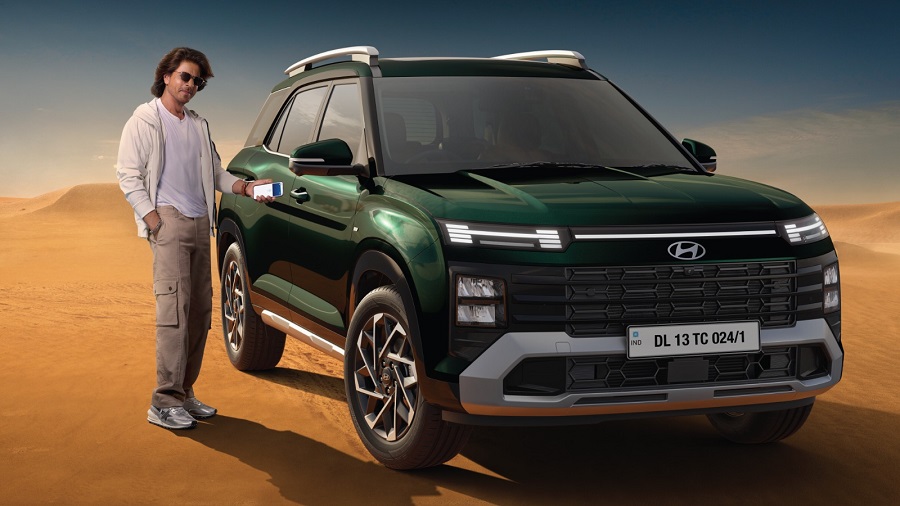
Hyundai said it will expand its SUV portfolio in India beginning with the launch of an all-new electric SUV in the fourth quarter.
The vehicle will be localised and designed for India and will feature a next-generation infotainment system along with Level 2 assisted-driving technology.
Hyundai has described it as an all-new A-segment SUV EV, placing it among the seven new products the company says will arrive globally within the next eight months.
India will also receive a new ICE-powered mid-size SUV, although Hyundai has not disclosed its name, launch timing or powertrain specifications.
The strategy suggests that Hyundai is not placing all of its chips on a single powertrain. Battery-electric vehicles, hybrids, extended-range EVs and conventional combustion engines are all expected to remain part of the company’s global mix.
“Our fundamentals have never been stronger. Hyundai Motor Group is the third-largest automotive group and the second-most profitable, which gives us the ability to invest while others are pulling back. We are bringing more than 100 new models to market by 2030 with multiple powertrain options and raising our operating margin above 9 percent. We are leveraging partnerships to scale new technologies and opportunities and becoming a physical AI company which will produce and deploy robots and robotaxis.” – José Muñoz, President and CEO of Hyundai Motor Company.
Hyundai to Add 320,000 Units of Capacity in India
India is also set to play a larger manufacturing role.
Hyundai Motor plans to expand its global production capacity by 1.27 million units by 2030, including an additional 320,000 units in India.
Other capacity additions include 500,000 units in North America, 250,000 units across completely knocked-down, or CKD, operations and 200,000 units in Korea.
Hyundai said its Indian manufacturing operations will have the capacity to produce 1.1 million vehicles annually.
The company is simultaneously working to increase localisation. Hyundai aims to source 90% of vehicle content in India by 2030, supported by more than 1,400 local suppliers and over 900 local engineers.
India will remain an important export hub as well. Hyundai expects to export around 30% of its India production volume by 2030, supplying vehicles to markets across the Middle East, Africa, Asia and South America.
Genesis Preparing to Enter India
Perhaps the bigger surprise at the luxury end of the announcement is Genesis.
Hyundai Motor confirmed that its premium brand will expand into India and Asia Pacific in the near future, although it did not announce a precise launch date or the models earmarked for the Indian market.
Genesis is entering its second decade with an ambitious expansion programme. Hyundai said the luxury marque aims to operate in more than 40 markets and reach annual sales of 350,000 vehicles by 2030.
Its global retail network is expected to grow to more than 270 locations, representing an increase of about 50%.
Genesis has already expanded into Italy, France, the Netherlands, Tunisia and Morocco, while Spain is scheduled to follow in the fourth quarter.
For India, the eventual arrival of Genesis would place Hyundai Motor Company in direct contention with established luxury manufacturers rather than leaving that end of the market entirely to European and Japanese brands. The parking lot, in other words, could become considerably more crowded.
GV90 to Lead Genesis’ Next Phase
Genesis’ future portfolio will be led by the GV90 flagship SUV, alongside an expanding range of electrified powertrains.
The GV80 Hybrid, the brand’s first hybrid vehicle, is scheduled to launch in the fourth quarter, while Genesis plans to introduce an EREV SUV in early 2027 targeting more than 640 miles of range.
The GV90 will also introduce Hyundai Motor’s new Thermal Runaway Protection technology, designed to prevent heat from spreading between battery cells in the event of a thermal incident.
Hyundai said the system has been verified through more than 200 repeated tests involving prismatic and pouch-type NCM batteries.
Hyundai Bets on Extended-Range EVs
One of the broader changes in Hyundai’s electrification strategy is the introduction of Extended Range Electric Vehicles, or EREVs.
Unlike a conventional hybrid, an EREV primarily operates through its electric drivetrain while carrying an onboard combustion-powered system that can generate electricity when required.
Hyundai’s first production EREV models are scheduled to arrive from the first half of 2027.
The Santa Fe EREV will be among the first and is expected to provide more than 600 miles of total range. It will be manufactured in the United States at Hyundai Motor Manufacturing Alabama.
Hyundai said its EREV architecture uses less than half the battery capacity of a comparable battery-electric vehicle while aiming to retain EV-style driving characteristics.
The company has also developed its own new battery cells, which it says provide more than twice the output of its previous high-nickel cells while reducing charging time by 40%.
EVs arriving next year are also set to use mid-nickel NCM cells that Hyundai says can cut battery costs by about 30% while maintaining performance in real-world conditions.
More Than 100 Hyundai Products by 2030
Globally, Hyundai plans more than 100 launches and model refreshes before 2030, including more than 18 entries into vehicle categories or market segments where it currently has limited representation.
Seven new products are expected within the next eight months.
They include the all-new Elantra, IONIQ 3, all-new Tucson, Tucson Hybrid, Santa Fe EREV, an A-segment electric SUV for India, an all-new global B-segment SUV and a B-segment SUV for Europe.
The Tucson and Tucson Hybrid will begin reaching initial markets in the fourth quarter. Hyundai said cumulative global Tucson sales have exceeded 10 million units, making it its most successful global nameplate.
The automaker is also examining categories where it has traditionally had a smaller presence, including body-on-frame vehicles, a midsize pickup and light commercial vehicles.
Hyundai estimates such “white space” segments account for roughly 29% of global automotive sales.
Hyundai N Targets 100,000 Annual Sales
Hyundai’s performance-focused N division is also being expanded.
The automaker wants the N range to reach 100,000 annual sales by 2030, supported by additional models and a new higher-volume performance tier.
That strategy reflects Hyundai’s attempt to cover an unusually wide spectrum of the automotive market — from compact electric SUVs to performance cars, luxury vehicles, commercial models and, eventually, machines that do not necessarily need a driver at all.
Robotaxis, Autonomous Cars and 50,000 GPUs
Hyundai’s roadmap stretches well beyond conventional cars.
The first IONIQ 5 Waymo robotaxis are scheduled for delivery in the fourth quarter of 2026. The vehicles will be assembled at Hyundai Motor Group Metaplant America in Georgia.
Hyundai said the programme could support international expansion of robotaxi services as early as 2027.
Motional will also use robotaxi-ready IONIQ 5 vehicles when its commercial driverless service launches later this year.
For its own autonomous-driving development, Hyundai will deploy Atria AI in Gwangju, South Jeolla Province, by the end of 2026 to collect real-world driving data.
In 2028, Hyundai plans to introduce Level 2+ autonomous-driving technology on its first mass-produced software-defined vehicle under a strategic collaboration with NVIDIA.
A much larger computing infrastructure will follow.
From 2029, Hyundai Motor plans to bring its Saemangeum AI Data Center online. The 100-megawatt facility is designed to accommodate more than 50,000 GPUs as the company builds the computing capacity required for artificial intelligence, software-defined vehicles and autonomous driving.
Atlas Humanoid Robots Planned for Hyundai Factory
Hyundai Motor is also accelerating commercialisation of robotics through Boston Dynamics.
Its Robot Metaplant Application Center, or RMAC, opened in the United States in June and is expected to expand tenfold by the end of 2026.
The facility is being used to train manufacturing AI robots, collect real-world operational data and conduct testing before robots are deployed on factory production lines.
Hyundai Motor aims to introduce Boston Dynamics’ Atlas humanoid robot at Hyundai Motor Group Metaplant America from 2028.
“Let me give some dimension on our opportunity to scale and deploy our robotics business,” explained Muñoz during the presentation. “Boston Dynamics is now part of Hyundai Motor Group. We’re building Spot and Stretch robots and soon, we’ll be mass producing Atlas humanoid robots. We have existing potential distribution for selling robots through our dealer partners. And Hyundai Capital is exploring the feasibility to finance sales of robots. Development, production, distribution, sales and finance for robotics. This is the power of the Group!”
The company is also entering the electric three-wheeler segment through a partnership with TVS Motor Company, with Hyundai designing the vehicles and TVS handling manufacturing.
Hyundai Raises 2030 Profit Target
The product expansion comes alongside a stronger profitability target.
Hyundai Motor has raised its 2030 consolidated operating profit margin target to above 9%, compared with its previous guidance of 8% to 9%.
The company expects its total operating profit to increase by 11% over the period while reducing its cost-of-sales ratio by three percentage points.
The planned reduction comprises 1.5 percentage points from cost innovation across the vehicle lifecycle, 1 percentage point from lower material costs and 0.5 percentage points from localisation.
Hyundai is maintaining its 2026 operating profit margin guidance of 6.3% to 7.3%, compared with 6.2% in 2025.
During the first half of 2026, Hyundai delivered two million wholesale vehicles and generated revenue of 95.2 trillion won, up 2.7% year-on-year. Its operating profit margin stood at 5.6%.
The company’s average market capitalisation during 2026 to date was about 105 trillion won.
India Takes a Bigger Role in Hyundai’s Global Strategy
Hyundai’s announcement makes clear that India is being positioned not simply as another high-volume sales market but as a larger manufacturing, engineering, sourcing and export base within the company’s global operations.
The combination of 26 launches and refreshes, 320,000 units of additional manufacturing capacity, 90% localisation, new electric products and the eventual arrival of Genesis could significantly broaden Hyundai Motor Company’s footprint in India before the end of the decade.
For Indian buyers, that means the Hyundai badge is likely to appear on a substantially wider variety of vehicles. For Hyundai, the challenge will be more complicated: converting an ambitious product calendar into profitable growth in one of the world’s most competitive automotive markets. With 26 launches and refreshes on the agenda, there should at least be no shortage of new metal to talk about.