

There are cars that become classics because they were fast, expensive or beautifully engineered. Then there are cars that become classics because absolutely nobody is likely to build anything quite like them again. The SAIL Badal belongs firmly to the second category. Launched in 1975, this tiny fibreglass-bodied machine attempted something wonderfully unconventional: take the basic mechanical philosophy of an auto-rickshaw, wrap it in station-wagon-like bodywork, add another door or two depending on which side you were standing, and sell the result as an economical family car.
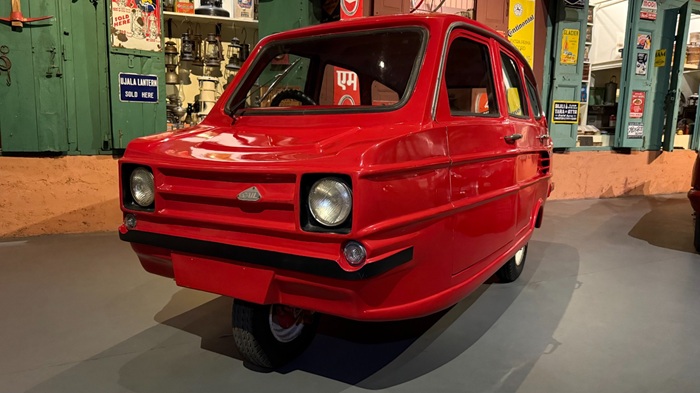
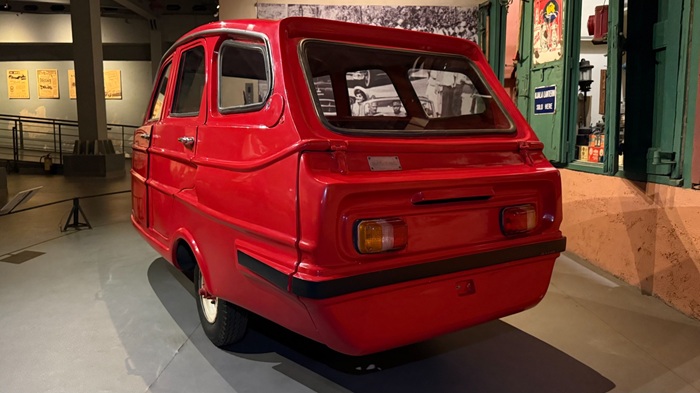
The example here is a 1978 first-generation Badal, and it is considerably more historically interesting than its modest 10 horsepower might suggest. This particular red car is associated with the 1980 Hindi film Ram Balram, in which Amitabh Bachchan and Dharmendra drove a Badal during the song Ek Rasta Do Rahi. Today, the car is displayed at collector Tarun Thakral’s Heritage Transport Museum. Hollywood has its Aston Martins, Italy has its Alfa Romeos, and India, quite magnificently, once put two of its biggest film stars into a three-wheeled fibreglass microcar.
More importantly, the Badal is regarded as India’s first three-wheeled car. It was produced in tiny numbers, with approximately 700 examples believed to have been sold before production ended in 1981. That makes merely seeing one today unusual. Seeing one with this sort of cinematic history makes it considerably more special.
And yet the Badal was not conceived as a museum curiosity. It was designed as practical transport for an India operating under very different economic and industrial circumstances. Its priorities were low running costs, fuel economy, manoeuvrability and maximum use of locally available technology. Its wonderfully optimistic advertising line summed that philosophy up neatly: “The optimum smileage car.” It is difficult to imagine a modern manufacturer having the courage to use the word “smileage”, which is perhaps another sign that progress does not always move in the correct direction.
Born in the Licence Raj
To understand the Badal, you need to understand the company behind it. Sunrise Automotive Industries Limited, better known as SAIL, was established in 1973. The company would later become Sipani Automobiles Ltd., taking its new name from founder Ridh Karan Sipani.
SAIL was one of three companies to receive licences to manufacture cars during India’s Licence Raj era; the other licences went to Maruti and Vadodara’s Manubhai Thakkar. The conditions were restrictive. According to the history associated with the Badal, manufacturers were not permitted simply to collaborate with an established foreign car company or rely on imported technology. The Badal therefore became an unusually indigenous exercise, assembled in Bangalore and using components sourced within India, including several mechanical parts from Scooters India.
That local-development story is important because the Badal’s appearance inevitably invites comparison with Britain’s Reliant Robin. Both employ the same instantly recognisable three-wheel layout, with a single wheel at the front and a pair at the rear. Some observers therefore describe the Badal as Robin-inspired.
There was, however, no Reliant Motors involvement in the original Badal project. Ironically, when Badal production was coming to an end, Reliant later approached SAIL with the possibility of manufacturing cars such as the Reliant Robin or Kitten in India. Reality, as usual, has a slightly more complicated plot than the obvious visual comparison.
Sipani itself survived until 2002, but the Badal remains arguably its most eccentric contribution to Indian motoring history.
A car, an auto-rickshaw, or something between the two?
Stand beside the Badal and its origins become fairly obvious. Mechanically, the concept is closely related to an auto-rickshaw, but its passenger compartment is enclosed by a streamlined fibreglass body designed to provide something approaching conventional-car practicality.
Calling it “streamlined” requires viewing the word through the lens of 1970s Indian transport, but there is genuine thought behind the shape. The anti-corrosive fibreglass body was developed by expert Gave Cursetjee, and beneath it sits a steel metal floorboard. Fibreglass offered obvious advantages for a small manufacturer working under restricted industrial conditions: it could resist corrosion, save weight and be moulded without requiring the enormously expensive metal-stamping infrastructure employed by major car companies.
The overall silhouette has something of a miniature station wagon about it. There is a relatively upright cabin, a long roofline and a useful-looking rear section. It is less “sports estate” and more “garden shed that has developed an unexpected interest in aerodynamics”, but there is charm in its complete lack of pretension.
The Badal was available in red, blue, black, green, yellow and white. The red of this particular car suits it rather well, particularly given its Bollywood history.
At the nose there is, of course, only one wheel. That single fact dominates both the styling and the engineering. The front bodywork tapers inward toward it, giving the Badal a distinctly narrow-footed stance from certain angles. You do not need to examine suspension geometry or aerodynamic coefficients to realise this is not a conventional car.
Then there is one of the Badal’s most entertaining design quirks: its asymmetric doors. One side has two doors, while the other has only one. In an era when modern manufacturers spend millions ensuring a car’s shut lines are perfectly symmetrical, the Badal cheerfully approaches the subject with, essentially, “three doors should be enough; decide among yourselves.”
The little SAIL Badal badges complete an exterior that is simple, functional and almost impossible to confuse with anything else.
Small outside, seriously light underneath
The Badal measures approximately 3 metres in length, 1.3 metres in width and 1.3 metres in height. Those dimensions make even today’s small hatchbacks look extravagantly large. In dense urban traffic, the Badal occupies roughly the amount of road space modern SUVs reserve for one alloy wheel and an illuminated grille badge.
Ground clearance is approximately 120 mm, which is not especially generous by contemporary Indian standards. But then the entire vehicle has a dry weight of only about 450 kg. That is less than the battery pack of some modern electric SUVs.
Despite its tiny mass, the Badal was rated for approximately 350 kg of payload. That is a substantial proportion of the vehicle’s own weight and a reminder that this machine was designed as practical transportation rather than merely an eccentric city toy.
Its weight distribution is quoted at 31 per cent over the front and 69 per cent at the rear. That rearward bias makes sense once you discover where the engine lives, and it also ensures the single front tyre does not have to carry an unreasonable amount of the Badal’s total mass.
The turning circle is 7.3 metres, giving the car the sort of manoeuvrability that made it particularly attractive in crowded urban environments. Tight lanes and awkward parking spaces are exactly the situations where something this narrow begins to make conventional cars seem unnecessarily ambitious.
It runs on tiny 10-inch steel wheels with 4.50-10 8PR Birla Roadmax BT 339+ tyres at both ends. Braking is via 150 mm drum brakes front and rear. No giant painted calipers, no ventilated discs, no brake-by-wire algorithm—just drums tasked with stopping 450 kg and ten horsepower. Context is everything.
Rear-engined, rear-wheel drive — technically exotic, just not quickly
One of the most fascinating aspects of the Badal is its drivetrain layout. The engine sits at the rear and drives the rear wheels. Period accounts have even suggested that the Badal may have been among the earliest, possibly the first, made-in-India rear-engined cars, although that claim is best treated cautiously rather than as settled fact.
Whatever the historical ranking, the layout itself is intriguing. Rear-engine, rear-wheel drive is the architecture associated with machines as diverse as the Volkswagen Beetle, Porsche 911 and several classic city cars. The Badal joins that mechanical family in much the same way a ceiling fan and a helicopter can both technically be described as rotating-wing devices.
The engine comes from Scooters India: a 198 cc, single-cylinder, air-cooled, two-stroke petrol unit, described in the source material as having a horizontally opposed configuration. The cylinder block is cast iron while the cylinder head is light alloy.
Maximum output is 10 horsepower, accompanied by 21 Nm of torque. Those numbers look almost comical today, but remember that the entire vehicle weighs 450 kg dry. The power-to-weight ratio is still modest, certainly, but the Badal was designed to move people economically rather than disturb the timing equipment at a drag strip.
Drive is sent through a four-speed manual gearbox and a wet-type clutch.
There is no diesel, no automatic and obviously no hybrid assistance. The Badal was sold only with its petrol two-stroke powertrain, and when new its price was approximately Rs. 15,000.
That sounds astonishingly inexpensive from a modern perspective, though comparing rupee figures across half a century without accounting for inflation and purchasing power is of limited value. What does matter is intent: this was designed to be accessible transport.
Ten horsepower, used enthusiastically
The performance numbers deserve appreciation in the appropriate frame of reference. Zero to 50 km/h takes 15 seconds. Reaching 75 km/h takes 37.5 seconds, and 75 km/h is also quoted as the top speed.
Modern performance testing would therefore produce a slightly unusual result: 0-75 km/h in 37.5 seconds, followed immediately by… nothing further.
Yet driving something like the Badal is not about waiting impatiently for a three-digit speedometer reading. At urban speeds the combination of low mass, short gearing and a two-stroke engine would have made it feel much more animated than the raw horsepower figure suggests. There is very little vehicle for those 21 Nm to move, and every throttle input is dealing with mechanical components rather than several layers of software consultation.
The four-speed manual gearbox is part of the experience. You work with the engine rather than simply requesting acceleration from it. Momentum matters. Planning matters. A gap in traffic must be assessed not merely according to distance but perhaps also according to prevailing wind direction.
The quoted 0-50 km/h time of 15 seconds is enough for typical city use of the period, and that was exactly where the Badal’s strengths lay. On modern expressways it would clearly be out of its depth, but judging it by today’s highway standards would be like criticising a fountain pen because it cannot send an email.
Refinement, similarly, belongs to another era. A single-cylinder air-cooled two-stroke mounted behind the cabin is not a recipe for near-silent progress. You would hear the engine working, sense vibration through the structure and know quite clearly when another gear was required. In a modern luxury vehicle, engineers spend years isolating occupants from mechanical activity. The Badal takes the opposite approach: the machinery is part of the conversation.
Suspension engineered for the job
Under the front sits a suspension arrangement using helical springs with telescopic hydraulic shock absorbers. At the rear, the Badal uses telescopic hydraulic dampers combined with longitudinal semi-elliptic multi-leaf springs.
That rear arrangement sounds more commercial vehicle than sports car, but once again it reflects the Badal’s working brief. This was a vehicle expected to carry passengers and luggage, and some examples were even pressed into taxi service.
Rack-and-pinion steering handles directional duties. With one tyre doing the steering, little mass over the nose and only a 1.3-metre-wide body to position, the Badal would have been wonderfully easy to place in urban traffic.
Its 7.3-metre turning circle reinforces that impression. Manoeuvrability was one of the car’s selling points, and in tightly packed Indian towns it must have felt exceptionally agile compared with larger contemporary automobiles.
The more delicate question is cornering.
Three-wheelers with a single front wheel inevitably come with unusual dynamics. The Badal’s 31:69 front-to-rear weight distribution puts most of the mass over its widely spaced rear wheels, which helps, but physics remains physics. This is not something you attack mountain switchbacks in as though qualifying for Monte Carlo.
Drive it within the limits for which it was intended, however, and the Badal’s light weight and compact dimensions are the more relevant qualities. Its task was to carry people economically over ordinary roads, negotiate congestion and park easily, not set lateral-g records.
Broken roads would expose the inherent simplicity of the suspension, particularly with such a short, light structure and tiny wheels. The leaf-sprung rear is more interested in carrying load than delivering limousine isolation, while 10-inch tyres have only so much ability to absorb potholes before submitting a formal complaint.
But durability and simplicity mattered more than polish. There was less to go wrong, mechanical systems were relatively straightforward, and the car’s low mass reduced the punishment dealt to components.
A wonderfully basic cabin
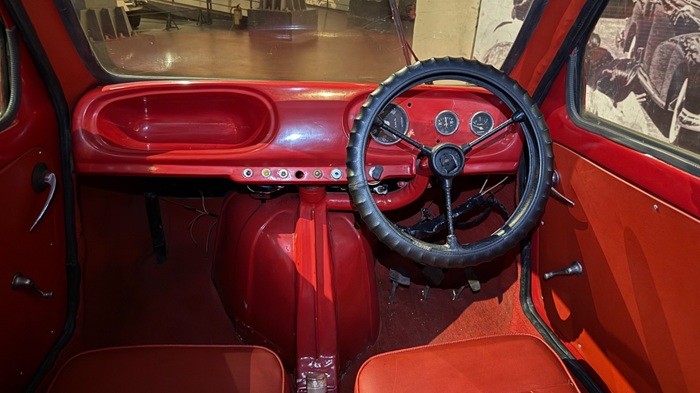
Inside, the Badal feels every bit the product of an era before touchscreens turned dashboards into electronic department stores. There is no vast infotainment display, no wireless smartphone integration and no ambient lighting with 64 colours from which you’ll eventually select blue and forget about forever.
Instead, the driver gets the information required to operate the machine. There are warning lights for functions including oil and indicators, along with other basic tell-tales. Controls are simple and mechanical. The steering wheel operates rack-and-pinion steering. The manual gearlever connects you directly with a four-speed transmission. Everything exists because the car needs it.
The cabin’s fibreglass structure and steel floor reinforce the utilitarian atmosphere. Material quality cannot sensibly be compared with a modern hatchback assembled by robots to fractions of a millimetre. This was a low-volume Indian car engineered under restrictive industrial conditions more than four decades ago.
What deserves greater appreciation is the packaging.
With the engine mounted at the rear and only one front wheel consuming space up ahead, the Badal could devote much of its compact footprint to passengers. Its station-wagon-like roofline provides a practical shape rather than chasing style at the expense of room.
It was never luxurious, but practicality and weather protection were significant improvements over more exposed forms of three-wheeled transport. For families or taxi operators, that mattered considerably more than soft-touch plastics.
The asymmetric door arrangement also makes cabin access part of the Badal’s personality. Two doors on one side and one on the other would never survive a modern product-planning committee without a PowerPoint deck explaining the “user journey”, but here it feels charmingly direct.
Economy was the superpower
If performance was not the Badal’s defining statistic, fuel consumption certainly was.
The claimed average was approximately 25 km/l, impressive even by the standards of many much newer petrol cars. Combined with a 15-litre fuel tank, that theoretical figure gives the Badal a useful potential operating range, although actual consumption would naturally depend on load, road conditions and driving style.
Fuel economy was central to the car’s appeal. Contemporary descriptions celebrated its mileage, on-road performance, futuristic styling and manoeuvrability. The slogan “The optimum smileage car” was not merely advertising whimsy; it captured the logic of the entire vehicle.
A lightweight fibreglass body, tiny engine and modest performance demands meant the Badal could make efficient use of petrol at a time when running cost was an extremely important consideration for buyers.
It is also easy to understand why examples found work as taxis. A small footprint, low fuel consumption, relatively simple mechanical components and enclosed passenger body make a sensible urban transport package even if the specification now appears unconventional.
In that context the Badal starts to look less like an eccentric engineering joke and more like a rational answer to a very specific Indian mobility problem.
Before safety became an acronym competition
Safety technology on a 1970s Badal is, understandably, almost entirely mechanical. There are no airbags, ABS, ESC, traction control systems, cameras, tyre-pressure sensors or driver-assistance features in the specification supplied here, and there is no crash-test rating to cite.
The braking system consists of 150 mm drum brakes, while the car’s greatest passive advantage is probably its extremely low mass and limited maximum speed—although neither should be mistaken for modern crash protection.
A three-wheeled layout also demands appropriate respect from the driver. Its handling characteristics cannot be approached in the same manner as a contemporary four-wheel hatchback with electronic stability control quietly waiting to correct an ambitious decision.
By modern standards, then, the Badal belongs in the world of historical motoring rather than everyday family safety expectations. That is not criticism so much as chronology.
Why there was a four-wheel Badal
The story did not end with three wheels. In 1981, SAIL introduced a four-wheel version called the Badal 4. It was an obvious development of the concept, although it arrived just as the original three-wheeled Badal was being discontinued.
The original car’s production run therefore lasted from its 1975 introduction until 1981. With only around 700 units sold, survival rates today are understandably low.
That rarity is one reason the Badal deserves greater recognition in Indian automotive history. India has produced millions of Ambassadors, Marutis, Fiats, Mahindras and Tata vehicles, but the country’s automotive development also includes small companies prepared to try ideas outside the established formula.
The Badal is one such experiment.
It emerged in an era when domestic manufacturers faced regulatory restrictions and limited access to foreign technology. Rather than simply importing a ready-made design, SAIL created an indigenous body, sourced available Indian mechanical components and assembled the result in Bangalore.
Whether or not every part of the concept worked brilliantly is almost secondary to the ambition.
The Bollywood car
Then there is this particular Badal’s second life as a film star.
The model became famous after appearing in the 1980 film Ram Balram. Amitabh Bachchan and Dharmendra drove a Badal during Ek Rasta Do Rahi, giving the three-wheeler the kind of cultural exposure most obscure small-volume cars could only dream of.
The red example seen here is identified as that film car and now sits in Tarun Thakral’s Heritage Transport Museum.
That makes approaching it rather different from inspecting a restored anonymous example. It is not merely an old car; it is an artefact from a period when India’s automotive and cinematic cultures were both changing rapidly.
You can imagine the Badal in its original setting far more easily than you can imagine it in today’s traffic. Small streets, modest speeds, fewer oversized SUVs, two-stroke exhaust notes and a pair of Bollywood legends squeezing performance from ten horsepower. It is an image that feels almost absurdly charming now.
What was it competing with?
The Badal’s real competition was not necessarily another three-wheeled passenger car. Its challenge was to bridge the gap between basic three-wheeled transport and a conventional automobile.
Compared with an auto-rickshaw, the Badal offered a more car-like enclosed body and station-wagon-style practicality. Compared with traditional cars of its era, it promised a smaller footprint, lower weight, excellent fuel economy and easier manoeuvrability.
The compromises followed naturally. Performance was modest, refinement basic, the three-wheel layout imposed dynamic limitations, and the manufacturing sophistication of a major conventional carmaker was never really part of the equation.
But that is what made the Badal distinctive. It did not attempt to beat ordinary cars by playing their game. It attempted to create a cheaper, lighter and more economical category of transport all its own.
Verdict
It would be easy to treat the SAIL Badal purely as a novelty. After all, here is a three-wheeled Indian “car” with a 198 cc two-stroke engine, ten horsepower, 10-inch wheels, three asymmetrically arranged doors and performance figures that would give a modern superbike enough time to complete its acceleration run, stop for tea and return.
That would also miss the point.
The Badal is interesting precisely because its engineering makes sense when viewed through the economic and regulatory reality that produced it. India in the 1970s was not today’s enormous globally integrated automotive market. Manufacturers worked under strict licensing rules, imported technology was difficult to access, and affordable personal mobility remained a serious engineering challenge.
SAIL’s answer was wonderfully pragmatic. Use Indian components. Keep the vehicle light. Give it an anti-corrosive fibreglass body. Put the little two-stroke engine at the back. Drive the rear wheels. Make it manoeuvrable enough for crowded cities. Extract around 25 km/l. Sell it for roughly Rs. 15,000. And if a fourth wheel appears unnecessary, well, that’s material saved.
The Badal was not fast. It was not luxurious. By modern standards it was not sophisticated, and contemporary safety expectations have moved far beyond what a three-wheeled 1970s microcar can provide. Its suspension and mechanical refinement were basic, while its 75 km/h maximum speed placed firm boundaries around the sort of journeys it could undertake comfortably.
But it was inventive.
It was light, economical, distinctively Indian and sufficiently useful that some examples became taxis. It carried approximately 350 kg despite weighing only around 450 kg dry. It could turn within 7.3 metres. It offered enclosed transport with remarkable fuel economy. And for a brief period it represented one company’s attempt to solve mass mobility without simply copying the conventional four-wheeled template.
Around 700 were sold, production ended in 1981, and SAIL’s later Badal 4 quietly added the wheel most people expected to see in the first place.
Today the original Badal is far more valuable as history than as transportation. This red Ram Balram example takes that significance even further: it connects India’s early independent automotive manufacturing effort with one of Bollywood’s most recognisable eras.
The SAIL Badal ultimately feels less like a failed conventional car and more like an idea from an alternate version of Indian motoring—one in which tiny rear-engined fibreglass three-wheelers might genuinely have become normal family transport.
They didn’t.
And that is exactly why the Badal is now so compelling.
It has only three wheels, ten horsepower and perhaps one door fewer than common sense intended. Yet in terms of character, history and sheer ability to make you stop and stare, this tiny 1970s machine has more than enough.
“The optimum smileage car,” SAIL called it.
Nearly half a century later, the mileage is almost irrelevant. The smile remains.