The road-legal 296 Challenge Stradale packs 670 hp, weighs just 1,330 kg and generates 617 kg of downforce, while its racing counterpart prepares for the 2027 Ferrari Challenge season.
Montmeló, Spain: Ferrari has unveiled the 296 Challenge Stradale and 296 Challenge Evo at the 2026 Ferrari Finali Mondiali, introducing two closely related machines that further narrow the distance between the Italian manufacturer’s road cars and racing programme. Both feature a 2.9-litre twin-turbocharged V6 engine without hybrid assistance, putting lightweight construction, aerodynamic performance and driver engagement at the centre of their development.
Presented at the Circuit de Barcelona-Catalunya in Montmeló, the 296 Challenge Stradale brings competition-derived engineering to a road-legal package, while the 296 Challenge Evo will make its competitive debut in the 2027 Ferrari Challenge season.
In an automotive industry increasingly devoted to electrification, Ferrari’s latest duo makes a compelling case for subtraction rather than addition.
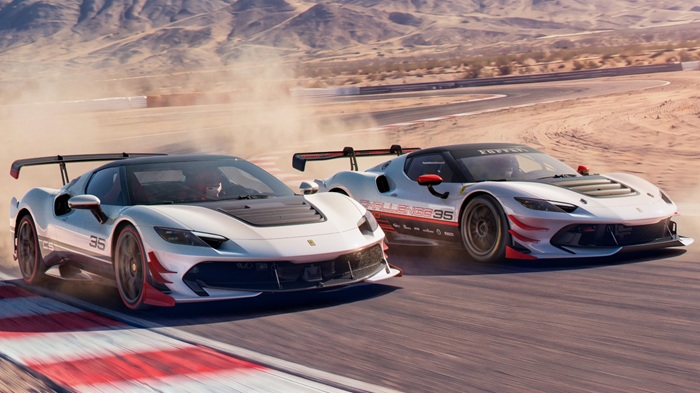
Ferrari 296 Challenge Stradale: A Race Car With Number Plates
Ferrari describes the 296 Challenge Stradale as the model offering the closest connection to a race car within its current road-going line-up. Rather than pursuing outright horsepower through electrification, the Maranello manufacturer has focused on reducing weight, improving responsiveness and delivering consistent performance during extended track sessions.
Power comes from a 2,992 cc, 120-degree twin-turbocharged V6 engine producing 670 hp at 8,000 rpm and 740 Nm of torque at 6,250 rpm. The engine features a dry-sump lubrication system, a compression ratio of 9.4:1 and a maximum engine speed of 8,500 rpm.
An eight-speed F1 dual-clutch transmission sends power to the rear wheels. Gear changes under heavy acceleration take approximately 170 milliseconds, while a dedicated calibration derived from the SF90 XX Stradale improves smoothness at lower engine speeds.
The removal of hybrid components, combined with lightweight materials and a revised driveline, has helped Ferrari achieve a dry weight of 1,330 kg with optional equipment — 140 kg lighter than the 296 GTB. The resulting power-to-weight ratio stands at 1.98 kg per horsepower.
The numbers are suitably serious. The 296 Challenge Stradale accelerates from 0 to 100 km/h in 2.8 seconds and reaches 200 km/h in 7.9 seconds, with a top speed exceeding 300 km/h. Braking from 200 km/h to a standstill requires just 101 metres.
Around Ferrari’s Fiorano test circuit, the car has recorded a lap time of 1 minute and 18.5 seconds.
Aerodynamics That Put 617 Kg of Pressure on the Road
The 296 Challenge Stradale generates 617 kg of downforce at 250 km/h, representing a 72 per cent increase over the 296 GTB.
Its aerodynamic package includes a prominent fixed rear wing, enlarged front splitter, aerodynamic flicks, vortex generators, aero dampers and a completely enclosed underbody. The rear wing alone contributes 270 kg of downforce at 250 km/h.
Ferrari says development involved thousands of hours of computational fluid dynamics simulations and hundreds of hours of wind-tunnel testing.
The aerodynamic system has also been engineered to accommodate everyday road conditions, including speed bumps and changes in road surfaces — a modest concession to life outside the pit lane.
Race-Derived Suspension, Brakes and Electronics
The 296 Challenge Stradale features dedicated suspension geometry, revised semi-active dampers and springs approximately twice as stiff as those used in previous applications.
Compared with the 296 GTB, Ferrari claims a 7 per cent improvement in maximum lateral performance, a 34 per cent improvement in stability and a 68 per cent reduction in roll gradient.
Braking duties are handled by carbon-ceramic discs measuring 398 mm at the front and 380 mm at the rear. A dedicated cooling system compensates for the absence of regenerative braking.
Pirelli has developed bespoke P Zero R and P Zero Trofeo RS tyres for the model, with the latter offering a semi-slick construction focused on circuit performance.
The electronic package includes predictive slip control, Ferrari’s Side Slip Control 9.0, ABS Evo, an electronic differential and the Ferrari Integrated Vehicle Estimator (FIVE) system derived from the flagship F80.
Drivers can select from five Manettino settings: Wet, Sport, Race, CT-Off and ESC Off.
The absence of a hybrid system has also prompted the introduction of a Belt Starter Generator combining starter and alternator functions, a first for a Ferrari road car.
Flavio Manzoni’s Team Gives Function Priority Over Decoration
Developed by the Ferrari Design Studio under the leadership of Flavio Manzoni, the 296 Challenge Stradale retains the compact proportions of the 296 GTB while incorporating functional elements from its racing counterpart.
The front features a substantial aerodynamic insert on the bonnet, enlarged air intakes and openings that draw air from the underbody. At the rear, a fixed wing supported by hollow struts, a black metal mesh and a redesigned diffuser emphasise the car’s competition origins.
Seven twin-spoke wheels complete the exterior, while optional forged wheels reduce unsprung mass by approximately 11.9 kg.
Inside, the cabin follows the general architecture of the 296 GTB but adopts a considerably more minimalist approach. Single-piece carbon-fibre door panels dispense with conventional armrests and storage pockets, while an optional interior configuration removes sections of carpeting and trim to expose parts of the chassis.
Carbon-fibre tubular seats derived from the SF90 XX Stradale offer a 25 per cent weight reduction compared with standard racing seats.
Despite its stripped-back character, the Ferrari retains modern conveniences such as wireless smartphone charging, along with driver assistance technologies including adaptive cruise control, automatic emergency braking, lane-keeping assistance, blind-spot detection and rear cross-traffic alert.
Ferrari will also offer its seven-year Genuine Maintenance programme, covering scheduled servicing every 20,000 km or once a year.
Ferrari 296 Challenge Evo: 700 HP for the Racetrack
Alongside its road-going sibling, Ferrari introduced the 296 Challenge Evo, an evolution of the 296 Challenge that has competed in the manufacturer’s single-marque championship since 2024.
The track-only model features the same 2,992 cc twin-turbocharged V6 architecture but produces 700 hp at 7,500 rpm and 740 Nm of torque at 6,000 rpm. Power is transmitted through a seven-speed F1 dual-clutch gearbox.
With a dry weight of 1,330 kg, the Evo delivers a specific power output of 234 hp per litre.
Its most significant developments, however, are found in aerodynamics and vehicle dynamics rather than beneath the engine cover.
Maximum downforce has increased by 12 per cent, equivalent to an additional 100 kg at 250 km/h compared with the outgoing 296 Challenge. A newly introduced Low Drag configuration reduces aerodynamic resistance by 4 per cent, allowing teams to optimise the car for high-speed circuits.
The revised aerodynamic package incorporates carbon-fibre components, a redesigned rear diffuser, new rear-view mirrors, extended rear-wing adjustment settings and aircraft-inspired wing endplates.
Teams can also increase the rear ride height by up to 10 mm, generating approximately 30 kg of additional downforce at 250 km/h.
Updated traction-control strategies, electronic differential calibrations and revised brake-pedal characteristics are intended to improve stability, cornering performance and consistency over longer racing distances while reducing tyre degradation.
In comparative testing at Mugello, the 296 Challenge Evo in its High Downforce configuration recorded a lap time 0.8 seconds quicker than its predecessor — a meaningful gain in a championship where every fraction of a second matters.
Ferrari Challenge Enters Its 35th Season in 2027
The 296 Challenge Evo will become the tenth model in the history of the Ferrari Challenge Trofeo Pirelli, which was established in 1993 with the 348 Challenge.
The championship has since featured several generations of Ferrari competition cars, including the F355 Challenge, 360 Challenge, F430 Challenge, 458 Challenge, 488 Challenge and their respective evolutionary models.
The Evo will initially compete in the European and North American series in 2027, before joining regional championships from 2028.
Ferrari is also expanding its international racing programme with a new Middle East series, beginning in Bahrain on December 11–12, 2026, followed by events in Qatar, Saudi Arabia and Abu Dhabi.
The European championship will introduce a new endurance format in 2027, featuring 40-minute races plus one lap at Mugello, Hockenheim and Valencia, with mandatory pit stops and the option for two drivers to share a car.
Ferrari 296 Challenge Stradale vs 296 Challenge Evo: Technical Specifications
| Specification | 296 Challenge Stradale | 296 Challenge Evo |
|---|---|---|
| Application | Road-legal | Track-only |
| Engine | 2,992 cc twin-turbo V6 | 2,992 cc twin-turbo V6 |
| Maximum power | 670 hp | 700 hp |
| Maximum torque | 740 Nm | 740 Nm |
| Maximum engine speed | 8,500 rpm | 8,500 rpm |
| Transmission | 8-speed F1 DCT | 7-speed F1 DCT |
| Hybrid assistance | None | None |
| Dry weight | 1,330 kg* | 1,330 kg |
| Length | 4,678 mm | 4,795 mm |
| Width | 2,039 mm | 1,958 mm |
| Height | 1,301 mm | 1,159 mm |
| Wheelbase | 2,600 mm | 2,600 mm |
| Front tyres | 245/35 R20 | 280/680 ZR19 |
| Rear tyres | 305/35 R20 | 300/720 ZR19 |
| Front brake discs | 398 mm | 408 mm |
| Rear brake discs | 380 mm | 390 mm |
| 0–100 km/h | 2.8 seconds | Not disclosed |
| 0–200 km/h | 7.9 seconds | Not disclosed |
| Top speed | Above 300 km/h | Not disclosed |
*Stradale dry weight measured with optional equipment. Power figures follow Ferrari’s published metric horsepower ratings.
Pricing and Availability
Ferrari has not disclosed pricing, production numbers or customer delivery timelines for the 296 Challenge Stradale in its unveiling announcement. Official WLTP fuel consumption and carbon dioxide emissions figures are also pending homologation.
The simultaneous introduction of the 296 Challenge Stradale and 296 Challenge Evo underlines Ferrari’s continued reliance on motorsport as a development platform for its production cars. While hybrid technology remains an important part of the manufacturer’s broader portfolio, these two machines demonstrate that the pursuit of performance can still benefit from a lighter, mechanically simpler and more focused approach.
For Ferrari, the road from the racetrack to the showroom has rarely been this short.