

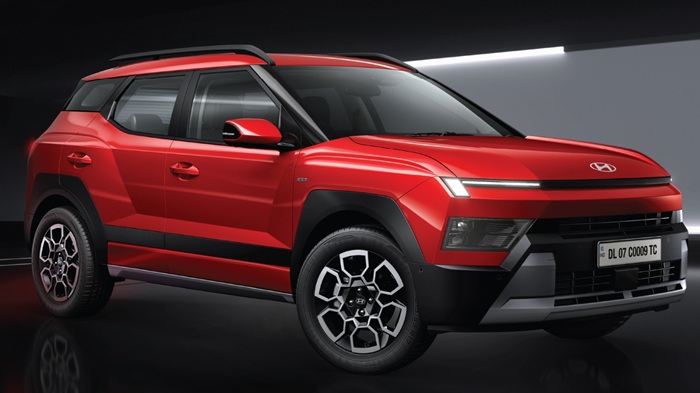
Gurugram: Hyundai Motor India Limited (HMIL) has unveiled the India-spec Hyundai Bayon ahead of its official launch on October 26, 2026. Positioned as an “Intelligent Utility Vehicle,” the new SUV introduces Hyundai India’s first Generative AI Voice Assistant, an NVIDIA-accelerated connected cockpit, dual 12.3-inch curved displays and extensive over-the-air software update capabilities. Bookings are now open for ₹11,000 through authorised Hyundai dealerships and the company’s official website.
The Bayon will be powered by a 1.5-litre, four-cylinder petrol engine producing 115 PS and 144 Nm of torque, with buyers offered a choice between a six-speed manual transmission and an Intelligent Variable Transmission (IVT). Deliveries are scheduled to begin during the festive season, although detailed timelines will be announced at launch.
Hyundai is placing particular emphasis on the Bayon’s digital capabilities, introducing several technologies intended to make the vehicle more conversational, connected and adaptable over time.
Hyundai Bayon Introduces Perplexity-Powered Generative AI Voice Assistant
One of the most significant additions to the India-spec Bayon is HMIL’s first Generative AI Voice Assistant, which combines intelligence from Perplexity with voice AI technology powered by SoundHound AI.
Unlike conventional voice recognition systems that largely depend on predefined commands, the new assistant is designed to understand natural conversations and respond to more complex requests.
According to Hyundai, drivers will be able to ask the system to prepare travel itineraries, check real-time weather conditions, recommend hotels and restaurants, identify nearby shopping destinations and provide sports scores and related information.
The integration represents Hyundai’s attempt to move in-car voice assistance beyond basic vehicle functions towards a broader information service. Whether drivers find themselves asking for directions or debating where to stop for dinner, the system is intended to offer assistance without requiring rigid command phrases.
Commenting on the technology, Tarun Garg, Managing Director and CEO, Hyundai Motor India Limited, said, “With Hyundai Bayon, we are introducing an Intelligent Utility Vehicle that places technology and convenience at the heart of the customer experience.”
The company describes the Bayon’s overall development philosophy as “Intelligence That Moves,” highlighting the integration of artificial intelligence, connectivity and software-driven features.
NVIDIA-Accelerated Connected Cockpit With Dual 12.3-Inch Displays
The Bayon features Hyundai’s Connected Car Navigation Cockpit (ccNC), an NVIDIA-accelerated infotainment architecture designed to combine navigation, vehicle controls, connected services and digital interfaces.
The system offers online onboard navigation, split-screen functionality, personalised control panels and smartphone-style quick controls.
A prominent feature of the cabin is the dual 12.3-inch curved panoramic display arrangement, which brings the digital instrument cluster and infotainment system together in a unified dashboard layout.
The displays provide access to driving information, navigation, entertainment and connected vehicle functions. Individual user profiles also allow selected interface settings to be personalised.
With two large screens occupying a substantial portion of the dashboard, the Bayon’s cabin places digital interaction at the centre of its design.
Over-the-Air Updates Supported Across Up to 19 Controllers
Hyundai has also equipped the Bayon with Vehicle Controller Over-the-Air (C-OTA) technology, supporting remote software updates for up to 19 vehicle controllers.
The system is designed to enable software enhancements and selected feature updates without requiring owners to visit a dealership.
According to the manufacturer, the technology can help streamline the rollout of improvements, reduce certain maintenance requirements and support ongoing safety and security enhancements.
The capability reflects the automotive industry’s growing emphasis on software-defined vehicles, where selected functionalities can continue to evolve after the vehicle has been delivered.
However, Hyundai has not specified the complete list of vehicle functions that will be eligible for remote updates.
More Than 70 Hyundai Bluelink Connected Features
The India-spec Bayon will offer Hyundai Bluelink connectivity with more than 70 connected features.
These include remote engine start and stop, vehicle information access, remote controls, smartphone and smartwatch integration, location-based services, navigation assistance and safety-related connectivity functions.
The connected ecosystem is intended to allow owners to access selected vehicle services even when they are away from the vehicle.
Hyundai has also focused on making the interface more accessible to Indian customers through extensive language support.
The infotainment and digital instrument cluster interface will support 10 regional and two international languages.
Additionally, the Bayon will feature more than 500 embedded voice commands covering English, Hindi, Hinglish, Tamil, Bengali and Telugu.
Importantly, these embedded commands can operate without an internet connection for several in-car functions, distinguishing them from the vehicle’s broader connected AI capabilities.
This offline functionality could prove particularly useful on journeys through areas with inconsistent mobile network coverage.
Hyundai Bayon Engine, Power and Transmission Options
Under the bonnet, the Hyundai Bayon will use a naturally aspirated 1.5-litre MPi four-cylinder petrol engine.
The powertrain specifications announced for India are:
| Specification | Details |
|---|---|
| Engine | 1.5-litre MPi petrol |
| Configuration | Four-cylinder |
| Maximum power | 115 PS (84.4 kW) |
| Maximum torque | 144 Nm (14.7 kgm) |
| Manual transmission | 6-speed manual |
| Automatic transmission | Intelligent Variable Transmission (IVT) |
| Fuel type | Petrol |
Hyundai is positioning this engine-transmission combination around refinement, efficiency and everyday usability rather than outright performance.
The availability of both manual and IVT options will give buyers a choice between conventional manual driving and automatic convenience.
Fuel-efficiency figures have not been disclosed in the announcement.
Hyundai Bayon India Launch Date, Booking Amount and Deliveries
The Hyundai Bayon is scheduled to launch in India on October 26, 2026, with bookings already underway.
Customers can reserve the SUV by paying ₹11,000 through authorised Hyundai dealerships or Hyundai India’s official website, www.hyundai.co.in.
The company says deliveries will commence during the festive season, with more specific delivery schedules expected to be communicated at the time of launch.
Hyundai has not disclosed the Bayon’s India pricing in its October 12 announcement.
The final price, variant structure and distribution of technology features across the range will be important factors in determining its competitiveness.
A Greater Focus on Software and Connected Mobility
With the Bayon, Hyundai is expanding its approach to in-car technology beyond touchscreen infotainment and conventional connected-car features.
The combination of generative AI, cloud-connected services, multilingual voice recognition, NVIDIA-accelerated interfaces and controller-level software updates points towards a greater role for software in everyday vehicle ownership.
The real test, however, will be how reliably these technologies operate under Indian driving conditions, particularly when connectivity is limited or multiple functions need to work together.
As the October 26 launch approaches, the Bayon’s pricing and feature availability across variants will help determine whether its technology-focused positioning translates into a compelling proposition for Indian SUV buyers.