
The Honda ZR-V is the sort of crossover that appears to have been designed after someone at Honda asked a refreshingly sensible question: what if an SUV didn’t need to look as though it was permanently furious with the world? There are no cartoonishly squared-off wheel arches, no grille large enough to frighten passing livestock and no pretence that you will spend your weekends crossing the Sahara. Instead, the ZR-V sits somewhere between family crossover, grown-up hatchback and Civic-on-stilts, bringing Honda’s strong-hybrid technology into a 4.6-metre package that feels unusually restrained in an era of visual shouting.
This is the 2026 Honda ZR-V, still part of the first generation originally launched in 2022. Its internal codename is RZ, Shuichi Ono served as the model development manager, Hirotoshi Tamura designed the exterior and Daiki Ueno was responsible for the cabin. Honda says ZR-V stands for “Generation Z Runabout Vehicle”, a name that sounds slightly more like a marketing department had an energetic Tuesday than something a customer will ever say out loud. Fortunately, the car itself is far more mature than the name.
In India, Honda keeps matters extremely simple. There is one ZR-V powertrain, one strong-hybrid configuration and an ex-showroom price of ₹48 lakh. No diesel, no conventional petrol and no four-wheel-drive version are offered here. It arrives as a Completely Built Unit, which largely explains why a practical Honda crossover is suddenly knocking on the door of considerably more premium territory.
Globally, the ZR-V has already found more than eight lakh buyers, according to Honda’s figures, and it is assembled in Japan, China and Mexico. Depending on the market, closely related versions are also sold under the HR-V name.
A Civic family member wearing walking shoes
Underneath, the ZR-V uses Honda Architecture, or HA, hardware related to an impressive family of models including the Civic, Accord, CR-V, HR-V, Prelude, Acura Integra and ADX. That lineage becomes relevant because this is not intended to feel like a lumbering traditional SUV. The basic philosophy is closer to a road-focused crossover with enough ride height and practicality to deal with family duty.
At 4.6 metres long, 1.8 metres wide and 1.6 metres tall, the ZR-V occupies useful middle ground. It has enough physical presence to look substantial but has resisted joining the modern SUV arms race in which apparently every new model must be six centimetres wider than your parking space.
Kerb weight is 1,570 kg, while gross vehicle weight is quoted at 2,050 kg. Ground clearance is 186 mm, which should be enough for typical urban obstacles and the more ambitious speed breakers India continues to breed with startling enthusiasm. The turning circle is 5.5 metres.
Honda also quotes a towing capability of up to 750 kg and roof-loading capacity of 65 kg. Neither figure will dominate the average buyer’s purchasing decision, but both reinforce the idea that the ZR-V is supposed to work for a living rather than merely decorate an apartment driveway.
Exterior: confident without trying too hard
The ZR-V looks better in person precisely because it doesn’t contain too many ideas.
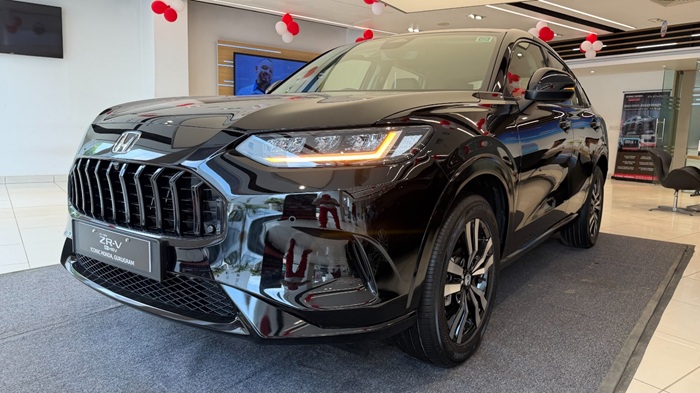
Our car is finished in Crystal Black Pearl, which suits the restrained body particularly well. Violet, grey and white are also offered in India, while red, beige and blue are not available here.
The nose is dominated by a grille with vertical slats, but it is relatively well integrated rather than appearing to have been borrowed from industrial ventilation equipment. The bumper incorporates air curtains, giving the front end some aerodynamic intent without visually screaming about it.
The lighting is suitably sophisticated. Full-LED automatic headlamps come with LED daytime running lamps, a light sensor, auto high beam, Follow-Me-Home and Lead-Me-To-Car functions, plus sequential LED turn indicators. Rain-sensing wipers include integrated washer spray nozzles, which is one of those details nobody boasts about at a dinner party but everybody appreciates after driving through a muddy monsoon.
The glass specification is similarly thoughtful. Honda uses infrared-cut and acoustic sound-absorbing glass for the front windscreen, along with heat-absorbing glazing front and rear. These features matter more in India than some extravagantly animated welcome graphic ever will.
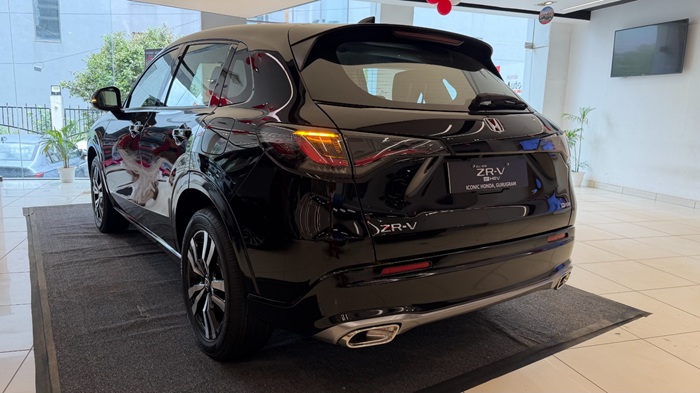
Along the sides, 18-inch diamond-cut alloy wheels fill the arches without overwhelming them. They wear 225/55 R18 98H Yokohama Advan dB V552 radial tubeless tyres made in Japan. The relatively generous sidewall is welcome because large wheels and wafer-thin tyres have become an automotive fashion trend best enjoyed by people who do not encounter potholes.
The electrically adjustable exterior mirrors power-fold and include LED indicators, cameras and an automatic reverse-tilt function. The latter is particularly handy around expensive alloys and unforgiving kerbs.
At the rear, the ZR-V gets full-LED tail lamps with an Emergency Stop Signal, an LED high-mounted stop lamp, rear washer and wiper, and a defogger. Dual outlet exhaust finishers provide a mildly sporting flourish, although this is ultimately a strong-hybrid crossover rather than something that wakes the neighbourhood at 6am and calls it personality.
Practical enough to be a proper family Honda
The boot offers 380 litres with the rear seats in position. Fold the 60:40 split rear bench flat and available cargo capacity expands to 1,313 litres.
There are larger boots elsewhere, but the ZR-V compensates with a usefully configurable rear seat and easy loading. The tailgate can also be opened by moving your foot underneath the rear bumper, useful when both hands are occupied with shopping, luggage, children’s belongings or the inevitable assortment of items families somehow transport everywhere.
There is also a walk-away close-and-lock function, so the vehicle can close and secure itself as you leave. LED lighting inside the luggage compartment prevents late-night searches for a dropped bag from becoming an archaeological expedition.
Honda lists accessories including a body cover, boot mat, floor mats, key chain and mud guards. Sensible stuff rather than faux-carbon appendages, which suits the ZR-V rather nicely.
Inside: Honda remembers the importance of ergonomics
The cabin immediately feels more grown-up than theatrical.
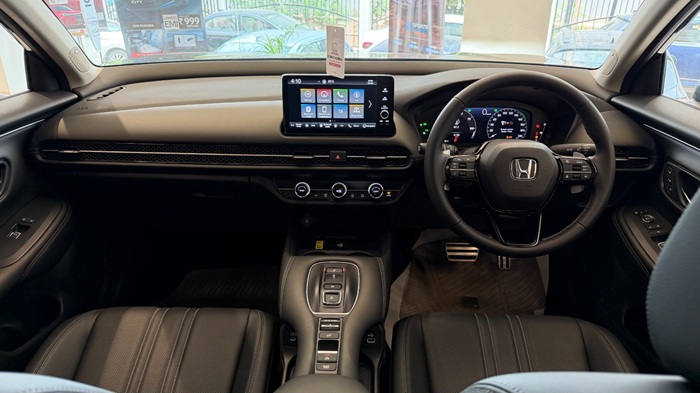
Rather than attempting to turn the dashboard into an IMAX auditorium, Honda has retained a recognisable dashboard architecture with physical shapes, clearly defined controls and a floating central touchscreen. Smooth leather soft pads across the dashboard lift the perceived quality, while the roof is finished in Tricot material.
Leather upholstery is standard, and the front seats offer meaningful electrical adjustment: eight ways for the driver and four for the passenger. The steering column has both tilt and telescopic adjustment, so finding a natural driving position should be straightforward for a wide range of occupants.
The steering wheel itself is leather-wrapped, electrically power-assisted and mounted on a collapsible column. Controls include volume and voice-command functions without giving the impression that Honda’s interior designers were paid by the button.
Ahead sits a 10.2-inch HD TFT digital instrument cluster displaying information including digital speed, driver-assistance status, range, average consumption, odometer, tripmeter and media information. It is modern without making essential driving information unnecessarily complicated.
At the centre is a 9-inch floating touchscreen supporting Android Auto, wireless Apple CarPlay, Bluetooth, USB connectivity, FM/radio functions, a clock and hybrid power-flow information.
Nine inches now sounds almost restrained when some manufacturers appear determined to install televisions where dashboards used to be. Yet for everyday driving, the question is not how many diagonal inches you can boast about but how easily you can perform the required task without staring at the screen long enough to become part of the accident statistics.
A wireless smartphone charger is included, while the Bose premium surround-sound system uses 12 speakers and a subwoofer. The ZR-V therefore has enough audio hardware to make the daily commute considerably less irritating, assuming your playlist does not consist entirely of podcasts about traffic congestion.
Dual-zone fully automatic climate control uses an electrically driven air-conditioning compressor and coolant pump, with heating functionality. The cabin filtration system is designed to filter PM2.5 particles, aldehyde, dust and pollen — another specification that matters rather more in real-world Indian conditions than an illuminated logo projected onto the pavement.
Ambient LED lighting and footwell illumination add some atmosphere after dark, while capacitive-touch LED reading lamps bring another modern touch. There is also a frameless auto-dimming interior mirror.
All four power windows receive one-touch automatic operation and pinch protection, and the windows can be opened or closed from the key. Walk Away Auto Lock further reduces the chances of reaching a restaurant table and wondering, approximately seven minutes later, whether you actually locked the car.
Front occupants also get height-adjustable shoulder seatbelt anchors, a small ergonomic detail but an important one.
The rear bench folds completely flat in its 60:40 configuration. Combined with the ZR-V’s crossover body and sensible roofline, the cabin should appeal strongly to buyers who want genuine daily usefulness but have no interest in piloting something the size of a small municipal building.
Strong hybrid, properly explained
The mechanical centrepiece is Honda’s self-charging strong-hybrid system.
The ZR-V uses a 2.0-litre inline four-cylinder petrol engine with 16 valves, direct injection, water cooling, an Atkinson-cycle combustion process, DOHC architecture and Dual VTC. Honda identifies it as its LFC-H4 unit, part of the Honda R-engine family also used in models including the Civic, CR-V and Prelude hybrids.
One particularly interesting engineering detail is the use of piston cooling jets, technology historically associated more commonly with higher-performance engines. Their inclusion reflects the thermal demands placed on a modern, highly optimised combustion unit constantly working alongside electric propulsion.
The engine is paired with a 262.8-volt lithium-ion battery and Permanent Magnet AC Synchronous electric motor. The engine and electric motor are located at the front, while the battery sits at the rear.
Quoted output is 181 horsepower and 315 Nm of torque.
Transmission duties are handled by Honda’s electrically coupled continuously variable automatic arrangement, while the source specification also identifies a wet-type multi-plate component within the drivetrain.
Unlike the four-wheel-drive ZR-V offered elsewhere, the Indian model sticks to the configuration supplied here without AWD.
What matters behind the wheel is that a strong hybrid does not behave like a conventional petrol engine with an electric motor merely providing occasional assistance. At low speeds, the ZR-V can operate electrically, while the petrol engine and hybrid system vary their contributions according to demand.
An Acoustic Vehicle Alerting System provides an external warning sound during low-speed electric running, ensuring pedestrians receive some indication that 1.57 tonnes of Honda is approaching even when the combustion engine is silent.
Paddle controls behind the steering wheel can be used to adjust battery regeneration. This is much more useful in a hybrid than pretending they are conventional racing-car gearshift paddles. Increasing regenerative braking on descents or in traffic helps recover energy that would otherwise become heat at the brakes.
Three driving modes are provided: Econ, Normal and Sport.
Econ prioritises efficiency, Normal is the obvious everyday setting, while Sport sharpens the car for those moments when a crossover carrying luggage and family suddenly discovers it has somewhere important to be.
Performance: 181 horses, but torque does the talking
Honda quotes 0-100 km/h in 7.9 seconds and a maximum speed of 172 km/h.
Seven-point-nine seconds is sufficiently brisk to make the ZR-V feel genuinely energetic rather than merely adequate. More importantly, the 315 Nm torque figure is the sort of number that should give the hybrid its useful mid-range character.
Electric motors do not need to wait for engine revs to rise before contributing useful thrust. That should make initial response around town and overtaking at normal road speeds more immediate than the headline horsepower figure might suggest.
This is not a hot SUV, and treating it as one rather misses the point. The interesting bit is how hybrid assistance should allow the ZR-V to respond cleanly in the gaps between slow traffic, accelerate onto a highway without ceremony and produce decent overtaking performance without repeatedly demanding dramatic engine revs.
The 172 km/h top speed similarly tells you that Honda has prioritised the hybrid system around everyday efficiency and accessible performance rather than autobahn bragging rights. In India, finding somewhere to exploit much beyond that would require considerable optimism, a private track or a highly persuasive lawyer.
Chassis: more road car than pretend off-roader
The ZR-V’s suspension configuration reinforces its road-biased character.
At the front are McPherson struts with coil springs. Honda’s source specification describes the rear arrangement with coil springs and a multi-link layout while also referring to a torsion-beam element, so it is best regarded as the multi-element rear suspension configuration described by Honda rather than trying to reinterpret the wording beyond the supplied technical material.
Torsion-bar-type anti-roll hardware and telescopic hydraulic nitrogen gas-filled dampers are also specified.
That combination, together with the ZR-V’s Civic-related architecture, hints strongly at Honda’s intention: this should drive like a crossover designed by people who still believe steering and body control matter.
Agile Handling Assist is fitted, working alongside the electronic stability systems to improve the way the vehicle responds during cornering.
Its 186 mm ground clearance gives enough breathing space over rough roads without raising the body excessively. This is important because every additional millimetre of ride height eventually wants repayment in the form of body roll.
Disc brakes are fitted front and rear, supplemented by an electric regenerative braking system. In a hybrid, brake calibration is especially important because the pedal is effectively juggling regenerative deceleration and traditional friction braking. The ideal result is seamless enough that the driver stops thinking about which system is doing what.
There is Hill Descent Control and Hill Start Assist, but the Indian ZR-V is emphatically not being presented as a hardcore off-roader. There is no Indian-market four-wheel-drive version here, no low-range transfer case and no supplied specification for locking differentials, approach angles or serious water wading.
That honesty is refreshing. Most crossover owners need predictable handling in rain, confidence over broken asphalt and enough clearance for an ugly ramp far more often than they need to climb a mountain.
22 km/l claimed efficiency changes the equation
Honda quotes average fuel economy of 22 km/l.
That is the number that gives the strong-hybrid ZR-V much of its appeal. A 57-litre fuel tank also means the theoretical cruising range between refuelling stops should be substantial, although actual fuel consumption will naturally vary with traffic, weather, terrain, driving style and how frequently the driver decides Sport mode is medically necessary.
The hybrid system is self-charging, so there is no requirement to connect the ZR-V to an external charger. Energy is recovered through regenerative braking while the petrol engine and hybrid system manage propulsion and battery charging internally.
That makes the technology particularly easy to live with for buyers who want electric running in urban conditions but do not have convenient access to home charging.
Safety: comprehensive hardware, cautiously interpreted ratings
Honda equips the ZR-V with its Advanced Compatibility Engineering body structure, or ACE, alongside an extensive set of active and passive safety technologies.
There are eight airbags, ABS, EBD, Electronic Stability Control, Vehicle Stability Assist and traction control. Automatic Brake Hold, a Brake Override System, Hill Start Assist and Hill Descent Control are also included.
Parking assistance is comprehensive, with front and rear sensors plus a 360-degree surround-view camera. There is also ISOFIX child-seat mounting, seatbelt reminders and three-point ELR seatbelts. The front seatbelts incorporate energy-absorbing pretensioners and load limiters.
Honda SENSING provides the principal ADAS functions. These include Collision Mitigation Braking System, Lane Keeping Assist, Road Departure Mitigation System, Lead Car Departure Notification System and Driver Attention Monitor.
Adaptive cruise control includes Low Speed Follow, a particularly useful feature in traffic because adaptive cruise becomes considerably less impressive if it gives up precisely when congestion begins.
The ZR-V also receives Honda’s Lead Car Departure Notification System. It is essentially the vehicle politely informing you that traffic has started moving while you were contemplating the meaning of life at a red light.
Keyless entry, central locking, a vehicle immobiliser, security alarm and Walk Away Auto Lock complete the security package.
According to the supplied information, the ZR-V received four stars out of five in European and Australian NCAP assessment and has also received an IIHS Top Safety Pick award. Those results should be considered within the respective organisations’ own test protocols rather than treated as directly interchangeable scores.
Ownership: Honda backs the hybrid hardware
The standard vehicle warranty is three years with unlimited kilometres.
Honda allows that coverage to be extended up to 10 years or 1.20 lakh km. The hybrid system itself receives five years or 1 lakh km of warranty coverage, while the lithium-ion battery is protected for eight years or 1.60 lakh km.
Three years of roadside assistance is also included.
For buyers considering their first strong hybrid, those separate hybrid-system and battery warranties matter. They address one of the questions that inevitably appears whenever electrification enters the conversation: what happens when the clever electrical bits become older and considerably less clever?
The ₹48 lakh question
And this is where the ZR-V becomes complicated.
At ₹48 lakh ex-showroom as a CBU, it is no longer merely competing on the basis of being a sensible Honda crossover. Its price pushes it toward buyers who will inevitably compare it with premium-badged alternatives.
That creates an unusual proposition.
The ZR-V’s strengths are not based on social signalling. You are buying engineering, hybrid efficiency, usability, Honda familiarity, a generous safety specification and a car developed around a well-regarded road-car architecture. What you are not buying is the prestige badge some customers naturally expect when spending nearly ₹50 lakh before registration, insurance and other charges.
For one type of buyer, that will immediately end the conversation.
For another, it may be precisely the appeal.
The ZR-V feels like something chosen by someone who knows exactly what it is rather than what other people are supposed to think it is.
Verdict
The 2026 Honda ZR-V Hybrid is a refreshingly coherent crossover.
Its exterior is restrained without becoming anonymous. The cabin combines digital technology with sensible ergonomics rather than surrendering every function to touchscreens. The strong-hybrid system brings 181 hp, 315 Nm and a claimed 22 km/l, while the 7.9-second 0-100 km/h time means efficiency has not required the driver to formally abandon the concept of acceleration.
It is also properly practical. There is a 380-litre boot, 1,313 litres available with the rear seats folded, a hands-free powered tailgate function, configurable rear seating and enough technology to make daily ownership easy rather than merely impressive during the showroom demonstration.
Safety equipment is extensive, Honda SENSING covers the important assistance systems and the hybrid battery warranty stretches to eight years or 1.60 lakh km.
The central problem is price.
At ₹48 lakh ex-showroom, the CBU-imported ZR-V cannot simply rely on traditional Honda rationality. Buyers in this territory have access to vehicles that may offer a more overtly luxurious cabin, a prestige badge or different drivetrain choices. The absence of the overseas four-wheel-drive and non-hybrid alternatives also means Indian buyers receive little freedom to configure the ZR-V around their priorities.
Yet there is something rather appealing about a car that does not chase every current SUV cliché.
The ZR-V does not pretend to be an off-roader, does not require a charging cable and does not need 500 horsepower to establish its relevance. It is instead a sophisticated road-focused crossover built around hybrid efficiency, useful performance, everyday practicality and the sort of careful engineering details Honda enthusiasts tend to notice long after the showroom novelty has disappeared.
Buy it if you value engineering subtlety, strong-hybrid efficiency, Honda’s road-car DNA and a crossover that appears designed for actual daily use. Look elsewhere if badge prestige, four-wheel drive or maximum metal-for-money matters more.
The ZR-V’s defining personality is therefore not aggression, luxury or outright performance. It is intelligence — occasionally expensive intelligence, admittedly — wrapped in a very usable family crossover.
And in a market increasingly populated by SUVs attempting to look like they could invade a neighbouring country, there is something pleasantly confident about a Honda that simply wants to be excellent at the school run, the office commute and the open road.