
The BMW X1 has always occupied an interesting corner of the BMW universe. It is the gateway into the brand’s SUV-shaped world — or “Sports Activity Vehicle” world, as Munich would prefer you call it — yet it has gradually become too substantial, too sophisticated and, increasingly, too expensive to feel like the junior member of anything. For 2026, that transformation becomes even harder to ignore with the X1 sDrive18Li M Sport Long Wheelbase, a stretched version that takes the compact crossover formula and applies the sort of rear-seat generosity normally associated with cars several rungs further up the ladder.
And yes, the name is a mouthful. BMW X1 sDrive18Li M Sport Long Wheelbase sounds less like a car and more like the password requirements for a German banking website. But behind that alphabet soup is a fairly straightforward proposition: take the third-generation X1, lengthen it substantially, concentrate on passenger comfort and sell it in India at ₹49.90 lakh ex-showroom.
The X1 itself dates back to 2009, and the car you see here belongs to its third generation. This long-wheelbase derivative carries the U12 codename and was originally conceived specifically for the Chinese market, where rear-seat space can carry almost as much importance as the badge on the bonnet. BMW has now brought the idea to India as well, giving Indian buyers a version of its smallest SAV with a distinctly chauffeur-friendly streak.
A small BMW that isn’t particularly small anymore
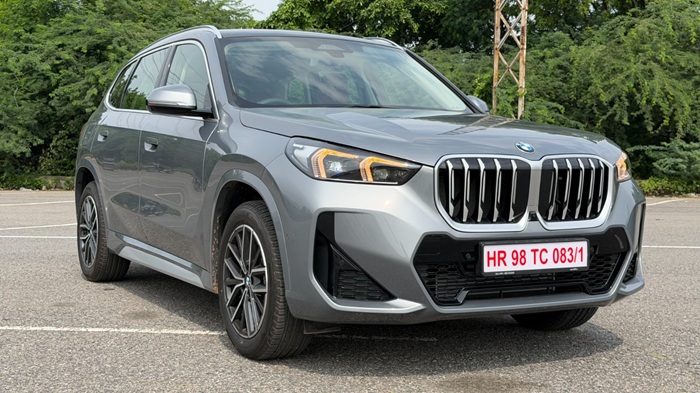
The standard X1 is hardly tiny these days, but the long-wheelbase car stretches the formula further. At approximately 4.6 metres long, 2.1 metres wide and 1.6 metres tall, it has genuine road presence rather than the slightly apologetic stance associated with some entry-level luxury SUVs. More importantly, it is 116 mm longer than the standard X1, and BMW claims the model offers the longest wheelbase in its segment.
That extra length is not difficult to appreciate visually. The proportions appear more relaxed through the middle of the car, and there is less of the stubby, upright character that once defined compact crossovers. It still looks unmistakably like an X1, but now with the visual confidence of a car that knows its rear passengers have somewhere to put their knees.
BMW says roughly 2.40 lakh X1s are sold globally every year, which gives some perspective to the model’s importance. This is no fringe product sitting quietly in a corner of the catalogue. For many customers, the X1 is their first BMW, and therefore its job is arguably harder than that of a flagship: it needs to deliver enough of the brand experience to explain why the roundel commands the money in the first place.
The design itself is credited to Jacek Pepłowski, while underneath sits BMW’s UKL2 architecture. The same platform family also underpins models including the 1 Series, 2 Series, X2, MINI Countryman, Clubman and Zinoro 60H. It is a front-wheel-drive-oriented architecture, which immediately tells you that this X1 approaches the traditional BMW formula rather differently from the company’s classic rear-wheel-drive saloons.
Production is international too, with the source material listing assembly in India, Germany, Thailand, Indonesia, Malaysia and China. That is appropriate for a car which has become one of BMW’s global volume players.
Price and positioning
The X1 range in India starts at ₹49.90 lakh ex-showroom and extends to ₹52.90 lakh, with both petrol and diesel powertrains available. The car reviewed here is the petrol-powered X1 sDrive18Li M Sport Long Wheelbase, priced at ₹49.90 lakh.
Its electric relative, the iX1, begins at ₹52.70 lakh, putting EV propulsion intriguingly close in price to the combustion-powered X1 family.
Elsewhere in the world, the X1 range can become far more adventurous. BMW offers a roughly 300 hp M35i, plug-in hybrid derivatives and xDrive all-wheel-drive versions, none of which are part of the India specification described here. Whether any of those make their way to India remains an open question. An M35i would certainly inject considerably more chilli into the recipe; the 156 hp X1 tested here has rather more sensible ambitions.
BMW also advertises an EMI of ₹44,444 per month for the X1 along with a 60 per cent assured buyback after four years. As ever with finance schemes, the monthly number is only part of the ownership equation, but it illustrates BMW’s attempt to make the leap into a luxury badge appear slightly less alarming than staring directly at a ₹50 lakh ex-showroom price.
M Sport clothes, sensible shoes
This X1 wears the M Sport treatment, giving it M-specific bumpers and a more assertive exterior than the standard luxury-crossover template might suggest.
At the front is BMW’s familiar kidney grille finished in chrome. By modern BMW standards it is relatively restrained, which is another way of saying the grille has not yet developed its own postal code. Flanking it are automatic Adaptive LED headlights incorporating daytime running lights, position lights and cornering functions, together with automatic headlamp range control, High Beam Assistant and BMW’s light staging.
The bonnet and upright nose help give the X1 more visual substance than its position in the range might suggest. There is enough detailing to identify this as the M Sport version without covering every square centimetre in vents, blades and aerodynamic theatre.
The Skyscraper Grey paintwork of this particular car suits the restrained aggression well. White, blue and black are also offered, while green, red, silver and BMW Individual paint options mentioned elsewhere are not available in India according to the supplied specification.
Along the sides sit 18-inch double-spoke M light alloy wheels carrying 225/55 R18 98V Bridgestone Turanza T001 radial tubeless tyres at both ends. Disc brakes are fitted front and rear. The relatively generous sidewall is worth noting because, despite the M Sport badges, somebody in Munich appears to have remembered that Indian roads occasionally resemble a civil-engineering experiment that ran out of funding.
The outside mirrors are electrically adjustable and folding, incorporate indicators and cameras and have an automatic anti-dazzle function. Rain-sensing wipers are also included.
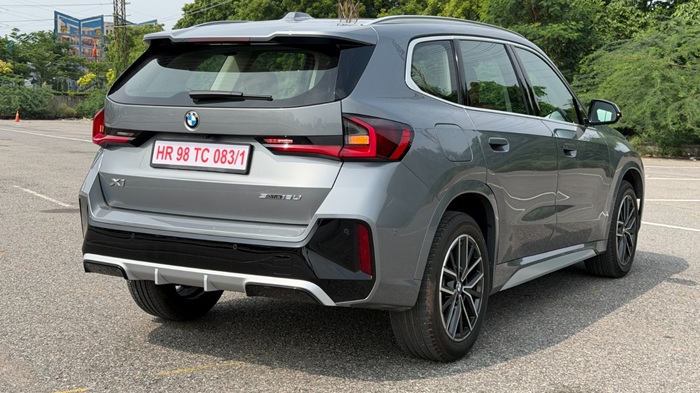
At the back, 3D-sculpted LED tail-lamps provide much of the visual identity. The overall styling is more grown-up than flamboyant: recognisably premium, visibly BMW, but without trying quite as hard as some contemporary luxury SUVs to intimidate the hatchback in front.
And that is perhaps the right personality for this X1. Its job is not to play junior super-SUV. It is supposed to look expensive without turning every school run into an audition for an action film.
Long-wheelbase thinking pays off inside
The clearest reason to choose the Li becomes obvious once you open the rear doors.
BMW says the rear seats can recline through 28.5 degrees, and the cabin provides 150 mm of legroom as specified in the supplied material. The rear bench splits 40:20:40, increasing flexibility when passengers and luggage need to coexist.
That extended wheelbase is therefore not simply a styling exercise. It gives the X1 an unusually rear-passenger-focused personality for a BMW this size. In a market such as India, where a premium vehicle may spend Monday carrying its owner behind the steering wheel and Tuesday carrying the same owner behind the front passenger seat, this makes considerable sense.
Above is a nine-square-foot panoramic glass roof, helping the cabin feel airier. The combination of additional longitudinal space and the large glass area should prevent rear occupants from feeling as though they have been assigned the economy section of the BMW experience.
Practicality is equally convincing on paper. The boot offers 540 litres with the seats in place and expands to 1,700 litres when they are folded. There is also a 17-inch tubeless spare wheel — the sort of unglamorous feature you may not mention while showing the car to your neighbours but may appreciate enormously at the side of an Indian highway.
A cabin designed around screens, but not only screens
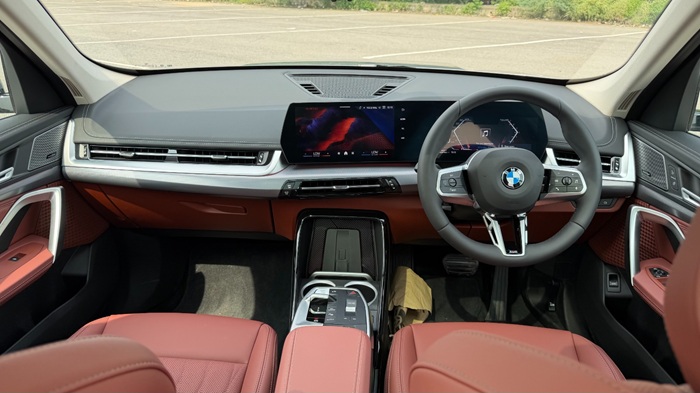
Up front, the X1 adopts the modern BMW cabin philosophy with a Widescreen Curved Display dominating the dashboard. The interface combines a 10.25-inch digital instrument cluster with a 10.7-inch touchscreen infotainment system running BMW Operating System 9.
The infotainment package supports teleservices, remote software upgrades, the MyBMW App, remote services, BMW’s personal assistant, wireless smartphone integration, Bluetooth, USB connectivity, navigation, real-time traffic information and conventional FM/radio functionality.
It is a technologically dense environment, although the integration is cleaner than simply gluing an enormous tablet onto the centre of a dashboard and declaring victory.
One particularly unusual detail is the QLOCKTWO digital clock. Instead of behaving like an ordinary numerical clock, it presents time in a more design-oriented format. It is the sort of tiny detail that makes almost no difference to the mechanical worth of the car yet gives passengers something to prod and ask about — which, in the luxury-car world, probably counts as a successful feature.
There is no head-up display on the India-specification car described here, however. That omission is noticeable in a vehicle approaching ₹50 lakh, especially when so much of the rest of the cabin is devoted to digital convenience.
The front occupants get electrically adjustable Sport seats upholstered here in brown perforated Veganza leatherette. White is another available upholstery colour. Veganza may lack the romance of telling people your seats were trimmed by some obscure Alpine cow, but the modern leather-free material fits the contemporary premium-cabin brief.
There is an M leather steering wheel with electronic power assistance and Servotronic Steering Assist, while a floating centre armrest frees up space around the console.
Two-zone automatic climate control takes care of cabin temperature, wireless charging handles compatible phones and ambient lighting supplies the expected after-dark theatre.
Audio duties are handled by a 12-speaker, 205-watt Harman Kardon Surround Sound System. For most buyers, it will probably be more relevant on the daily commute than another tenth shaved from the car’s theoretical lap time.
There is an automatically anti-dazzling interior rear-view mirror as well, plus Cruise Control with Braking Function.
One of the more useful technological features is BMW Digital Key functionality. An NFC key card or compatible smartphone can be used to lock, unlock and start the vehicle, while the digital key can be shared with as many as 18 users. Whether you actually know 18 people whom you trust with your BMW is an entirely separate question.
Three cylinders, front-wheel drive and 156 hp
Under the bonnet sits BMW’s B38A15M2 TwinPower Turbo petrol engine: a 1.5-litre, inline three-cylinder unit featuring direct injection, DOHC construction, double-VANOS variable valve timing and turbocharging.
Output stands at 156 hp with 230 Nm of torque.
The engine drives through a Getrag 7DCT300 seven-speed Steptronic dual-clutch automatic transmission. This sDrive derivative is front-wheel drive rather than xDrive all-wheel drive.
Those numbers immediately establish the X1’s character. This is not intended to be a miniature performance SUV masquerading as a family crossover. With 156 hp moving a premium long-wheelbase vehicle, its priorities are everyday usability, refinement and efficiency rather than destroying tyres outside the local coffee shop.
BMW quotes 0-100 km/h in 9.3 seconds and a top speed of 207 km/h. Neither number will rearrange your internal organs, but both are sufficient for the sort of driving the X1 will actually encounter.
Nine-point-three seconds to 100 km/h means it should merge onto a highway comfortably and deal with normal overtaking without drama, but an enthusiast expecting the badge to deliver old-school BMW urgency may find the experience measured rather than mischievous.
The 230 Nm torque figure is more relevant in ordinary driving than peak horsepower. Combined with the dual-clutch transmission, it should give the X1 the useful mid-range shove required to escape a slow-moving truck or fill a gap in fast traffic without requiring an elaborate committee meeting between your right foot and the gearbox.
The claimed average is 15 km/l, while fuel capacity is 54 litres. As supplied, those are claimed figures rather than a documented real-world economy test, so actual consumption will naturally depend on traffic, driving style and conditions.
The B38 itself has an interesting history. Variants of this engine are also used in the BMW 2 Series Active Tourer and X2, and the source material notes that the B38 family first appeared in BMW’s i8 sports car. That does not mean your X1 contains half an i8 waiting to escape — sadly, biology and engineering are rarely that generous — but it does give the little three-cylinder an unusually glamorous entry on its CV.
The turbocharger also uses what is described as the world’s first aluminium turbine housing, manufactured by Continental. A 1.2-litre version of the B38 engine exists as well.
More interested in composure than theatre
BMW says the X1 uses Comfort Suspension specifically tuned for the long-wheelbase layout, with the aim of combining a smooth ride with strong driving dynamics. There is also claimed 50:50 front-to-rear weight distribution.
Performance Control can make engine-control and braking interventions while cornering, with BMW describing functions including Agility Enhancement and Curve Neutrality. In plain English, the electronic systems can subtly adjust the car’s behaviour through a bend to help it remain composed rather than simply allowing physics to submit its invoice later.
BMW Efficient Lightweight construction is part of the package too.
The interesting question is what all of this means for the personality of the long-wheelbase X1.
The answer appears to be balance rather than extremity. An elongated wheelbase often benefits straight-line stability and passenger comfort but can make a car feel less eager to rotate into a corner. BMW’s suspension tuning, steering assistance and Performance Control are therefore tasked with ensuring the additional rear-seat space does not turn the X1 into a small limousine wearing trainers.
The 18-inch wheels and 55-profile tyres should also give the suspension a useful amount of compliance over broken surfaces. That matters far more in India than the final few percentage points of cornering aggression.
Servotronic assistance varies the steering support, while the overall setup is clearly intended to make low-speed urban operation manageable without abandoning the reassuring stability expected at motorway speeds.
It is unlikely to provide the intimate, chatty steering feel enthusiasts associate with older BMWs — virtually no modern electrically assisted premium crossover does — but that is not necessarily the point. The X1’s brief has evolved. It now has to deal with airport runs, families, chauffeur duty, shopping centres, office basements and speed breakers that appear to have been designed for Himalayan goats.
Safety goes well beyond airbags
The X1 has been awarded five stars by both Euro NCAP and Australian NCAP according to the supplied specifications.
The equipment list is extensive. Eight airbags are fitted alongside ABS, Brake Assist, Cornering Brake Control, Dynamic Stability Control and Dynamic Traction Control.
Its driver-assistance systems include Lane Departure Warning with active feedback, Front Collision Warning with brake intervention, Manual Speed Limit Assist, Evasion Assistant, Blind Spot Assistant, Rear Collision Warning and Attentiveness Assistant.
There is also Park Assist, front and rear Park Distance Control, Reversing Assistant, a surround-view camera, Remote 3D View and Drive Recorder. A Tyre Pressure Monitoring System, electronic immobiliser, crash sensor and ISOFIX child-seat mountings are included as well.
The front three-point seatbelts use pyrotechnic pretensioners and force limiters, and BMW even includes the less glamorous but useful warning triangle and first-aid kit.
One particularly interesting feature is the post-crash system referred to in the supplied notes as PC iBrake or PostCrash approach control warning. Following an accident, the system can warn approaching traffic and apply light braking where necessary so that the vehicle comes to a controlled halt rather than continuing uncontrolled after the initial impact.
It is the type of technology you hope never to experience, which is generally the best compliment one can give a post-crash safety system.
Ownership: BMW wants the relationship to last
BMW provides a two-year, unlimited-kilometre warranty on the X1, and the coverage can be extended for as long as 10 years. Two years of 24×7 roadside assistance is also included.
The car incorporates BMW Condition Based Service, an intelligent maintenance system designed to track servicing requirements rather than relying solely on the driver to remember when something needs attention.
A smartphone app also gives access to several vehicle functions remotely, extending the digital ecosystem beyond the cabin itself.
E25 fuel compliance provides an additional degree of future-readiness for the petrol powertrain.
There is even an M door projector, because apparently illuminating the ground with evidence of your trim level is now part of the modern luxury experience. Completely unnecessary? Perhaps. Slightly entertaining every time you open the door at night? Also perhaps.
So, what is the X1 Li really trying to be?
The most revealing thing about this version of the X1 is not its turbocharger, its infotainment software or the number of electronic assistants watching over the driver. It is that extra 116 mm of length.
The long-wheelbase X1 shifts the centre of gravity of the entire product — figuratively, if not literally — towards comfort and usability. BMW has taken what was historically its compact entry-level crossover and turned it into something capable of appealing to buyers who value rear-seat accommodation nearly as much as driving position.
That inevitably changes the enthusiast equation.
If what you want from a BMW is abundant horsepower, rear-wheel-drive adjustability and a powertrain that encourages unnecessary journeys through tunnels, the 156 hp front-driven X1 sDrive18Li is unlikely to become the object of your bedroom-wall affection. BMW itself offers far more exciting machinery elsewhere, and even the X1 family includes a much more powerful M35i in other markets.
But judged against its actual mission, the long-wheelbase X1 makes considerably more sense.
The 540-litre boot is useful. The rear bench reclines. There is a genuinely large panoramic roof. The infotainment suite is modern. The safety package is broad. You get a spare wheel. The digital key can replace the physical key for everyday use. And the stretched body gives the X1 a level of second-row relevance that smaller luxury crossovers often struggle to provide.
The compromises are equally clear. Nearly ₹50 lakh is serious money for a 1.5-litre three-cylinder, 156 hp front-wheel-drive crossover, regardless of the badge. The 9.3-second 0-100 km/h time means performance is adequate rather than genuinely premium in sensation, at least on paper. The lack of a head-up display in the India-specification car is disappointing, and keen drivers may look at the more powerful X1 variants sold abroad with some understandable envy.
Yet reducing the X1 to its cylinder count or acceleration figure misses what BMW is attempting here.
This is a BMW engineered for people whose lives involve more than finding the longest route home. It is for the buyer who wants a premium badge and modern cabin but also has parents in the back, luggage in the boot, a phone charging wirelessly, a panoramic roof overhead and a speed breaker appearing suddenly in the headlights.
Verdict
The 2026 BMW X1 sDrive18Li M Sport Long Wheelbase is not the X1 for someone chasing maximum performance per rupee. Nor is it a shrunken M car wearing family-friendly clothing.
Instead, it represents the X1 growing into a different kind of premium vehicle.
The long wheelbase gives it a convincing reason to exist in India, the 540-litre boot makes it properly useful, the cabin technology is suitably contemporary, the safety equipment is extensive and the 156 hp three-cylinder engine promises reasonable efficiency while delivering enough performance for everyday driving. BMW’s 15 km/l claim and 54-litre tank underline the fact that this version has been configured for living with, rather than merely showing off.
Its greatest achievement may be that it no longer feels like a BMW chosen simply because the larger BMWs were too expensive. The extra length, rear-seat flexibility and equipment give the X1 Li an identity of its own.
Would we like the M35i’s 300 hp? Absolutely. Enthusiasm has bills to pay, but it is not dead.
Would xDrive make the badge feel more mechanically complete? Certainly.
Could BMW have thrown in a head-up display at ₹49.90 lakh? We would not have complained.
But the X1 sDrive18Li Long Wheelbase understands its audience. It has matured from being the little BMW SUV into something closer to a compact premium family express — one that just happens to have BMW badges at either end and enough rear legroom to make the person holding the finance agreement wonder whether perhaps somebody else should drive.
The X1 has grown up. More importantly for India, it has grown longer.