
There are electric cars designed to make the transition from petrol feel as painless as possible, and then there are electric cars that seem determined to remind you every five minutes that the future has arrived. The Mahindra BE 6 belongs firmly to the second camp. It is a 4.4-metre-long Indian coupe-SUV with the stance of a concept car, the electronic vocabulary of a gaming laptop and enough lighting theatrics to make an airport runway look slightly underdressed.
Launched originally in 2024, the BE 6 is Mahindra’s dedicated electric SUV, with “BE” standing rather appropriately for “Born Electric”. The model shown here is described in the supplied material as the 2026 first-generation facelift, and this particular car is the range-topping Sporteq Four. Prices start at ₹19.45 lakh ex-showroom and rise to ₹27 lakh for the top version. Unlike an adapted petrol SUV whose exhaust pipe has simply gone missing, the BE 6 was conceived around electric propulsion from the beginning.
That distinction matters because underneath sits Mahindra’s INGLO architecture, a dedicated EV platform also used by the XEV 9e and XEV 9s. Assembly takes place at Chakan in Pune, while the design is credited to Pratap Bose, whose portfolio mentioned in the source also includes the Thar Roxx, Scorpio N and XEV 9e. That family resemblance isn’t necessarily literal, but there is a shared confidence: none of these cars seems especially interested in disappearing anonymously into traffic.
And anonymity is certainly not the BE 6’s speciality.
A design that refuses to whisper
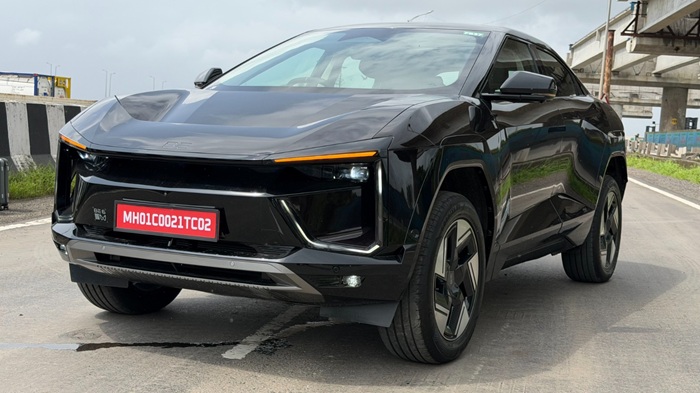
The BE 6 looks like somebody took the conventional Indian family SUV, handed the sketchbook to a science-fiction enthusiast and removed the instruction to “play it safe”. In Ruby Velvet, as seen here, the shapes, cuts and lighting elements become even more theatrical. Buyers also have orange, black, red, green, white, beige and grey available according to the supplied specification.
At the front, C-shaped LED daytime running lamps establish the visual signature. The auto-booster LED headlamps incorporate cornering lamps, sequential turn indicators and start-up and goodbye animations, while fog lamps remain part of the package. This is an EV that apparently believes arriving and leaving should both involve a small ceremony.
Rain-sensing wipers and an auto defogger take care of less glamorous circumstances, because even cyberpunk SUVs eventually encounter Indian monsoons.
The mirrors are electrically adjustable, power-folding and auto-dimming, with reverse auto-dip functionality, integrated indicators and cameras. The doors use electrically deployed flush handles, another increasingly familiar EV trick that cleans up the profile and adds a bit of theatre every time you approach the car.
And approach it you may without even touching the key. A new approach-unlock and walk-away-lock function has been added, while the BE 6 can also be locked, unlocked and started through a digital key or card.
Dimensionally, it occupies an interesting middle ground. At approximately 4.4 metres long, 1.9 metres wide and 1.6 metres tall, it has the footprint of a substantial SUV without becoming a suburban aircraft carrier. Ground clearance is a useful 222 mm, particularly relevant on roads where the speed breaker occasionally appears to have been designed by the local hill-climb association. The quoted turning-circle diameter is 10 metres.
That width, however, will be something to remember in tight parking spaces. The styling may say spaceship, but the neighbour’s scooter will remain resolutely analogue.
Wheels, stance and the business end
The Sporteq Four pictured here runs 19-inch alloy wheels with 245/55 R19 103V Goodyear Electric Drive radial tubeless tyres at both ends. They are low-rolling-resistance tyres, as you would expect on an EV where every watt counts. According to the source, 20-inch alloys are also available, while 18- and 19-inch steel-wheel options exist too.
Disc brakes are fitted front and rear.
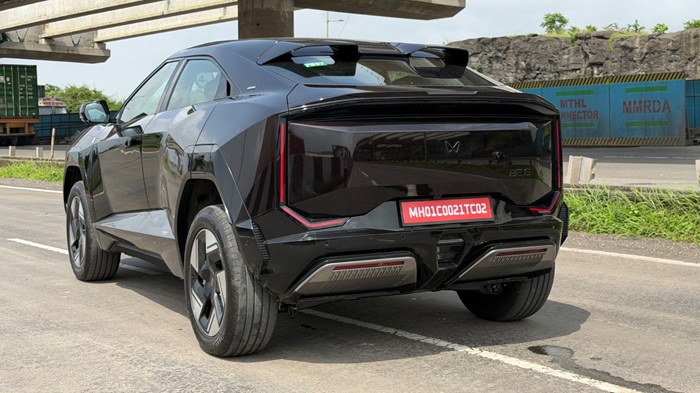
The BE 6’s coupe-SUV silhouette gives it a more dramatic stance than a conventional upright SUV. The visual mass is broken up by the wheel arches, sharply defined body surfaces and the descending roofline. Whether you consider it futuristic or slightly theatrical will depend on your tolerance for automotive extroverts, but dull is not an accusation likely to stick.
At the back, another C-shaped lighting treatment appears through the LED tail-lamps, complete with pixel animation and sequential indicators. The car also offers personalised LED tailgate messaging and animation, with messages changeable through the phone or infotainment system.
Yes, your car can effectively display messages from its backside.
Human civilisation has clearly progressed.
More usefully, the tailgate supports gesture control, and behind it sits a 455-litre boot. There is another 45 litres of storage beneath the bonnet in the frunk, making good use of the space liberated by the absence of an internal-combustion engine.
Inside: part SUV, part gaming room
If the exterior is adventurous, the cabin makes little attempt to calm things down.
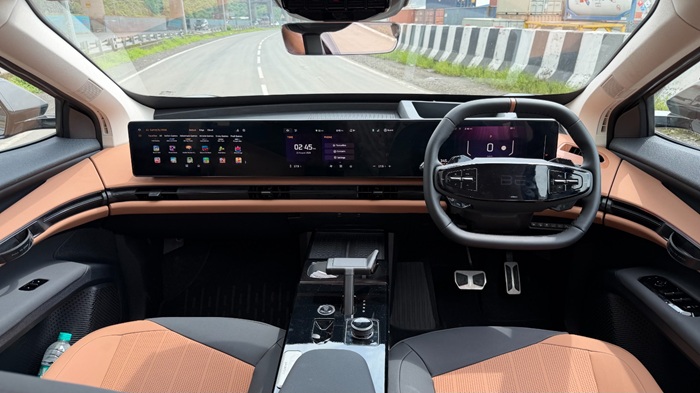
Brown leatherette upholstery features in this car, although black and fabric upholstery options are also listed. The front seats are ventilated, while the driver’s seat gets six-way electric adjustment. The steering column offers both tilt and telescopic adjustment, making it easier to establish a comfortable driving position.
The rear bench is split 60:40 and offers two-stage reclining, which is the sort of feature passengers will appreciate far more frequently than a clever start-up animation. Device mounts can also be attached behind the seats, a small but thoughtful nod towards passengers who regard an iPad as essential travel equipment.
Above is a fixed panoramic glass roof featuring an LED pattern. Ambient lighting adds further after-dark decoration, and acoustic laminated door glass is fitted to help isolate the cabin from outside noise.
There is only a driver-side one-touch up/down power-window function listed in the supplied specification, an oddly specific detail in a car otherwise loaded with technology.
Storage hasn’t been forgotten either. Cooled storage is provided, useful in India’s climate where an ordinary bottle of water parked inside a closed car can become approximately the temperature of tea before lunch.
Climate control itself is dual-zone automatic and comes with a VR-LED smart air-filtration system and an AQI display.
But inevitably, screens are where the BE 6 really starts showing off.
A 12.3-inch HD touchscreen infotainment system sits at the centre of an enormous digital ecosystem. Its listed functionality includes wireless Android Auto and Apple CarPlay, navigation, USB connectivity, FM and radio, 5G, a connected-car suite and over-the-air software updates. There are more than 60 apps, built-in Amazon Alexa and Google Gemini integration.
Then Mahindra keeps going.
There is karaoke, an in-car gaming suite, Dolby Vision, Private Audio, GrooveMe Party, SonicSuite virtual engine sound, valet mode, dog mode, camp mode, Charge Scheduler, Tribe Drive, news and 17 specialised AI agents.
The phrase “infotainment system” feels slightly inadequate here. “Small consumer-electronics department embedded in the dashboard” may be closer.
A separate 12.3-inch HD passenger display offers games and parental-lock functionality among other features, while four Bluetooth game controllers can be connected simultaneously.
Whether anybody genuinely needed their SUV to become a four-player gaming lounge is debatable. But if you are stuck waiting for a charger with three friends, Mahindra clearly does not want you staring silently at one another.
The audio system is similarly ambitious: a 16-speaker, 1,400-watt Harman Kardon arrangement with Dolby Atmos. There is also a VisionX augmented-reality head-up display and a 12.3-inch HD digital instrument cluster, with the supplied notes specifically mentioning a compass among its displayed information.
Underlying much of the digital architecture is Qualcomm’s flagship Snapdragon 8295 chipset, tasked with the digital cockpit, infotainment and dedicated safety subsystems. It also powers MAIA — Mahindra Artificial Intelligence Architecture.
Technology isn’t merely present in the BE 6. It has moved in, unpacked its luggage and changed the Wi-Fi password.
Power: rear-wheel drive, as nature intended?
The BE 6 is rear-wheel drive, a configuration that immediately distinguishes its mechanical personality from many everyday front-driven crossovers.
Three battery specifications are included in the supplied material. The top specification uses a 79 kWh BYD LFP battery delivering 281 horsepower and 360 Nm of torque, with a claimed range of 708 km.
A 70 kWh lithium-ion version is listed with 241 horsepower, the same 360 Nm and 651 km of claimed range, while the 59 kWh lithium-ion pack is quoted at 228 horsepower, again with 360 Nm, and a claimed 573 km range.
Those are significant outputs for a family-oriented Indian coupe-SUV, particularly the 281 hp flagship. More interesting than the horsepower figure itself is the fact that full propulsion is directed to the rear axle. With electric torque available promptly and no combustion engine needing to build revs, this should give the BE 6 a distinctly different character from a conventional urban SUV.
Mahindra even provides six drive modes: Default, Range, Everyday, Race, Custom and Snow.
And then there is Drift mode.
In a country where simply negotiating a roundabout can sometimes feel like motorsport, providing a dedicated setting for easy drifting demonstrates admirable optimism.
There is also Revive mode. According to Mahindra’s supplied information, even after the battery reaches 0 per cent charge, Revive can provide approximately 11 km of additional range. Think of it as the EV equivalent of finding an emergency ₹500 note in a jacket you haven’t worn for months: not something to build your financial strategy around, but tremendously welcome when everything has gone wrong.
Regenerative braking can be adjusted through five levels, allowing drivers to tailor how aggressively the car harvests energy when lifting off the accelerator.
No 0–100 km/h time or maximum-speed figure is supplied in the source material, so it would be wrong to manufacture one. But 281 hp and 360 Nm in a rear-driven dedicated EV clearly place the top BE 6 well beyond the territory of merely adequate commuting performance.
Underneath the drama, serious chassis hardware
The more interesting aspect of the BE 6 may actually be what happens beneath the bodywork.
At the front is an independent MacPherson-strut i-Link arrangement with a stabiliser bar, while the rear uses a five-link independent multi-link layout, also with a stabiliser bar. That is a considerably more sophisticated recipe than simply fitting enormous wheels, stiffening everything until passengers complain and labelling the result “sporty”.
Mahindra lists Frequency Dependent Damping, or FDD, alongside MTV-CL — Multi-Tuned Valve Concentric Land — suspension technology. The stated goal is to reconcile low-speed comfort with high-speed stability.
The car also features Intelligent Adaptive Suspension.
That combination is important because the BE 6 has contradictory jobs to perform. On one hand, its styling, rear-wheel-drive layout, Race mode and Drift mode invite enthusiastic driving. On the other, it is still an Indian SUV expected to survive broken surfaces, expansion joints, uneven tarmac and speed breakers built with varying interpretations of geometry.
The 222 mm ground clearance should provide welcome breathing room on poor roads, but ride quality ultimately depends on far more than clearance alone. Large 19-inch wheels, substantial 245-section tyres and adaptive damping must work together rather than against one another.
Variable-ratio electric power steering is fitted. The cabin also provides dedicated controls for functions including traction-control defeat, hill-descent control, auto hold and park assist.
What the supplied source does not provide are measured steering-feedback impressions, braking-distance figures, body-roll observations or specific high-speed ride behaviour. Those therefore shouldn’t be fictionalised. Mechanically, however, the BE 6’s independent suspension at both ends, adaptive damping technology, variable-ratio steering and rear-drive layout give it unusually serious ingredients for an electric SUV in this price bracket.
Charging and range
For the 79 kWh version, claimed range is 708 km. The 70 kWh specification is quoted at 651 km, while the 59 kWh version is listed at 573 km.
These are claimed figures; actual road range will inevitably depend on speed, climate-control use, traffic, terrain, driving style and other conditions. No independent real-world range result is supplied in the notes, so it would be misleading to present one.
Charging options span both AC and DC. The supplied figures state that a 7.2 kW AC charger takes “11 hr 70 mins” for a full charge, while an 11.2 kW AC charger takes eight hours to reach 100 per cent. A 180 kW DC charger is quoted as adding 60 per cent charge in 20 minutes. The unusual “11 hr 70 mins” wording is retained here exactly in substance rather than silently replacing it with an unsupported figure.
Mahindra also offers a BaaS — Battery as a Service — pricing structure. According to the supplied information, the BaaS price starts at ₹11.45 lakh, with battery cost charged at ₹3.75 per km.
The regular ex-showroom range, meanwhile, begins at ₹19.45 lakh and extends to ₹27 lakh for the top version.
A lifetime battery warranty is also stated in the source. The exact conditions, eligibility requirements and exclusions are not detailed in the supplied notes, so prospective owners would sensibly want to examine the warranty terms rather than treating the word “lifetime” as an invitation to include the car in their will.
Safety: five stars and a lot of electronic eyes
The BE 6 has received five out of five stars from Bharat NCAP according to the supplied information, giving the car a strong headline safety credential.
Seven airbags are fitted, together with electronic stability programme, tyre-pressure monitoring, driver-drowsiness detection and a brake-by-wire system with an Intelligent Electronic Brake Booster.
There are front and rear parking sensors and a 540-degree camera system, plus Secure360 Pro with live-view functionality. The car also includes a dashcam and tyre inflator.
Level 2+ ADAS is fitted, although the individual assistance functions within that package are not detailed in the supplied material and therefore should not be invented here.
Auto Park Assist is another significant feature, and the BE 6 can even be parked using the key. That will be useful when the parking bay is so narrow that opening the driver’s door would otherwise require the flexibility of a competitive gymnast.
Passive keyless entry also joins the equipment list, alongside the newer approach-unlock and walk-away-lock functionality.
Technology this extensive can be impressive when it works unobtrusively. The real test for any ADAS-heavy car in India, of course, is whether its electronic helpers remain genuinely useful amid motorcycles appearing from improbable angles, creatively interpreted lane markings and pedestrians whose confidence in right of way would impress a constitutional lawyer.
The app becomes another key
The Me4U smartphone application extends the car beyond the dashboard. It provides access to features including real-time vehicle monitoring, remote commands and safety alerts.
This increasingly matters with EV ownership because charging status, vehicle security and remote functions can be more useful when checked from a phone than by physically walking back to the car.
The BE 6’s digital key and card offer additional alternatives to the conventional key, while software can be updated over the air.
All of this illustrates the broader philosophy behind the BE 6. Mahindra isn’t merely replacing petrol with electricity; it is attempting to redesign the relationship between owner and vehicle around software.
Whether you find that exciting or mildly exhausting probably depends on how many passwords you already have.
Formula E, Batman and a refusal to be ordinary
Mahindra has also created special editions of the BE 6, including Formula E and Batman editions.
That seems entirely in character.
A beige diesel SUV with a Batman edition would require considerable explanation. The BE 6, with its illuminated surfaces, pixel graphics, dramatic proportions and digital cockpit, probably only needs the cape.
These editions underline something important about the car’s positioning. The BE 6 is trying to sell personality along with range and equipment. Plenty of EVs can advertise battery capacity, charging rates and connected functions. Mahindra has clearly decided that emotional identity matters too.
And that may be one of the BE 6’s strongest weapons.
Living with it
For all the theatrics, the BE 6 contains plenty of sensible family-car thinking.
There are five seats, a 455-litre rear boot and an additional 45-litre frunk. Rear passengers get reclining backrests, device-mounting provision and the enormous glass roof above them. Front occupants get ventilated seats, dual-zone climate control, serious audio hardware and enough digital entertainment to make traffic jams considerably less tragic.
Acoustic laminated door glass should help refinement, while the suspension technology has specifically been engineered around the competing demands of low-speed comfort and high-speed control.
The 10-metre turning-circle diameter is welcome considering the 1.9-metre width. Parking technology, multiple cameras and sensors will also earn their keep in crowded cities.
Yet the BE 6 is clearly not intended for someone seeking simplicity.
There are six drive modes, five regenerative-braking settings, multiple displays, AI agents, apps, gaming controllers, AR projection, connected services, personalised lighting messages, several key formats, party software, virtual engine sounds and modes for dogs and camping.
A person moving into the BE 6 from a basic hatchback may require less of an owner’s manual and more of an induction programme.
But equally, this feature density gives the car a sense of occasion that conventional vehicles increasingly struggle to provide.
Verdict
The Mahindra BE 6 Sporteq Four is interesting because it does not behave like an electric vehicle designed by a company afraid of alienating traditional buyers. Mahindra has gone the other way. The styling is overtly futuristic, the cockpit is saturated with software, the powertrain sends its output to the rear wheels and the chassis specification includes independent multi-link rear suspension, adaptive damping and variable-ratio steering.
Then it adds Drift mode, because apparently restraint had already left the meeting.
Its practical side remains convincing on paper. There is 222 mm of ground clearance, a 455-litre boot, a 45-litre frunk, reclining rear seats, ventilated front seats and useful parking technology. The 79 kWh version combines 281 hp and 360 Nm with a claimed 708 km range, while smaller 70 kWh and 59 kWh battery specifications broaden the choice. A five-star Bharat NCAP result and seven airbags add substance where it matters most.
There are potential compromises inherent in its philosophy. Buyers who dislike touchscreens, software layers and electronic complexity may find the BE 6’s digital enthusiasm excessive. At 1.9 metres wide, it isn’t a tiny urban runabout either, and the vast feature set raises a more important long-term question than how impressive everything looks in the showroom: how seamlessly all this technology works after years of everyday use.
But that is also why the BE 6 matters.
For years, mass-market Indian cars were expected to win primarily through value, fuel economy, practicality and perhaps a generous feature list. The BE 6 attempts something more ambitious. It wants to have a distinct engineering identity and a personality strong enough that you might want one even before opening the spreadsheet.
Starting at ₹19.45 lakh and extending to ₹27 lakh in conventional pricing — with a BaaS entry point stated at ₹11.45 lakh plus ₹3.75 per km for the battery — it is not positioning electric mobility merely as the sensible alternative to petrol. It is positioning it as the more interesting alternative.
The BE 6 is therefore not simply a Mahindra SUV without an engine. It is the sort of machine that illustrates what “Born Electric” can mean when designers are allowed to stop pretending an EV needs to resemble yesterday’s car.
Some of its technology may prove unnecessary. Some of its styling will divide opinion. You may never use Drift mode, four game controllers or personalised tailgate messages in your life.
But in a market increasingly filled with competent cars engineered not to offend anyone, the BE 6 commits a far more memorable crime.
It has character.