
There are luxury cars, there are luxury SUVs, and then there is the Mercedes-Benz V-Class—a vehicle for people who consider an ordinary first-class seat insufficiently first class.
The V-Class is technically an MPV, but calling it merely an MPV feels slightly disrespectful. That is like describing a five-star presidential suite as “a room with a bed.” This is a luxury lounge, boardroom, family transporter and mobile wellness centre packaged inside the body of a very large van.
The Mercedes-Benz V-Class story began in 1995, and the vehicle you see here is the 2026 facelift of the third-generation W447 model. It has returned to India with a substantially upgraded design, more technology, greater passenger comfort and the sort of road presence that politely requests traffic to move aside.
The Indian range consists of two Extra Long Wheelbase powertrain variants: the petrol-powered V 300 and the diesel-powered V 300 d. Both were introduced at an ex-showroom price of ₹1.40 crore. The vehicle featured here is the V 300 Extra Long Wheelbase petrol with AMG Line exterior styling. crore before registration, insurance and optional indulgences, the V-Class is not intended for the average school run—unless, of course, the school has its own helipad.
Spanish Origins, German Discipline
Although it wears a German badge, this luxury MPV has strong Spanish roots. The V-Class and its related mid-size van family are produced at Mercedes-Benz’s Vitoria plant in Spain, one of the company’s most important van-manufacturing facilities. The same broad family includes the commercially focused Vito, the electric EQV and the camper-style Marco Polo. Related versions have also appeared under names such as Metris and Valente in certain international markets, although not all those badges remain in current use everywhere. Indian V-Class is also locally assembled at Mercedes-Benz’s Chakan facility near Pune. Therefore, this is a Spanish-born, German-engineered and Indian-assembled luxury lounge—a wonderfully international arrangement, rather like a global business summit, only with massage seats. platform has been around since 2014, but repeated updates have ensured that it does not feel like an old commercial van wearing expensive perfume. This facelift has brought the design and cabin technology closer to Mercedes-Benz’s contemporary passenger cars.
Mercedes-Benz has also unveiled the all-electric VLE, which previews the next era of its premium passenger vans. The VLE is more accurately described as an electric next-generation grand limousine than simply a conventional fourth-generation V-Class. It represents where Mercedes-Benz wants this category to go: quieter, more aerodynamic, more digital and probably even more expensive. When it reaches India remains to be seen. ior Design: A Van Wearing an Expensive Suit
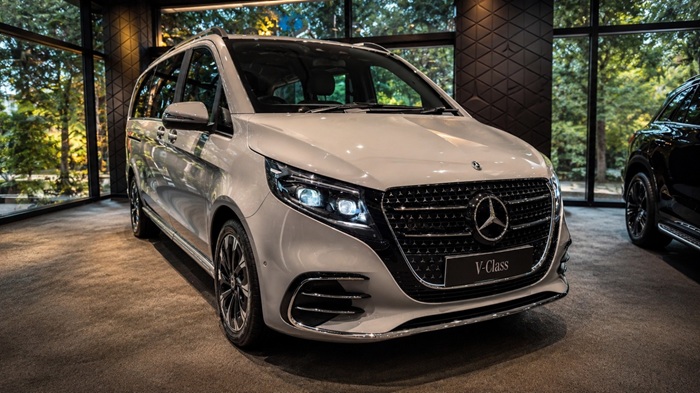
The basic proportions remain unmistakably van-like. There is no disguising a 5.37-metre-long rectangular body, but the AMG Line treatment gives the V-Class considerably more visual authority.
At the front is a huge star-pattern radiator grille featuring an enormous Mercedes-Benz emblem. The grille is framed by a slim LED light strip, creating an instantly recognisable signature after dark. This is not a shy face. It looks as though Mercedes asked its designers to create a grille that could be noticed from the passenger terminal of an airport.
The Multibeam LED headlamps add both visual drama and serious functionality. Each module contains 84 individually controllable high-performance LEDs, allowing the beam pattern to respond to traffic and road conditions. Highbeam Assist Plus can provide maximum illumination while reducing glare for other road users. In simple terms, the V-Class can illuminate the road intelligently rather than blasting every approaching driver with the brightness of a small interrogation room. trically adjustable outside mirrors incorporate turn indicators and cameras for the surround-view system. Their size is appropriate because when you are piloting something this large, ordinary mirrors would be about as useful as two compact makeup mirrors on a cargo ship.
The vehicle shown here is finished in Alpine Grey, a shade that complements the enormous body rather well. Depending on the available Indian specification, buyers can also consider more conventional silver, black, white and blue finishes. Certain brighter international colours, including red, gold and light blue, are not expected to form part of the regular Indian palette.
The side profile reveals the sheer scale of the Extra Long Wheelbase model. It measures 5,370 mm in length, 1,928 mm in body width and approximately 1,901 mm in height. The wheelbase itself is an enormous 3,430 mm. Despite that length, the turning circle is 11.8 metres, which is respectable for a vehicle resembling a premium studio apartment on wheels. ght is approximately 2,491 kg for the petrol version and 2,494 kg for the diesel, while the permissible gross vehicle weight is 3,100 kg. In other words, the V-Class weighs around two and a half tonnes before your extended family, luggage, business associates and collection of unnecessarily large suitcases climb aboard. Line specification brings attractive 18-inch, 10-spoke alloy wheels. This vehicle uses 245/45 R18 tyres at both ends, with large disc brakes at the front and rear. The relatively sensible wheel size is a good decision. Twenty-one-inch wheels might look spectacular in a showroom, but on Indian roads they would convert every pothole into a strongly worded complaint from the second row.
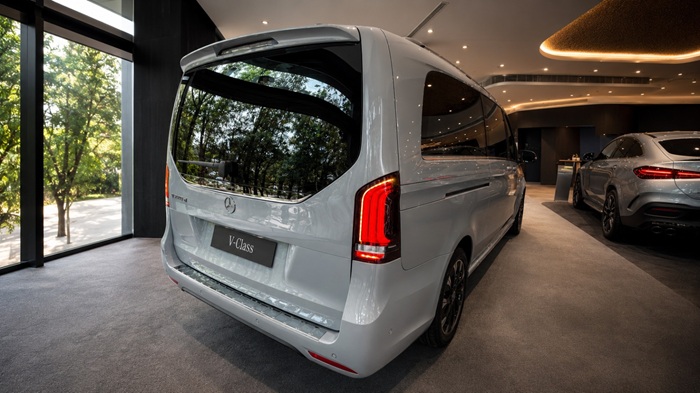
At the rear, the upright tailgate is decorated with distinctive LED tail lamps. The split opening arrangement is genuinely useful: the rear glass can be opened independently, allowing smaller bags to be loaded without raising the entire tailgate. That matters in tight parking spaces, because the full tailgate is approximately the size of the main entrance to a small banquet hall.
Heat-insulating glass helps reduce temperature build-up inside the enormous cabin. It is especially valuable in India, where a parked vehicle can go from “pleasant luxury lounge” to “commercial bakery oven” remarkably quickly.
Both rear sliding doors are electrically operated. They can be opened using exterior handles, dashboard controls, cabin switches or the key remote, depending on the situation. The doors create a wide opening and make entry far more dignified than climbing into the back of a conventional three-row SUV. : Bring the Family, Staff and Possibly a Conference
The Indian V-Class is configured as a six-seater. There are two seats in each row, giving every passenger an individual chair rather than asking three adults to negotiate ownership of one rear bench.
With all seats in use, boot capacity is around 500 litres—enough for airport luggage or a weekend trip, provided nobody interprets “weekend” as moving permanently to another city.
Reconfiguring or removing the rear seats can expand the luggage area to as much as 5,010 litres. That is not simply a boot; it is almost a warehouse with ambient lighting. Mercedes officially lists the maximum luggage capacity at 5,010 litres. s can slide forward and backwards on floor rails, rotate, fold or be removed. Additional seating arrangements can also be created depending on specification and market. Owners can configure the cabin as a traditional forward-facing six-seater, a face-to-face meeting room or a large cargo area.
This flexibility is one of the V-Class’s greatest strengths. A Lexus LM is a magnificent luxury MPV, but it feels more permanently arranged around its executive-lounge identity. The Mercedes can transform itself according to the occasion. On Monday it can carry company directors, on Friday it can take the family to the airport, and on Sunday it can transport enough luggage to suggest that the family has left the country indefinitely.
Internationally, this vehicle family is offered in many other forms, including seven- and eight-seat passenger versions, electric derivatives, panel vans, cab-chassis configurations and Marco Polo campers equipped with sleeping and kitchen facilities. India receives the sophisticated luxury-passenger interpretation rather than the version designed for carrying cement bags or cooking breakfast beside a mountain.
Interior: Welcome to the Private Suite
Open an electric sliding door and the commercial-vehicle associations rapidly disappear.
The cabin is upholstered in black Lugano leather, while a lighter beige treatment may also be offered. The black interior is easier to maintain and looks businesslike; beige creates a brighter atmosphere but may require passengers to sign a legally binding agreement before carrying coffee.
The second row is the centrepiece. Each individual luxury seat offers powered adjustment, reclining functionality, ventilation, massage and adjustable calf support. The seats can create a deeply relaxed, semi-reclined position that feels closer to an airline business-class suite than a conventional car seat. Mercedes officially describes the rear accommodation as a private-suite environment, and that is not much of an exaggeration. supports are particularly useful during long journeys. Once reclined, ventilated and massaged, second-row passengers may become so comfortable that they begin questioning why the destination is necessary.
Deployable cupholders and multiple storage compartments ensure that drinks, devices and personal items remain within reach. There is one concern, however: once passengers discover the massage function, the person driving may receive no conversation whatsoever for the remainder of the journey.
The third row is not treated like an economy-class punishment area. Mercedes-Benz India highlights ventilated third-row seats, making this one of the first vehicles in its segment to provide ventilation across all three rows. That is particularly valuable in our climate, where the third row of many vehicles feels less like a passenger compartment and more like a poorly ventilated attic. m that every row offers first-class comfort is not entirely marketing theatre. Front occupants receive electrically adjustable seats with memory, heating, ventilation and lumbar support. Second-row passengers receive the most elaborate chairs, while the third row retains individual seating, ventilation and generous space.
A wood-look dashboard trim softens the otherwise digital cabin, while illuminated scuff plates and LED logo projection from the doors add the necessary theatre. When you spend ₹1.40 crore on a luxury van, it is reasonable to expect the ground itself to be informed that a Mercedes has arrived.
The cabin also features 64-colour ambient lighting extending through the cockpit and rear passenger area. You can select a calming blue, elegant gold, energetic red or whatever colour best matches the mood of the next board meeting. ’ Energizing Comfort package can coordinate the climate control, ambient lighting, audio and seat functions through a selection of programmes. It effectively allows the vehicle to change its internal atmosphere depending on whether passengers require relaxation, refreshment or renewed energy.
This is a useful feature after a difficult working day. Instead of discussing your stress with someone, you can ask a 5.37-metre German van to adjust the lighting and massage your back.
Dashboard and Technology
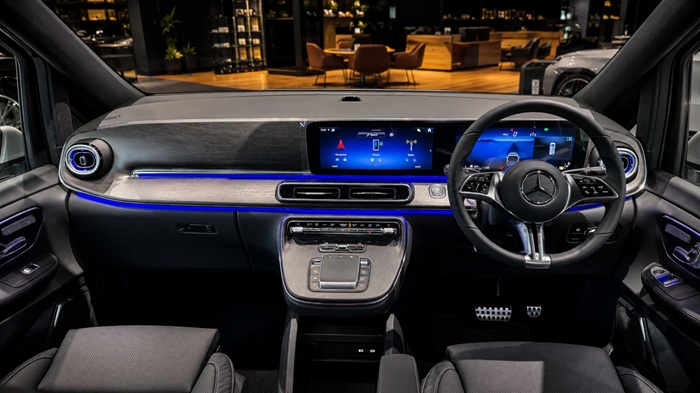
The dashboard has been modernised with a Widescreen Cockpit containing two 12.3-inch displays beneath a continuous glass panel.
The 12.3-inch digital instrument cluster provides the driver with speed, engine information, navigation instructions, assistance-system data and configurable displays.
Alongside it is a 12.3-inch MBUX touchscreen supporting wireless Apple CarPlay and Android Auto, navigation, voice commands, USB connectivity, radio and various vehicle functions. The “Hey Mercedes” voice assistant can control many features without requiring the driver to search through menus. ONIC voice control is useful, although asking a digital assistant to change the temperature while five passengers simultaneously discuss lunch plans may still test the limits of artificial intelligence.
A touchpad on the centre console provides another method of controlling the infotainment system. Some users will prefer direct touchscreen inputs, while others may appreciate having a physical interface when the vehicle is moving over uneven roads.
The three-spoke multifunction steering wheel is wrapped in leather and carries controls for the instrument cluster, infotainment, telephone, audio volume, voice assistant and cruise-control functions. The layout resembles Mercedes-Benz passenger cars, helping the V-Class feel less like a van from behind the wheel.
There is also an automatically dimming rear-view mirror, although with a cabin this long, objects in the mirror are not only closer than they appear—they may also belong to a completely different time zone.
The THERMOTRONIC automatic climate-control system provides separate temperature management to keep the large cabin comfortable. Cooling a vehicle of this volume is no small challenge, but strategically positioned vents and rear climate controls ensure that passengers are not dependent entirely on the front dashboard outlets.
Burmester Sound: A Concert Hall With Sliding Doors
The V-Class receives a 640-watt Burmester surround-sound system with 15 speakers and Dolby Atmos support. It has enough power and speaker coverage to provide a rich listening experience across all three rows. important because a normal four-speaker system inside a cabin this large would sound as though the music were being played from a neighbouring building.
The Burmester system can deliver detailed vocals, controlled bass and a wide soundstage. Whether passengers choose classical music, Bollywood, jazz or a conference call involving eight people speaking simultaneously, the audio system ensures everyone can hear it clearly.
Connected-Car Features
Through the Mercedes-Benz smartphone application and compatible Digital Extras, owners can access functions such as vehicle monitoring, location information, door-lock status, remote locking and unlocking, journey data and general vehicle status.
This is useful when you are sitting inside a hotel and suddenly begin wondering whether you locked one of the enormous sliding doors. Instead of walking all the way back, you can check the app and preserve both dignity and energy.
A wide range of accessories is also available, including roof rails, roof boxes, bicycle carriers, storage crates, child seats, dashcams, trailer couplings and coat hangers.
The genuine Mercedes hanger deserves a special mention. Nothing communicates success quite like arriving at a meeting in a ₹1.40-crore luxury MPV with your suit jacket transported on a factory-approved German hanger.
Safety and Driver Assistance
The V-Class is equipped with seven airbags, including a centre airbag designed to reduce contact between the front occupants in a side impact. It also receives a substantial collection of active safety and driver-assistance systems. istance Assist Distronic uses radar to maintain a selected gap from the vehicle ahead and can reduce fatigue in highway and stop-and-go traffic.
Active Lane Keeping Assist monitors lane markings and can provide steering intervention when the vehicle begins drifting unintentionally.
Blind Spot Assist warns the driver when another road user is positioned in a difficult-to-see area, while Rear Cross Traffic Alert is particularly helpful when reversing something more than five metres long out of a crowded parking space.
Active Parking Assist works with the 360-degree camera system to make parking easier. The surround-view display can show the area around the vehicle from different perspectives, including a virtual bird’s-eye view.
This is not a luxury gimmick. Without a 360-degree camera, parking the V-Class in an urban basement would require a spotter, two walkie-talkies and possibly local police assistance.
The driver-monitoring camera observes eye movement and gaze direction. Working with Attention Assist, it can warn the driver when it detects signs of fatigue or reduced alertness. fety features include three-point seat belts, ISOFIX child-seat mounting points, Hill-Start Assist, child locks, tyre-pressure monitoring, Traffic Sign Assist, Pre-Safe occupant protection and systems intended to improve stability during strong crosswinds.
Crosswind Assist is particularly relevant because the V-Class presents a considerable side area to the wind. A strong gust can affect a tall vehicle more noticeably than a low sedan, so electronic intervention can help maintain its intended direction.
The model family historically achieved a five-star Euro NCAP rating in 2014, and certain V220 d and V250 d versions also carried a five-star ANCAP rating. However, these ratings relate to older tested vehicles and protocols; the ANCAP rating subsequently expired in December 2022. They should not be presented as a fresh 2026 crash-test result for this exact Indian facelift. tinction is important. Safety technology has improved substantially, but crash-test stars belong to the specific model, equipment and testing year assessed—not automatically to every later facelift wearing the same name.
AIRMATIC: Because Indian Roads Do Not Respect Luxury
One of the most important features of the Indian V-Class is its Airmatic air suspension with adaptive damping and automatic level control.
The system continuously adjusts damping according to the road surface, driving conditions and vehicle movement. It can regulate the body’s ride height based on speed, passenger load and selected driving mode, helping the V-Class remain composed even when fully occupied. -Benz has calibrated the India-specification suspension with local road conditions in mind. That matters because a luxury MPV cannot merely look comfortable—it must remain comfortable while dealing with expansion joints, speed breakers, unfinished road repairs and potholes deep enough to have their own municipal boundaries.
India is notable for receiving Airmatic with both petrol and diesel versions. The combination of air springs, adaptive damping and 18-inch wheels should deliver a significantly more polished ride than a conventional van suspension.
Do not expect it to float with complete indifference over every obstacle. This is still a tall, heavy vehicle with a long wheelbase. Sharp potholes and poorly designed speed breakers can be felt. But the suspension should round off disturbances more effectively, maintain body control and prevent the cabin from developing the bouncing motion commonly associated with large people carriers.
Steering and Road Manners
The V-Class uses rear-wheel drive in both petrol and diesel forms. Sending power to the rear wheels helps improve traction under load and contributes to the relatively tight turning circle. teer provides speed-sensitive assistance. The steering remains light during parking and urban manoeuvres but becomes more stable as speed increases.
Nobody will mistake the V-Class for a sports car. It weighs nearly 2.5 tonnes, stands 1.9 metres tall and has the aerodynamic subtlety of a luxury wardrobe. Yet it can feel surprisingly manageable once moving.
The driver sits high with a commanding view of the road. The upright glass area improves visibility, while the cameras, sensors and large mirrors make the dimensions easier to judge.
Body roll is naturally more noticeable than in a sedan, particularly during quick direction changes. However, the adaptive suspension helps control the mass, and the vehicle feels secure when driven smoothly.
That last point is crucial. The V-Class rewards calm, progressive driving. It is designed to transport passengers in comfort, not to set a Nürburgring lap record while four executives attempt to drink coffee in the rear.
Petrol Engine: Smooth, Quiet and Mildly Electrified
The V 300 petrol uses a 1,999 cc, turbocharged, inline-four-cylinder M254 engine—not the older M274 unit.
The engine develops 170 kW, equivalent to 231 PS or approximately 228 bhp, along with 370 Nm of torque. An integrated starter-generator supports the mild-hybrid system, providing recuperation, smoother restarting and a temporary electrical boost of around 15 kW, or approximately 20 hp. delivered to the rear wheels through Mercedes-Benz’s 9G-Tronic nine-speed automatic transmission.
The M254 is a newer-generation Mercedes petrol engine. Therefore, the claim that this exact V-Class engine is the same M274 used in older versions of the E-Class, C-Class, GLC, SLC, Infiniti Q50, Q60, Q70 and Nissan Skyline would be inaccurate. Those vehicles did use variants of the earlier M274 family in certain markets, but the 2026 Indian V 300 officially receives the M254.
The petrol version suits owners who prioritise refinement. It starts quietly, responds smoothly and keeps vibration well controlled. The mild-hybrid assistance helps the engine move this substantial vehicle away from rest without making every departure sound like an argument between mass and machinery.
With 370 Nm available, it will not deliver the effortless low-speed shove of the diesel, particularly when fully loaded. Nevertheless, the nine-speed transmission keeps the engine in its useful operating range and shifts unobtrusively during relaxed driving.
The supplied expectation of approximately 9 km/l should be treated as a broad estimate rather than a guaranteed figure. Actual consumption will depend heavily on traffic, passenger load, air-conditioning use and driving style. A two-and-a-half-tonne petrol luxury van is not the vehicle to purchase when your main objective is winning arguments about fuel economy.
The fuel tank holds 70 litres. At a petrol station, the attendant will have enough time to admire the size of the vehicle, discuss the weather and perhaps reconsider several career decisions.
Diesel Engine: The Sensible Choice for Serious Mileage
The V 300 d uses Mercedes-Benz’s 1,950 cc OM654 turbo-diesel, inline-four-cylinder engine.
It produces 174 kW, equivalent to 237 PS or approximately 233 bhp, and a substantial 500 Nm of torque. Like the petrol, it uses the 9G-TRONIC automatic transmission and rear-wheel drive. Mercedes lists a 0–100 km/h time of 8 seconds and a top speed of 220 km/h. -second sprint is impressive for something that can carry six people in individual luxury chairs and swallow more than 5,000 litres of luggage with the seats removed.
The diesel is likely to be the better option for buyers covering long distances. Its 500 Nm torque output makes it feel more relaxed when accelerating with passengers and luggage, while the engine does not need to work as hard during highway overtakes.
The quoted figure of around 16 km/l is optimistic for many real-world situations and should not be treated as an unconditional promise. Still, the diesel should deliver meaningfully better touring efficiency than the petrol, especially at steady highway speeds.
The trade-off is refinement. The OM654 is a sophisticated diesel and is well insulated, but some diesel sound and vibration can be detected, particularly during cold starts and hard acceleration. Once cruising, it settles into the background effectively.
For city-focused, low-mileage use where silence is the priority, the petrol makes sense. For long highway journeys, frequent airport transfers and high annual usage, the diesel’s additional torque and efficiency make it the more logical choice.
Petrol or Diesel?
The petrol V 300 is the smoother and quieter option. It suits private owners, luxury hotels and corporate buyers whose vehicles spend most of their time in cities.
The diesel V 300 d is the stronger all-rounder for long-distance touring. Its additional 130 Nm of torque makes a noticeable difference when the cabin is fully occupied.
Since both versions were introduced at the same ex-showroom price, the decision comes down largely to usage rather than initial cost.
The petrol is the choice of the heart—or at least the ears.
The diesel is the choice of the calculator.
Comfort From the Driver’s Seat
Although most V-Class buyers will probably occupy the second row, the driver has not been forgotten.
The elevated seating position, large windscreen and broad mirrors provide excellent forward visibility. The powered, heated and ventilated front seats reduce fatigue, while the adjustable steering column and extensive seat travel make it easy to find a comfortable position.
The nine-speed automatic transmission is well suited to the vehicle’s relaxed character. In normal use, it changes gears smoothly and avoids drawing attention to itself. That is precisely what a luxury-car transmission should do. A good automatic gearbox is like an efficient hotel manager: always working, rarely noticed and never interrupting the guests.
The driving-assistance package is especially useful on long journeys. Distronic manages the distance to the vehicle ahead, lane assistance helps maintain position and the driver camera monitors fatigue.
Nevertheless, these remain assistance systems rather than replacements for an attentive driver. Even a ₹1.40-crore Mercedes cannot understand why a motorcycle has suddenly entered your lane from the pavement.
Ownership and Exclusivity
Mercedes-Benz planned priority delivery for existing customers during the initial rollout, which makes strategic sense. The likely buyer may already own an S-Class, GLS, Maybach or AMG and now wants a more spacious vehicle for family, business or hotel-transfer duties.
The V-Class is not likely to become a common sight. Its price, dimensions and specialised purpose keep it firmly in the luxury niche.
That exclusivity is part of its appeal. A large luxury SUV may be expensive, but premium SUVs are now familiar. The V-Class communicates something different. It suggests that the owner has moved beyond merely wanting a luxury car and now requires an entire mobile lounge.
It also attracts less aggressive attention than an exotic sports car. The V-Class looks important without appearing desperate to prove it. It is the automotive equivalent of someone who arrives quietly, sits at the head of the table and does not need to introduce themselves.
Practical Limitations
Despite its many strengths, the V-Class is not perfect.
First, it is enormous. At 5.37 metres long, it requires careful planning in crowded cities. Many Indian basement parking spaces were designed when cars were smaller and optimism was greater.
Second, the width and long wheelbase can make narrow streets, tight turns and congested market areas stressful. The 360-degree camera helps, but it cannot physically widen the road.
Third, this remains a van-derived platform. The cabin is luxurious, but certain surfaces, proportions and driving characteristics cannot completely disguise the commercial-vehicle foundations.
Fourth, the price is substantial. At ₹1.40 crore ex-showroom, the V-Class competes not only with luxury MPVs such as the Toyota Vellfire, Lexus LM and MG M9 but also with premium SUVs and sedans offering stronger brand glamour or more sophisticated driving manners.
Finally, owners will need a competent chauffeur. Putting an impatient driver behind the wheel of a V-Class defeats the purpose of massage seats, adaptive suspension and carefully calibrated tranquillity. One badly judged speed breaker can cancel several minutes of Energizing Comfort.
Verdict
The 2026 Mercedes-Benz V-Class is one of the most complete luxury people carriers available in India.
It combines enormous space, genuinely flexible seating, powered sliding doors, air suspension, excellent rear-seat comfort, modern infotainment and an extensive assistance package. The petrol engine prioritises refinement, while the diesel provides stronger torque and better long-distance suitability.
It is not as glamorous as a Maybach, not as discreetly Japanese as a Lexus LM and not as futuristic as a fully electric luxury MPV. What it offers instead is an unusual mixture of prestige, practicality and adaptability.
You can use it as an executive limousine, luxury family car, hotel shuttle, mobile office or airport transporter. Remove the seats and it can swallow an extraordinary amount of cargo. Rotate the seats and it becomes a meeting room. Recline the second row and it becomes a relaxation lounge.
Very few ₹1.40-crore vehicles can carry six adults in genuine comfort while also being capable of transporting the contents of a small apartment.
The exterior may still say “van,” but the cabin says “private suite.”
The dimensions say “commercial vehicle,” but the massage seats say “do not disturb.”
And the three-pointed star says that even when you need the practicality of a minivan, you need not arrive looking as though you borrowed one from the hotel.
The Mercedes-Benz V-Class is therefore not merely an MPV. It is an S-Class philosophy stretched vertically, fitted with sliding doors and given enough interior space to hold a board meeting.
It may not have wings, but for six privileged passengers, it comes remarkably close to business class.