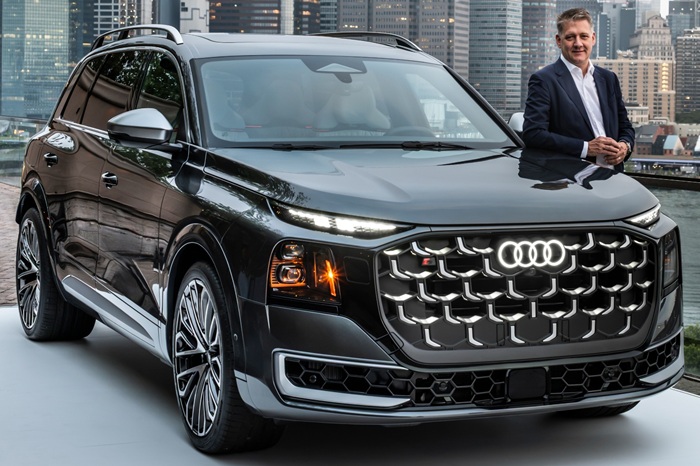
Audi has unveiled the Q9, its first large full-size SUV and the biggest production vehicle in the company’s history, expanding the upper end of its portfolio with three-row seating, advanced driver-assistance technology and a starting price of €108,400 in Germany.
The new flagship will be available to order in Germany from the end of July 2026, with deliveries scheduled to begin in the fourth quarter, including from November. The Q9 will initially be offered with a 3.0-litre V6 diesel engine producing 220 kW (299 PS) and 630 Nm of torque, while selected European markets will also receive a 180 kW version.
Audi says the Q9 marks the first time it has assigned the number “9” to an SUV, placing the model above its existing utility vehicles and giving the company a direct flagship built around space, comfort and technology.
“The Audi Q9 is the new flagship of the Audi portfolio. With our first large full-size SUV, we are elevating our brand’s premium positioning,” Audi CEO Gernot Döllner said.
“In the future, ‘Vorsprung durch Technik’ will increasingly be defined by the in-car experience – because cars are much more than just a means of transportation. For many of our customers, they are becoming mobile living spaces,” Döllner said. “That is exactly what the Audi Q9 represents as the new flagship of our portfolio. Premium materials, individual electric seats in the second row, and automatic doors underscore our commitment to quality in the interior. When combined with the latest driver assist systems and a holistic user experience, it becomes clear where we are taking the Audi brand.”
Audi’s Biggest SUV Yet
Calling the Q9 large would be something of an understatement. The SUV measures 5.31 metres long, 2.21 metres wide and 1.81 metres tall, with a substantial 3.14-metre wheelbase.
Those dimensions make it the largest Audi produced to date and provide enough room for seven occupants as standard.
An optional six-seat configuration replaces the conventional second-row bench arrangement with two electrically adjustable individual seats, creating what Audi describes as a business-class atmosphere.
All three second-row positions in the seven-seat version include Isofix-compatible child-seat mounting points, while the long wheelbase is intended to make the third row suitable for adults rather than merely serving as an emergency seating area.
The second-row seats are power-adjustable fore and aft, and Audi has developed an electrically operated comfort-entry system that slides and tilts an outer second-row seat forward without requiring an attached child seat to be removed.
Third-row seatbacks can also be folded electrically, including through controls positioned in the luggage compartment.
Automatic Doors Make Audi Debut
Another first for the brand is the availability of automatic doors.
Surround sensors monitor the area around the vehicle, with obstacle detection capable of stopping a door if a person or object prevents it from opening fully.
An electric soft-close mechanism assists when shutting the doors, while opening and closing functions can be controlled from several points inside the Q9 or remotely using the myAudi app.
Audi has also linked the doors with its exit-warning technology. Rear radar sensors monitor approaching vehicles, cyclists and pedestrians when the Q9 is stationary.
If a potential collision is detected as an occupant attempts to leave the vehicle, the system can prevent a door from opening or halt one that has already begun moving.
Largest Panoramic Sunroof Ever Fitted to an Audi
The Q9 gets Audi’s largest panoramic sunroof to date as standard, featuring more than 1.5 square metres of glass.
Unlike many panoramic glass roofs, it can be opened or tilted rather than remaining permanently fixed.
Audi will also offer optional switchable transparency divided into nine individually controllable segments, allowing passengers to adjust how much light enters the cabin without requiring a conventional sunblind.
When the Q9 is parked, the roof automatically becomes opaque to reduce visibility into the cabin. Audi says the coated laminated glass also blocks more than 99.5% of ultraviolet radiation.
On higher specifications, the glass roof can be illuminated using 84 LEDs, with a choice of 30 colours coordinated with the vehicle’s ambient lighting.
It is perhaps the closest a sunroof has come to demanding its own lighting department.
Curved OLED Rear Lights Make Production-Car Debut
Lighting technology is another major focus of the new flagship.
The Q9 introduces what Audi describes as the world’s first curved digital OLED rear-light panels in a production vehicle.
The third-generation digital OLED system uses ultra-thin glass measuring just 0.1 mm thick, allowing the outer panels to follow the bodywork’s three-dimensional curvature.
Audi says this provides greater freedom for designers while improving the visibility of the rear lamps when viewed from the side.
Across six digital OLED panels, the rear lighting system incorporates 512 individually controlled segments. The outer panel contains 99 segments, the centre panel 84 and the inner panel 73 on each side.
A continuous LED strip with illuminated Audi rings connects the rear lamps.
The Q9 can additionally project stylised turn signals onto the road at night in synchronisation with the vehicle’s conventional dynamic indicators.
Digital Matrix LED headlights with a new micro-LED module provide the corresponding technology at the front.
The headlights can project lane-change warnings, lane-departure guidance and even an ice-crystal symbol onto the road when connected traffic information indicates potentially icy conditions.
A marking-light function can also highlight pedestrians close to the roadway during darkness.
Hands-Free Driving at Up to 130 km/h
The Q9 debuts Audi’s adaptive driving assistant plus with hands-free driving on approved highways and Autobahn sections.
Initially offered in Germany, the United States and Canada, the system allows drivers to remove their hands from the steering wheel at speeds of up to 130 km/h or 85 mph while the vehicle handles steering, acceleration and braking.
The system can also assist with lane changes after the driver activates the indicator.
Audi stresses that the technology remains classified as SAE Level 2 partial automation, meaning the driver remains responsible for the vehicle and must continue monitoring the road.
A camera mounted on the steering column monitors the driver’s eye position and head movements.
If the driver stops paying attention or becomes unresponsive, the system issues escalating visual, audible and haptic warnings.
Should there still be no response, the Q9’s new emergency-assist function can slow the vehicle and bring it to a controlled stop.
On suitable highways, the system can also steer the SUV onto an unoccupied shoulder while travelling at between 50 and 30 km/h, before stopping and eventually initiating an emergency call if the driver remains inactive.
Extensive Safety and Parking Technology
Other assistance technologies include automatic emergency braking with pedestrian and cyclist detection, blind-spot monitoring, rear cross-traffic warning, a 360-degree camera system and automated parking.
Trailer users also receive dedicated assistance systems, including trailer manoeuvring assistance, trailer stability control and integrated trailer brake control.
The SUV’s connected exit-warning system can additionally use its digital rear lighting and door-projection functions to alert approaching cyclists and other road users.
Three Screens Across the Dashboard
Inside, Audi’s latest infotainment architecture centres around its curved MMI panoramic display.
The system combines a 12.3-inch Audi virtual cockpit with a 14.5-inch central MMI touchscreen, while a separate 12.3-inch passenger display is standard.
A dynamic privacy mode prevents video and other potentially distracting content on the passenger screen from being visible to the driver when the vehicle is moving.
The infotainment platform runs Android Automotive OS and supports third-party applications through the integrated Audi Application Store.
Audi’s voice assistant has also been upgraded with ChatGPT integration.
The vehicle first determines whether a command relates to a car function, navigation or another task that its own systems can perform. General questions that Audi’s system cannot answer can then be forwarded to ChatGPT.
Audi says the process is integrated into its assistant so occupants do not need to manually switch between systems.
Bang & Olufsen System Adds Seat Vibrations
Audi is also offering an updated Bang & Olufsen premium sound system with 4D sound.
It comprises 22 speakers producing 1,360 watts, including four headrest speakers for the driver and front passenger.
New actuators integrated into the front seats generate vibrations synchronised with music to make low frequencies physically perceptible.
The system incorporates Fraunhofer Symphoria technology for adaptive sound distribution, while users can adjust or completely disable the additional immersive effects.
The headrest speakers can separately handle phone calls and navigation instructions, reducing interference for other occupants.
Premium Materials and Plenty of Charging
Cabin material choices include wool upholstery such as alpaca fibre, Dinamica microfibre, leather and leatherette combinations and fine Nappa leather.
New interior colours include tamarind brown, natural beige and stone beige, while available decorative finishes include natural-grain ash, lime-structure trim and carbon-fibre weave.
Glossy surfaces have deliberately been reduced in favour of matte and textured finishes — a small but potentially welcome development for anyone who has spent too much time wiping fingerprints from a modern touchscreen-heavy cabin.
The redesigned centre console includes an optional dual wireless charger compatible with the Qi2.2 standard.
USB-C charging outputs reach 60 watts in the front row, 100 watts in the second row and 45 watts in the third row.
Audi has even enlarged the cup holders to accommodate the oversized tumblers popular in the United States.
The luggage compartment gains an aluminium rail system with movable hooks and anchor points for securing cargo.
3.0-Litre V6 Diesel With Mild-Hybrid Assistance
At launch in Germany, the Q9 will be powered by a 3.0-litre V6 TDI diesel developing 220 kW (299 PS) and 630 Nm.
Audi quotes combined fuel consumption of 8.0 to 7.4 litres per 100 km, equivalent to 29.4-31.8 US mpg, and CO2 emissions of 209-194 g/km, placing the vehicle in CO2 class G.
Selected European markets will also receive a 180 kW (245 PS) version generating 500 Nm.
Both engines use Audi’s MHEV plus mild-hybrid system, including a powertrain generator capable of supplying up to 18 kW (24 PS) of additional power.
The V6 also features a 7.5 kW peak-output electrically powered compressor working alongside two-stage turbocharging.
Audi says the compressor can build absolute boost pressure of up to 3.6 bar in 1.2 seconds, improving engine response at low revs.
Both versions are paired with an eight-speed tiptronic automatic transmission and permanent quattro all-wheel drive.
Air Suspension and Rear-Wheel Steering Standard
Adaptive air suspension is standard on the Q9 and provides up to 90 mm of total ride-height adjustment.
From its balanced setting, the vehicle can be lowered by as much as 62 mm to provide easier entry and exit.
An optional adaptive air suspension sport system adds a more dynamic calibration.
All-wheel steering allows the rear wheels to turn by as much as five degrees. At low speeds they steer in the opposite direction to the front wheels to reduce the turning circle; at higher speeds they turn in the same direction to improve stability.
Braking is handled by ventilated discs measuring 400 mm at the front and 350 mm at the rear, with six-piston fixed front calipers.
Audi drive select provides seven driving modes, while a drive-select assistant can automatically choose a setting according to road conditions and driving behaviour.
Advanced and S Line Versions
The Q9 will be available in two major exterior specifications.
The standard advanced line uses vertical slats within the Singleframe grille and places greater emphasis on a restrained luxury appearance.
The optional S line features a more open grille treatment, stronger lower-body styling and a more prominent rear spoiler.
Wheel sizes range from 20 to 23 inches, with 22- and 23-inch tyres receiving acoustic foam inserts to reduce road noise.
An illuminated Singleframe grille will also be available.
Production in Bratislava
Audi will manufacture the Q9 in Bratislava.
German customers will be able to place orders from the end of July 2026, while customer deliveries are expected to begin during the fourth quarter, with the company identifying November as the start of deliveries.
The Audi Q9 TDI 220 kW starts at €108,400 (INR 1.19 crore).
With the Q9, Audi is moving into the upper reaches of the full-size luxury SUV market with a vehicle that combines traditional flagship ingredients — sheer size, six- or seven-seat accommodation and a powerful diesel engine — with a growing emphasis on software, automated driving and highly configurable digital lighting.
For Audi, the significance of the Q9 goes beyond adding another SUV. It signals how the brand intends to define its next generation of flagships: less around transportation alone and increasingly around the technology, comfort and digital experience occupants encounter once the doors close.