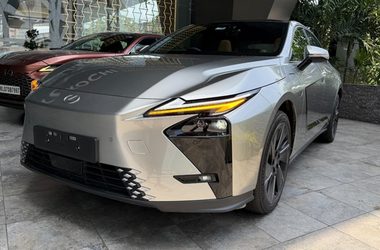
The eighth-generation Lexus ES arrives with dramatic styling, a beautifully considered interior, 338 bhp and all-wheel-drive electric performance. But at ₹91.20 lakh, can this sophisticated Japanese sedan convince buyers to look beyond the traditional German luxury establishment?
There was a time when buying a Lexus ES was a wonderfully sensible way of declaring that you had made it in life but had absolutely no intention of telling the entire neighbourhood about it. It was comfortable, beautifully constructed, exceptionally refined and about as interested in aggressive driving as a Japanese tea ceremony. The 2026 Lexus ES, however, has apparently decided that discretion need not mean anonymity. Now in its eighth generation, this Japanese luxury sedan has acquired a striking new appearance, an extensively redesigned cabin and, for the first time, a fully electric powertrain. The ES 500e is the most powerful expression of that transformation, combining two electric motors, intelligent all-wheel drive and a level of technological sophistication that would have seemed rather extravagant in the old ES. Yet its fundamental mission remains reassuringly familiar: make every journey feel more civilised than the world outside.
The Lexus ES story began in 1989, when it was introduced alongside the flagship LS as one of the original members of the Lexus family. Over nearly four decades, it has evolved from a relatively modest executive saloon into a globally recognised luxury sedan, sold in more than 80 countries. The initials ES have been associated with both Executive Sedan and Elegant Sedan, descriptions that neatly capture the car’s established personality. It has never been particularly obsessed with Nürburgring lap times or making loud statements in hotel driveways. Its priorities have traditionally been refinement, reliability, passenger comfort and the sort of understated craftsmanship that becomes more appealing with age.
The eighth-generation model, internally identified by the XZ20 codename, represents one of the most significant departures in the ES’s history. Rather than simply modernising its predecessor, Lexus has fundamentally reconsidered what an executive sedan should look and feel like in an electrified world. The transformation draws inspiration from the Lexus LF-ZC Concept and its Clean Tech x Elegance philosophy, while the broader styling approach continues the company’s principle of Provocative Simplicity.
Chief designer Yahiko Kumai and his team have attempted something more ambitious than merely creating another aerodynamic electric car. The objective is to combine classical sedan elegance with futuristic technology, preserving a sense of visual sophistication while giving the ES a genuinely contemporary identity. Judging by the design, Lexus has taken that brief rather seriously.
A Different Kind of Executive Sedan
In India, the 2026 Lexus ES range begins at ₹66.10 lakh, ex-showroom, for the ES 350h Exquisite petrol-hybrid, with the better-equipped ES 350h Luxury positioned at ₹71.80 lakh. The fully electric ES 500e sits at the top of the range at ₹91.20 lakh. This is the flagship version under consideration here, and it represents considerably more than a conventional ES with its petrol engine removed.
The petrol-hybrid and electric variants share their fundamental design and architecture, but they cater to rather different buyers. The ES 350h appeals to owners who want the fuel-saving benefits of electrification without changing their refuelling habits. The ES 500e targets those prepared to embrace charging infrastructure in exchange for near-silent propulsion, strong acceleration and the distinctive character of a premium electric vehicle.
That distinction matters particularly in India, where luxury sedan buyers often expect one car to handle everything from chauffeur-driven urban journeys to long intercity drives. The ES has always been comfortable with the former. The electric version now has to prove that its technological sophistication can accommodate the latter without turning every weekend escape into an exercise in charging-station geography.
Beneath its new bodywork sits an evolution of Toyota’s TNGA GA-K architecture, developed to accommodate different electrified powertrains. Its engineering family has connections to a remarkably broad selection of Toyota and Lexus vehicles, including the Camry, Avalon, RAV4, Highlander, Harrier, Sienna and Crown, along with Lexus models such as the NX and RX. Related applications across the wider Toyota ecosystem extend to large luxury SUVs and MPVs, including the Lexus LM and TX, Toyota Vellfire and Century SUV, while the Suzuki Across also shares Toyota-derived engineering.
The breadth of this architecture is significant because the ES must combine the refinement expected of a traditional luxury sedan with the packaging demands of an electric vehicle. Lexus also has production and assembly operations associated with the ES in Japan and India, with local assembly forming an important part of the model’s Indian-market strategy.
Exterior: Elegance With a Sharper Edge
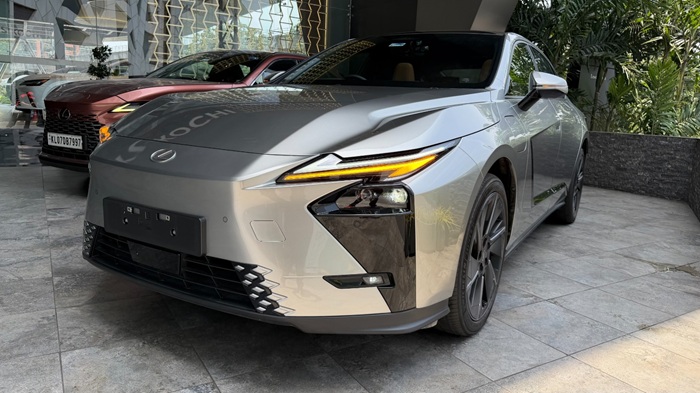
The first thing you notice about the new ES is how comprehensively it has abandoned the visual conservatism of its predecessors. This is no longer a sedan that hopes to disappear politely into the executive parking area. The front end is wide, low-looking and assertive, with an unmistakable Lexus identity despite the absence of a traditional oversized radiator grille.
Instead of relying on the familiar spindle grille alone, the ES incorporates spindle-shaped graphics into the front bodywork. The effect is more architectural than ornamental, with carefully sculpted surfaces creating visual depth without requiring an enormous collection of chrome bars. On an electric car, where a conventional grille has comparatively little mechanical work to do, that restraint is welcome.
The slim Twin L-signature LED headlamps give the nose much of its personality. Their inward-facing daytime running lights create a distinctive lighting signature, while adaptive high-beam technology and cornering lamps are intended to improve visibility after dark. The front bumper integrates cleanly with the aerodynamic treatment, and the bonnet’s sculpted lines introduce just enough visual tension to prevent the design from becoming anonymous.
It is a more mature approach to futuristic styling than covering the front of the car in illuminated shapes and hoping everyone mistakes them for innovation.
Viewed from the side, the ES reveals its greatest transformation. At approximately 5.1 metres long, 1.9 metres wide and 1.6 metres tall, it has grown into a substantial executive sedan. More precisely, the new model measures 5,145 mm in length, 1,920 mm in width and 1,575 mm in height, with a generous 2,950 mm wheelbase.
Those dimensions place it firmly in serious luxury-car territory. It is a large automobile by any reasonable definition, and although the sleek roofline attempts to disguise its considerable footprint, there is no pretending this is something you casually squeeze into the last available parking space outside a crowded café.
The proportions are deliberately aerodynamic, with a flowing roof, long wheelbase and carefully controlled body surfaces. The semi-flush e-Latch door handles help maintain the clean silhouette, while the electrically adjustable, folding and heated exterior mirrors incorporate memory functions, turn indicators, cameras and automatic tilt-down functionality. Rain-sensing windscreen wipers add another layer of everyday convenience.
Our featured car wears Sonic Titanium Silver, a finish that suits the ES’s technical character particularly well. It emphasises the sculpted panels without exaggerating their complexity. Other colour choices include blue, copper, white and black, giving buyers the opportunity to choose between understated executive transport and something rather more expressive.
Then there are the wheels.
At 21 inches, the aerodynamic alloy wheels are enormous by traditional executive-sedan standards. Their design serves both visual and efficiency-related purposes, although the practical implications of such large wheels deserve consideration. Wrapped around them are 235/45 R21 101W Michelin Primacy 5 Energy radial tubeless tyres at both ends. The Thailand-manufactured tyres carry an extra-load rating, an appropriate detail given the car’s considerable mass.
The wheel-and-tyre combination creates a confident stance, but low-profile rubber is rarely the best friend of badly repaired roads. Whether the adaptive suspension can compensate sufficiently is an important question for Indian buyers.
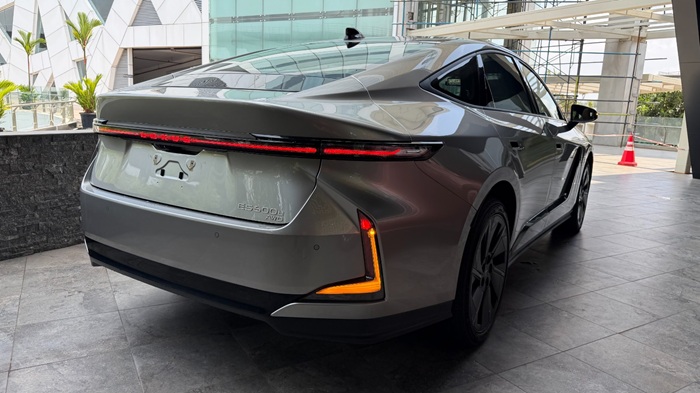
At the rear, Lexus has resisted the temptation to finish the design with unnecessary fake exhaust outlets. The electric ES has no need to pretend it burns petrol, and it is better for that honesty.
Instead, the tail features individual L-signature combination lamps, an illuminated Lexus identity and an emergency brake signal system. The lighting elements visually emphasise the width, while the sloping rear treatment gives the car an almost fastback-like character. The power-operated boot lid adds convenience without disrupting the design.
The result is arguably one of the more distinctive interpretations of the modern luxury sedan. It looks technological without becoming a caricature of technology, sporty without pretending to be a track-day special, and elegant without the anonymity that sometimes defined its predecessors.
Bigger Outside, More Considered Inside
Size is not merely a styling exercise in the Lexus ES. With a wheelbase approaching three metres, the car has the foundations for a properly spacious cabin, particularly for rear-seat occupants.
The ES 500e is a five-seater, although its natural role remains that of a four-adult luxury cruiser where rear passengers can enjoy generous personal space. The long wheelbase should particularly benefit legroom, while the taller overall body allows Lexus to accommodate the battery beneath the passenger compartment without abandoning the proportions expected of a sedan.
Its welded-steel unibody construction provides the structural foundation, but the electric powertrain inevitably brings additional weight. The ES 500e has a quoted kerb weight of 2,280 kg and a gross vehicle weight of 2,735 kg. That is a substantial amount of automobile, even before passengers and luggage are added.
The difference between those figures is 455 kg, illustrating how important load management becomes in a vehicle already carrying more than two tonnes of machinery and battery. The 5.9-metre turning radius is another useful reminder that the ES is happiest in environments where its generous dimensions are accommodated rather than constantly challenged.
Fortunately, the luggage compartment remains practical. At 517 litres, the boot offers enough capacity for airport runs, family luggage and the assorted items that inevitably accompany a long luxury-car journey. The powered opening mechanism makes access easier, and the absence of a conventional combustion engine does not mean the sedan has had to surrender its everyday usefulness.
The ES is not an SUV, of course, and buyers regularly encountering severe road damage or unusually large speed breakers will still need to be conscious of its sedan proportions. Ground clearance and suspension travel matter far more in India than they do in most luxury-car advertising campaigns.
Interior: Lexus Remembers That Luxury Is About More Than Screens
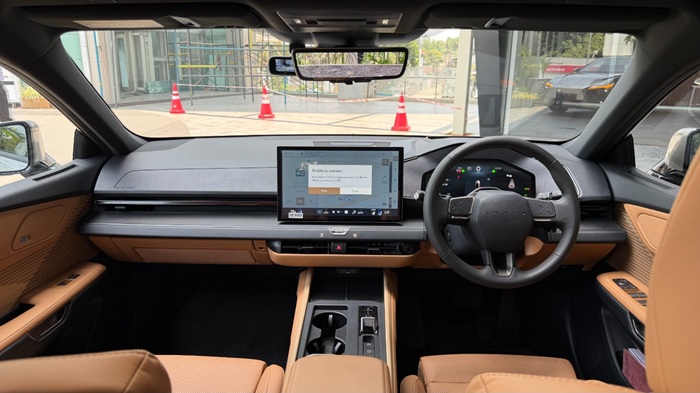
Step into the new ES and the philosophy changes from visual drama to carefully controlled calm. Lexus has approached the interior through its established Tazuna concept, a Japanese-inspired philosophy intended to reduce unnecessary driver movement and distraction by placing important controls within intuitive reach.
The dashboard adopts a comparatively clean horizontal layout, with technology integrated into the architecture rather than appearing to have been added as an afterthought. The result is a cabin that aims to feel modern without demanding that its occupants study an instruction manual before adjusting the temperature.
Materials are central to the experience. The featured specification includes brown semi-aniline leather upholstery, with a lighter white interior also available. Semi-aniline leather offers a more premium finish than ordinary synthetic upholstery, while the use of recycled materials and reduced urethane content reflects Lexus’s attempt to make the manufacturing process more environmentally considerate.
Particularly interesting are the illuminated, three-dimensional printed bamboo accents. Lexus has long built its identity around Japanese craftsmanship, and details like these are more convincing expressions of luxury than simply installing another glossy black plastic panel. Bamboo brings texture and visual warmth to a cabin that might otherwise feel excessively digital.
Ambient lighting reinforces the atmosphere, particularly after dark, while acoustic front and rear side glass is intended to isolate occupants from the outside world. In a battery-electric car, where engine noise is no longer available to disguise tyre roar and wind turbulence, this kind of attention to insulation becomes especially important.
Lexus describes its approach as Pleasant Time for All Seats, a rather charming phrase that essentially means the manufacturer would like everybody to enjoy themselves, not merely the person holding the steering wheel.
The front seats appear thoroughly equipped for that task. The driver receives 10-way electrical adjustment, while the passenger gets eight-way adjustment. Power lumbar support, memory functionality, heating and ventilation are also included, helping accommodate different driving positions and changing weather conditions.
Those features have genuine everyday value. Heated seats make cold mornings more pleasant, ventilation is particularly useful during Indian summers, and seat memory prevents the familiar ritual of readjusting everything after another family member has borrowed the car.
The steering wheel offers tilt-and-telescopic adjustment, electrical power assistance and heating, while a head-up display projects important driving information into the driver’s line of sight.
Ahead of the driver is a 12.3-inch digital instrument cluster, complemented by a large 14-inch central touchscreen. The latter manages infotainment, navigation and connected functions, with wireless Android Auto and Apple CarPlay integration. Bluetooth, USB connectivity, cloud-based navigation, voice commands, an intelligent assistant, 5G connectivity, Wi-Fi, hotspot capability, FM radio and a drive-recorder function form part of the technological package.
A screen of this size can be genuinely useful for navigation and camera displays, although the quality of the interface matters more than the diagonal measurement. A beautifully rendered menu is not especially impressive when accessing a basic function requires four separate inputs.
Lexus has an interesting answer to that problem: Responsive Hidden Switches.
Presented as a world-first innovation, this system incorporates controls that remain visually concealed until a finger approaches them, at which point the relevant switches illuminate. It is a clever attempt to combine a minimalist interior with some of the tactile familiarity of physical controls.
In principle, this is exactly the sort of technology a luxury car should embrace. The dashboard remains visually uncluttered, yet the driver is not entirely dependent on a touchscreen for every interaction. The real test will be how consistently the system responds while driving, particularly when the road surface is less than perfect.
The centre console houses the Lexus Electro-Shiftmatic gear selector, alongside conveniently positioned storage and wireless phone charging. The digital interior rear-view mirror provides an alternative to the conventional reflective display, while the tilt-and-slide sunroof introduces natural light into the cabin.
Climate management receives similar attention. The equipment list includes automatic climate control with nanoe X technology and a humidity sensor. Lexus’s focus here is not merely cooling the cabin but managing the atmosphere within it, a small distinction that becomes particularly relevant when the vehicle spends extended periods carrying passengers through hot, dusty cities.
And then there is the audio system.
The optional-sounding name is rather less impressive than the actual numbers: a Mark Levinson PurePlay surround-sound installation with 17 speakers and 1,800 watts of output. This is serious acoustic hardware, especially in a vehicle designed around a quiet electric powertrain and extensive sound insulation.
A good audio system in a quiet luxury car can make ordinary journeys unexpectedly enjoyable. The potential drawback is that passengers may become rather reluctant to leave, particularly when their favourite music sounds better inside the car than it does at home.
Rear-seat passengers benefit from the emphasis on cabin space, insulation and comfort, although those expecting the full reclining, massaging executive-lounge experience associated with considerably more expensive flagship sedans should examine the precise rear-seat specification. The ES is luxurious, but it does not attempt to duplicate every limousine feature at any cost.
Electric Performance With a Distinctly Lexus Character
Beneath the sculpted bodywork of the ES 500e sits a 74.68 kWh lithium-ion battery pack associated with Prime Planet Energy & Solutions, the Toyota-Panasonic battery venture. The battery uses liquid cooling to manage operating temperatures, an essential consideration for performance consistency, charging efficiency and longevity.
The flagship electric ES employs two permanent-magnet synchronous motors, one driving the front axle and the other the rear. Together, they produce 338 bhp and 438 Nm of torque, transmitted through an electric drive system rather than a conventional multi-speed gearbox.
An electric motor develops its torque differently from a combustion engine. There is no need to wait for turbo boost, select a lower gear or build revs before acceleration arrives. The response is immediate, smooth and generally much more linear, although manufacturers can tune throttle sensitivity to create different driving personalities.
Lexus claims the ES 500e accelerates from 0 to 100 km/h in 5.5 seconds, with an electronically limited top speed of 180 km/h. For a luxury sedan weighing 2,280 kg, that is impressive performance.
It is not hypercar acceleration, and that is precisely the point. The ES has enough power to deliver confident overtaking, brisk highway progress and genuinely entertaining acceleration without needing to turn every traffic-light departure into an audition for a drag-racing championship.
The dual-motor arrangement is supported by Lexus’s DIRECT4 all-wheel-drive system, which continuously manages the distribution of driving force between the front and rear axles. Unlike a conventional mechanical four-wheel-drive system, electric all-wheel drive can vary motor output electronically, responding quickly to changing traction demands.
That should be particularly beneficial during hard acceleration, on wet roads and when exiting corners. It also allows engineers to influence the car’s handling balance rather than simply using all-wheel drive as a traction aid.
Five driving modes are available: Normal, Eco, Sport, Range and Custom. Normal is intended to provide a balanced response, Eco prioritises efficiency, Sport sharpens the car’s behaviour, and Range focuses more deliberately on preserving available battery energy. Custom allows the driver to select preferred settings.
The advantage is flexibility. The disadvantage, as with most modern luxury vehicles, is the growing possibility of spending more time choosing how the car should behave than simply enjoying the journey.
Still, the ES 500e should have considerable appeal as a relaxed long-distance machine. Strong electric torque, the absence of conventional gear changes and extensive cabin insulation provide the ingredients for particularly effortless progress.
The qualification is important: acceleration figures establish performance capability, but they do not independently demonstrate steering feel, throttle calibration or refinement under different road conditions. Those qualities require a proper road test.
Ride and Handling: Can Two Tonnes Feel Graceful?
The traditional Lexus ES has built much of its reputation on ride comfort, so the chassis of this eighth-generation model carries considerable responsibility.
At the front, the ES employs MacPherson strut suspension, while the rear uses a multi-link arrangement. Torsion-bar stabilisers are fitted at both ends, and the flagship specification includes Adaptive Variable Suspension, or AVS.
The adaptive system adjusts damping behaviour according to driving conditions, with the aim of combining ride comfort and body control. Lexus also incorporates Pitch & Bounce Control, designed to reduce unwanted vertical and fore-aft body movements.
These systems are particularly relevant in an electric luxury sedan. The low-mounted battery helps lower the centre of gravity, which is advantageous for stability, but the overall mass means the suspension must manage substantial inertia when accelerating, braking and changing direction.
At slower speeds, a well-calibrated adaptive setup should help absorb ordinary surface imperfections without transmitting every disturbance into the passenger compartment. On highways, the objective is controlled vertical movement and reassuring stability rather than the nervous firmness sometimes associated with more overtly sporting sedans.
The real challenge will be the ES’s 21-inch wheels. Large rims and relatively low-profile tyres look excellent in photographs, but broken tarmac, sharp potholes and irregular expansion joints are unforgiving. Even sophisticated dampers cannot completely eliminate the consequences of limited tyre-sidewall compliance.
There is also the question of steering character. Electrically assisted steering makes perfect sense in a car of this type, but the ideal calibration should combine low-speed ease with sufficient reassurance at higher speeds. The ES does not need exaggerated steering weight to feel premium. It needs accuracy, consistency and a sense that the driver remains connected to what the front wheels are doing.
A relatively large turning radius and substantial body width are unavoidable compromises in tight urban environments. Fortunately, the 360-degree 3D camera system and Intelligent Park Assist are designed to reduce the effort of manoeuvring.
Regenerative braking introduces another important dimension to the driving experience. By allowing the electric motors to recover energy during deceleration, the system helps improve efficiency and reduce reliance on the conventional friction brakes.
Disc brakes are fitted at both ends, but the critical issue is how naturally regenerative and mechanical braking work together. Poor calibration can make the pedal feel inconsistent, particularly during the final few kilometres per hour of deceleration. In a car dedicated to refinement, smooth stopping behaviour matters every bit as much as impressive acceleration.
Ultimately, the ES 500e’s handling mission should be understood correctly. It is not trying to replace a lightweight sports sedan. Its achievement will depend on whether it can make its considerable size and mass feel unobtrusive while providing enough control to keep an enthusiastic driver interested.
Range and Charging: The Luxury of Not Worrying
Lexus quotes a driving range of up to 580 km for the ES 500e from its 74.68 kWh battery.
That is a useful headline figure, but prospective buyers should remember that certified range and real-world range are different things. Driving speed, outside temperature, air-conditioning usage, terrain, passenger load and tyre conditions can all influence electricity consumption.
Sustained high-speed motorway travel tends to be especially demanding for electric vehicles, because aerodynamic resistance increases rapidly with speed. The ES’s streamlined body should help manage that penalty, although its 21-inch tyres, dual-motor system and substantial weight remain relevant factors.
For city use, where regenerative braking can recover some energy during repeated deceleration, an electric sedan may perform comparatively efficiently. Long-distance highway journeys, meanwhile, require more deliberate planning.
Charging hardware is therefore a significant part of the ownership proposition. Lexus supplies a 2.8 kW portable charger and an 11 kW home charger with the car, according to the supplied equipment details.
Using the 11 kW AC charging arrangement, a full recharge is quoted at approximately 10 hours. That suits overnight charging, allowing owners with dedicated parking and a suitable electrical installation to begin most mornings with a replenished battery.
For longer journeys, the ES supports DC fast charging at up to 150 kW. The quoted fast-charging time is approximately 28 minutes for a 10–80 per cent recharge, equivalent to replenishing 70 percentage points of battery capacity under suitable conditions.
Naturally, the actual charging rate depends on battery temperature, state of charge, charger output and other operating conditions. A charger advertising 150 kW is not a guarantee that the car will accept that power continuously.
The electronically operated charging-port cover is a small but appropriate luxury touch, particularly on a vehicle that already makes most conventional interactions electrically assisted.
Running costs could be attractive for owners charging at home, especially compared with similarly powerful petrol luxury sedans. However, public rapid-charging tariffs and charging-network reliability can materially affect the economics and convenience of longer journeys.
The electric ES makes the strongest financial and practical case for owners who can charge at home or at work. Without that arrangement, the benefits of electric ownership become rather more dependent on circumstances.
The Hybrid Alternative Still Makes Plenty of Sense
While the ES 500e is the technological flagship, the ES 350h deserves consideration because it retains much of the same underlying luxury experience while avoiding the need for external charging.
Its powertrain combines a 2.5-litre naturally aspirated, inline four-cylinder Toyota Dynamic Force petrol engine, from the A25A-FXS family, with an electric motor and an electronically controlled continuously variable transmission.
The petrol engine is quoted in the supplied specification at 186 hp and 237 Nm, supported by an electric motor that helps with propulsion and energy recovery. The complete hybrid system delivers more than the petrol engine’s output alone.
Lexus quotes 0–100 km/h acceleration in 7.7 seconds, while the supplied details indicate a top speed of 200 km/h and a 55-litre fuel tank. The original specification also lists fuel economy at approximately 19 km/l, although buyers should check the latest India-certified figure for the exact variant.
The hybrid’s character is fundamentally different from that of the electric model. The petrol engine remains present during stronger acceleration, and the e-CVT manages the relationship between engine speed, electric assistance and road speed. It will not deliver the same near-silent, uninterrupted surge as the ES 500e, but it offers an appealing compromise between efficiency and refuelling convenience.
For owners frequently travelling between cities where dependable fast charging is not guaranteed, the ES 350h may be the more straightforward choice. It also costs substantially less, leaving a considerable financial difference between the hybrid and electric flagship.
That makes the 500e a purchase driven as much by preference, technology and electric refinement as by conventional value calculations.
Safety: More Than a Collection of Electronic Acronyms
A modern executive sedan is expected to provide considerable protection, and the ES incorporates an extensive combination of active and passive safety technology.
The supplied equipment details include multiple SRS airbags, anti-lock braking, electronic brakeforce distribution, brake assist, electronic brake hold, vehicle stability control, traction-related systems, active cornering assist and hill-start assistance. ISOFIX child-seat mounting provisions make it suitable for family use, while a tyre-pressure warning system adds another layer of preventive monitoring.
Lexus’s driver-assistance package includes Lane Departure Alert, Lane Tracing Assist, Blind Spot Monitoring and a Pre-Collision System, supported by a driver-monitoring camera. Dynamic Radar Cruise Control is particularly useful on longer highway journeys, maintaining a selected speed while adjusting to traffic conditions ahead.
Automatic emergency braking can assist when the system detects an impending collision, although no such system eliminates the driver’s responsibility to remain attentive.
The 360-degree 3D camera system and parking assistance technology are especially valuable given the car’s dimensions. They make an otherwise imposing sedan easier to negotiate through congested spaces, narrow entrances and unfamiliar parking areas.
Further security features include an immobiliser, anti-theft system, siren, intrusion sensor and tilt sensor. An Acoustic Vehicle Alerting System provides an audible warning to pedestrians at appropriate low speeds, important because electric vehicles can otherwise approach remarkably quietly.
The rear lamps also incorporate an emergency brake signal function, intended to communicate sudden braking to following traffic.
The ES has a comprehensive safety specification, but the exact airbag count should be confirmed for the Indian ES 500e because published equipment lists differ. No Bharat NCAP, Global NCAP or Euro NCAP rating is being claimed here without a verified result for this particular model.
Safety technology is most effective when it intervenes unobtrusively and predictably. A lane-keeping system that constantly argues with the driver can become irritating, while an overenthusiastic collision warning may be switched off altogether. The sophistication lies not merely in providing these systems but in calibrating them well.
Connected Luxury and Ownership
The modern Lexus experience extends beyond the physical car through the Lexus India smartphone application.
Depending on the supported function and connected-service availability, owners can access real-time vehicle information, remotely control selected systems, manage charging and use digital-key functionality. Features described for the application include vehicle starting functions, door and window locking or unlocking, headlamp control, charge-port access, live vehicle tracking and remote air-conditioning operation.
Security alerts and operational notifications add another dimension, particularly useful when the car is parked away from home.
The most useful connected feature is arguably remote climate control. Being able to cool the cabin before entering a parked car during a particularly aggressive Indian summer is not merely a technological novelty. It can feel like a personal victory over the weather.
Lexus also offers an extensive accessories catalogue for the ES, covering practical and cosmetic items such as floor mats, key covers, cup holders, phone holders, screen protectors, charging cables, wheel locks and door-edge guards. Other available accessories include freezers, black exterior emblems, paint-protection film, puddle lamps, illuminated scuff plates and pet-related equipment.
There is even the opportunity to make the car more personal without interfering with its underlying design, although excessive decorative accessories would rather defeat the point of buying something this thoughtfully styled.
Ownership support is another important consideration. The supplied Indian-market package includes an eight-year or 2,00,000 km warranty and five years of roadside assistance, offering long-term reassurance. Buyers should check the precise warranty terms, battery coverage and service requirements in the final purchase documentation.
Lexus’s established emphasis on customer experience and engineering quality is an important part of its appeal, particularly to owners who are less interested in displaying a famous German badge than in enjoying an uncomplicated ownership experience.
That said, the electric ES introduces long-term considerations of its own. Battery condition, electronic systems, charging hardware and future resale demand will all influence the ownership equation. The ES 500e is a new-generation electric vehicle, so predicting its long-term reliability or residual values with certainty would be premature.
The Competition: Germany Is Not Going to Make This Easy
The ES operates in a fiercely competitive part of the Indian luxury market, where its principal rivals include the Mercedes-Benz E-Class, BMW 5 Series, Audi A6 and, for the electric flagship, the BMW i5.
Each approaches luxury from a slightly different direction.
The Mercedes-Benz E-Class remains an obvious choice for buyers who place considerable importance on rear-seat comfort, established prestige and the traditional experience of a premium executive sedan. Its appeal lies in delivering a familiar combination of technology, refinement and chauffeur-friendly luxury.
The BMW 5 Series takes a more driver-oriented approach, with an emphasis on steering, chassis response and dynamic confidence. Buyers who regularly prefer driving themselves may find BMW’s interpretation of executive motoring more naturally aligned with their priorities.
The Audi A6 offers its own blend of restrained styling, cabin technology and polished road manners. For those who appreciate understated European luxury, it remains a relevant alternative.
The BMW i5 is a particularly interesting rival for the ES 500e because it addresses the same fundamental question: can a large electric sedan deliver the refinement expected of an established luxury brand while adding the performance and smoothness of electric propulsion?
The Lexus counters with a distinctive Japanese approach to interior design, extensive comfort equipment, all-wheel-drive performance and a strong emphasis on passenger tranquillity.
Yet the ES 500e’s price creates a serious dilemma. At ₹91.20 lakh, it is not an inexpensive alternative to German luxury. It is a fully fledged premium purchase, and one that requires buyers to place a considerable value on Lexus’s particular combination of styling, craftsmanship, electrification and ownership support.
The cheaper ES 350h, meanwhile, may be the more rational choice for many customers who simply want the new ES’s design and comfortable character without paying a substantial premium for battery-electric propulsion.
Verdict: A Lexus That Has Finally Learned to Make an Entrance
The 2026 Lexus ES 500e represents a fascinating change in direction for a car that has spent most of its life perfecting the art of being quietly excellent.
It is larger, more expressive and significantly more technologically ambitious than the ES models that came before it. Its striking exterior gives Lexus a more distinctive presence in the executive-sedan market, while the interior combines modern screens and connected technology with traditional ideas of material quality and Japanese craftsmanship.
The 74.68 kWh battery, dual-motor DIRECT4 all-wheel-drive system, 338 bhp output and claimed 5.5-second acceleration make it a genuinely quick luxury sedan. The claimed 580 km range and support for 150 kW DC charging give it credible electric touring credentials, at least on paper.
Its real appeal, however, should lie in the way these technologies work together. A Lexus does not need to dominate an acceleration chart to justify its existence. It needs to make journeys feel effortless, passengers feel valued and its driver feel that every interaction has been considered.
There are legitimate reservations. The car is undeniably large and heavy, the 21-inch wheels may complicate ride comfort on damaged roads, and the battery-electric powertrain makes dependable charging access an important part of ownership. The flagship’s ₹91.20 lakh price also places it against well-established premium rivals and a significantly cheaper hybrid version of itself.
For buyers seeking maximum rear-seat opulence, a Mercedes-Benz E-Class deserves close inspection. Those prioritising driver involvement should consider a BMW, while frequent long-distance travellers without convenient charging may find the ES 350h considerably easier to live with.
But for someone who wants a distinctive electric luxury sedan, values refined design over conspicuous aggression and appreciates a cabin that treats comfort as an engineering discipline rather than a marketing slogan, the ES 500e makes a compelling case.
The old Lexus ES was a car for people who had little interest in attracting attention. The new one is entirely capable of turning heads, yet its most important ambition remains unchanged: to make the world outside feel slightly less chaotic.
And perhaps that is the cleverest part of its transformation. Lexus has given the ES a new face, a new powertrain and a new sense of confidence without completely abandoning the understated personality that made it appealing in the first place.
The ES 500e does not need to shout to establish its credentials. It has finally learned how to make an entrance—and still remembers the importance of leaving its passengers feeling relaxed.