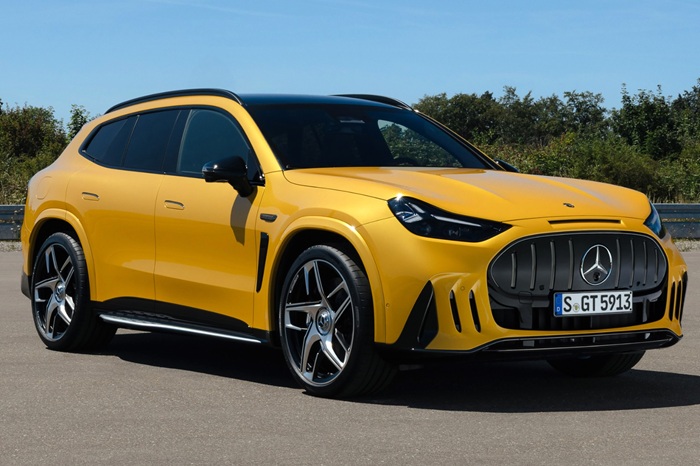
Mercedes-AMG has unveiled the new GT SUV, its first full-size SUV developed entirely in-house, marking a significant expansion of the performance division’s electric vehicle portfolio. Built on the dedicated AMG.EA architecture, the all-electric SUV offers up to 1,169 hp, acceleration from 0 to 100 km/h in just 2.5 seconds, and a claimed WLTP driving range of up to 700 kilometres. It also introduces ultra-fast DC charging capability of up to 710 kW, placing charging speed alongside outright performance as one of its headline attractions.
The new Mercedes-AMG GT SUV becomes the second vehicle based on the AMG.EA high-performance architecture, following the recently unveiled AMG GT 4-Door Coupé. According to Mercedes-AMG, the SUV has been engineered to combine sports car driving characteristics with the practicality, comfort and interior space expected from a full-size luxury SUV.
The range consists of three variants: the Mercedes-AMG GT 53 SUV, GT 55 SUV and GT 63 SUV. Order books for the entry-level GT 53 SUV will open on 20 October 2026, with prices starting at €113,050. The more powerful GT 55 and GT 63 models are scheduled to follow in spring 2027.
Three Electric Powertrains With Up to 1,169 HP
Mercedes-AMG has developed two electric drivetrain configurations for the GT SUV, with the more powerful models employing three axial flux motors and the entry-level version using two synchronous motors.
The flagship Mercedes-AMG GT 63 SUV produces up to 860 kW (1,169 hp), making it the most powerful variant in the range. Mercedes-AMG claims the SUV can accelerate from 0 to 100 km/h in 2.5 seconds and reach 200 km/h from a standstill in 6.8 seconds. Its maximum speed is 270 km/h when equipped with the Driver’s Package.
The Mercedes-AMG GT 55 SUV uses the same three-motor configuration but produces a lower peak output of 600 kW (816 hp).
Meanwhile, the GT 53 SUV features two synchronous motors, one mounted on each axle, generating a combined 400 kW (544 hp). Its rear-mounted motor works with a two-speed transmission designed to balance acceleration and high-speed efficiency.
In the GT 63 and GT 55, two axial flux motors are positioned at the rear axle, while a third motor at the front provides additional power and traction when necessary. During lighter driving conditions, the front motor can be disconnected to reduce mechanical losses and improve efficiency.
Despite the different configurations, all three models feature an electric all-wheel-drive system.
Mercedes-AMG says the flagship drivetrain can deliver up to 530 kW of continuous output, highlighting its emphasis on sustained performance rather than relying exclusively on short bursts of peak power.
Formula 1-Inspired Battery Technology With Up to 700 KM Range
One of the most significant technological developments in the GT SUV is its AMG High Performance Electric Battery, which incorporates technology inspired by Formula 1.
The 800-volt battery system is offered with two usable capacities: 106 kWh and 128 kWh.
The smaller battery contains 18 modules, while the larger version uses 22 modules and provides a claimed WLTP driving range of up to 700 kilometres.
Both batteries feature cylindrical cells measuring 105 mm in height and 26 mm in diameter. Their construction is designed to improve heat dissipation and support high charging and discharging rates.
Mercedes-AMG employs a direct cooling system in which an electrically non-conductive oil circulates around individual battery cells. The objective is to maintain consistent operating temperatures, particularly during repeated acceleration, high-speed driving and rapid charging.
The cells use an NCMA cathode and a silicon-containing anode, delivering an energy density exceeding 298 Wh/kg, according to the manufacturer.
A newly developed Central Coolant Hub coordinates the thermal management of the battery, electric motors, inverters and other components. The system can redirect cooling capacity according to operating requirements, helping maintain performance during demanding driving conditions.
Up to 450 KM of Range Added in Just 10 Minutes
The GT SUV’s charging specifications are particularly ambitious.
Mercedes-AMG claims the 106 kWh battery can support DC charging at up to 600 kW, adding as much as 380 kilometres of WLTP driving range in 10 minutes under suitable conditions.
The larger 128 kWh battery raises peak charging capability to 710 kW, potentially adding up to 450 kilometres of WLTP range in the same period.
According to the company, the larger battery can be charged from 10 to 80 per cent in as little as 12 minutes under optimal conditions. At a 400 kW charging station, the manufacturer quotes charging times of 14 minutes for the 106 kWh battery and 16 minutes for the 128 kWh battery.
These figures depend on charging infrastructure and battery conditions, with the headline 710 kW charging rate requiring compatible high-power equipment.
The GT SUV also supports 400-volt charging infrastructure through an automatic voltage switching system.
To accommodate different international markets, Mercedes-AMG has engineered compatibility with five charging standards: CCS2 for Europe, GB/T for China, CHAdeMO for Japan, CCS1 for South Korea and NACS for the United States.
AMG ACTIVE RIDE CONTROL+ Brings Active Pitch and Roll Stabilisation
Beyond its electric powertrain, the Mercedes-AMG GT SUV introduces the newly developed AMG Active Ride Control+ suspension system.
Standard on the GT 63 SUV and optional on the GT 55 SUV, the technology uses hydraulically interconnected shock absorbers and adjustable air springs to control body movements.
Unlike conventional suspension systems that rely on mechanical anti-roll bars, AMG Active Ride Control+ uses active hydraulic components to counteract body roll while cornering and pitch movements during braking and acceleration.
The system can also adjust vehicle ride height almost instantaneously and lower the body at higher speeds to improve aerodynamic efficiency.
The suspension incorporates three-stage adjustable air springs and an integrated 8.2-litre pressure reservoir.
Active rear-axle steering is standard across the range, allowing the rear wheels to turn by up to six degrees.
At speeds below 80 km/h, the rear wheels turn in the opposite direction to the front wheels, helping improve manoeuvrability. Above 80 km/h, they turn in the same direction by up to one degree to enhance stability.
Braking hardware differs across the range. The GT 53 uses steel brakes, while the GT 55 offers optional carbon-ceramic brakes. The flagship GT 63 receives carbon-ceramic brakes as standard on both axles.
Electric Performance With the Sound of a V8
Although the GT SUV is fully electric, Mercedes-AMG has retained an important element of its traditional performance identity: engine sound.
Its AMGForce Sport+ driving programme digitally reproduces the sound characteristics of AMG V8 and six-cylinder engines.
The GT 63 and GT 55 feature V8-inspired sound profiles, while the GT 53 recreates the character of an AMG six-cylinder engine.
Rather than generating entirely synthetic sound effects, Mercedes-AMG says it recorded actual combustion-engine sounds using more than 100 measurements and 16 microphones, including recordings from vehicles such as the Mercedes-AMG GT R.
The system also simulates transmission shifts, allows manual gear-change inputs through steering-wheel paddles and uses integrated seat shakers to provide additional physical feedback.
Drivers can adjust the sound through multiple settings, including Powerful, Balanced and Silent.
In other words, the SUV can deliver the soundtrack of a combustion-powered AMG without requiring a single drop of petrol.
The GT SUV offers seven driving modes: Comfort, Sport, AMGFORCE Sport+, RACE, Slippery, Individual and Eco.
The GT 55 and GT 63 additionally feature AMG RACE ENGINEER, which allows drivers to adjust throttle responsiveness, cornering characteristics and wheel-slip control using three rotary switches on the centre console.
Active Aerodynamics and a Low-Slung SUV Design
The Mercedes-AMG GT SUV has been designed with a relatively low roofline, wide track, muscular wheel arches and an elongated silhouette.
Its exterior incorporates a steep front end, pronounced shoulders, frameless side windows and short overhangs.
The familiar AMG radiator grille features metallic vertical struts, with optional illumination for both the grille and the central Mercedes-Benz star.
The lighting design includes star-shaped daytime running lights and six circular rear lamps with a turbine-inspired appearance.
Aerodynamic efficiency is supported by the Aerokinetics system, which combines an active roof spoiler with adjustable cooling-air openings in the front bumper.
On the GT 55 and GT 63, the active roof spoiler adjusts automatically from 150 km/h, changing its angle depending on speed and driving conditions to manage aerodynamic drag, stability and traction.
Meanwhile, the front Airpanel uses movable vertical slats that remain closed when additional cooling is unnecessary, reducing air resistance.
Mercedes-AMG has also employed aluminium, steel and fibre-reinforced composites in the body structure to balance rigidity, crash protection and weight.
Driver-Focused Interior With Three Screens and AI Integration
Inside, the GT SUV combines a performance-oriented driving position with the digital technology expected from a modern Mercedes-Benz.
The dashboard features a 10.2-inch digital instrument cluster and a 14-inch multimedia touchscreen angled towards the driver. A separate 14-inch passenger display is available as an option.
The GT 55 and GT 63 feature three physical rotary controls in the centre console for the AMG RACE ENGINEER system.
The cabin offers supportive front seats, with optional AMG Performance seats featuring integrated headrests. Despite its sporty roofline, Mercedes-AMG claims the SUV provides generous rear headroom and legroom.
A three-seat rear bench is standard, with folding backrests and electrically adjustable headrests.
Other features include an optional Burmester 4D sound system, configurable ambient lighting and a SKY CONTROL panoramic glass roof that can switch between transparent and opaque settings.
Personalisation is another major focus, with more than 60 MANUFAKTUR exterior paint finishes, coloured wheel accents and distinctive interior seat-belt options.
New MBUX System Integrates ChatGPT, Bing and Gemini
The GT SUV features a new generation of the Mercedes-Benz User Experience (MBUX), built on the Mercedes-Benz Operating System, or MB.OS.
Its AI-powered virtual assistant integrates technologies from ChatGPT, Microsoft Bing and Google Gemini, enabling more complex, multi-step conversations and interactions.
The system also includes AMG-specific applications designed for performance driving.
AMG PERFORMANCE MENU provides real-time information on power delivery, battery temperatures, tyre pressures and aerodynamic functions.
AMG SET-UP allows drivers to configure vehicle behaviour, steering-wheel functions and aerodynamic settings.
AMG TRACK PACE is intended for circuit driving, recording more than 80 vehicle data parameters ten times per second. It can display lap times, sector information, acceleration figures and other telemetry data.
An optional dashcam system, available in selected markets, can record driving footage with overlays showing speed, steering angle, braking and lap information.
The SUV also introduces a Predictive Performance Manager, which manages energy delivery across different sections of a racetrack to balance outright performance with battery and drivetrain thermal limits.
Range, Efficiency and Energy Consumption
Mercedes-AMG has published combined energy-consumption figures for all three variants.
| Variant | Combined energy consumption | CO₂ emissions |
|---|---|---|
| AMG GT 53 SUV | 18.8–21.1 kWh/100 km | 0 g/km |
| AMG GT 55 SUV | 21.2–23.8 kWh/100 km | 0 g/km |
| AMG GT 63 SUV | 21.2–23.8 kWh/100 km | 0 g/km |
All three variants carry a CO₂ classification of A, based on the manufacturer’s published figures.
These are official consumption figures, and real-world energy use will vary with driving conditions, vehicle configuration, temperature and driving style.
Production at Mercedes-Benz’s Historic Sindelfingen Plant
The Mercedes-AMG GT SUV will be manufactured at the Mercedes-Benz production facility in Sindelfingen, Germany.
Assembly takes place in Hall 32, which has been modified to accommodate the technical requirements of the AMG.EA electric vehicle architecture.
The facility will also manufacture key body components, including pressed panels, the body-in-white and painted structures.
Founded in 1915, the Sindelfingen manufacturing complex has a 111-year history and remains one of Mercedes-Benz’s most important production locations.
A New Direction for AMG Performance
The GT SUV represents an important step in Mercedes-AMG’s transition towards electrification, bringing technologies previously associated with dedicated high-performance cars into the luxury SUV segment.
Its combination of three-motor electric propulsion, sophisticated thermal management, ultra-fast charging and active chassis technology illustrates how the company intends to preserve its performance identity in an increasingly electric market.
However, figures such as the claimed 700-kilometre range, 710 kW charging capability and 2.5-second acceleration will ultimately need to be assessed through independent testing. Pricing beyond the entry-level model and the vehicle’s availability in individual international markets also remain to be clarified.
For Mercedes-AMG, the challenge is no longer simply making an electric SUV accelerate like a sports car. The more meaningful test will be whether it can deliver that performance consistently while retaining the comfort, practicality and long-distance usability expected from a grand tourer.