

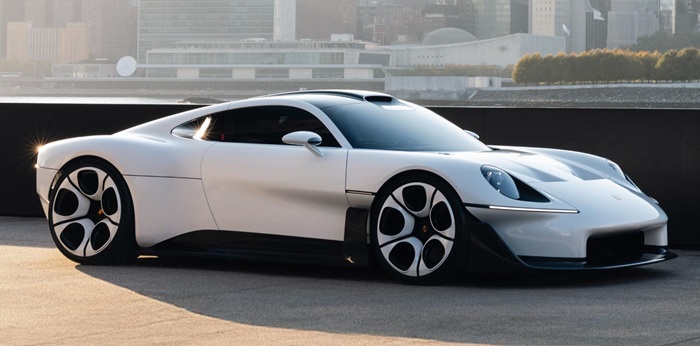
New York: Porsche has unveiled the Mission S, a new concept car that previews the next generation of the German sports car manufacturer’s design language and an ambitious expansion of its performance car portfolio. More significantly, the Mission S signals the development of a new mid-engined supercar platform positioned above the iconic 911, marking a strategic move towards a permanent range of higher-performance sports cars rather than occasional limited-production hypercars.
The concept forms part of Porsche’s Sportwagenschmiede ’35 strategic realignment, which aims to redefine the company’s design identity while preserving the characteristics that have distinguished its sports cars for decades.
“A Porsche must be recognisable as a Porsche at first glance,” said Dr Michael Leiters, Chairman of the Executive Board of Porsche AG.
“The Mission S provides a glimpse of the ideas and design features that will shape Porsche in the coming years.”
Leiters also confirmed the broader significance of the project.
“At the same time, the Mission S represents a mid-engined super sports car platform positioned above the 911 – not as a one-off hypercar, but as a permanent and versatile addition to our customer offering,” said Leiters.
A Historic New York Debut With a Connection to the 550 Spyder
Porsche selected a pier in Queens, New York, overlooking the Manhattan skyline, for the Mission S world premiere. The location holds particular significance in the company’s history.
In 1953, photographs of the mid-engined Porsche 550 Spyder were taken at the same pier before gaining international recognition. The 550 Spyder, regarded as Porsche’s first super sports car, helped establish the manufacturer’s sporting identity and contributed to its growing popularity in the United States.
More than seven decades later, Porsche has returned to the location to introduce another mid-engined sports car concept, this time with its sights firmly set on the future.
The Mission S draws inspiration from the company’s historic models, including the 550 Spyder, 356, 911, 917, 928, 959 and GT1.
“The Mission S is the result of a forward-looking, holistic design strategy,” said Tobias Sühlmann, Head of Style Porsche.
“This vision model illustrates a fundamental strategic direction that we will soon be translating into our future product portfolio.”
Exterior Design: Classic Porsche Proportions Meet Modern Aerodynamics
The Mission S introduces an evolved interpretation of Porsche’s established design philosophy, built around three principles: authenticity, consistency and timelessness.
Its exterior features pronounced torpedo-style front fenders, a low roofline and an exceptionally wide stance. Porsche describes the sculptural bodywork as a combination of floating volumes, with flowing surfaces intended to communicate performance without unnecessary visual complexity.
A continuous character line wraps around the vehicle, connecting the front and rear lighting signatures. Above this line, the bodywork emphasises muscular proportions, while the lower sections expose elements associated with aerodynamics, cooling and lightweight construction.
Several details reference historic Porsche models.
The circular headlights and prominent fenders recall the 911, while the shut lines integrated into the lighting graphics pay tribute to the classic 911 G model. The low front-end treatment takes inspiration from the GT1, and the roofline beneath the rear wing references the legendary 959.
At the rear, Porsche incorporates a contemporary interpretation of the GT1’s distinctive car-in-car design.
The mid-engined architecture plays an important role in determining the concept’s proportions. Positioning the engine centrally allows Porsche to maintain its characteristic flyline while creating the packaging required for a high-performance supercar.
Functional details include a cooling arrangement inspired by the Porsche 917’s radiator fan and a fully integrated active rear wing.
The wheels also revisit Porsche’s design heritage. Inspired by the distinctive dial-style wheels of the 928, their construction has been reinterpreted with a focus on reducing weight.
Interior Design: Fewer Screens, Greater Driver Engagement
Inside the Mission S, Porsche has adopted a notably restrained approach to digital technology.
Instead of following the industry trend towards increasingly screen-dominated dashboards, the concept combines traditional physical controls with carefully integrated digital displays.
The cabin takes inspiration from historic Porsche sports cars, particularly the 550 Spyder and 356. Two prominent design lines extend across the dashboard and doors, creating an enclosed cockpit environment intended to make occupants feel seated deep within the vehicle.
Conventional switches and buttons remain integral to the interior, with Porsche prioritising tactile interaction and intuitive operation.
The seats incorporate new technical solutions, including an integrated seatbelt buckle in the centre panel and repositioned electrical adjustment controls.
The colour scheme references Porsche’s motorsport heritage, using white, grey and red tones.
Specially developed finishes include Firn White Metallic, Light Red Metallic, Black Chrome and Special Black for the interior.
Five Round Instruments and a Moving Analogue Rev Counter
One of the Mission S’s most distinctive features is its redesigned instrument cluster.
Porsche has retained the familiar arrangement of five circular instruments behind the steering wheel, but introduced a new interpretation that combines mechanical movement with digital functionality.
At the centre sits an analogue rev counter with a conventional needle and a digital display behind it.
Depending on the selected driving mode, the rev counter physically moves closer to the driver, while the surrounding instrument tubes can rearrange themselves side by side or behind one another.
The system is intended to adapt the presentation of driving information according to the vehicle’s operating mode.
The concept also retains another familiar Porsche tradition: the ignition key position to the left of the steering wheel.
A specially designed key holder occupies this location, while new push-pull dashboard controls provide direct access to driving and comfort functions.
Porsche has also reimagined the Sport Chrono display, combining analogue design elements with digital precision.
No Fixed Central Touchscreen: Smartphone Takes Over Navigation
Perhaps the most unconventional interior decision is Porsche’s choice to omit a permanently integrated central infotainment display.
The Mission S also does without a fixed passenger-side screen.
Instead, Porsche has developed a retractable smartphone mounting system compatible with MagSafe technology.
Owners can use their personal smartphones for navigation and other information functions when required.
The accompanying My Porsche App has been streamlined to provide access to vehicle functions. It also allows drivers to select digitally rendered instrument designs inspired by historic Porsche models.
The approach suggests a deliberate attempt to reduce unnecessary digital distractions without abandoning modern connectivity.
For a modern supercar concept, the absence of another enormous dashboard touchscreen is arguably a refreshing change of scenery.
New Supercar Platform Will Expand Porsche’s Range Above the 911
Beyond its appearance and interior technology, the Mission S’s most important announcement concerns Porsche’s future model strategy.
The company has confirmed development of a new mid-engined super sports car platform designed to support a permanent product offering above the 911.
Unlike exclusive hypercars produced in limited numbers, Porsche intends this architecture to provide a versatile foundation for a broader supercar range.
The announcement represents an important development in the company’s portfolio, potentially establishing a new performance category between its established sports cars and its most exclusive flagship projects.
Porsche says the platform will draw upon decades of motorsport engineering, advanced technologies and its evolving design philosophy.
However, the manufacturer has not disclosed the Mission S’s engine specifications, power output, transmission, acceleration figures, top speed or production timeline.
Pricing and specific production models based on the new platform also remain unannounced.
Porsche’s Next Chapter: Evolution Rather Than Reinvention
The Mission S provides an early indication of how Porsche intends to balance its heritage with the technological requirements of future performance cars.
Its historic styling references, driver-oriented controls and emphasis on mechanical engagement suggest that the company wants to preserve the traditional sports car experience even as vehicle technology continues to evolve.
More importantly, the confirmation of a permanent mid-engined supercar family above the 911 could reshape Porsche’s performance hierarchy in the coming years.
For a manufacturer whose identity has long been closely associated with the 911, developing an entirely new flagship platform is a significant undertaking.
The Mission S may currently be a concept, but its underlying message is clear: Porsche is preparing to expand beyond its established sports car formula without abandoning the design and engineering principles that made it successful in the first place.