
NEW DELHI: South Korean automotive giant Hyundai Motor Group has announced plans to invest $15.5 billion in India between 2026 and 2032, outlining an ambitious seven-year strategy to expand vehicle manufacturing, strengthen research and development, develop local suppliers and accelerate next-generation mobility technologies. The investment is intended to establish India as a central pillar of the Group’s global growth and export operations.
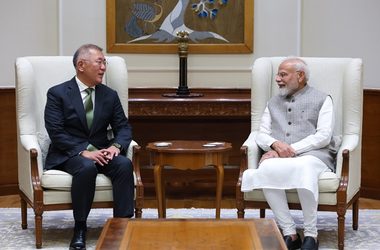
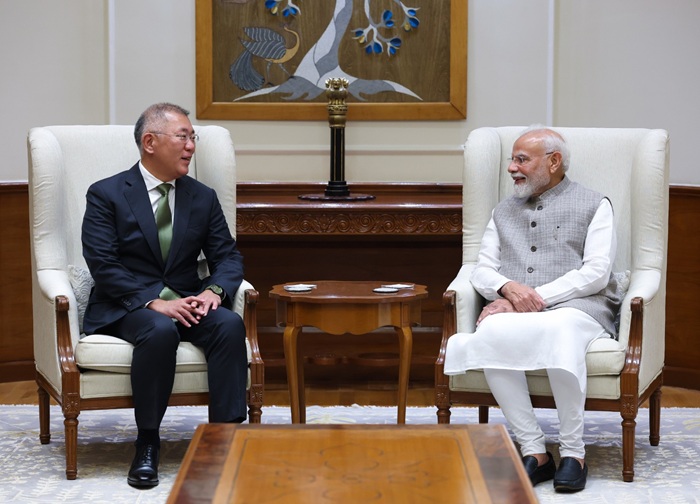
The announcement followed a meeting between Hyundai Motor Group Executive Chair Euisun Chung and Prime Minister Narendra Modi at the Prime Minister’s Office in New Delhi on October 13, where the two discussed India’s automotive industry and the company’s long-term investment strategy.
The proposed investment covers the operations of Hyundai Motor India Limited (HMIL) and Kia India Pvt. Limited, alongside technology development, automotive component localisation and emerging mobility businesses.
Hyundai Motor Group also plans to establish a dedicated investment entity in India to oversee capital deployment, coordinate strategic partnerships and support the development of the country’s automotive industry ecosystem.
Hyundai’s $15.5 Billion Investment: Manufacturing, Technology and Localisation
Unlike an investment programme focused exclusively on building additional factories, Hyundai’s latest commitment extends across several areas of the automotive value chain.
A major component involves expanding production capacity at Hyundai Motor India and Kia India to meet growing domestic demand while strengthening India’s role as an international vehicle export base.
The Group already has a substantial manufacturing presence in the country, with a combined annual production capacity exceeding 1.4 million vehicles across three facilities.
These include Hyundai Motor India’s Chennai plant, with an annual capacity of 824,000 vehicles; its Pune manufacturing facility, with an initial capacity of 170,000 vehicles; and Kia India’s Anantapur plant, capable of producing 431,000 vehicles annually.
The Pune facility is scheduled for phased capacity expansion, giving Hyundai additional flexibility to increase domestic production and exports in the coming years.
The company has not specified how much of the overall $15.5 billion commitment will be allocated to individual manufacturing facilities.
Around $700 Million Earmarked for Research and Development
Research and development will form another important component of Hyundai Motor Group’s India expansion.
The company plans to invest approximately $700 million in its Indian R&D centre, including a vehicle testing track, as part of efforts to develop next-generation automotive technologies and improve local engineering capabilities.
The investment will support expanded research infrastructure, technological development and the training of engineering talent.
Hyundai intends to build a more comprehensive R&D ecosystem in India, enabling its local operations to contribute more significantly to global vehicle development programmes.
The strategy also reflects the increasing importance of India not merely as a destination for vehicle sales and manufacturing, but as a potential centre for automotive engineering and technological innovation.
For an industry undergoing rapid changes in electrification, digital technology and vehicle architecture, engineering capabilities are becoming just as strategically important as assembly lines.
Local Suppliers and Automotive Component Production to Receive Support
Hyundai Motor Group plans to strengthen its Indian supply chain through investments in local component manufacturers and strategic partnerships with regional suppliers.
The initiative aims to increase parts localisation, improve supply-chain resilience and support domestic companies participating in the automotive manufacturing ecosystem.
Greater localisation could also help Hyundai and Kia reduce dependence on imported components while improving the competitiveness of their India-manufactured vehicles.
The proposed investment entity will play an important role in identifying potential local partners and facilitating long-term industrial collaborations.
Hyundai already operates in India through several affiliated businesses, including Hyundai Mobis, Hyundai Transys, Hyundai Capital, Hyundai Wia and Hyundai Glovis, providing a foundation for further integration of manufacturing, components and associated services.
EV Charging, Automotive Financing and Vehicle Recycling Among Future Opportunities
Hyundai’s investment strategy also extends into businesses associated with the transition towards new mobility technologies.
The Group plans to explore opportunities in electric vehicle charging infrastructure, specialised automotive financing and end-of-life vehicle recycling.
It will also consider investments in promising startups and mobility services that complement its existing automotive operations.
These initiatives could support the development of a wider electric mobility ecosystem, covering infrastructure, vehicle ownership and services extending beyond the initial purchase.
However, Hyundai has not disclosed specific investment allocations, project locations or implementation timelines for these proposed business verticals.
The announcement therefore represents a broad strategic commitment, with further details expected as individual projects are developed.
Euisun Chung Reaffirms Hyundai’s Long-Term Commitment to India
Highlighting India’s importance in Hyundai Motor Group’s international operations, Executive Chair Euisun Chung described the investment as a continuation of the company’s three-decade relationship with the country.
“India remains one of Hyundai Motor Group’s most important and strategic markets globally. The past 30 years have been defined by our commitment to India. This investment reaffirms our commitment to India for the next 30 years and beyond. Through this investment, we will create more employment opportunities and work together with our partners and stakeholders to support India’s continued industrial development.”
— Euisun Chung, Executive Chair, Hyundai Motor Group
The announcement underlines Hyundai’s intention to use India as a major manufacturing, engineering and export platform while expanding its presence across emerging automotive markets.
India is already one of the world’s largest passenger vehicle markets, making it an important destination for global manufacturers seeking long-term growth.
Hyundai Investment Expected to Generate Employment Opportunities
Hyundai Motor Group currently employs more than 24,000 people across its Indian operations.
The company expects its latest investment programme to generate additional employment opportunities in vehicle manufacturing, engineering, research and development, and automotive supply chains.
Indirect employment could also emerge through component suppliers, technology partnerships, infrastructure development and new mobility businesses.
Hyundai has not announced a specific number of jobs expected to be created under the seven-year programme.
The Group also intends to strengthen India’s technical talent pool through investments in research infrastructure and workforce development.
Hyundai’s Three-Decade Journey in India
Hyundai’s latest announcement comes as the South Korean automotive group approaches three decades of operations in India, a market that has evolved into one of its significant international manufacturing bases.
Alongside its industrial operations, the Group has undertaken social initiatives focused on education, disability inclusion, technical training and community development.
These include the Samarth campaign, which promotes disability inclusion, and the planned Hyundai Academy for Technical Skills (HATS), a vocational training institute in Chennai.
According to the company, its major affiliates have collectively contributed approximately $110 million towards social welfare, education, skill development and community programmes in India since 2016.
The initiatives form part of Hyundai’s broader efforts to develop its presence in the country beyond vehicle manufacturing and sales.
India Takes a Bigger Role in Hyundai’s Global Automotive Strategy
The $15.5 billion commitment signals Hyundai Motor Group’s intention to deepen its industrial and technological footprint in India at a time when global automakers are reassessing manufacturing networks, supply chains and future mobility investments.
The programme could help increase domestic production, strengthen automotive exports, encourage local component manufacturing and expand India’s capabilities in advanced vehicle engineering.
Its ultimate economic impact, however, will depend on the execution of individual projects, the pace of capacity expansion and the development of supporting infrastructure and suppliers.
For Hyundai, the investment represents a long-term commitment to a market it considers essential to its international growth. For India, it presents an opportunity to move further up the automotive value chain—from assembling vehicles for domestic and overseas buyers to developing the technologies, components and services that will shape the industry’s future.
The significance of the announcement will ultimately be measured not simply by the billions committed, but by the factories expanded, technologies developed and skilled jobs created over the next seven years.