
The Indian sedan may have surrendered plenty of showroom floor space to SUVs, but nobody appears to have told the Škoda Slavia. Four years after it first arrived in 2022, Škoda’s India-focused three-box contender is preparing for its first meaningful facelift, bringing fresher lighting, new cabin technology, a revised automatic gearbox and, rather unexpectedly, massaging rear seats. Because apparently the way to fight the SUV invasion is not to surrender, but to give your passengers a back rub.
This is the 2026 first-generation Slavia facelift, and the car seen here is the Prestige 1.0 TSI, sitting towards the richer end of the range. Bookings are already open, with the market launch expected roughly two months later. Škoda plans to keep the Slavia petrol-only, with the range expected to start at around ₹11 lakh ex-showroom and stretch to approximately ₹19 lakh for the top version. That puts it firmly in the increasingly interesting corner of the Indian market where buyers have to choose between fashionable high-riding crossovers and sedans that generally offer better road manners, bigger boots and less visual pretence.
The Slavia has already made a reasonable argument for the latter. More than 80,000 examples have been sold, according to the information supplied, and that matters because the car arrived with the unenviable task of replacing the Rapid. The Rapid was never the newest-looking thing in the room, but it earned an enthusiastic following for its solid engineering, strong turbo-petrol engines and distinctively European road manners. The Slavia had to retain enough of that character while becoming roomier, more contemporary and substantially more India-specific.
Its name goes considerably further back than either car. “Slavia” was taken from the first bicycle produced by company founders Václav Laurin and Václav Klement in 1896. It is a rather charming bit of heritage for a modern turbocharged sedan stuffed with connected-car technology. The original Slavia bicycle presumably did not feature wireless Apple CarPlay, an electronic differential lock or a warning when somebody tried to tow it away, but progress has a habit of complicating things.
Underneath, this remains one of the Volkswagen Group’s MQB A0 IN products, the heavily localised architecture developed for India and shared with the Škoda Kushaq and Kylaq as well as the Volkswagen Virtus and Taigun. The family resemblance beneath the skin is no secret, but that is hardly a criticism. Sharing expensive engineering is one of the reasons modern cars exist at vaguely attainable prices in the first place.
The Slavia is assembled in India and Vietnam, and the facelift avoids throwing away the fundamentally sensible proportions of the original. At roughly 4.5 metres long, 1.7 metres wide and 1.5 metres tall, it remains a traditionally shaped sedan rather than one masquerading as a coupe, crossover, SUV or some other marketing department invention. Its kerb weight is around 1,300 kg, while gross vehicle weight is approximately 1,700 kg. Ground clearance is quoted at 145 mm, enough to make daily Indian roads workable but low enough to remind you that enthusiastic attacks on badly designed speed breakers remain a poor financial strategy.
Familiar shape, sharper face
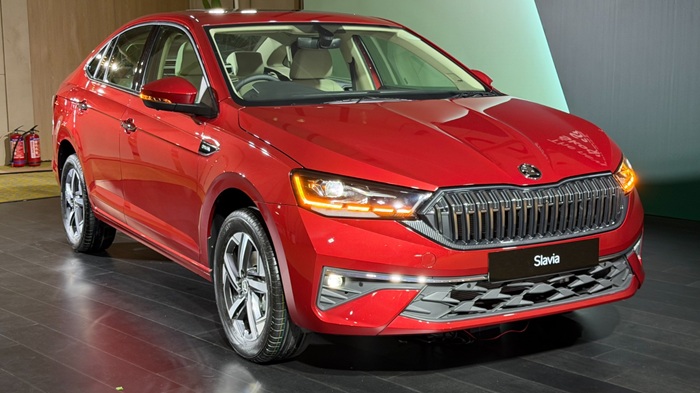
The facelift concentrates its visual changes where they will be noticed most. Up front sits Škoda’s familiar hexagonal grille, dressed with chrome highlights. There are new automatic LED headlamps with L-shaped daytime-running lights, supported by the Light Assistant function, while fog lamps remain part of the specification. It still looks unmistakably like a Slavia rather than a completely redesigned car, which is appropriate for a facelift. Nobody has attempted to disguise it beneath three floors of plastic cladding.
The revised lighting gives the nose a cleaner, slightly more technical expression without destroying the restrained European character that helped the original car stand apart. Slavia design has always been more crisp shirt than tracksuit, and even in Cherry Red it avoids trying excessively hard to look angry. Rain-sensing wipers add everyday convenience and, unlike some modern automotive technology, have a purpose that can be explained without a PowerPoint presentation.
The side profile continues to be one of the Slavia’s stronger visual arguments. Its long body, conventional boot and sensible glasshouse give it the elegant proportions that many similarly priced compact SUVs simply cannot replicate. The facelift introduces new 16-inch Savio dual-tone alloy wheels, paired here with 205/55 R16 91H CEAT SecuraDrive radial tubeless tyres front and rear. A 15-inch steel wheel option will also be available lower down the range.
Disc brakes are fitted at the front and drums at the rear. Enthusiasts may instinctively prefer four discs because symmetry pleases the soul, but rear drums remain common in this category and are perfectly capable of doing the job when properly calibrated. The more meaningful question is brake feel and consistency rather than whether every wheel hides something shiny behind the spokes.
The electrically adjustable and foldable outside mirrors incorporate turn indicators and cameras, while anti-glare functionality is also listed. Their camera integration becomes more relevant because one of the facelift’s significant additions is a 360-degree camera. On a 4.5-metre sedan, that is not essential in the same way it might be on a hulking luxury SUV, but Indian parking spaces have a remarkable ability to become smaller precisely when you arrive, so few owners will complain.
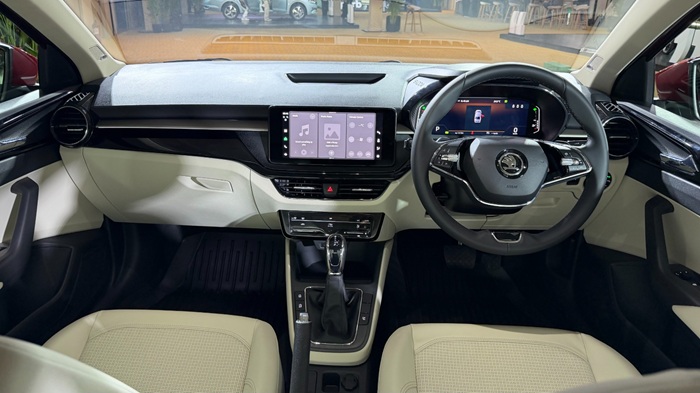
At the rear, new LED tail-lamps incorporate sequential indicators, bringing a little theatre to what remains a fundamentally sensible shape. There is chrome garnish and a rear defogger, while the facelift retains the clean, wide-looking tail rather than turning the boot lid into an illuminated nightclub. That restraint works.
The exterior palette extends beyond the Cherry Red car photographed here to beige, green, silver, white, steel, blue, grey and black. Dual-tone versions will be offered with a black roof. There are enough choices, then, to satisfy buyers who want everything from discreet executive transport to something that can actually be found in a shopping-mall car park without repeatedly pressing the key fob.
A genuinely useful boot
One of the strongest reasons to choose the Slavia over a similarly priced compact SUV remains luggage capacity. The boot offers 521 litres with the rear seats upright and expands to a claimed 1,050 litres when the 60:40 split-folding rear bench is lowered. That is proper family-holiday territory and one of those specifications that becomes much more impressive the first time you discover how much luggage Indian families can generate for a two-day journey.
The cabin itself continues the European-meets-India approach of the existing Slavia, but the facelift adds enough equipment to make the experience feel considerably more contemporary. This Prestige version receives beige leatherette upholstery, although fabric trim will also be offered. Electrically adjustable front seats with ventilation should prove more meaningful in Indian summers than almost any animated welcome graphic could ever be.
The rear is where Škoda has deployed one of its more unusual facelift party tricks: massaging seats. A massage function in a relatively accessible Indian sedan is exactly the sort of feature nobody was desperately demanding until somebody offered it. Whether it becomes a daily essential or something demonstrated enthusiastically to relatives during the first week of ownership remains to be seen, but it certainly gives the refreshed Slavia a talking point.
Passenger convenience continues with a phone pocket, LED reading lamps, ambient lighting and footwell illumination. All four doors also carry reflective tape, one of those small safety-oriented touches unlikely to make a television advertisement but potentially rather useful when a door is opened on an unlit road.
Škoda’s familiar practical thinking appears elsewhere too. There is a SmartGrip bottle holder, a SmartClip ticket holder and a cooled glovebox. None is technologically dramatic, but all three are the kind of things owners actually use. Sometimes the smartest feature in a car is not powered by an eight-core processor.
Screens, connectivity and actual buttons — sort of
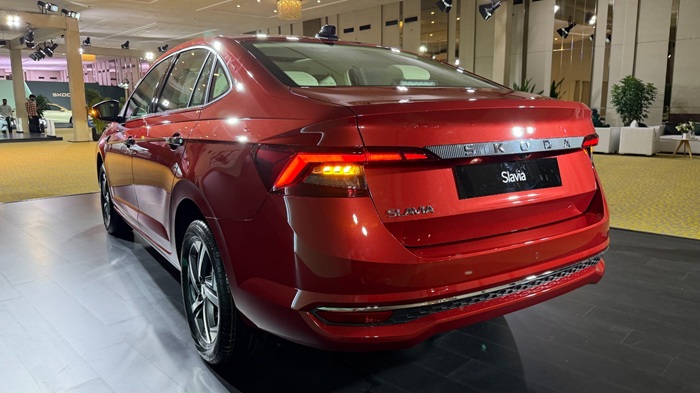
The dashboard’s centrepiece is a 10.1-inch touchscreen infotainment system. Its feature set is extensive, including Google Cloud automotive AI assistant functionality, Škoda Play apps, wireless SmartLink, Apple CarPlay and Android Auto, MyŠkoda Connect, USB connectivity, Sygic offline navigation, booking functions, built-in connectivity, audiobooks, Gaana, BBC World News, valet mode, FM and radio.
That is enough digital content to ensure a person could theoretically sit inside a stationary Slavia and avoid interacting with civilisation for some considerable time. Lower variants are expected to receive a 7-inch infotainment screen instead.
The driver gets an equally substantial technological upgrade in the form of a new 10.25-inch Škoda Virtual Cockpit instrument display capable of showing navigation information. Lower trims will use either an 8-inch cluster or conventional analogue instruments depending on specification. The leather-wrapped two-spoke multifunction steering wheel carries controls for volume, infotainment, voice commands and instrument-cluster functions, and the steering column is adjustable for both height and reach.
A two-spoke steering wheel still divides opinion. Traditionalists may feel a proper steering wheel should have three spokes because racing cars have three spokes and racing cars are obviously relevant while negotiating a queue outside a Delhi shopping mall. In practice, the Slavia’s arrangement gives the cabin a distinctive appearance and preserves straightforward access to its switchgear.
Climatronic automatic air conditioning uses a touch control panel and includes an Air Care function. The touch interface looks more sophisticated than traditional rotary knobs, although tactile controls remain easier to operate without taking your eyes from the road. Fashion occasionally defeats ergonomics; the motor industry is hardly alone in this.
Wireless phone charging, an auto-dimming interior mirror and an electric sunroof with anti-pinch protection further modernise the cabin. The audio system uses eight speakers. There is also a one-touch driver’s power window with bounce-back protection.
Connected whether you like it or not
MyŠkoda Connect gives the Slavia the suite of remote and connected functions expected of a contemporary car. Through the smartphone application, owners can access vehicle tracking, geofencing, real-time speed tracking, roadside assistance, emergency SMS messages with location information, route tracking, driving-behaviour data, tow alerts and device-tampering warnings.
Some of those functions are genuinely useful. Vehicle location and roadside assistance can make ownership easier, while geofencing and speed tracking may be particularly attractive to parents lending the car to newly licensed family members. The teenager in question may be less enthusiastic about this brave new connected world.
The little TSI remains important
The Prestige car here uses the familiar 1.0-litre TSI, a 999 cc Volkswagen EA211 turbo-petrol. TSI stands for Turbo Stratified Injection, and the engine uses three cylinders arranged inline, positive ignition, dual variable valve timing, a variable oil pump and direct fuel injection. The engine is also described as plasma-coated.
Output is 114 hp with 178 Nm of torque. Those numbers will not terrify the rear tyres — which is useful because this remains a front-driven family sedan — but the 1.0 TSI’s appeal has traditionally come from extracting surprising urgency from a very small displacement.
The claimed 0–100 km/h time is 9.7 seconds, with a 189 km/h top speed. For ordinary driving, the more relevant figure is the 178 Nm torque output. Turbocharging means the engine should have considerably more mid-range muscle than an old-fashioned naturally aspirated 1.0-litre unit, making it better suited to short overtakes, flyover climbs and those moments when a gap in traffic becomes available for approximately 0.8 seconds.
One of the most significant mechanical changes to the facelift is the addition of a new eight-speed torque-converter automatic transmission with the 1.0 TSI, while a six-speed manual remains available. The extra ratios should allow the automatic to keep the small engine nearer its useful operating range while also lowering revs when cruising.
That gearbox is a particularly interesting change because small turbo-petrol sedans can live or die by transmission calibration. A good torque converter can be smoother and more forgiving at crawling speeds than a dual-clutch setup, especially in the endless stop-start conditions common in Indian cities. Whether all eight ratios result in seamless progress or an automatic gearbox constantly debating which gear it would prefer will depend on the final calibration, but on paper it looks a logical move.
And then there is the 1.5 TSI
Buyers wanting substantially more performance can step up to the 1.5-litre Volkswagen EA211 Evo TSI. This is a four-cylinder positive-ignition direct-injection turbo-petrol with a variable oil pump and Active Cylinder Technology.
Output rises to 147 hp and, more importantly, 250 Nm. It accelerates from 0–100 km/h in a claimed 8.1 seconds and reaches 203 km/h. That changes the Slavia from merely brisk into something with genuine overtaking authority.
The 1.5 TSI is paired with the option of Volkswagen Group’s seven-speed DSG direct-shift transmission, using a dry dual-clutch arrangement. The defining feature of the larger engine, however, is its Active Cylinder Technology. Under light loads, two of the four cylinders can temporarily deactivate to reduce fuel consumption.
It sounds slightly alarming until you remember the whole process is designed to happen without the driver thinking about it. Drive gently and half the cylinders can take a brief holiday; ask for acceleration and the full quartet returns to work. It is mechanical efficiency rather than some dramatic selectable eco mode.
The larger engine is undoubtedly the more appealing choice for keen drivers. An additional 72 Nm over the 1.0 TSI is a meaningful difference in a car weighing roughly 1.3 tonnes. Where the three-cylinder engine relies on momentum and sensible gearbox management, the 1.5 should feel much less bothered by passengers, luggage or high-speed overtaking.
Efficiency without diesel
There is no diesel option. That may disappoint long-distance drivers who remember the effortless economy of older diesel sedans, but the market and regulatory environment have clearly shifted.
The 1.0 TSI is quoted at around 20 km/l with the manual and 18 km/l with the automatic. The 1.5 TSI is quoted at approximately 19 km/l, while fuel-tank capacity is 45 litres. These are claimed figures rather than guarantees of what an owner will see in daily traffic, naturally. Real-world consumption will depend heavily on congestion, driving style and how frequently the turbocharger is encouraged to prove that it exists.
Škoda also equips the Slavia with Start & Stop Recuperation, or SSR, intended to lower CO2 emissions and improve efficiency. Combined with the 1.5’s cylinder deactivation system, it shows how much engineering effort is now being spent squeezing fuel from petrol engines without making the driving experience completely anaemic.
Chassis: where the sedan still makes sense
The Slavia’s underlying suspension layout remains straightforward. At the front are MacPherson struts with lower triangular links and a stabiliser bar; the rear uses a twist-beam axle.
That may not sound exotic, but exotica is not required for a good road car. Suspension tuning matters more than the number of diagrams required to explain it. A sedan also begins with one useful physical advantage over an SUV: a lower centre of gravity. You do not need to defeat quite as much physics every time the road turns.
The steering uses electro-mechanical power assistance. Škodas on the MQB A0 IN platform have generally been designed to balance low-speed usability with secure highway manners, and that is exactly the behaviour the Slavia needs. Indian buyers may value light steering while squeezing into a parking space, but a sedan capable of 189 km/h — or 203 km/h in 1.5-litre form — also needs to feel settled once speeds rise.
The XDS electronic differential lock system is fitted to enhance stability. Rather than being a traditional mechanical locking differential, XDS uses electronic intervention to help manage wheel behaviour and improve traction through corners. It will not transform the Slavia into a rally car, but it can make power delivery cleaner when accelerating out of a bend.
There is also a Rough Road Package, an important phrase in a country where some stretches of tarmac appear to have been designed as informal suspension durability programmes.
The Slavia uses a hydraulic diagonal-split vacuum-assisted braking system. Brake Disc Wiping is another clever piece of engineering largely invisible to the driver: in wet conditions it can help remove water from the brake discs, improving braking response when needed. This is exactly the kind of technology worth having — not because it will impress anybody at a dinner party, but because it quietly does useful work in the background.
Safety is one of its strongest cards
Safety has been central to the Slavia’s reputation. The model has received a five-star Global NCAP rating, giving it an important advantage in a market where consumers are increasingly paying attention to crash performance rather than simply counting touchscreen inches.
The high-strength-steel body provides the foundation, while the facelift’s safety inventory is extensive. Six airbags are supplemented by ABS, EBD, electronic stability control, traction control, Multi Collision Braking, Motor Slip Regulation and hill-hold control.
There is a tyre-pressure monitoring system, ISOFIX child-seat mounting points, three-point seatbelts with pretensioners, a front seatbelt reminder, rear door and window child locks, an emergency triangle and a door-open indicator. Parking assistance includes sensors at both ends, Park Pilot and the new 360-degree camera.
Security systems include an engine immobiliser with floating-code technology, anti-theft alarm, central locking linked to the speed sensor and keyless entry. It is a fairly comprehensive package, and significantly, much of it focuses on accident prevention rather than simply dealing with the consequences.
Living with it
Škoda supports the Slavia with a four-year/1,00,000 km warranty. That is accompanied by four years of roadside assistance and four labour-free services. For a brand that once had to work harder than some Japanese rivals to reassure Indian buyers about long-term ownership costs, packaging the car with predictable support is important.
The Slavia’s practicality remains equally persuasive. It seats five, provides a genuinely large boot and retains enough rear-room usefulness to work as a family car or chauffeur-driven sedan. The addition of powered and ventilated front seats, rear massage functionality, ambient lighting and the upgraded digital displays gives this facelift a more expensive ambience, even if none of it changes the fundamental advantage of simply having a long wheelbase and a proper separate boot.
And this is where the Slavia makes its strongest argument against the ubiquitous SUV. A compact crossover may provide a taller seating position and more visual toughness, but the Slavia offers the calmer proportions of a sedan, substantial luggage space and a chassis layout naturally suited to road driving. It is less interested in looking ready for an expedition and more interested in travelling quickly and comfortably on actual tarmac.
Where does it sit against the competition?
The obvious comparison remains the Volkswagen Virtus, its MQB A0 IN sibling. Mechanically the relationship is close enough that choosing between them often comes down to styling, equipment, dealership experience and personal preference. The Škoda adopts its own visual identity and cabin presentation, while the Volkswagen offers an alternative interpretation of essentially the same engineering foundation.
Elsewhere, buyers looking at this part of the market will inevitably consider mainstream petrol sedans as well as the endless parade of compact and midsize SUVs positioned around similar prices. Those rivals may offer greater ground clearance, a more commanding seating position or a different approach to interior packaging. Some naturally aspirated competitors may also offer smoother low-speed engine manners for drivers who value simplicity over turbocharged urgency.
What the Slavia continues to offer is character. The little 1.0 TSI has more personality than its displacement suggests, while the 1.5 TSI gives the car genuinely strong performance. A 203 km/h top speed is hardly something most Indian owners will ever explore, nor should they on public roads, but the performance reserve behind that figure translates into much more effortless highway driving.
The facelift then adds technology exactly where the original was beginning to age: digital instrumentation, camera coverage, comfort equipment and automatic-transmission sophistication. Importantly, it has not attempted to reinvent a package that was already fundamentally sound.
Verdict
The 2026 Škoda Slavia facelift is not trying to persuade India that the SUV was a terrible mistake. That battle has probably been lost somewhere beneath several million square metres of black plastic wheel-arch cladding. Instead, the Slavia makes a calmer case: perhaps you simply do not need an SUV at all.
It remains handsome without looking desperate for attention, spacious without being physically enormous and practical enough to swallow 521 litres of luggage before the rear seats are even folded. The 1.0 TSI should continue to provide an effective balance of performance and economy, and pairing it with a new eight-speed torque-converter automatic could make the everyday driving experience significantly more relaxed. Those wanting the more interesting Slavia will still be drawn to the 147 hp, 250 Nm 1.5 TSI DSG, whose stronger acceleration suits the chassis particularly well.
The facelift’s headline additions — new LED lighting, Savio alloys, the 10.25-inch Virtual Cockpit, 360-degree camera and rear massaging seats — add enough freshness to make a four-year-old design feel current again. Some of the technology borders on indulgence, and the touch-sensitive climate controls remain less convincing than good old-fashioned knobs, but the overall package is richer without becoming ridiculous.
Most importantly, the Slavia retains the ingredients that made the original relevant: a strong high-strength-steel structure, five-star Global NCAP credentials, turbocharged engines, a huge boot and European-flavoured road-car proportions. Back that with a four-year/1,00,000 km warranty, four years of roadside assistance and four labour-free services, and Škoda has clearly worked on the less glamorous parts of ownership too.
At the expected ₹11 lakh to ₹19 lakh ex-showroom range, the facelift will not be an automatic bargain. The upper versions venture into very serious SUV money, and buyers who prioritise ride height, rough-road clearance or sheer visual bulk will inevitably look elsewhere. But if you still believe a car should sit relatively close to the road, have a proper boot and become more enjoyable rather than more alarming when the road starts twisting, the Slavia remains one of the more convincing arguments for keeping the sedan alive.
And the Prestige 1.0 TSI may be the sweet spot for buyers who want that character without paying for the 1.5-litre engine’s extra punch. It is sensible, increasingly well-equipped and just Germanic-Czech enough to take driving seriously without demanding that you do the same every minute.
The SUV may have won the popularity contest. The Slavia, however, seems perfectly content competing for the people who would rather drive.