



There is something faintly amusing about Volvo building its smallest-ever car and then giving it enough performance to embarrass machinery twice its size. The EX30 is a compact electric crossover, but “compact” is doing quite a lot of work here. It may be only 4.2 metres long, yet beneath its minimalist Scandinavian body sits a 272 hp electric motor capable of dispatching 0–100 km/h in 5.3 seconds. That is the sort of acceleration once reserved for serious sports cars, not family-friendly Volvos with reusable materials in the cabin and a first-aid kit in the boot.
Launched globally in 2023, the EX30 you see here is a 2025 first-generation model and currently sits at the very bottom of Volvo’s size hierarchy. In India, however, its positioning is anything but bargain-basement. The EX30 is offered solely in the rear-wheel-drive Ultra specification at an ex-showroom price of ₹41 lakh, placing this tiny Volvo firmly in premium-EV territory.
What you are paying for is not simply a smaller electric SUV wearing a prestigious badge. The EX30 represents Volvo trying to compress almost everything it currently stands for — safety, Scandinavian restraint, sustainability, software and electrification — into the smallest possible footprint. Think of it as Volvo concentrate. Just add electricity.
The car is assembled in China, Belgium and Malaysia, and beneath the Swedish styling sits considerable Chinese engineering influence. The EX30 uses Geely’s Sustainable Experience Architecture, specifically the SEA2 platform. It shares those bones with the Smart #1, Smart #3, Zeekr X and Lynk & Co Z20, which makes the EX30 part of a rather cosmopolitan electric family.
That global upbringing hasn’t diluted the distinctly Volvo design language. The EX30 follows an aggressively minimalist Scandinavian philosophy: tidy surfaces, very little visual clutter and just enough distinctive detailing to make it recognisable from considerable distance. It has also earned some serious silverware, including the 2024 World Urban Car award and the Red Dot ‘Best of the Best’ Design Award. Various other awards have followed, including Car of the Year, Eco Warrior of the Year, Best City Car, Best Electric City Car and Small SUV of the Year honours in different markets and publications.
Volvo also claims the EX30 has the lowest lifetime carbon footprint of any Volvo produced so far. The company says recycled materials include 25 per cent recycled aluminium, 70 per cent recycled polyester, 17 per cent recycled steel and 17 per cent recycled plastic. Sustainability claims can sometimes sound like the automotive equivalent of corporate salad dressing, but the EX30 at least makes the philosophy visible in the materials and design rather than confining it to a paragraph in an ESG report.
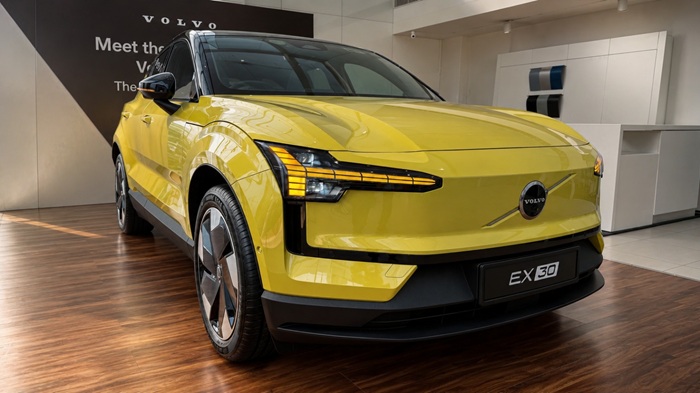
Small, clean and unmistakably Volvo
The Moss Yellow paint of this particular car suits the EX30 rather well. It gives what could otherwise be an extremely restrained design a welcome dose of personality. White, black, blue, grey and Sand Dune are also available, but Moss Yellow makes the little Volvo look as though somebody has finally persuaded the Scandinavian design department to have a second cup of coffee.
At the front, you get the modern closed-face EV treatment rather than a conventional radiator grille. An active grille shutter manages airflow according to cooling requirements, opening only when the car actually needs it. The lack of decorative openings makes the EX30 look clean and technical without appearing completely anonymous.
The signature Thor’s Hammer LED headlights provide the strongest connection with larger Volvos. They incorporate LED daytime running lights, an automatic low-beam function, a welcome-light sequence and active high beam. Volvo has been using the Thor’s Hammer motif for years, but here it feels particularly well integrated into the EX30’s compact proportions.
The bonnet is short and neatly sculpted, while the relatively upright windscreen and substantial body sides give the EX30 more visual presence than you might expect from something measuring just 4.2 metres from bumper to bumper. It is 1.9 metres wide and 1.5 metres tall, which means this is not some narrow little city hatchback masquerading as an SUV. It has a planted stance, especially on the 19-inch wheels fitted to our car.
Those are five-spoke aerodynamic alloys wrapped in 245/45 R19 102V Goodyear EfficientGrip Performance SUV extra-load radial tubeless tyres, made in China. Volvo also offers 18- and 20-inch wheel choices in other configurations and markets. Discs are fitted at both ends.
The combination of broad tyres and relatively short overall length gives the EX30 an almost toy-like stance when viewed from certain angles, though thankfully not in the sense of looking cheap. The wheelarches are pronounced without being absurdly swollen, and there is enough black cladding to satisfy the crossover rulebook without making the EX30 look as though it is permanently preparing for the Dakar Rally.
The electrically adjustable exterior mirrors feature automatic dimming, puddle lights, integrated indicators and cameras. Rain-sensing wipers are standard, naturally, because operating your own windscreen wipers in a ₹41 lakh EV would apparently constitute intolerable hardship.
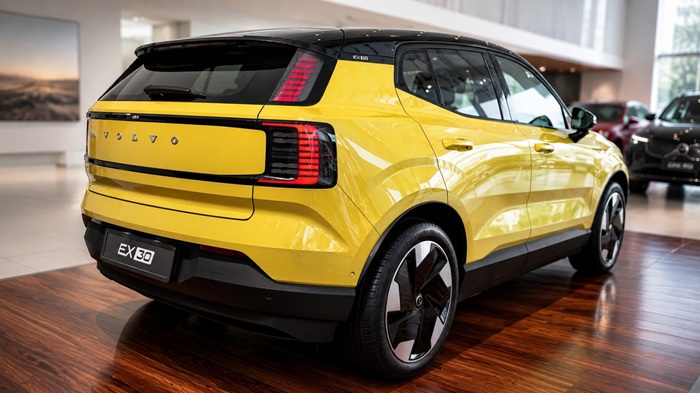
At the back, Volvo uses an unusual two-section C-shaped LED tail-light arrangement. The lighting signature helps visually stretch what is otherwise a compact rear end and gives the EX30 a distinctive after-dark identity. A rear fog lamp is incorporated as well.
Overall, this is not an aggressively styled SUV. There are no enormous fake exhausts, angry grilles or unnecessary aerodynamic appendages. It looks tidy, expensive and quietly confident. In a market where many cars increasingly appear to have been designed after losing an argument, the EX30’s restraint is refreshing.
Compact dimensions, serious weight
One number that immediately reveals the nature of the modern electric car is kerb weight. The EX30 may be small, but it weighs 1,850 kg. That is a remarkable amount of mass for something only 4.2 metres long, though hardly surprising once a sizeable NMC battery is tucked beneath the cabin.
The 11-metre turning circle is respectable rather than outstanding for something sold as an urban-oriented crossover. Around tight Indian parking structures, you may occasionally wish Volvo had found another half-turn of steering lock, but the compact length remains an obvious advantage.
It is surprisingly capable of doing more grown-up jobs too. The roof has a 75 kg load rating, while the EX30 can tow up to 1,600 kg. A foldable tow bar is available among Volvo’s sizeable accessories catalogue, so the tiny Swedish EV can pull considerably more than its dimensions suggest.
Boot capacity is quoted at 400 litres, expanding to 1,000 litres with the second row folded. There is also a useful additional 7-litre luggage compartment. The rear bench splits 60:40, allowing longer objects to be carried without completely sacrificing passenger space.
For a car marketed around urban usability, this is useful rather than extraordinary practicality. Families migrating from a similarly sized combustion-engined SUV should manage comfortably, but anyone expecting SUV vastness purely because the EX30 sits a little higher off the ground may need to recalibrate expectations.
Scandinavian minimalism reaches its logical conclusion
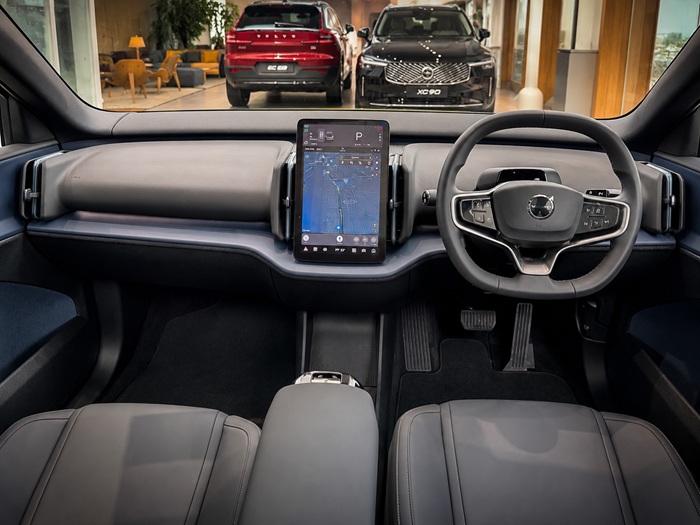
Step inside and the EX30 demonstrates just how committed Volvo has become to the idea of minimalism. The dashboard is extraordinarily clean, with very few physical controls and almost every meaningful function gathered into the centrally mounted 12.3-inch touchscreen.
Whether you find that elegant or slightly irritating will depend on your relationship with touchscreens. At its best, the cabin looks beautifully uncluttered and modern. At its worst, you occasionally wonder whether somebody in Gothenburg has declared physical buttons environmentally irresponsible.
There is no conventional instrument binnacle directly ahead of the driver. Instead, speed, navigation and other information are incorporated into the central display. It takes adjustment, particularly if you are accustomed to looking through the steering wheel for basic driving information, but the screen is crisp and the interface makes good use of its available space.
The 12.3-inch infotainment unit uses Qualcomm Snapdragon Cockpit Platforms and supports 5G connectivity, digital audio broadcasting, wireless Apple CarPlay, Android Auto, Volvo Assistance, Google services, over-the-air updates, Google Assistant, Google Maps, Google Play Store, USB connectivity, FM and radio.
Google integration is particularly useful because navigation, voice assistance and apps feel more like extensions of the digital ecosystem people already use rather than awkward car-manufacturer interpretations of it. Saying a destination aloud and having Google Maps deal with it is far preferable to fighting with the sort of built-in voice recognition that traditionally hears “Delhi” and assumes you said “deli”.
The physical cabin design is intentionally unconventional. Switchgear for the power windows and central locking is positioned on the armrest rather than spread across the doors in traditional fashion, helping simplify the door panels and presumably reducing wiring and components. There is a removable storage box, another example of Volvo trying to rethink familiar cabin architecture rather than merely decorating it differently.
Our car uses black leather-and-fabric combination upholstery, though blue, green and beige alternatives are also available. The cabin gets Breeze inlays, with two other inlay options offered. Some surfaces intentionally draw attention to the recycled-material philosophy rather than attempting to imitate traditional luxury-car wood and leather.
That is perhaps one of the EX30’s more interesting qualities. It does not desperately attempt to convince you that premium must mean glossy veneers and acres of cow. Its version of luxury is more modern: clean design, clever storage, sophisticated electronics and reduced visual noise.
The front seats are electrically adjustable and feature lumbar support, seat-track position sensors and whiplash protection. They provide the firm but supportive seating posture Volvos have long been associated with, while the slightly elevated hip point gives the driver decent forward visibility.
The steering wheel is trimmed in synthetic material, is heated, and has a tailored sports design. It feels substantial enough without attempting the flat-bottomed, Alcantara-wrapped theatrics increasingly fitted to SUVs that spend their entire existence commuting between offices and shopping centres.
A frameless auto-dimming interior rear-view mirror contributes to the clean appearance, while the fixed panoramic glass roof makes the relatively compact cabin feel airier. Because it is fixed, there is no pretending you are driving a convertible, but the extra light is welcome, particularly for rear passengers. A sunroof sunshade can be purchased as an accessory if Indian summers begin making the glass roof feel less Scandinavian and more solar oven.
Ambient lighting adds atmosphere after dark, while the nine-speaker, 1,040-watt Harman Kardon premium audio system brings rather more drama. Integrating the speaker arrangement into the dashboard helps free up door space and contributes to the minimalist aesthetic. The system has enough output to ensure that nobody buys an electric car solely for peace and quiet.
The rear seats are sufficiently useful for a compact crossover, although this is where the EX30’s short overall dimensions inevitably show themselves. The 60:40 folding bench offers flexibility, but rear passengers do not get limousine space. Adults will be fine for regular journeys provided the front occupants are not professional basketball players.
The cabin also gets two-zone electronic climate control with a PM2.5 air-quality filter, Clear Air status animation, a humidity sensor and an airborne particulate-matter sensor. A heat pump improves the efficiency of cabin heating, particularly valuable in colder environments where resistive heating can noticeably reduce EV range.
One screen, many responsibilities
Many of the EX30’s functions live within the infotainment system, including vehicle settings and assistance systems. Voice control helps reduce the need to constantly poke through menus while driving, but there remains a philosophical question around whether consolidating everything onto one screen actually makes life simpler.
It certainly makes the dashboard simpler.
The ownership experience extends into the Volvo Cars app, through which owners can remotely access air-conditioning, vehicle status, location tracking, charging controls, range monitoring and door locking or unlocking. The system can also schedule over-the-air software updates.
Digital Key Plus allows a compatible smartphone to operate as the car key, and that digital access can be shared with friends. There is also an NFC smart card that can unlock and start the car and is slim enough to stay in your wallet. It is the sort of technology that initially sounds frivolous until you become accustomed to not carrying a conventional key.
The serious bit: 272 hp through the rear wheels
India receives the rear-wheel-drive EX30 Ultra with the larger 69 kWh lithium nickel manganese cobalt oxide — NMC — battery.
A single electric motor drives the rear wheels through a shift-by-wire single-speed automatic transmission, producing 272 hp and 343 Nm.
There are versions of the EX30 offered overseas with a smaller 51 kWh battery, and an all-wheel-drive configuration also exists, but neither is currently available in India according to the specification supplied here. The dual-motor EX30 deserves mention because it holds the distinction of being the fastest-accelerating Volvo ever produced.
India’s single-motor version is hardly sluggish.
Zero to 100 km/h takes 5.3 seconds and the maximum speed is electronically limited to 180 km/h. To place that in perspective, 5.3 seconds to 100 km/h means this compact Volvo can produce the sort of straight-line acceleration that would have required a serious six-cylinder performance saloon not very long ago.
Electric motors make such performance wonderfully undramatic. There is no rising engine note, no turbocharger waiting to wake up and no gearbox frantically deciding which ratio would best protect its reputation. Press the accelerator and the EX30 simply goes.
The 343 Nm output does not sound outrageous by contemporary EV standards, but because it arrives immediately, the car feels very eager from low speed. Urban gaps appear more accessible, highway overtakes require little planning and pulling away from junctions can be genuinely amusing.
The rear-wheel-drive layout also gives the EX30 a more interesting mechanical personality than the bland front-driven arrangement sometimes used in entry-level EVs. With the driven wheels separated from the steering duties, the front end can concentrate on direction while the rear motor supplies propulsion.
That said, this is still fundamentally a compact luxury crossover, not an electric drift machine. Volvo’s priorities remain security, stability and predictability. Anyone approaching the EX30 expecting the tail-happy personality of a traditional rear-wheel-drive sports car has perhaps spent too much time on YouTube.
Quick enough to surprise, calm enough to be a Volvo
Acceleration is the headline performance trick, but the more useful quality is how effortless the EX30 feels at normal speeds.
Electric propulsion suits urban driving extraordinarily well. Throttle response is immediate, there is no clutch or multi-speed transmission to manage, and low-speed progress is quiet and smooth. In congestion, the EX30 feels like exactly what a premium urban electric crossover ought to feel like: easy.
Give it a large throttle input and it suddenly reveals the full 272 hp. The first surge is forceful enough to press passengers firmly into their seats, and because there is no gearbox interruption, momentum builds in one uninterrupted sweep.
The 180 km/h top-speed ceiling is very Volvo. The company has long adopted a safety-oriented maximum-speed policy, and frankly, on Indian public roads the difference between a 180 km/h limiter and a theoretical 230 km/h top speed is largely academic unless your morning commute includes a private runway.
Refinement is naturally strong because there is no combustion engine generating vibration, but EV silence often exposes sounds that an engine would normally mask. Tyre noise and wind noise therefore matter more. Those broad 245-section Goodyears have a meaningful contact patch, so perfect library-like silence should not be assumed, particularly on coarse road surfaces.
A comfort chassis carrying 1.85 tonnes
The EX30 uses what Volvo calls a Comfort Chassis setup and features a five-link rear suspension arrangement designed to balance control with ride comfort.
That is important, because the EX30 has two opposing engineering challenges. It is short enough to be manoeuvrable in cities but heavy enough to make suspension tuning difficult. A 1,850 kg kerb weight means the dampers have substantial mass to manage when the road suddenly deteriorates.
At low speeds, the chassis aims for compliance rather than sporty stiffness. Broken urban surfaces and expansion joints are dealt with in a manner appropriate to a premium crossover, although 19-inch wheels inevitably give the suspension less sidewall assistance than a smaller wheel-and-tyre combination would.
Those buyers prioritising ride quality may therefore find the available 18-inch wheels conceptually attractive, while anyone choosing 20s should understand the oldest law in automotive engineering: larger wheels look excellent right until the road stops being excellent.
The five-link rear arrangement gives the EX30 a sophisticated foundation for maintaining tyre contact over imperfect surfaces. Through faster corners, the low-mounted battery helps keep the centre of gravity lower than the SUV body shape might suggest.
You can still feel the vehicle’s substantial mass. Physics has not received an over-the-air update. Direction changes are controlled rather than delicate, and the EX30 is happier making swift, accurate progress than pretending to be a lightweight hot hatch.
The steering prioritises easy placement over elaborate feedback. Around town that makes complete sense, particularly when paired with the 360-degree camera and extensive parking assistance. At highway speed, stability matters more than hyperactive steering information anyway, and the EX30’s broad footprint contributes to a reassuringly planted character.
Braking is assisted by discs front and rear, with the usual electronic safety systems working behind the scenes. In electric vehicles, the handover between regenerative and friction braking can significantly influence pedal feel. The EX30’s overall philosophy is clearly to keep operation intuitive rather than turning regeneration into another engineering puzzle for the driver.
480 km claimed range
Volvo quotes a driving range of 480 km from the 69 kWh battery in this configuration.
As with every electric car, that number should be treated as a laboratory-based reference rather than an inviolable promise. Speed, ambient temperature, climate-control use, traffic, gradient, tyre pressure and driving style all affect real-world range. A sustained high-speed motorway run will inevitably consume electricity faster than relaxed city driving.
For everyday ownership, the more relevant story may be charging flexibility. The EX30 supports an 11 kW onboard charger, which Volvo supplies with the car. Using the stated 16-amp AC charging arrangement, the supplied information quotes approximately eight hours for a full charge.
At a sufficiently powerful DC fast charger, the EX30 can accept up to 175 kW, with the supplied figures stating that 70 per cent charging can be completed in approximately 28 minutes.
That kind of charging performance changes how the EX30 can be used on longer journeys. A half-hour halt becomes enough to replenish a meaningful chunk of battery, assuming you actually find a functioning charger capable of delivering the appropriate output — an assumption that in parts of India can still occasionally require the optimism of a lottery-ticket purchaser.
Safety: still very much a Volvo
If any modern Volvo arrived without an enormous suite of safety technology, there would probably be emergency meetings in Sweden.
The EX30 carries a five-star Euro NCAP crash-safety rating, an important validation of the basic structure as well as its active-safety technology.
Volvo collectively describes much of the electronic protection architecture as Safe Space Technology. The EX30 uses an extensive sensor array comprising five radars, five cameras and 12 ultrasonic sensors, continuously monitoring the area around the vehicle to support collision avoidance and occupant protection systems.
Pilot Assist provides steering support and can help prevent the vehicle from unintentionally leaving its lane, applying braking intervention when necessary.
The ADAS package is extensive. It includes Lane Keeping Assist, Blind Spot Information System or BLIS, Park Pilot Assist, Lane Departure Warning, Traffic Jam Assist, rear cross-traffic alert with automatic braking, front cross-traffic alert, evasive manoeuvre assist, oncoming mitigation by braking, intersection autobrake and pedestrian and cyclist steering avoidance.
Adaptive cruise control further reduces workload during long drives and dense traffic.
Automatic emergency braking includes pedestrian and cyclist detection, while a door-opening alert helps reduce the chance of occupants opening a door into an approaching cyclist or vehicle.
Passive and supporting safety equipment includes six airbags, SIPS side-impact protection, post-impact braking, a siren alarm, inclination sensor, 360-degree camera, manual child locks, hill-start assist, hill-descent control, direct tyre-pressure monitoring, driver-alert functionality, front and rear parking assistance and central locking.
A first-aid kit and warning triangle are also included. Very Volvo. If the EX30 could personally remind you to wear a warm coat and call your mother, it probably would.
Owning the smallest Volvo
Living with the EX30 should benefit greatly from its digital ecosystem. Remote cabin conditioning through the smartphone app is particularly useful in Indian summers, allowing the interior to cool before you reach the car rather than requiring the first five minutes of every journey to resemble survival training.
Charging management, location tracking and remote status checking likewise make sense for an EV, where owners often want to know both the battery state and whether the car is plugged in without physically walking downstairs.
The accessory range is unusually broad. Volvo offers snow chains, a dog harness, back-seat organiser, headrest pillow, neck pillow, panoramic-roof sunshade, dashcam, digital rear-view mirror, microfibre cloth, mudflaps, charging-cable bag, floor mats, alternative alloy wheels, valve caps, wheel covers, locking wheel bolts, AutoSock traction aids, a protective nylon net, bumper cover, foldable tow bar, roof rack, bicycle carrier, roof box and cargo bag among various other items.
Some will be useful; others exist primarily because no premium-car accessories catalogue has ever knowingly stopped at “enough”.
For Indian owners, Volvo’s positioning remains different from that of mass-market EVs. Buyers are paying for the brand’s safety reputation, engineering, design philosophy and premium dealership experience as much as outright kilometres per rupee.
What does ₹41 lakh put it up against?
At ₹41 lakh ex-showroom, the EX30 finds itself in an intriguing position. It may physically be Volvo’s smallest car, but its price puts it into competition with larger and more conventionally luxurious vehicles.
That means a buyer needs to genuinely value the EX30’s particular strengths. It cannot simply rely on size or specifications to justify itself.
There are electric alternatives offering more visual bulk, more rear-seat space or a stronger value equation, and some buyers spending this much money will inevitably gravitate towards larger premium SUVs simply because larger vehicles traditionally look more expensive parked outside the house.
The EX30 takes the opposite approach. It asks you to pay for compactness rather than apologise for it.
Its advantages are easy urban dimensions, extremely strong acceleration, excellent safety credentials, sophisticated software integration and genuinely distinctive design. The rear-wheel-drive layout gives it technical character, while its 480 km claimed range and 175 kW DC charging capability make it far more than an urban-only runabout.
Its compromises are equally clear. Rear-seat and luggage space cannot magically ignore the 4.2-metre length, its touchscreen-heavy interior demands adaptation, and a kerb weight of 1,850 kg means the driving experience will never have the delicacy suggested by the tiny footprint. Then there is the ₹41 lakh price, which ensures every hard plastic, awkward touchscreen command or missing conventional switch will receive greater scrutiny.
Verdict
The Volvo EX30 is one of those cars that becomes easier to understand once you stop judging it by the square metre.
It is not trying to offer maximum metal for your money. Nor is it pretending to be an electric off-roader, seven-seat family bus or pseudo-coupe with an unnecessarily complicated tailgate. It is a compact premium EV intended for buyers who want a Volvo-sized philosophy rather than a Volvo-sized vehicle.
And there is rather a lot packed into it.
You get 272 hp, rear-wheel drive, a 69 kWh NMC battery, a claimed 480 km range, 175 kW DC charging, sophisticated connected technology, a five-star Euro NCAP rating and enough active-safety equipment to make the surrounding traffic feel as though it is being supervised.
The design is one of its strongest assets. It manages to look modern without becoming cartoonish, recognisably Volvo without simply shrinking an XC40, and environmentally conscious without dressing the cabin in hemp sacks and self-righteousness.
The driving experience follows the same philosophy. It is absurdly quick when required, reassuringly composed the rest of the time and engineered primarily around ease rather than entertainment. The rear-wheel-drive platform and 272 hp output provide more potential than most owners will regularly exploit, but knowing 0–100 km/h takes 5.3 seconds does make every empty slip road slightly more interesting.
Where the EX30 may divide opinion is inside. The extreme centralisation of controls into a single touchscreen is aesthetically clever but not automatically ergonomically superior. Minimalism becomes less charming when you are searching through menus for something that once required moving one switch.
And yet, as an overall product, the EX30 has personality — something increasingly rare in a world of electric crossovers built from broadly similar engineering ingredients.
It is small but unusually heavy, environmentally minded but properly rapid, Scandinavian in appearance but globally engineered, expensive for its footprint yet packed with technology that would have belonged to flagship luxury cars only a few years ago.
Buy it if you want a genuinely compact premium electric car, value Volvo’s safety-first philosophy, spend plenty of time in cities and appreciate understated rather than attention-seeking design. Buyers needing generous rear-seat space, maximum luggage capacity or the most EV range per rupee may find larger or less prestigious alternatives more rational.
But rationality has never been the only reason people spend ₹41 lakh on a car.
The EX30 works because it feels like someone took everything modern Volvo believes in, reduced the dimensions, increased the voltage and left the sense of humour intact.
Smallest Volvo? Absolutely.
Small ambitions? Not remotely.