
There are cars that sell because they are fashionable, cars that sell because they are cheap, and cars that somehow become part of the national furniture. The Tata Nexon is rapidly approaching the third category. Since arriving in 2017, Tata’s sub-four-metre crossover has gone from being the slightly unconventional choice with a curved roofline to one of the defining compact SUVs of the Indian market. More than a million examples later — Tata’s latest figures put cumulative sales beyond 11 lakh — the Nexon no longer needs an introduction. What it needs, increasingly, is a reason to keep buyers interested.
Enter the 2026 Nexon, still fundamentally the first-generation model but comprehensively evolved through facelifts, technology upgrades and an increasingly ambitious list of variants. The car here is the new Fearless+ PS Camo, a top-spec version priced at around ₹14 lakh ex-showroom, sitting close to the upper end of a Nexon range that stretches from ₹7.39 lakh to ₹14.39 lakh. The new Camo line itself begins at approximately ₹10 lakh, while buyers wanting battery power instead can look at the Nexon EV, whose range starts at ₹12.49 lakh.
That is quite a spread for a car measuring roughly four metres long. Then again, today’s Nexon is trying to be several cars at once: affordable family runabout, high-riding urban commuter, diesel mile-muncher, CNG economy tool, connected gadget and — in this Fearless+ PS specification — a surprisingly technology-heavy compact SUV.
Somewhere beneath all that, thankfully, there is still a car.
A familiar shape that has learned new tricks
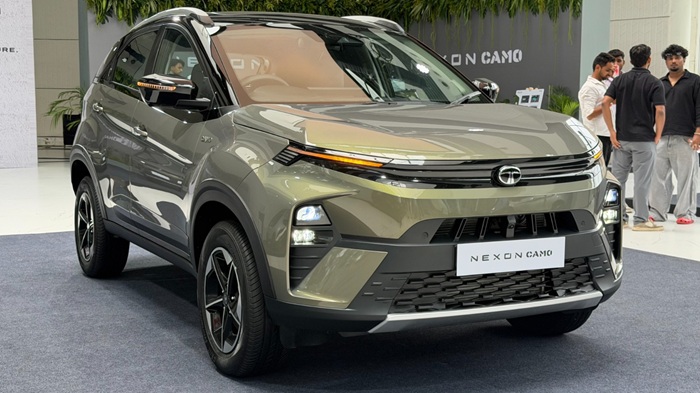
The Nexon was originally launched in 2017, and despite numerous changes since, the 2026 model remains part of that first-generation lineage. It was designed by Martin Uhlarik, and the basic concept always stood apart from the more squared-off mini-SUV formula followed by much of the competition. Tata gave the Nexon a crossover silhouette, a raised stance and a roofline with just enough coupé influence to make it identifiable from fifty metres away.
Nine years on, the basic proportions are still recognisable, but the detailing has grown dramatically more sophisticated. Tata describes the latest Nexon through a combination of digital-inspired design, safety, contemporary technology and performance. Strip away the corporate vocabulary and what that essentially means is this: the Nexon now wants to look as electronic as an EV even when there is a three-cylinder petrol engine coughing politely away under the bonnet.
The front is the clearest evidence. Rather than relying on one enormous grille — the default solution for designers who have run out of subtler ideas — the Nexon uses layered surfaces, slim lighting signatures and a more technical-looking face. Sequential LED turn indicators are incorporated with the daytime running lamps, while the main lighting duties are handled by automatic bi-function full-LED headlamps with follow-me-home illumination and high-beam assist.
There are fog lamps with a cornering function too, useful when turning into poorly lit side streets where dogs, bicycles and ambitious speed breakers tend to materialise without warning. Air curtains form part of the front-end treatment, suggesting someone in the aero department was allowed into the styling meeting.
Rain-sensing wipers add another little piece of automation, although anyone who has experienced an Indian monsoon will know that the difference between “light drizzle” and “biblical event” can be about thirty seconds.
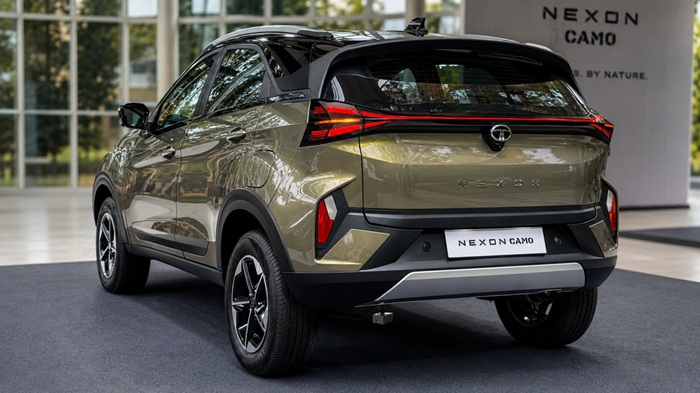
The Camo model brings additional visual identity without radically changing what a Nexon is. The car supplied here is described in Grassland Beige, while white, grey, blue and black are also listed, with contrasting black or white roof options available on dual-tone versions. The palette gives the Nexon enough personalisation without descending into the sort of colour naming that requires an interior designer and a Himalayan wellness retreat to decipher.
From the side, this remains a chunky little thing. The wheel arches and lower body receive protective cladding, while electrically adjustable outside mirrors incorporate both turn indicators and cameras. The black detailing and raised beltline give the Nexon visual weight beyond its actual dimensions.
And those dimensions are worth remembering. At roughly 4 metres long, 1.8 metres wide and 1.6 metres tall, the Nexon fits squarely into India’s taxation-friendly compact SUV class. Yet because it is fairly broad and rides high, it looks more substantial than the tape measure suggests.
Ground clearance is a useful 208 mm, enough to make most oversized urban speed breakers somebody else’s problem. Kerb weight is around 1,300 kg, depending on configuration, so this is not an especially lightweight machine for its footprint.
The Fearless+ sits on 16-inch diamond-cut alloy wheels, although steel wheels are available lower down the range. The tyres here are 215/60 R16 95H CEAT SecuraDrive SD004 radial tubeless units at all four corners. There are disc brakes up front and drums at the rear — not particularly exotic, but hardly unusual for this category.
Move around to the back and Tata’s current lighting obsession continues. The LED X-factor tail lamps incorporate sequential turn indicators, giving the rear a distinctive signature after dark. There is a neatly hidden rear wiper with washer, along with a rear defogger. The styling remains recognisably Nexon, but cleaner, more deliberate and less bulbous than the original 2017 car.
It is still a compact crossover rather than a miniature off-roader, and nobody should confuse 208 mm of clearance with a transfer case and locking differentials. But for broken roads, monsoon craters and those unmarked excavations municipalities occasionally disguise as streets, the stance makes sense.
A small SUV with very large ambitions inside
If the exterior shows how far the Nexon has evolved since 2017, the cabin positively shouts about it.
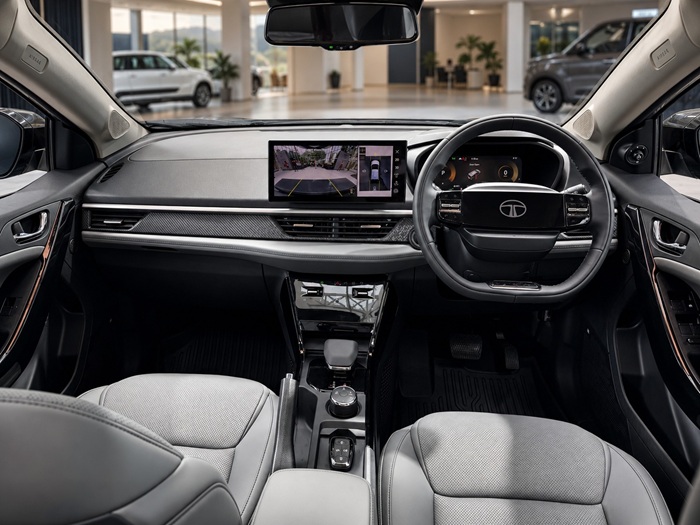
The dashboard adopts a dark theme and is dominated in this version by an enormous 12.3-inch floating Harman touchscreen, paired with a 10.25-inch Harman digital instrument cluster. Taken together, there is enough display acreage here to make an early Tata Nexon owner wonder whether they have accidentally climbed into the IT department.
The touchscreen supports wireless Android Auto and Apple CarPlay, built-in navigation, more than 200 voice commands across six languages, Amazon Alexa, Tata’s own voice assistant, Audioworx processing, FM and radio functionality, and storage support up to 256 GB. There is also a 360-degree surround-view camera, while an integrated dashcam recorder comes with 1 GB of internal memory.
Lower Nexon variants are understandably less theatrical, offering a 7-inch infotainment system instead.
The digital driver display is equally comprehensive. The 10.25-inch cluster can show speed, engine revs and navigation information, meaning less reason to glance sideways at the central screen when following directions. Lower trims make do with 7-inch or 4-inch instrument displays.
The steering wheel itself has become one of the cabin’s visual talking points. It is a leather-wrapped two-spoke “phygital” steering wheel with an illuminated Tata logo and controls for phone functions, volume, infotainment, voice commands, the instrument cluster and cruise control.
“Phygital” is one of those modern words nobody asked for, but the wheel itself does look suitably contemporary.
There is a new touch-sensitive control panel below the infotainment display, and the Nexon receives fully automatic temperature control with Xpress Cool functionality, an air purifier and dust sensors. Given the air quality in several Indian cities, the purifier is less gimmick and more quiet acknowledgement of reality.
Front occupants also get ventilated seats, which are infinitely more useful in May than another animated welcome sequence on the touchscreen. Both front seats are height-adjustable according to the supplied specification, while the front seat belts can also be adjusted for height.
The upholstery in this particular specification is grey Benecke Kaliko leatherette, though purple and Ocean Blue colour treatments and fabric upholstery are also available depending on version. The leatherette does a convincing job of lifting the cabin visually, even if a few harder plastics inevitably remind you this remains a mass-market Tata rather than a Range Rover that shrank in the wash.
There is a leatherette central armrest, a wireless smartphone charger, a cooled glovebox and an auto-dimming rear-view mirror. The driver gets one-touch up/down operation for the power window, while a passenger-airbag deactivation switch is also provided.
A voice-assisted electric sunroof sits overhead. As with most sunroofs in Indian SUVs, its practical contribution to everyday mobility is debatable, but buyers now expect one with the same intensity that previous generations expected power steering. At least this one can be operated by voice, which saves the monumental physical effort of pressing a switch.
Audio is handled by an eight-speaker JBL system with a subwoofer, giving the Nexon enough sonic ability to make up for whatever compressed playlist your phone has decided you enjoyed five years ago.
Rear seats and luggage: the sensible bit
Underneath all the screens and illuminated logos, the Nexon remains a family car, so what happens behind the front seats matters rather more than whether Alexa understands your accent.
There is seating for five, with a fairly broad cabin helped by the Nexon’s approximately 1.8-metre width. Rear-seat accommodation is supported by a 60:40 split-folding backrest, which allows a useful compromise between carrying passengers and longer items.
The conventional petrol and diesel versions provide 382 litres of boot capacity, a respectable figure for a sub-four-metre SUV. The CNG version sacrifices some luggage room but still offers 321 litres, an important improvement in usability over the sort of CNG installation where the cylinder traditionally arrives in the boot like an unwanted house guest and refuses to leave.
The luggage bay also includes hooks rated for 3 kg, useful for preventing shopping bags from rolling around enthusiastically every time the driver remembers Sport mode exists.
Petrol, diesel or CNG? Tata says yes
One of the Nexon’s greatest advantages is how broadly Tata has spread the powertrain net. Petrol, diesel and CNG are all offered, while the separate Nexon EV covers buyers wanting full electric propulsion.
The car tested here uses Tata’s familiar 1.2-litre Revotron turbocharged petrol engine, an inline three-cylinder unit producing 118 hp and 170 Nm. In this version it is paired with Tata’s seven-speed wet-clutch DCA dual-clutch automatic transmission.
Other petrol gearbox choices include a five-speed manual, six-speed manual and six-speed AMT, depending on variant. It is an unusually wide transmission menu. Tata appears to have approached gearbox choice much as a restaurant approaches a buffet: somebody, somewhere, will find something they like.
The wet-clutch DCA is the most sophisticated automatic option. Compared with a conventional automated manual, its dual-clutch construction is designed to deliver smoother and more immediate shifts, which suits the turbo-petrol engine rather better when driven with enthusiasm.
The 1.2-litre motor’s 170 Nm is more relevant in everyday driving than the headline horsepower. There is enough torque to move the Nexon smartly through urban traffic and provide useful mid-range response when overtaking. Three selectable drive modes — Eco, City and Sport — alter its character.
City is likely where most owners will leave it. Eco makes sense when range anxiety applies to your fuel gauge rather than a battery percentage, while Sport sharpens things when the road opens up and your passengers have not explicitly objected.
Being a three-cylinder engine, the Revotron naturally has a slightly distinctive note and texture compared with a four-cylinder petrol. It is not trying to masquerade as a silky six-cylinder, nor should anyone expect it to. What matters is that turbocharging provides the sort of low- and mid-range shove that makes a compact SUV easy to live with.
Tata quotes fuel-efficiency figures of approximately 16 km/l for the petrol automatic and 17 km/l for the petrol manual, with a 44-litre fuel tank. These are supplied claimed averages rather than guaranteed real-world numbers; traffic, driving style, load and the frequency with which Sport mode is treated as a personality trait will all influence what an owner actually sees.
The diesel still has a point
For buyers covering serious highway distances, the Nexon continues to offer a diesel engine at a time when several manufacturers have abandoned the fuel completely.
The 1.5-litre Revotorq turbo-diesel is an inline four-cylinder unit producing 113 hp and 260 Nm, available with a six-speed manual or six-speed AMT. A claimed efficiency figure of around 22 km/l gives it obvious appeal for high-mileage users.
The numbers explain the character. The petrol makes 170 Nm; the diesel has 260 Nm. That additional torque should be most noticeable when the Nexon is loaded with passengers and luggage or when overtaking at highway speeds. It will not make the car a hot hatch wearing platform shoes, but it gives the diesel the muscular, low-rev character that long-distance Indian drivers continue to appreciate.
CNG without surrendering the entire boot
Then there is the CNG version, using the same basic 1.2-litre three-cylinder turbocharged Revotron petrol engine.
In petrol operation it is listed at 118 hp, dropping to 98 hp in CNG mode, while torque is stated at 170 Nm. A six-speed manual transmission is offered with CNG.
The claimed CNG economy figure is around 17 km/kg, and the car carries a 60-litre CNG tank alongside the 44-litre petrol tank. More importantly for family use, Tata has managed to retain that 321-litre luggage capacity.
CNG-specific safety provisions include leak detection, leakage prevention, a fire extinguisher and thermal-incident protection. Those systems are not glamorous additions, but they matter considerably more than animated indicators when you are storing compressed gas beneath a passenger vehicle.
How does the Nexon behave on an Indian road?
The underlying chassis formula is fairly conventional. At the front, the Nexon uses an independent lower-wishbone McPherson-strut arrangement with coil springs, while the rear employs a semi-independent open-profile twist beam with coil springs, shock absorbers and a stabiliser bar.
There is nothing exotic here, but the important thing about the Nexon has traditionally been its sense of solidity. A kerb weight of around 1.3 tonnes is not especially light for a four-metre SUV, but the upside is that the car carries a certain substantial feel over indifferent surfaces.
The 208 mm ground clearance gives it confidence over broken roads and abrupt ramps. You do not need to crawl diagonally over every speed breaker as though guiding a Lamborghini through an archaeological site.
The relatively tall body inevitably introduces some roll when pushed through corners, but that is the compromise you accept for ground clearance, a raised seating position and family-friendly suspension travel. This is not an evo-style corner-carving machine, nor does it pretend to be. The point is confidence rather than delicacy.
The 215-section tyres provide a sensible footprint, while the front-disc/rear-drum braking arrangement is typical for the class. At motorway speeds, the Nexon’s broad stance and substantial kerb weight should favour stability over nervousness.
The three drive modes also allow the powertrain to suit different situations better. Around congested streets, City mode gives the Nexon the most natural calibration. Sport is the entertaining option for faster roads, where the turbo engine’s mid-range can be exploited more freely. Eco is the mode for anyone whose driving personality is dictated by the distance-to-empty readout.
One thing the Nexon cannot escape is physics. It remains short, tall and relatively heavy, so enthusiasts looking for steering purity and minimal body movement will be happier in a lower, lighter car. But that misses the point somewhat. Nexon buyers are far more likely to ask whether it can digest a cratered urban street with four people on board than whether it communicates the precise loading of its outside front tyre at 0.8g.
For that job description, the setup makes considerably more sense.
Safety remains one of the Nexon’s strongest arguments
Safety has become central to the Nexon story. The model has been awarded five stars by both Bharat NCAP and Global NCAP, according to the supplied information, making occupant protection one of the reasons many families place it on their shortlist.
Tata also refers to an Iron Clad Skeleton body structure intended to provide additional protection.
Passive safety begins with six airbags, three-point seat belts with occupant detection and ISOFIX child-seat mounting points. Active systems include an Electronic Stability Program, hill-hold control and tyre-pressure monitoring.
Front and rear parking sensors are fitted, joined by the surround-view camera system, useful because the easiest crash to avoid remains the one involving a pillar in a basement car park.
The Nexon also incorporates a Blind View Monitor and driver-attention assistance.
More significantly, the higher specification now adds an ADAS suite containing Front Collision Warning, Autonomous Emergency Braking, Lane Centering System, Traffic Sign Recognition, Lane Departure Warning and Lane Keep Assist.
This represents a major shift from the original 2017 Nexon. The old car’s technological ambition largely involved pairing your phone; the latest one is watching lane markings and warning you about traffic ahead.
As ever with ADAS in India, its effectiveness depends heavily on road markings, traffic behaviour and whether the vehicle next to you considers lanes to be legally binding concepts rather than decorative suggestions. But the hardware is increasingly relevant, particularly on long highway journeys.
Connected enough to know more about the car than you do
The Nexon comes with iRA 2.0 connected-car functionality, including a one-year subscription.
Through a smartphone, owners can access features such as emergency calling, remote engine start/stop, vehicle diagnostic reports, over-the-air software updates, weather information, navigation-based services and smartwatch integration.
Some of this will be genuinely useful. Remote starting on a furnace-like summer afternoon, for example, can allow the air-conditioning to begin its work before you enter. Vehicle diagnostics can also provide early warning of issues.
Other features may spend most of their lives undiscovered in an app menu, but that is hardly unique to Tata. Modern cars increasingly contain more functionality than most owners will ever deliberately use. Somewhere, perhaps, there is a person regularly checking vehicle data from a smartwatch. We hope they are happy.
A remarkable amount of Nexon for one nameplate
Perhaps the most interesting part of the Nexon in 2026 is not this particular Camo model at all. It is the extraordinary breadth of the family.
You can enter at ₹7.39 lakh, buy this heavily equipped Fearless+ PS Camo for around ₹14 lakh, or spend as much as ₹14.39 lakh within the combustion range. The Camo family starts at approximately ₹10 lakh. Petrol, turbo-CNG and diesel are all available, with multiple manual, AMT and dual-clutch transmissions depending on engine.
Then, standing next door, is the Nexon EV from ₹12.49 lakh.
Few compact SUVs cover so many propulsion and transmission combinations under one badge. That matters because not every Indian buyer has the same use case. The urban commuter may favour petrol. A high-mileage intercity owner may still want diesel. Cost-conscious users with CNG access have another option. The EV buyer can stay within the Nexon family entirely.
It also helps explain the model’s sales performance. Tata has sold more than 10 lakh Nexons since 2017, with the latest cumulative milestone stated at over 11 lakh units. Annual volumes are said to be approximately 2 lakh vehicles in recent years.
That is no longer the performance of a niche alternative. It is a mainstream Indian motoring institution.
The car is assembled in Pune, and in some international markets the Nexon is also sold under the Osprey name. Whatever badge appears on the tailgate, though, the formula is very Indian: keep the footprint tax-friendly, provide enough ground clearance for unpredictable roads, offer every fuel possible short of coal, and make the equipment list long enough to require a scrolling gesture.
Ownership and warranty
Tata provides a three-year/1,00,000 km warranty on the Nexon, giving buyers a useful level of standard coverage.
The broader ownership proposition will also depend on the selected powertrain. Petrol offers the simplest mainstream choice for moderate use. Diesel should continue to appeal to high-mileage owners because of its torque and claimed 22 km/l efficiency. CNG can reduce fuel expenditure where filling infrastructure is convenient, while the Nexon EV brings an entirely different running-cost equation.
Resale is helped by the model’s strong recognition and enormous installed customer base. More than a million cars on Indian roads also means the Nexon is no longer an unfamiliar product for workshops, used-car buyers or independent garages.
But what about the rivals?
The compact SUV battlefield in India is brutally crowded, and the Nexon is no longer fighting from a position of novelty.
Its closest rivals include familiar names such as the Maruti Suzuki Brezza, Hyundai Venue, Kia Sonet and Mahindra XUV 3XO, each offering a slightly different interpretation of the same basic idea.
The Brezza’s appeal lies in its straightforward usability, naturally aspirated petrol character and Maruti’s enormous ownership ecosystem. Buyers who value fuss-free familiarity may find it the easier long-term companion.
The Venue and Sonet tend to lean heavily into polished cabin execution and technology, with the Kia in particular historically using equipment count as a competitive sport. Their interiors can feel slick and carefully resolved.
The XUV 3XO brings its own punchy powertrains, broad stance and assertive road presence, making it one of the Nexon’s strongest alternatives for buyers interested in performance and cabin space.
The Nexon counters with something none of those rivals quite replicate in the same way: sheer powertrain breadth. Petrol, diesel, CNG and EV derivatives allow Tata to keep buyers within the same family even when their fuel preference changes completely. Add the strong crash-test record, 208 mm ground clearance, comprehensive equipment and distinctive design, and the Nexon continues to make a convincing case.
The trade-off is complexity. There are numerous variants, multiple transmissions, different screens and enough specification combinations to make configuring one feel like choosing a mobile-phone tariff. At this level, buyers should decide what they actually need rather than automatically ticking the most expensive box.
Verdict
After nearly a decade, the Tata Nexon has reached the stage where reinvention is less important than refinement. The 2026 Fearless+ PS Camo does not transform the basic formula; it piles more polish, technology and personality onto one of India’s most established compact SUVs.
There is a lot to like. The design remains distinctive without abandoning the Nexon identity. The 208 mm ground clearance suits Indian conditions, the cabin now feels significantly more digital, and useful luxuries such as ventilated front seats, the 360-degree camera, large digital displays and JBL audio make the top model feel convincingly upmarket.
The turbo-petrol’s 118 hp and 170 Nm should be entirely adequate for everyday use, while the seven-speed wet-clutch DCA gives this version a more sophisticated automatic solution than the AMT alternatives. Buyers covering big distances still have the 113 hp, 260 Nm diesel; those hunting lower fuel bills can choose CNG; and anyone determined to avoid a combustion engine altogether can buy the EV.
Its five-star Bharat NCAP and Global NCAP credentials remain powerful selling points, and the addition of ADAS brings the Nexon further into line with what buyers increasingly expect at the upper end of the compact-SUV market.
There are reservations. At around ₹14 lakh, this Fearless+ PS Camo is no longer inexpensive simply because it is less than four metres long. It sits deep enough into the market that buyers can legitimately demand excellent refinement, cabin quality and software execution, not merely a spectacular equipment list. The touch-heavy interface will not suit everyone either, and the sheer number of Nexon variants is capable of inducing decision fatigue before you have even selected a colour.
But perhaps that breadth is also the secret of the Nexon’s success.
The Tata Nexon started life in 2017 as the unusual-looking newcomer trying to persuade Indian families that Tata could build a desirable compact crossover. More than 11 lakh sales later, it no longer has anything to prove on that front. It has become one of the cars everybody else has to plan around.
The Fearless+ PS Camo is the Nexon at its most extravagant: large screens, illuminated steering wheel, ventilated seats, ADAS, surround cameras, connected technology and enough LEDs to make the original car look almost analogue. Yet beneath all the digital theatre is the same basic proposition that made the Nexon successful in the first place — sensible dimensions, generous ground clearance, useful practicality, strong safety credentials and an engine option for almost every kind of Indian buyer.
If you want absolute simplicity, the Brezza may make more sense. If cabin polish is the priority, the Korean alternatives demand inspection. If punchy performance is what gets you out of bed, the XUV 3XO deserves a drive.
But if you want one compact SUV that can be specified as petrol, diesel, CNG or electric, wrapped in a distinctive design and backed by nearly a decade of market acceptance, the Nexon remains extremely difficult to ignore.
After nine years and more than a million sales, it has become less of a fashionable crossover and more of an Indian motoring fixture. The Camo version merely puts on a new jacket, adds several screens and reminds everyone it has no intention of quietly retiring.