
There are luxury cars that try very hard to announce your arrival, and then there is the Kia Carnival, which would rather quietly slide open an enormous electric door and ask whether you would like to put your feet up. The Carnival is technically a people mover, practically a seven-seat luxury lounge, and philosophically something of an antidote to India’s obsession with pretending every large family vehicle needs to look ready for the Dakar Rally.
This fourth-generation Carnival, codenamed KA4, represents a very different interpretation of premium motoring. It isn’t an SUV, despite Kia making considerable effort to give it SUV-like shoulders, a large grille and enough visual confidence to discourage anyone from calling it a van at a hotel entrance. What it actually offers is something many SUVs struggle with: genuinely lavish second-row accommodation, enormous luggage capacity and effortless access through powered sliding doors.
The Carnival name itself has been around since 1998, and what you see here is the 2024 facelift of the fourth-generation model. Designed by Park Jung-Yong, it follows Kia’s Opposites United design philosophy and sits on the Hyundai-Kia N3 platform, an architecture shared with an impressively varied family including the Kia Sportage, Sorento, K8 and K5, alongside the Hyundai Tucson, Staria, Santa Fe, Sonata, Custo and Mufasa.
That gives the Carnival proper modern-car foundations rather than the faintly commercial-vehicle flavour traditionally associated with large MPVs. And at ₹63.90 lakh ex-showroom for the Limousine Plus specification described here, it needs them. Once a vehicle costs this much, “it has lots of space” is no longer sufficient justification. A railway waiting room has lots of space too.
A van that has been spending time with SUVs
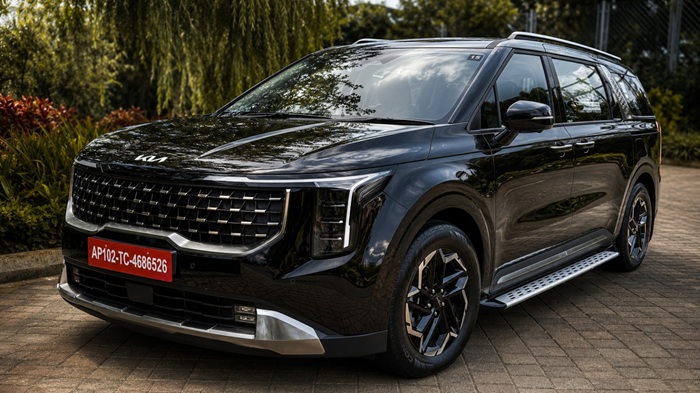
The previous Carnival was hardly a small object, yet this generation has grown another 40 mm in length. Overall, you are dealing with roughly 5.1 metres of Korean real estate, about 2 metres wide and 1.8 metres tall. Ground clearance is 172 mm, kerb weight is 2,129 kg, gross weight is 2,800 kg, and the turning circle is 5.8 metres.
In other words, this isn’t the sort of thing you impulsively squeeze into a questionable parking gap outside Connaught Place. But considering its immense footprint, the turning circle isn’t absurd, and the upright proportions at least make its boundaries reasonably easy to understand from behind the wheel.
The facelift has successfully moved the Carnival farther away from conventional MPV aesthetics. At the front sits Kia’s familiar Tiger Nose grille, finished here in a combination of black and chrome. It is broad, assertive and sufficiently decorative to ensure nobody mistakes this for an airport shuttle.
The Starmap LED daytime running lights give the front end its modern Kia identity, while automatic LED projector headlamps incorporate high-beam assist. LED fog lamps sit lower down, and a matte chrome-plated skid plate provides the fashionable suggestion of off-road robustness.
Suggestion is the operative word. With 172 mm of ground clearance, this remains a luxury MPV rather than something you should aim enthusiastically at a rocky trail. The skid plate is essentially formal footwear rather than hiking boots.
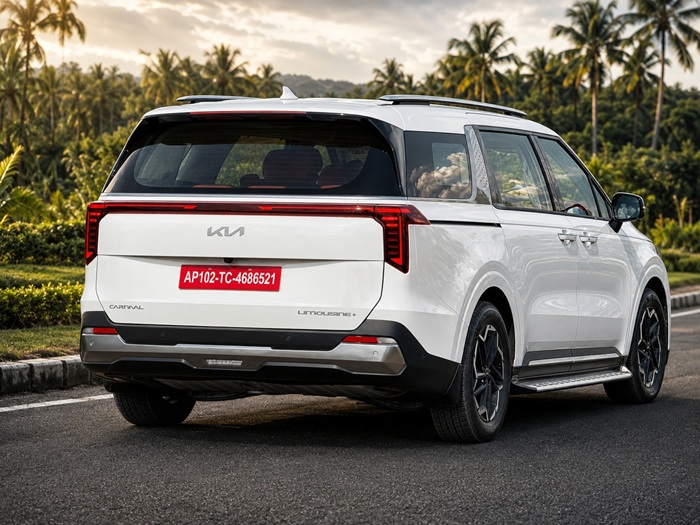
Our car is finished in Glacier White Pearl, which suits the Carnival’s clean architectural shapes nicely. Black is also available if you’d prefer your enormous seven-seater to have a slightly more presidential-airport-convoy disposition.
From the side, the sheer length becomes impossible to ignore. Those electrically operated sliding rear doors dominate the profile and are among the Carnival’s defining practical advantages. They also get puddle lamps, an apparently minor detail until you’re climbing aboard at night in the monsoon and discover that luxury is sometimes simply being able to see where you’re putting your shoe.
The outside mirrors are electrically adjustable and incorporate turn indicators as well as cameras. They are attached to doors that seem to occupy their own postcode, but the camera hardware is welcome given the Carnival’s considerable girth.
Underneath are 18-inch diamond-cut alloy wheels wearing 235/60 R18 103H Continental CrossContact RX radial tubeless tyres, made in Thailand. The relatively generous sidewall is sensible. A luxury people mover designed for Indian conditions does not require absurd 21-inch wheels wrapped in liquorice-strip tyres just because somebody in the styling department discovered Instagram.
Disc brakes are fitted front and rear. Suspension consists of MacPherson struts at the front and a multi-link arrangement at the rear, with gas shock absorbers and coil springs. This is a much more sophisticated recipe than the crude rear suspension layouts historically associated with utilitarian vans, and it underpins the Carnival’s fundamental proposition: carry a lot of people without reminding them they’re being carried in a lot of vehicle.
At the back, the design remains suitably clean. You get an LED combination tail-lamp setup with emergency stop signal, an LED high-mounted stop lamp, another matte chrome skid-plate treatment and a neatly hidden rear wiper. Hiding the wiper is one of those tiny design decisions nobody urgently needed, yet once hidden it makes every exposed rear wiper look vaguely unfinished.
Size used properly
The Carnival is huge, but at least it is huge for a reason.
This is a seven-seater, and luggage space is quoted at an enormous 1,139 litres. Fold the third-row seats and capacity expands to 2,460 litres, at which point the Carnival begins to blur the distinction between personal transport and commercial warehousing.
The third row has a 60:40 split-folding and sinking mechanism, allowing the seats to disappear more cleanly into the rear load area rather than simply creating an awkward elevated platform.
This flexibility matters because people buy large three-row vehicles with conflicting requirements. On Monday it might carry six adults and some laptop bags; on Friday it might swallow airport luggage; on Sunday somebody will inevitably discover an antique cupboard they absolutely must take home immediately.
Internationally the Carnival family is broader still. Your notes mention 11-seat versions, a 6-speed automatic, 2.0-litre and 3.5-litre V6 petrol engines, and a 1.6-litre hybrid in other markets. Those configurations are not offered in India according to the supplied material, but they demonstrate just how extensively Kia adapts the Carnival to different markets.
Production and assembly are similarly global, with the Carnival associated with facilities in South Korea, Russia, China, Vietnam and Malaysia.
The proper Carnival experience starts in row two
You can judge the Carnival from the driver’s seat, but that is slightly like judging an Airbus A380 exclusively from the cockpit. The interesting bit is farther back.
Open one of the powered sliding doors and the Carnival’s priorities become immediately obvious. The cabin is finished in a brown-and-black two-tone leather upholstery, giving it a richer atmosphere than the sea of all-black interiors commonly found in supposedly premium vehicles.
The centrepieces are the powered relaxation captain seats in the second row. They are not merely individual chairs with armrests; they offer ventilation, heating, powered sliding and reclining functions, leg support and a walk-in device.
This is where the Carnival justifies the Limousine badge. You can recline, extend the leg support, adjust your seating position and treat the traffic outside as something happening to other people.
In a conventional three-row SUV, the second row is often generous because it has to be. Here, the second row feels like the reason the vehicle exists.
There are sunshade curtains, useful both for cutting heat and for achieving the properly VIP effect of becoming mysteriously invisible when the door closes. A wide dual electric sunroof stops the enormous cabin feeling claustrophobic, while 64-colour ambient mood lighting supplies whichever hue best matches your current opinion of the day’s traffic.
And because luxurious chairs deserve an appropriately indulgent soundtrack, Kia fits a 12-speaker Bose premium audio system.
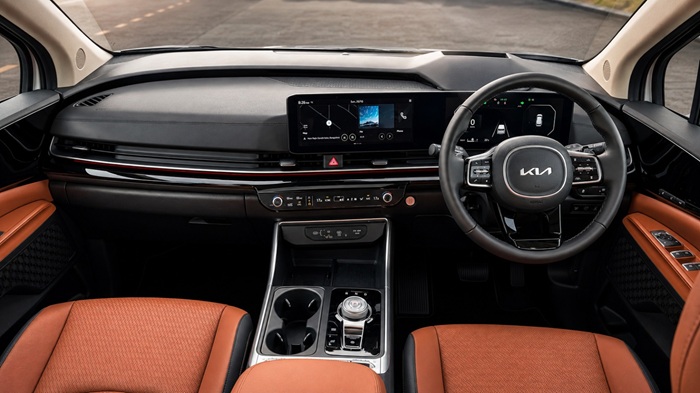
The dashboard follows the current industry appetite for large displays, but Kia has packaged them relatively elegantly into a curved display arrangement. A 12.3-inch HD touchscreen infotainment system supports navigation, over-the-air updates, USB connectivity, wireless Android Auto, Apple CarPlay, voice commands, Bluetooth, FM and radio.
Beside it sits a 12.3-inch HD digital instrument cluster, and the driver also gets an 11-inch head-up display. Between the main screens and the HUD, there is now almost enough display area to run a small newsroom.
Still, unlike touchscreen-heavy interiors that make basic adjustments feel like filing an online tax return, the Carnival mixes its technology with a generally straightforward cabin layout.
Climate control is a three-zone fully automatic system, entirely appropriate for a vehicle whose front and rear occupants may have very different interpretations of what constitutes “comfortable”. A wireless phone charger is provided as well.
The driver gets a 12-way powered seat with four-way lumbar adjustment, while the front passenger seat offers eight-way electrical adjustment. Both front seats are ventilated and heated.
Heating may sound faintly optimistic in much of India, but anyone who has experienced a January morning in North India will understand that ventilated-only seats are not the complete answer.
The steering wheel is a four-spoke leatherette-wrapped unit, carrying controls for the phone, volume, infotainment and voice functions. Steering adjustment is tilt and telescopic, while the steering itself is a motor-driven power-assisted system.
The transmission selector is particularly modern: rather than a conventional lever, there is a shift-by-wire rotary dial controlling the 8-speed automatic. It frees up space around the centre console and feels appropriately contemporary, although rotary selectors remain one of those innovations that solve a problem most of us didn’t realise we had.
There are dedicated switches for functions including power-door operation, boot opening and rear-door control. The glovebox is illuminated, which sounds gloriously mundane until you’re trying to find something inside one after sunset.
An auto anti-glare rear-view mirror is standard too, though with 5.1 metres of vehicle extending behind you, the surround-view camera system will frequently be a more valuable friend.
Technology that earns its place
Kia Connect is included with a three-year free subscription and allows several functions to be accessed through a smartphone application. These include live traffic information, live vehicle tracking, remote engine start and stop, remote climate control, locking and unlocking, vehicle-status checks and broader vehicle-management features.
Connected-car systems can sometimes feel like software searching desperately for a purpose, but remote climate control makes considerable sense in India. If a car has been baking in an open car park through a 44-degree afternoon, switching the AC on before reaching it stops being a gimmick and starts resembling humanitarian aid.
The Carnival also gets four selectable driving modes: Eco, Normal, Sport and Smart.
Normal will presumably be where most owners leave it. Eco is there to calm the throttle and your fuel bills. Sport wakes up the drivetrain when required, while Smart allows the vehicle to adapt more automatically to how it is being driven.
No, it will not turn two tonnes of luxury MPV into a hot hatch. Physics continues to enjoy legal immunity from drive modes.
The diesel engine makes a lot of sense here
The detailed Indian-spec powertrain supplied for this car is a 2.2-litre inline four-cylinder, 16-valve DOHC CRDi Hyundai Smartstream D4HE diesel engine, producing 190 horsepower and 441 Nm of torque.
It is paired with the aforementioned 8-speed shift-by-wire automatic transmission.
This engine is also used in vehicles such as the Kia Sorento and Hyundai Santa Fe, which tells you something about its intended job description. This is not a small engine being forced into service beneath a massive body. It is designed for large, relatively heavy vehicles that require a strong mid-range and relaxed cruising ability.
And 441 Nm is the more important number here than 190 horsepower.
In a vehicle weighing 2,129 kg, you aren’t looking for the delicate upper-rpm enthusiasm of a sports car engine. What matters is whether the Carnival can gather itself cleanly from low speed, merge decisively onto a highway and overtake with six passengers and luggage aboard without requiring an appointment three working days in advance.
A modern turbodiesel suits that task.
The automatic gearbox’s eight ratios should help keep the engine operating in its stronger torque band while allowing comparatively relaxed engine speeds on faster roads. In urban traffic, the idea is not to excite the driver but to reduce effort. Select D, let the torque do the work and leave the aggression to the man attempting to fit his motorcycle into the six inches between your front bumper and the car ahead.
With the Carnival’s size, smooth power delivery matters more than outright acceleration theatrics. There is no 0–100 km/h or top-speed figure supplied here, so any attempt to turn this into a performance statistic exercise would be invention. The more relevant expectation is muscular, predictable mid-range performance rather than dramatic off-the-line urgency.
The claimed fuel-economy figure supplied is 14 km/l, paired with a 72-litre fuel tank. Treat that 14 km/l as a claimed figure rather than a guaranteed real-world result: a 2.1-tonne vehicle operating in dense city traffic with its climate control working overtime is not traditionally where diesel-efficiency records are set.
Even so, diesel makes considerable practical sense for a vehicle designed to cover long distances with passengers aboard.
What should it be like from behind the wheel?
The Carnival’s chassis hardware tells you more about its intent than the Sport drive mode does.
With MacPherson struts up front and a multi-link rear suspension, it is engineered to deliver a mature passenger-car-like ride rather than the pitching and bouncing often associated with traditional vans. The relatively sensible 18-inch wheel package and 60-profile tyres should also give the suspension useful cushioning against potholes and sharp road joints.
That is especially important in India, where any luxury vehicle may encounter roads containing the full geological history of the subcontinent during a single journey.
At low speeds, the Carnival’s mass will always be present. You cannot disguise more than two tonnes and a body 5.1 metres long simply by making the steering light. But powered steering, the camera system and parking sensors should reduce the intimidation factor.
At speed, that long wheelbase and substantial footprint ought to provide the kind of relaxed highway stability that suits its limousine brief. This isn’t a car you buy to hunt apexes on a Sunday morning. It is a car in which the person in row two may be drinking coffee while reclining, so aggressive body movements would rather defeat the point.
The Continental CrossContact RX tyres, measuring 235 mm wide, provide a sensible footprint without chasing exaggerated performance-car rubber.
Disc brakes at all four corners also have substantial work to do. At its 2,800 kg gross weight, a fully loaded Carnival carries serious momentum. The reassuring part is that Kia backs the mechanical braking system with an extensive electronic safety suite.
The Carnival has more electronic supervision than some offices
Kia describes the driver-assistance package here as Level 2 DAS, with 23 autonomous and assistance features.
These include Forward Collision Avoidance Assist, Lane Keep Assist, Lane Follow Assist, Lane Departure Warning, Blind-Spot Collision Avoidance Assist, Rear Cross-Traffic Collision Avoidance Assist, Safe Exit Assist, Reverse Parking Collision Avoidance Assist, Driver Attention Warning, Manual Speed Limit Assist and Leading Vehicle Departure Alert.
There is also smart cruise control with stop-and-go capability, a 360-degree camera and a blind-view monitor.
Some driver aids make substantially more sense on this car than they might on something compact. Blind-spot monitoring is genuinely useful when you are managing two metres of width. A 360-degree camera is similarly invaluable while parking a vehicle that could potentially have its own municipal ward number.
The blind-view monitor is especially welcome in crowded traffic, where two-wheelers frequently approach your blind spot with the optimism of organisms unfamiliar with mortality.
The conventional safety specification includes eight airbags, ABS, EBD, Electronic Stability Control, Hill Assist Control, Vehicle Stability Management and ISOFIX child-seat mounts.
You also get seat-belt reminders, speed-sensing automatic door locking, impact-sensing auto door unlocking, front, rear and side parking sensors, a high-line tyre-pressure monitoring system, a second-row occupant alert and three-point seat belts.
No crash-test rating has been supplied in the source material, so none should be assumed.
Is it genuinely luxurious, or merely very well equipped?
That is an important distinction at ₹63.90 lakh.
Luxury is not the same thing as owning the largest touchscreen available from an electronics supplier. True luxury is reducing inconvenience.
And that is where the Carnival’s strongest ideas lie.
Powered sliding doors remove the need for enormous hinged doors in narrow parking spaces. Second-row relaxation seats provide actual physical comfort. Three-zone climate control allows occupants to stop fighting over temperature. Powered seat ventilation is useful in Indian summers. The huge boot means seven passengers do not automatically require a separate support vehicle for their luggage. The surround-view cameras make its intimidating exterior dimensions manageable.
Those are meaningful benefits.
There are flashier features too, of course. Sixty-four-colour ambient lighting means you can choose the precise shade of purple required to transport your mother-in-law to dinner. Twin sunroofs add theatre. Three digital displays across the driver’s field of view make the Carnival feel appropriately expensive.
But the clever thing is that beneath the decorative technology sits a vehicle whose fundamental package makes sense.
Ownership
Kia provides a three-year, unlimited-kilometre warranty on the Carnival according to the supplied information, with the option of extending coverage up to five years. There is also three years of roadside assistance.
Unlimited-kilometre coverage during the standard warranty period is particularly relevant because Carnivals used by hotels, executives, businesses or high-mileage private owners may accumulate distance considerably faster than an ordinary family hatchback.
The three-year complimentary Kia Connect subscription adds another ownership benefit, although buyers planning to keep the vehicle beyond that period will naturally need to consider whatever subscription terms apply later.
There is no specific service interval, maintenance-cost figure or resale-value data in the supplied material, so those should not be guessed.
The difficult question: why not buy an SUV?
This is where the Carnival becomes interesting.
At ₹63.90 lakh ex-showroom, buyers are within reach of serious premium SUVs and luxury-badged alternatives depending on trim and market pricing. Many will arrive with greater ground clearance, more fashionable styling and, crucially for Indian buyers, the social authority that apparently comes from sitting slightly higher than the person next to you at a traffic light.
An SUV also makes more sense if poor roads, rough terrain or genuine all-surface capability are routine requirements.
But most SUVs cannot answer the Carnival’s second-row experience.
A conventional three-row SUV inevitably involves packaging compromises. The third row may be tight, access can be awkward, rear doors require clearance to swing open and captain seats rarely approach the almost airline-style indulgence available here.
The Carnival instead accepts what it is and optimises around that purpose.
If you regularly travel with a chauffeur, its case becomes stronger still. Buying a dynamically sophisticated SUV and then spending every journey in the back seat can be a bit like purchasing a grand piano because you like the bench.
With the Carnival, the best seats are exactly where many owners will spend their time.
Verdict
The Kia Carnival is not trying to be the most adventurous vehicle for ₹63.90 lakh, nor the fastest, nor the sportiest. It does not need six terrain modes, three differential locks or a mountain-goat mascot to justify its existence.
Its talent is more civilised.
It takes seven-seat transportation and removes much of the inconvenience normally associated with it. The enormous dimensions create genuine cabin and luggage space rather than simply exterior theatre. The powered sliding doors make sense in tight environments. The second-row relaxation chairs offer an experience few similarly priced SUVs can replicate. Its 2.2-litre diesel’s 190 hp and 441 Nm are appropriately chosen for effortless long-distance duty, while the 8-speed automatic and four drive modes keep the mechanical experience contemporary.
There are compromises. At over 5.1 metres long and roughly 2 metres wide, urban parking will require planning. Its 172 mm ground clearance means broken roads deserve more respect than they might in a tall SUV. At more than two tonnes, no amount of electronic assistance will make it feel physically small. And ₹63.90 lakh is serious money for a vehicle wearing a mainstream badge, irrespective of how luxurious the second row becomes.
But that last criticism also misses the point slightly.
The Carnival is for buyers mature enough to value what a vehicle actually does rather than what shape fashion currently says it should be. If your priority is commanding SUV presence, rough-road ability or driver entertainment, look elsewhere. If you spend most journeys carrying family, clients or yourself over long distances and want business-class comfort without stepping into far more expensive luxury machinery, the Carnival’s logic becomes unusually persuasive.
It is essentially an executive lounge that happens to have 18-inch wheels, a turbodiesel engine and licence plates.
And perhaps the greatest compliment you can give the Carnival is that once you’ve spent enough time reclining in that second-row captain’s chair, the fact that it is technically a minivan stops sounding like an insult.