


There are SUVs that look adventurous while standing outside a premium café, and then there are SUVs that can genuinely disappear into the wilderness and return without making a social-media announcement about it.
The Toyota Land Cruiser Prado belongs firmly to the second category.
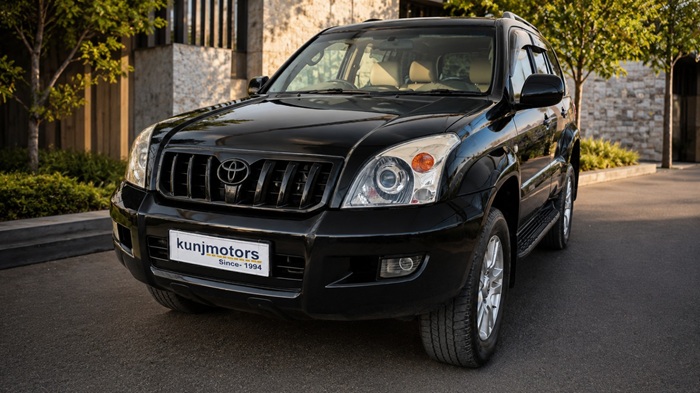
This is the 2005 Toyota Land Cruiser Prado VX, a luxurious Japanese full-size SUV from the third generation of the Prado family. The Land Cruiser Prado nameplate was introduced in 1990, and the model seen here belongs to the J120 generation.
When new, the Prado was offered with petrol and diesel engine options. Its ex-showroom price reportedly started at around ₹44 lakh and went all the way up to approximately ₹93 lakh, depending on the engine, trim and equipment.
This particular black Prado VX is now available through Kunjmotors for ₹11.90 lakh. That is roughly the price of a modern compact SUV, except this Toyota comes with a four-litre V6 engine, proper four-wheel drive and enough road presence to make toll-booth barriers rise out of respect.
The Prado was discontinued in India in 2009. Today, the nameplate has reached its fifth generation, although the latest model is currently not officially available in the Indian market.
Design and Background
The third-generation Prado was designed by Lance Scott at Toyota’s European design studio.
The word “Prado” comes from Spanish and means “field” or “meadow.” That is an appropriate name because this vehicle looks more comfortable crossing an open field than searching for parking inside a crowded shopping complex.
Toyota developed the Prado as a relatively light-duty member of the wider Land Cruiser family. However, “light-duty” must be understood according to Toyota’s standards. In normal automotive language, this is still a large, heavy and extremely capable body-on-frame SUV.
The J120 Prado was assembled in Japan and China. It was based on Toyota’s F2 platform, which also underpinned capable vehicles such as the Toyota FJ Cruiser and 4Runner.
This example is the four-door model, although Toyota also offered a shorter two-door version in selected markets. The four-door Prado is the more practical choice, particularly for people who want three-row seating without asking rear passengers to perform gymnastics every time they enter or exit.
Exterior Design
The J120 Prado has a clean, upright and distinctly early-2000s Toyota design. There are no unnecessarily complicated creases, oversized fake vents or illuminated panels trying to communicate with satellites.
It simply looks strong.
At the front, the Prado gets multi-reflector headlamps with a levelling function. The headlamps are large and straightforward, matching the SUV’s functional personality.
The tall bonnet, wide grille and substantial bumper give it unmistakable Land Cruiser DNA. Toyota also provided a crash-resistant body structure and energy-absorbing bumpers, combining a tough appearance with practical safety engineering.
Along the sides, the Prado gets protective moulding and substantial cladding. These elements add visual bulk while helping protect the body from minor scrapes and impacts during off-road use.
The windows use green-tinted UV-protection glass, which helps reduce the effect of sunlight entering the cabin. It is a small feature, but useful in a vehicle designed for long-distance touring across hot climates.
This Prado is finished in black, which gives it an especially formal and imposing appearance. Other colour options included red, white, silver, gold, green and blue.
Some Prado versions were offered with a rear-mounted hanging spare wheel. That arrangement gave the SUV a more traditional expedition-style appearance, although other versions carried the spare wheel in a different location.
Dimensions and Road Presence
The Prado measures approximately 4.8 metres in length, 1.8 metres in width and 1.9 metres in height.
Its substantial height and upright body provide the commanding driving position that traditional SUV buyers appreciate. You do not merely sit inside the Prado; you occupy an elevated observation post.
Despite its size, the turning radius is around 5.2 metres, which is respectable for a vehicle of this class.
The kerb weight is approximately 2,170 kg, while the gross vehicle weight is around 2,850 kg. In simple terms, this Toyota weighs more than two tonnes before passengers and luggage join the expedition.
It can tow up to approximately 2,800 kg, making it suitable for pulling trailers, boats and other heavy loads. The roof-loading capacity is around 80 kg.
Ground clearance stands at an impressive 222 mm, while the Prado can reportedly wade through water up to 700 mm deep.
That means heavy rainfall, broken roads and shallow river crossings are genuine operating conditions for the Prado—not excuses for cancelling the journey.
Wheels, Tyres and Brakes
This Prado rides on 18-inch alloy wheels.
The tyres are 265/60 R18 110H Bridgestone Dueler H/T 684 II steel-belted radial tubeless units at both the front and rear. These highway-terrain tyres are designed to provide a balance between everyday road comfort and mild off-road usability.
Disc brakes are fitted at all four corners.
The wheel and tyre setup looks proportionate to the large body. It also gives the Prado the sidewall depth required to deal with uneven roads without making every pothole feel like a personal attack.
Chassis and Suspension
The Prado uses a traditional body-on-frame chassis, one of the most important reasons behind its toughness, towing ability and off-road durability.
At the front, it uses a double-wishbone suspension arrangement with coil springs. At the rear, it gets a four-link suspension with coil springs.
Toyota also offered its Electronic Modulated Suspension system, which could electronically manage suspension behaviour according to road and driving conditions. Air suspension was available on certain models and variants as well.
This combination allowed the Prado to balance durability with comfort. It was not intended to corner like a low-slung sports car, and pretending otherwise would be unfair. Its real strength lies in absorbing poor surfaces, carrying passengers over long distances and remaining composed where ordinary cars begin reconsidering their life decisions.
Full-Time Four-Wheel-Drive System
The Prado comes with a proper full-time four-wheel-drive system.
Its hardware includes a limited-slip centre differential, differential lock and a transfer case. This is not an electronically simulated off-road package that relies solely on wheelspin detection and optimistic dashboard graphics.
The system is designed to send power to all four wheels continuously, improving traction across loose surfaces, wet roads, gravel, mud and difficult terrain.
The centre differential allows the front and rear axles to rotate at different speeds during normal driving. When conditions become challenging, the differential lock can improve traction by controlling the distribution of power between the axles.
The transfer case provides the mechanical flexibility required for serious low-speed off-road driving.
Manual versions used a dry, single-plate clutch.
The Prado also gets a “2nd Start” function with the automatic transmission. This allows the vehicle to begin moving in second gear, helping reduce wheelspin on slippery surfaces such as snow, mud or loose gravel.
Safety
The Toyota Land Cruiser Prado received four out of five stars from Australian NCAP.
Its safety package was comprehensive for an SUV from this era. Depending on the specification, the Prado offered up to eight airbags.
It also included:
ABS, electronic brake-force distribution, brake assist, vehicle stability control, active traction control, skid control, hill-start assist, downhill-assist control, a hydraulic brake booster, side-impact protection bars, child locks and ISOFIX child-seat mounting points.
Additional equipment included a seatbelt warning system, immobiliser, alarm and remote central locking.
The three-point ELR seatbelts were designed to lock during sudden deceleration. The front seatbelts also featured pretensioners and force limiters.
Toyota additionally provided an electronic fuel cut-off system to reduce fuel delivery in the event of an accident.
The front seats were designed to help reduce whiplash injuries during a rear impact.
It may not have had the latest lane-centering systems or a dashboard that repeatedly asks the driver to keep their hands on the steering wheel, but the Prado’s core safety structure and mechanical stability systems were strong for its time.
Boot Space and Practicality
The Prado offers approximately 620 litres of boot capacity, depending on the seating arrangement.
The third-row seats use a 50:50 split-folding design and can also be detached. Removing them creates additional cargo space when seven-seat capacity is not required.
The second-row seats offer a 60:40 split-folding and tumbling function, making it easier to access the third row or carry larger items.
This flexible arrangement gives the Prado the ability to function as a family SUV, long-distance tourer, airport-transfer vehicle or luggage-carrying expedition machine.
The cabin is spacious, although the third row is naturally better suited to shorter journeys or younger passengers. Adults can sit there, but they may begin negotiating for the second row before the return journey.
Interior and Comfort
Inside, the Prado VX combines durability with the luxury standards of its era.
Leather upholstery is provided throughout the cabin, giving the interior a premium appearance. The design is practical and straightforward, with large controls that can be operated without reading a digital instruction manual.
The front seats are electrically adjustable in eight directions and include electric lumbar support. These features are particularly useful during long highway drives, where proper seating support matters more than animated ambient lighting.
The driver gets a leather-wrapped four-spoke power steering wheel with tilt and telescopic adjustment.
The steering system uses a rack-and-pinion setup with variable ratio and a collapsible steering column. The variable ratio helps balance low-speed manoeuvrability with stability at higher speeds.
The dual-zone automatic climate-control system allows the driver and front passenger to select different temperatures. It also comes with a clean-air filter.
An electric tilt-and-slide sunroof is available with an anti-trap function. The sunroof adds light to the otherwise substantial cabin, although opening it during an off-road trail may also invite half the forest inside.
A nine-speaker music system provides entertainment.
By modern standards, the Prado’s audio and infotainment arrangement is relatively simple. There is no enormous touchscreen dominating the dashboard, no subscription-based heated-seat menu and no software update required before adjusting the temperature.
Everything has a physical purpose, and most controls can be operated through muscle memory.
Field Monitor and Instrument Cluster
One of the Prado’s most interesting features is its field monitor.
The display can provide information such as outside temperature, compass direction, average speed, barometric pressure and altitude.
These functions are especially useful for owners travelling through mountains or remote areas. The altimeter can show the vehicle’s approximate elevation, while the barometer helps track atmospheric pressure.
In modern cars, the central display often tells you which song is playing. In the Prado, it can tell you how high up a mountain you have climbed.
The Optitron instrument cluster provides crisp illumination and displays important vehicle information. Depending on the model, it can show the compass, outside temperature, altitude, barometric pressure, driving range and average fuel-consumption information.
The presentation is simple but effective, and the Optitron lighting was considered premium technology when this Prado was new.
Transmission Options
This example uses a five-speed automatic transmission.
The Prado was also offered with four-speed automatic, five-speed manual and six-speed manual gearbox options, depending on the engine, market and model year.
The five-speed automatic suits the relaxed character of the four-litre petrol engine. It is designed to deliver smooth shifts rather than aggressive, sports-car-style reactions.
There are no steering-mounted paddle shifters encouraging the driver to attack a racetrack. That is probably sensible because a 2.1-tonne, seven-seat body-on-frame SUV is unlikely to set a lap record—unless the racetrack includes a river crossing.
Four-Litre V6 Petrol Engine
Under the bonnet of this Prado is Toyota’s 1GR-FE petrol engine.
It is a 4,000 cc, water-cooled V6 engine with sequential multiport fuel injection, double overhead camshafts, 24 valves and VVT-i variable valve timing.
The engine produces approximately 249 horsepower and 380 Nm of torque.
It can accelerate the Prado from 0 to 100 km/h in around 9.1 seconds and reach a top speed of approximately 180 km/h.
For a large SUV weighing more than two tonnes, a sub-10-second acceleration time remains impressive. The Prado does not launch forward like a performance coupe, but the naturally aspirated V6 delivers smooth, confident and predictable power.
Fuel efficiency is around 6 km/l, depending on traffic, road conditions and driving style.
The fuel tank has a capacity of 87 litres. A large tank is necessary because the Prado’s V6 enjoys petrol with the enthusiasm of a wedding guest discovering an unlimited buffet.
Still, owners do not generally buy a four-litre, full-time four-wheel-drive Land Cruiser and then become shocked by fuel bills. That would be like buying a swimming pool and complaining that it uses water.
Other petrol engines offered in the J120 Prado included a 2.7-litre inline-four and a 3.4-litre V6.
The engine uses a die-cast aluminium cylinder block and an aluminium cylinder head, helping reduce weight compared with a traditional cast-iron construction.
Diesel Engine
Toyota also offered the Prado with a 3.0-litre 1KD-FTV diesel engine.
This inline-four diesel used double overhead camshafts and 16 valves. It produced approximately 166 horsepower and a strong 410 Nm of torque.
The diesel Prado could accelerate from 0 to 100 km/h in around 11.2 seconds and reach approximately 180 km/h.
Its claimed or expected fuel economy was around 11 km/l, making it considerably more efficient than the four-litre petrol version.
The diesel engine’s greater low-end torque and improved fuel economy made it especially suitable for long-distance touring, towing and off-road use.
The petrol V6, however, remains smoother and more refined, with a stronger high-speed response and a more premium character.
The 1GR-FE Engine Family
Toyota’s 1GR engine was used across several globally respected SUVs and pickup trucks.
Variants of this engine appeared in the Toyota 4Runner, Land Cruiser, Tacoma, Hilux, Tundra, Fortuner and FJ Cruiser, as well as the Lexus GX.
Its widespread use reflects the engine’s versatility and proven engineering. Toyota installed it in everything from family SUVs to demanding off-road and utility vehicles.
The GR-series engine was eventually succeeded in newer applications by Toyota’s more modern Dynamic Force engine family, developed to deliver improved efficiency, emissions performance and thermal management.
However, the naturally aspirated 1GR-FE still has an old-school charm. There are no tiny turbochargers working overtime to create large-engine performance from a small displacement. It is simply a large V6 doing large V6 things.
Driving Experience
From behind the wheel, the first thing you notice is the elevated seating position.
The Prado gives the driver an excellent view of the road ahead. The large windows and upright body help with visibility, although the vehicle’s overall dimensions still require attention in narrow urban areas.
The steering is light enough for everyday use but does not pretend to be overly sporty. The Prado prefers smooth, measured inputs.
Its body-on-frame construction and long-travel suspension give it a slightly relaxed, traditional SUV feel. There will naturally be some body movement through fast corners, but that is the trade-off for strong wheel articulation, ride comfort and off-road ability.
On broken roads, the Prado feels reassuring. The large tyres, substantial suspension travel and strong chassis allow it to absorb surfaces that would force a low-profile luxury SUV to request immediate emotional support.
The four-litre engine delivers smooth acceleration. Power builds progressively, and the five-speed automatic keeps the vehicle moving with minimal drama.
At highway speeds, the Prado feels stable and well suited to long journeys. The engine has enough reserve performance for overtaking, while the 87-litre fuel tank provides reasonable touring range despite the modest fuel economy.
Off-road, the Prado’s full-time four-wheel-drive system, centre differential lock, transfer case, traction systems, 222 mm ground clearance and 700 mm water-wading capability give it genuine ability.
This is where the Prado separates itself from road-focused crossovers. It is not merely designed to look ready for adventure. It has the mechanical hardware to participate.
Ownership Perspective
A used Toyota Land Cruiser Prado can be extremely appealing, but buyers must remember that the purchase price is only one part of the equation.
Although this example is available for ₹11.90 lakh, it was originally an expensive luxury SUV. Maintenance, tyres, suspension components, fuel consumption and replacement parts must therefore be evaluated according to the vehicle’s original class—not its current used-car price.
A proper inspection is essential. Buyers should check the service history, four-wheel-drive system, differential-lock operation, suspension, automatic transmission, electrical equipment, cooling system and condition of the chassis.
The air-suspension system, when equipped, should be checked carefully because age-related repairs can be expensive.
The V6 petrol engine is known for robust engineering, but its fuel consumption will remain high. For occasional use, touring or enthusiast ownership, that may be acceptable. For heavy daily city driving, the nearest petrol pump may gradually become part of the family.
Verdict
The 2005 Toyota Land Cruiser Prado VX is a product from an era when luxury SUVs were expected to combine comfort with genuine toughness.
It has leather seats, electric adjustment, automatic climate control, a sunroof, a nine-speaker sound system and an informative field monitor. At the same time, it offers a ladder-frame chassis, full-time four-wheel drive, a centre differential lock, transfer case, 222 mm ground clearance and serious towing capability.
The four-litre V6 petrol engine gives it smooth and effortless performance, although fuel economy is certainly not among its strongest qualities.
At ₹11.90 lakh, this Prado offers an extraordinary amount of vehicle for the money. However, it is best suited to an informed buyer who understands the maintenance and running costs associated with an ageing premium SUV.
Modern crossovers may offer larger touchscreens, better fuel efficiency and more electronic driving assistance. But very few can match the Prado’s combination of engineering integrity, long-distance comfort, mechanical capability and timeless road presence.
The Toyota Land Cruiser Prado does not shout about adventure.
It simply starts, selects four-wheel drive and goes there.