
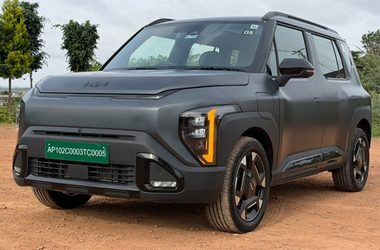
The Toyota Urban Cruiser Ebella is Toyota’s new Indian crossover SUV for 2026, and this is the first-generation model. It arrives at a time when the Indian electric SUV market is becoming more crowded, more competitive, and thankfully, more interesting than a WhatsApp family group debating petrol versus diesel.
The Ebella is sold in India as a Toyota, while Maruti Suzuki sells its version as the e Vitara. Both models are based on the same electric vehicle architecture and are assembled in Gujarat, from where the SUV is also exported to Malaysia, the Philippines and several other global markets. So yes, this is not just another “India-spec” EV. This is a global Toyota-Suzuki electric crossover with Indian manufacturing at its heart.
For now, the Toyota Urban Cruiser Ebella is available only in a single electric variant called E3, priced at ₹23.80 lakh ex-showroom. Toyota may introduce E1 and E2 variants in the future, which should make the range more accessible. There is also a Battery-as-a-Service price of ₹11 lakh, with a battery EMI of ₹3.99 per km. For buyers who like spreadsheets more than speedometers, Toyota is also offering a 60% assured buyback plan after three years.
The name Ebella comes from “bella”, which means beautiful. And that is a confident name because if you call your car beautiful, people will definitely inspect it from every angle.
Design: Urban Tech With Hammerhead Confidence
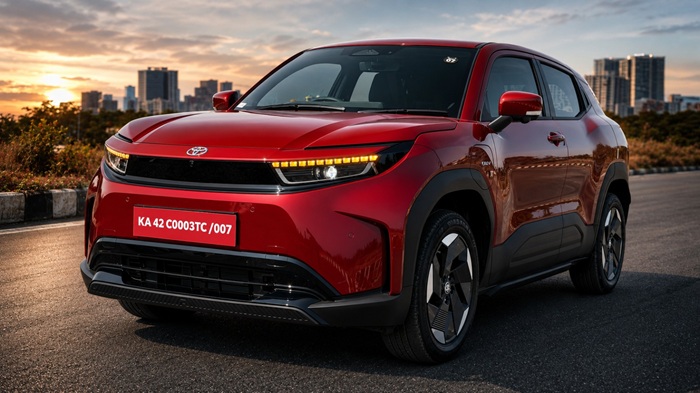
Toyota says the Ebella follows an Urban Tech design philosophy, with a hammerhead front design and 3D surfaces. In simple language, this means it does not look like a petrol SUV that was forcefully converted into an EV after a difficult board meeting. It looks properly electric, properly modern, and quite premium.
The front gets automatic LED headlamps with LED DRLs, welcome-home function, adaptive high beam and auto levelling. There are LED fog lamps as well, along with a smart grille that comes with adaptive shutters. These shutters help improve aerodynamics and thermal efficiency, because in an EV, even the grille has to do engineering homework.
The SUV has an aerodynamic silhouette, wheel arch extensions, black side moulding and a strong underbody cover. It also gets acoustic and infrared-cut windshield glass, rain-sensing wipers and electrically adjustable auto-fold outside mirrors with integrated turn indicators and cameras.
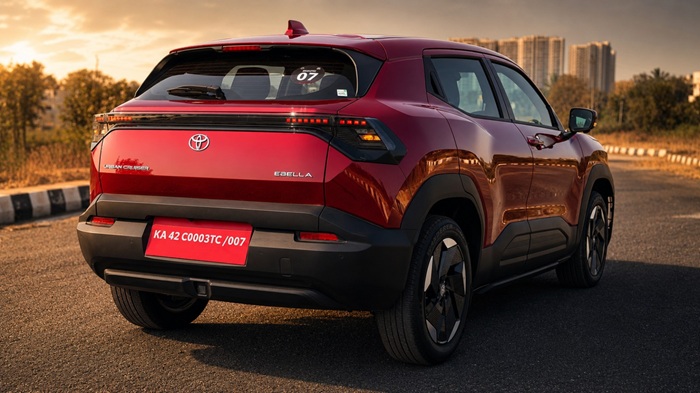
At the rear, the Ebella gets 3-point Matrix tail lamps, a rear wiper with washer, defogger and dark green glass for the doors. The lighting design gives it a sharp, tech-heavy appearance without looking like it is trying too hard to audition for a sci-fi movie.
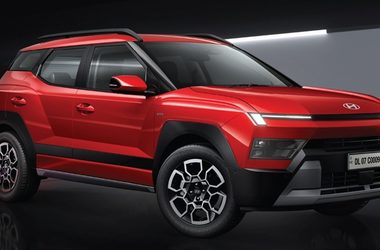
The model seen here is finished in Sportin’ Red. Other colour options include white, silver, grey, blue and green. In dual-tone form, Toyota offers a black roof option, which adds a sportier look and also helps the SUV appear a little more premium.
Dimensions And Road Presence
The Toyota Urban Cruiser Ebella measures 4.3 metres in length, 1.8 metres in width and 1.6 metres in height. It has a turning radius of 5.2 metres and a ground clearance of 180 mm, which is useful for Indian roads where surprise speed breakers often arrive without invitation.
The kerb weight is around 1,800 kg, while the gross vehicle weight is 2,250 kg. It can also tow up to 750 kg, which is a nice practical touch for an electric crossover. Not everyone will tow with it, but it is good to know the Ebella can pull more than just attention at traffic signals.
The SUV rides on 18-inch machine-cut alloy wheels. At the front and rear, it gets disc brakes, along with 225/55 R18 98V MRF Wanderer Ecotred steel-belted radial tubeless tyres. Toyota also provides an 18-inch alloy spare wheel, which is a welcome addition because full-size spare wheels are becoming rare enough to deserve their own fan club.
Platform: Built On A Proper EV Skateboard
The Toyota Urban Cruiser Ebella is based on the Heartect-electric vehicle skateboard platform. The same platform also underpins the Maruti Suzuki e Vitara. This EV-focused architecture has been designed to offer better structural integrity and a lower centre of gravity.
That lower centre of gravity matters because batteries are heavy, and placing them low in the floor helps improve stability. It also gives the cabin a flat floor, which makes the interior more spacious and easier to use. Unlike many electric cars that feel like modified versions of existing models, the Ebella feels more purpose-built.
The SUV is front-wheel drive in India. A dual-motor all-wheel-drive version is available internationally, but that model is not offered in India at the moment. For most Indian buyers, the front-wheel-drive layout should be more than adequate for city use, highway runs and the occasional road trip where Google Maps says “road” but the road says “best of luck.”
Battery, Motor And Performance
The Toyota Urban Cruiser Ebella E3 gets a 61 kWh BYD FinDreams lithium iron phosphate battery pack. This LFP battery is paired with a 3-phase AC permanent magnet synchronous electric motor.
The motor produces 171 horsepower and 193 Nm of torque. The Ebella can accelerate from 0 to 100 kmph in 8.7 seconds and has a top speed of 150 kmph. The claimed range is 543 km, which makes it a strong option for buyers who want an EV that does not ask for a charger every time you pass a café.
Toyota is also expected to introduce a 49 kWh battery pack model in the future. That version will make 142 horsepower and 189 Nm of torque, with a claimed range of 440 km. It should sit below the current E3 variant and may appeal to buyers who want a more affordable version of the Ebella.
The battery is IP67-rated for protection, which means it is designed to resist dust and water ingress. It can handle temperatures ranging from -30 degrees Celsius to 60 degrees Celsius. Toyota has also given it an advanced thermal management system using low-ion coolant, helping the battery maintain optimal performance in extreme conditions.
There is also battery thermal management preconditioning, which can heat or cool the battery to bring it to the ideal operating temperature. This is especially useful before fast charging or driving in extreme weather. In short, the Ebella’s battery has more climate control than some old apartments.
Toyota is offering an 8-year warranty on the battery, which should help reduce long-term ownership anxiety.
Charging: AC, DC And The Usual Waiting Game
The Ebella supports both AC and DC charging. With a 7.4 kW AC charger, it can charge up to 90% in around 9 hours. With an 11 kW AC charger, the same 90% charge can be achieved in about 5 hours and 30 minutes. Using a DC fast charger, it can charge up to 70% in around 45 minutes.
These numbers make the Ebella suitable for home charging as well as long-distance use, provided your route has reliable fast chargers. That last part is important because Indian EV ownership is not just about range; it is also about whether the charger you found on the app exists in real life and is not being used as a parking spot by a diesel SUV.
Driving Modes And Regeneration
The Toyota Urban Cruiser Ebella comes with three drive modes: Eco, Normal and Sport. Eco is for maximum efficiency, Normal is for daily driving, and Sport is for those moments when you remember that electric torque is instant and your passenger was not prepared.
There is also a Snow mode, designed to offer better traction and control on snow and slippery surfaces. While most Indian owners may never use it in daily life, it is still useful for those planning mountain drives or winter road trips.
The SUV gets Easy Operation Pedal technology, designed for one-pedal driving in traffic. This allows the driver to accelerate and decelerate mainly using the accelerator pedal, making city driving easier. There are also three levels of multi-level regenerative braking, allowing the driver to choose how aggressively the car recovers energy while slowing down.
Ride, Handling And Suspension
At the front, the Ebella uses MacPherson strut suspension, while the rear gets a multi-link setup. That is good news because a multi-link rear suspension generally improves ride comfort and handling balance, especially in a heavier electric SUV.
The low-mounted battery pack should help the Ebella feel planted at higher speeds. The front-wheel-drive layout keeps things simple and predictable, while the electric motor’s smooth power delivery should make it easy to drive in city conditions.
The 180 mm ground clearance gives it enough confidence for Indian roads, and the 5.2-metre turning radius should make it manageable in urban areas. It may not be a tiny hatchback in tight parking spots, but then again, it is not pretending to be one.
Safety: A Very Long List, Thankfully
The Toyota Urban Cruiser Ebella has received 4 stars from Euro NCAP and Australian NCAP, while Bharat NCAP has awarded it a full 5-star rating. That should make safety-conscious buyers sit up and pay attention.
Toyota has used a strong impact-absorbing body structure, with 60% high-tensile steel in the body. The SUV also gets an Acoustic Vehicle Alert System, or AVAS, which warns pedestrians at low speeds. This is important because EVs are extremely quiet, and pedestrians in India already have enough surprises to deal with.
The safety equipment list is extensive. It includes 7 airbags, ABS, EBD, brake assist, hill hold, electronic stability program, ISOFIX child seat mounts, child lock, seatbelt reminders, 3-point ELR seatbelts, and front seatbelts with pre-tensioners and force limiters.
It also gets a 360-degree camera, front and rear parking sensors, immobilizer, multi-collision braking, highline tyre pressure monitoring system, rear seat reminder, keyless entry, active cornering control, emergency stop signal and speed warning buzzer.
The Level 2 ADAS package includes automatic emergency braking, lane keep assist, lane departure prevention, vehicle sway warning, blind spot monitoring, lane change alert, rear cross-traffic alert and forward collision warning. In short, the Ebella watches the road, the lanes, the blind spots and possibly your driving habits with mild disappointment.
Toyota i-Connect: The Smartphone Becomes The Remote Control
The Toyota Urban Cruiser Ebella comes with Toyota i-Connect, allowing owners to access several car functions through a smartphone.
The connected features include geofence, time fence, valet alert, emergency alerts, calling, stolen vehicle tracking, tow-away tracking, trip planning, driving behaviour monitoring, vehicle location sharing and charging station details.
Owners can also use remote charging functions, door lock cancel, hazard light on/off, headlight off, AC on/off, scheduled AC operation, seat ventilation control, alarm, siren, immobilizer request, vehicle alerts, maintenance alerts, smartwatch connectivity and Alexa skill support.
This is the kind of feature list that makes the key fob look like it has taken early retirement.
Interior: Premium, Practical And Properly Modern
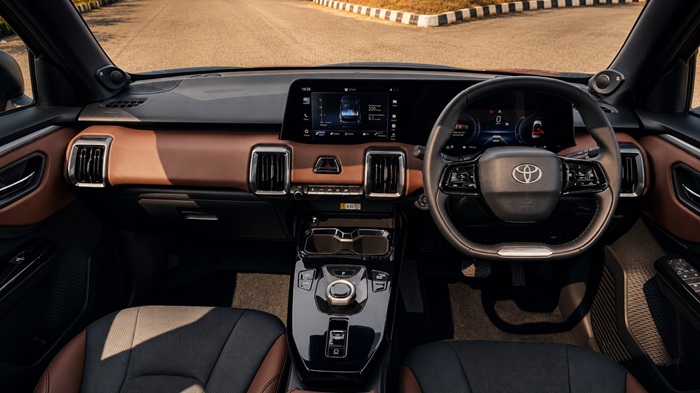
Inside, the Toyota Urban Cruiser Ebella gets a soft-touch dual-tone interior with a modern layout. There is a 3D pattern on the door trims, synthetic leather and fabric combination upholstery, ambient lighting, LED footwell lighting and LED reading lights.
The cabin gets a flat floor, which improves rear-seat comfort. The rear seats offer 10-step reclining, sliding adjustment and 40:20:40 split-folding functionality. This gives the Ebella a very practical cabin layout, especially for family buyers.
At the front, the driver gets a 10-way power-adjustable seat, while the front seats also offer ventilation. In Indian summers, ventilated seats are not a feature; they are a public service.
The steering wheel is a synthetic leather-wrapped 2-spoke Squircle unit. It comes with controls for the instrument cluster, volume and voice commands. The steering itself is tilt and telescopic adjustable and uses electric power assistance.
The centre console gets a piano black finish. It looks premium, though like most piano black surfaces, it will probably collect fingerprints faster than a crime investigation team.
Features And Infotainment
The Ebella gets a 10.1-inch touchscreen infotainment system with navigation, wireless Android Auto, Apple CarPlay, Toyota connected services, Playcast remote control app, voice assistant, Bluetooth, USB, FM and radio.
There is also a 10.25-inch TFT instrument cluster, giving the driver a modern digital display for speed, range, battery status and other driving information.
The SUV also offers adaptive cruise control, wireless charger, automatic climate control with PM 2.5 filter air purifier, quadruple vertical AC vents, a fixed glass sunroof, an LED-lit glovebox and an auto-dimming rear-view mirror.
Audio duties are handled by an 8-speaker JBL sound system with subwoofer and amplifier. That should make the Ebella a good place for music lovers, podcast listeners and people who test bass quality by playing the same song at every dealership.
All doors get auto up/down power windows, which is another small but premium touch.
Practicality And Boot Space
The Toyota Urban Cruiser Ebella offers 306 litres of boot space. With the rear seats folded, the space increases to 562 litres. That should be enough for daily luggage, airport runs and weekend trips.
The LED trunk lamp is useful at night, and the rear seat flexibility makes the Ebella more practical than its boot figure alone suggests. The 40:20:40 split rear seat is especially helpful when carrying passengers and longer items together.
Accessories
Toyota will offer several accessories for the Ebella. These include chrome garnish, side spoiler, alloy wheel cover, body side moulding, car cover, door visor, side step, carpet mat, scuff plate, sunshade, rear-view camera and more.
Some of these accessories will be useful, some will be cosmetic, and some will depend entirely on whether the owner believes chrome improves happiness.
Verdict: Beautiful Name, Serious Package
The Toyota Urban Cruiser Ebella is not just Toyota’s electric crossover for India; it is a globally relevant EV assembled in Gujarat and designed to compete in a fast-growing segment. It combines a proper EV skateboard platform, a large 61 kWh LFP battery, 543 km claimed range, Level 2 ADAS, strong safety credentials and a feature-loaded cabin.
At ₹23.80 lakh ex-showroom for the E3 variant, it sits in a premium space, but Toyota is clearly targeting buyers who want reliability, technology, safety and long-term ownership confidence. The future 49 kWh version should make the Ebella more accessible, while the possible E1 and E2 variants could widen its appeal further.
The Ebella’s biggest strengths are its range, safety features, connected tech, cabin practicality and Toyota’s brand trust. Its limitations are also clear: for now, India gets only the front-wheel-drive version, and the lower variants are yet to arrive.
Still, as a first-generation electric SUV, the Urban Cruiser Ebella feels like a serious product. It is stylish without being strange, practical without being boring, and tech-loaded without feeling like it was designed only for software engineers.
Toyota calls it Ebella because “bella” means beautiful. But beyond the name, what makes it interesting is that this beauty also comes with 171 horsepower, a 543 km claimed range, a 5-star Bharat NCAP rating and enough connected features to make your smartphone feel important.
In short, the Toyota Urban Cruiser Ebella is Toyota’s quiet but confident entry into India’s electric SUV future. And unlike many EVs that only talk about tomorrow, this one looks ready for Indian roads today.