
Gurugram: Hyundai Motor India Limited (HMIL) is targeting cumulative sales of 1 million connected cars by 2027 after surpassing 0.8 million connected vehicle sales in India, as the automaker expands the use of software, artificial intelligence and over-the-air technology across its passenger vehicle portfolio.
Connected vehicle penetration across HMIL’s portfolio has risen from 4% in 2019, when Hyundai Bluelink was introduced in India, to 20% in 2026. The company said it now plans to build on that momentum and cross 2 million cumulative connected car sales by 2030.
Hyundai’s connected car ecosystem is powered by around 1.2 million lines of code and forms part of the company’s broader push towards Software Defined Vehicles, or SDVs, where functions and features can increasingly be enhanced through software rather than requiring major hardware changes.
Bluelink, Hyundai’s AI-powered connected car platform, currently offers customers more than 70 features spanning safety, security and convenience. These include remote vehicle monitoring, vehicle health diagnostics, location tracking, trip history, remote commands, Digital Key, Digital Passport, Remote Immobilizer and Home-to-Car Connectivity.
The system also supports in-car payments through Hyundai Pay and more than 450 AI-powered voice commands across five languages.
Tarun Garg, MD & CEO, HMIL, said, “The growing adoption of connected vehicles reflects the evolving expectations of customers and the increasing role of technology in shaping mobility. As we move towards our goal of 1 million connected car sales by 2027, we remain focused on advancing software-defined mobility and expanding connected technologies across our portfolio. Our upcoming mass-market electric SUV, which will offer next-generation connected car technology as standard across all variants, marks an important step in strengthening the convergence of connected and electric mobility while delivering future-ready ownership experiences for customers.”
The announcement also provides a glimpse into Hyundai’s plans for its upcoming mass-market electric SUV, which the company said will offer next-generation connected car technology as standard across all variants.
From Venue to software-defined vehicles
Hyundai’s connected mobility push in India began in 2019 with the launch of the Hyundai VENUE, which the company describes as India’s first OEM-fitted connected SUV.
The automaker followed this with over-the-air map updates on the Hyundai i20 in 2020 and introduced next-generation AVNT — Audio Video Navigation Telematics — connected technology in 2022.
In 2025, Hyundai introduced its Connected Car Navigation Cockpit, or ccNC, with Controller OTA update capability. The technology represented a further step in the company’s Software Defined Vehicle roadmap in India, enabling vehicle systems to receive software enhancements remotely.
The idea is increasingly familiar in the smartphone era: instead of a vehicle’s technology remaining frozen on the day it leaves the showroom, selected functions can continue evolving through software updates. Cars, it seems, are acquiring another distinctly digital habit — the occasional update notification.
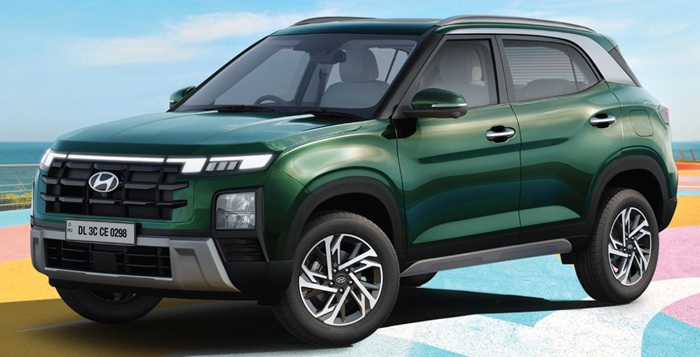
HMIL said customer demand for connected technology has been particularly strong across models including the CRETA, VENUE and i20.
Connected technology increasingly tied to safety
Beyond remote controls and convenience functions, Hyundai said Bluelink has assisted more than 0.5 million motorists through SOS and roadside assistance services.
The system has also supported around 15,000 crash notification interventions and aided law-enforcement agencies in vehicle tracing and recovery efforts, according to the company.
Other connected functions include Driving Score and Digital Passport, which are designed to provide customers with personalised information related to driving behaviour and vehicle maintenance.
The growing adoption of connected cars reflects a broader change in what Indian buyers increasingly expect from their vehicles. Features once associated mainly with infotainment are expanding into areas such as security, payments, diagnostics, emergency response and vehicle management.
For Hyundai Motor India, reaching the 1 million connected-car mark will therefore represent more than a sales milestone. It will also measure how quickly software is becoming as important to the modern car ownership experience as engines, gearboxes and increasingly, electric powertrains.