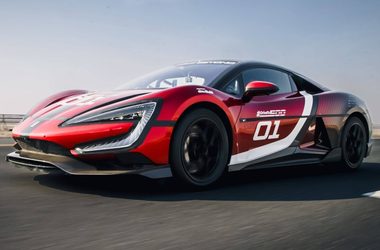
Abu Dhabi: Chinese automotive giant BYD has pushed the boundaries of electric vehicle performance after its luxury brand Yangwang achieved a top speed of 503.17 km/h with the U9 Xtreme hypercar in Abu Dhabi, setting two Guinness World Records and surpassing the 500 km/h milestone for a production car.
The record-breaking attempt took place on November 1, 2026, along Sheikh Khalifa Bin Zayed International Road (E11) in Abu Dhabi’s Al Dhafra Region. German racing driver Marc Basseng piloted the all-electric hypercar, exceeding the previous benchmark of 496.22 km/h established by the same vehicle in Germany in September 2025.
The achievement earned the 3,019 PS Yangwang U9 Xtreme two Guinness World Records: Highest Speed Achieved by a Production Car in a Single-Direction Run and Highest Speed Achieved by an Electric Production Car in a Single-Direction Run. According to BYD, the result has also received recognition from the Fédération Internationale de l’Automobile (FIA), motorsport’s international governing body.
The distinction is important because the records specifically recognise single-direction runs rather than the two-way average speeds sometimes used in automotive top-speed comparisons.
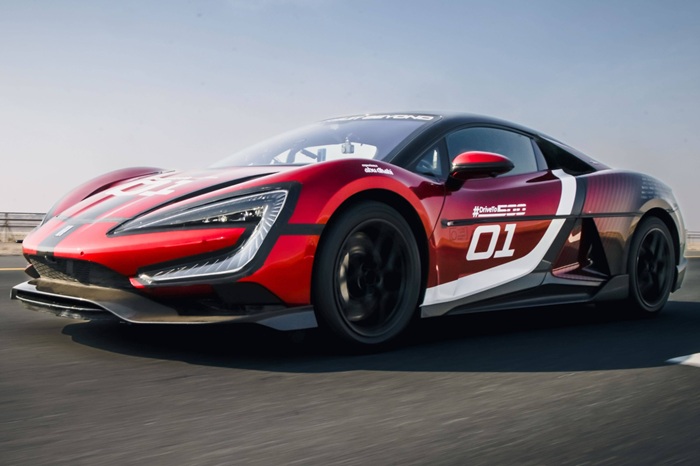
From Germany to Abu Dhabi: Breaking the 500 km/h Barrier
The record represents another milestone in a remarkably short development journey for Yangwang, which began work on the U9 project approximately three years ago.
In January 2024, the standard U9 reached 309 km/h at Wuhan Hannan Airport in China. By October that year, it had achieved 391.94 km/h at Germany’s ATP Papenburg proving ground.
Development accelerated in 2025 with the arrival of the U9 Xtreme, which recorded 472.41 km/h in August before reaching 496.22 km/h the following month.
Returning to attempt an even higher speed in Abu Dhabi presented a different set of challenges.
Unlike a dedicated proving ground, the record venue was an everyday public road temporarily closed for the attempt. Authorities provided approximately 10 kilometres of road, including a seven-kilometre straight suitable for top-speed runs.
The preparation was extensive. Crews swept the road surface to remove debris, while engineers examined the route for tiny wire particles left behind by cleaning equipment that could potentially damage the vehicle’s Giti tyres.
At speeds approaching 500 km/h, even the smallest road imperfection becomes a matter of considerable importance.
Two runs on October 31 produced a maximum speed of 490 km/h, prompting engineers to spend the night refining the vehicle’s setup.
Their adjustments included optimising battery and motor temperatures, increasing rear-axle downforce through changes to the rear-wing angle, modifying suspension rebound damping and fine-tuning tyre pressures.
Two additional runs followed on November 1. The first demonstrated improvements in stability and performance, while the second delivered the new record of 503.17 km/h.
Marc Basseng, who also drove the U9 Xtreme during its previous record-setting attempt in Germany, described the challenges of achieving such speeds on a public road.
“Breaking a world record once is extraordinary but doing it again in such a different environment is truly special.”
3,019 PS, Four Electric Motors and a 1,200V Architecture
Behind the Yangwang U9 Xtreme’s performance is a substantially reworked electric powertrain featuring four independently controlled motors.
While the standard Yangwang U9 develops 1,287 PS, the Xtreme increases combined output to 3,019 PS, with each motor capable of producing approximately 755 PS (555 kW).
The motors can operate at speeds of up to 30,000 rpm, enabled by specialised materials including 0.1 mm super-silicon steel stator laminations, 970 MPa ultra-high-strength silicon steel in the rotors and aerospace-grade aluminium motor housings.
According to BYD, the hypercar achieves a power-to-weight ratio of 1,217 PS per tonne.
The U9 Xtreme also employs the company’s e4 Platform, featuring independent torque vectoring that adjusts the power delivered to individual wheels more than 100 times per second.
This technology allows the vehicle to continuously respond to changing traction conditions, an essential capability when managing extraordinary power outputs at extreme speeds.
Another important development is the transition from the standard U9’s 800V electrical architecture to a 1,200V ultra-high-voltage platform, supporting currents of up to 1,000A.
BYD claims the higher-voltage system can reduce heat generation by up to 67% compared with an 800V system operating at the same power output.
Blade Battery Technology Delivers Extreme Discharge Performance
Despite its extraordinary performance requirements, the U9 Xtreme continues to use BYD’s lithium iron phosphate (LFP) Blade Battery technology.
The battery system has been substantially upgraded to support a maximum discharge rate of 30C, which theoretically corresponds to discharging its rated capacity in approximately two minutes.
BYD says the battery’s single-cell power density has increased by 170% compared with the 800V system referenced by the company.
Even at a 20% state of charge, the battery can reportedly support a power output of 1,800 kW.
Energy recuperation is equally substantial, with peak regenerative braking exceeding 700 kW, reducing reliance on the mechanical brakes during demanding driving conditions.
These figures illustrate the considerable thermal-management and electrical-engineering challenges involved in maintaining performance beyond 500 km/h.
Intelligent Suspension and Specially Developed Giti Tyres
The U9 Xtreme’s DiSus-X Intelligent Body Control System works alongside its four-motor powertrain to maintain stability during acceleration, braking and high-speed cornering.
Using dual-valve electronic dampers, the system can deliver up to 50 kN of active force within 120 milliseconds.
It also allows the vehicle to counteract body roll and potentially lean into corners by up to 2.43 degrees at 0.3g, according to the manufacturer.
Yangwang collaborated with Giti Tire to develop specialised track-focused semi-slick tyres capable of coping with the enormous forces generated during extreme-speed driving.
The tyres feature bespoke compounds and tread designs, while treatments at the wheel-rim interface are intended to minimise tyre movement relative to the rim during acceleration and braking.
The result is a package engineered not merely to achieve maximum speed, but to maintain stability and predictable handling while doing so.
Nürburgring Lap Record Adds Another Achievement
Straight-line performance is not the U9 Xtreme’s only claim to fame.
The electric hypercar has also recorded a Nürburgring Nordschleife lap time of 6 minutes 59.157 seconds, which BYD identifies as the production electric vehicle lap record.
According to the company, the vehicle that achieved the Nürburgring benchmark used the same specification as the car responsible for the Abu Dhabi top-speed record.
The combination illustrates how developments in motor control, suspension management and aerodynamics can contribute to both maximum speed and circuit performance.
Only 30 Yangwang U9 Xtreme Hypercars Will Be Built
Despite its engineering achievements, the Yangwang U9 Xtreme will remain an exceptionally rare sight.
BYD has confirmed that production will be limited to just 30 units worldwide, with individual vehicles tailored to their owners’ preferences.
The first production-standard example, named Dawn Moment, was unveiled at the 2026 Beijing Auto Show.
Its exterior finish incorporates micron-scale gold powder beneath multiple layers of clear coat, creating shifting reflections inspired by morning sunlight. Matte-gold sections also incorporate finishing techniques drawn from traditional Chinese lacquer craftsmanship.
According to Yangwang, several customers have already approved their bespoke configurations and are progressing towards contract signing and production scheduling.
Electric Hypercars Enter a New Era
Commenting on the achievement, BYD Executive Vice-president Stella Li praised the engineering team responsible for developing the U9 Xtreme.
“I always tell people that our engineers are young, bold and maybe a little crazy – but in a good way!”
The record also highlights the expanding ambitions of Chinese manufacturers in the global high-performance automotive industry, where established European brands have traditionally dominated discussions around the world’s fastest production cars.
For decades, maximum-speed records were largely a contest involving increasingly powerful combustion engines, advanced aerodynamics and specialised tyres. The Yangwang U9 Xtreme demonstrates that electric powertrains are now capable of competing at the very highest levels of automotive performance.
Beyond the headline-grabbing 503.17 km/h figure, the more significant development may be the technologies required to achieve it: high-output batteries, ultra-high-voltage electrical systems, sophisticated torque vectoring and intelligent chassis control.
Whether these innovations eventually find their way into more accessible electric vehicles remains to be seen. For now, the Yangwang U9 Xtreme has established a new single-direction production-car speed benchmark, demonstrating just how far electric vehicle engineering has progressed in a remarkably short period.