There are broadly two ways to build a modern midsize SUV. You can fill it with enormous screens, enough ambient lighting to illuminate a small wedding venue and a feature list that requires its own table of contents. Or you can concentrate on getting the fundamentals right: a good driving position, sensible proportions, strong engines, a sorted chassis and controls that behave as though engineers rather than social-media algorithms had the final say.
The Volkswagen Taigun has always leaned towards the latter philosophy.
Launched in India in 2021, the Taigun is now five years old, and what you see here is the first-generation model after its substantial 2026 facelift. This is not an all-new SUV pretending its predecessor never existed. Instead, Volkswagen has refreshed the styling, expanded the equipment, introduced useful technology and revised parts of the powertrain range while retaining the underlying character that made the original Taigun interesting in the first place.
And this particular Taigun is the one enthusiasts are most likely to stop and inspect: the flagship GT Plus Sport with the 1.5-litre TSI EVO engine and seven-speed DSG. At ₹19.29 lakh ex-showroom, it sits at the top of a range that begins at roughly ₹11 lakh, which means it is no longer playing the affordable-European-SUV card. At nearly ₹20 lakh before taxes, insurance and the inevitable accessories conversation at the dealership, it needs to be genuinely good.
Fortunately, there is rather more substance here than an illuminated badge and some red brake callipers.
A German SUV with a thoroughly Indian passport
The Taigun is an important Volkswagen because, despite the badge on its nose, this is very much an Indian-market product. It was designed and developed for India and is assembled at Chakan near Pune. Beneath it sits Volkswagen Group’s MQB-A0-IN architecture, the localised platform that also underpins the Volkswagen Virtus, Škoda Kushaq, Slavia and Kylaq.
That localisation is significant. The Taigun was not simply shipped into India from Europe and expected to understand potholes, monsoons, giant speed breakers and the peculiar urban ballet involving autos, cows, motorcycles and delivery riders. Its basic architecture was engineered around regional requirements while retaining Volkswagen’s familiar engineering philosophy.
Its name has history, too. Taigun first appeared on Volkswagen’s compact crossover concept shown in 2012. The production Indian SUV inherited that name almost a decade later. Closely related models and derivatives are associated with Volkswagen’s wider T-Cross/Tacqua family in international markets, while the India-built Taigun itself is exported to countries including Mexico and Indonesia.
Volkswagen describes its design thinking around ideas including stability, likeability and what it somewhat mysteriously calls the “secret sauce”. The Germans discussing secret sauce sounds a little like an accountant reviewing salsa recipes, but the underlying point is clear: Volkswagen wants the Taigun to look recognisably modern without becoming visually exhausting.
The facelift has learned a few lighting tricks
That restrained philosophy remains apparent even after the facelift, although Volkswagen has clearly realised that illuminated logos are now part of the SUV arms race.
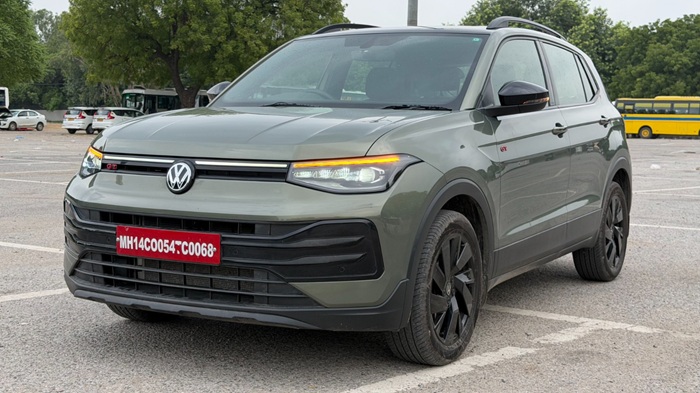
The revised nose receives full-LED automatic headlamps with LED daytime-running lights, auto levelling, coming-home and leaving-home functions and static cornering lights. A full-width front light band visually connects the lamps, while the Volkswagen badge itself now illuminates. The lower bumper incorporates a glossy black strip and darker detailing, and on this GT Plus Sport there is an appropriately positioned GT badge.
It is more theatrical than the original Taigun, certainly, but still recognisably Volkswagen. There are no grille openings large enough to consume neighbouring hatchbacks, no random geometric textures and no front bumper apparently inspired by a gaming laptop.
The bonnet remains nicely defined rather than over-sculpted, while the sharp dual shoulder lines along the body give the Taigun much of its visual tension. Rain-sensing wipers, infrared-cut glass, functional roof rails and electrically adjustable and folding mirrors with integrated LED indicators handle the practical details. Dark side cladding provides the necessary SUV visual toughness without making it look like half the car has been dipped in unpainted plastic.
Our car’s Avocado Pearl green paint works especially well with the Sport treatment because it provides some personality against the black detailing. Volkswagen offers nine colours on the updated Taigun, encompassing red, black, white, grey, blue, silver and darker or matte-style finishes alongside the green seen here.
Then there are the wheels. The GT Plus Sport gets 17-inch black-painted Plus alloys wrapped in 205/55 R17 91H CEAT SecuraDrive radial tubeless tyres. Lower versions are available with 16-inch alloys or steel wheels. Behind the black rims sit red brake callipers, and on the 1.5-litre facelift Volkswagen now uses disc brakes at both ends—a worthwhile mechanical upgrade rather than purely decorative red paint.
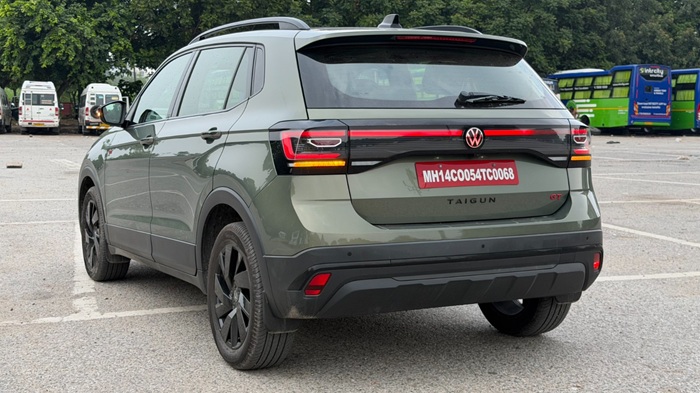
Around the rear, the facelift repeats the lighting theatre with an Infinity LED tail-lamp arrangement, sequential indicators, welcome and goodbye animations and another illuminated VW logo. There is a rear fog lamp, washer-wiper and defogger, while the black lower diffuser gives the GT Plus Sport a broader, sportier stance.
It is still fundamentally a conservative shape. But conservative is not necessarily a criticism. Five years into its life, the Taigun hasn’t suddenly started dressing like it is trying to get into a nightclub.
Compact dimensions remain one of its strengths
At 4,221 mm long, 1,760 mm wide and 1,612 mm tall, with a 2,651 mm wheelbase, the Taigun remains one of the more compact members of the midsize-SUV class. Volkswagen quotes 188 mm of unladen ground clearance, enough to deal with most Indian road obstacles without turning the car into something you need mountaineering equipment to enter.
The supplied specification places kerb weight at roughly 1.3 tonnes and gross weight at 1,700 kg. A turning circle of around five metres also matters far more in day-to-day Indian use than another decorative drive mode. In narrow streets and basement car parks, centimetres suddenly become very valuable things.
Boot capacity is 385 litres with the rear seats upright, expanding to 1,405 litres when the 60:40 split rear bench is folded. There is a 50-litre fuel tank and seating for five.
In other words, the Taigun occupies a useful middle ground. It gives you the seating position and practicality buyers expect from an SUV without becoming so enormous that every U-turn requires negotiations with municipal authorities.
Inside: familiar Volkswagen logic, now with more toys
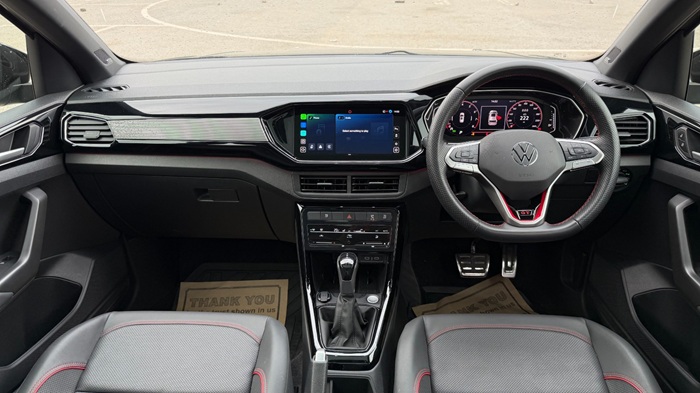
Open the door and the GT Plus Sport establishes its character immediately. Black leatherette upholstery with red stitching gives the cabin a sportier atmosphere without turning it into a red-and-black gaming chair. Other versions offer grey and fabric upholstery, but the darker GT treatment suits the car.
Volkswagen’s basic dashboard architecture remains straightforward. The dashboard uses a high-quality, scratch-resistant surface, while laser-red ambient lighting and footwell illumination add some evening drama. Fit, layout and ergonomics remain more important here than visual gymnastics.
The electrically adjustable front seats are also ventilated, and the driver’s seat includes height adjustment. The driving position is upright enough for SUV buyers without making you feel as though you are operating agricultural machinery. Aluminium pedals add a small GT flourish.
The steering is electromechanically power-assisted and controlled through a multifunction wheel carrying audio, cruise, instrument-cluster and voice functions. Ahead of it sits a 10.25-inch configurable digital cockpit capable of displaying navigation and vehicle information. Lower versions use an 8-inch cluster.
In the centre is Volkswagen’s roughly 10.1-inch Play touchscreen infotainment system. It supports Bluetooth, FM radio, wireless Android Auto and Apple CarPlay, voice commands through the “Hello Volkswagen” assistant, USB connectivity and connected applications.
And Volkswagen has not stopped there. Depending on connected-service availability, the system offers access to services including YouTube, Amazon Music, Spotify, Gaana, BBC News, Indian Express content, Sygic navigation, Booking.com, audiobooks and even the Vivaldi browser.
Whether anyone has ever sat in traffic and thought, “What this situation really needs is a web browser,” remains unclear, but the capability exists.
Lower variants receive a 7-inch infotainment screen.
There is wireless phone charging, Smart Touch Climatronic climate control, a cooled glovebox and an auto-dimming inside mirror. The panoramic electric sunroof receives a summer function, while the audio system comprises six speakers assisted by an amplifier and subwoofer.
The front windows include a one-touch function on the driver’s side with pinch protection, and even small details such as LED reading lights and door reflector markings have been attended to.
Rear-seat usefulness benefits from that 2,651 mm wheelbase, though this remains a relatively narrow SUV by class standards rather than something designed around three full-sized adults occupying the second row permanently. The 60:40 folding backrest adds flexibility when carrying luggage.
Independent contemporary road tests have also noted that the Taigun’s rear-seat experience is not quite as generous as some newer rivals. That is one of the consequences of its compact exterior: physics remains stubbornly unimpressed by infotainment updates.
Connected, but not obsessed with connectivity
MyVolkswagen Connect Plus allows several vehicle functions and information streams to be accessed through a smartphone. These include live tracking, geofencing, time fencing, driving-behaviour data, safety alerts, trip analysis, document-expiry reminders and emergency-call functionality.
These are the sort of connected features that can genuinely be useful rather than merely existing so somebody can mention the word “digital ecosystem” during a product presentation.
Parents can monitor where the car has travelled, owners can check journey information, and reminders help prevent the traditional moment when you discover an important document expired three weeks ago.
But the Taigun is not technologically complete simply because the app does clever things. Rivals have moved aggressively on features, and independent evaluations of the facelift point out the absence of ADAS, a 360-degree camera and rear sunblinds. The reversing camera is also relatively basic by current class standards.
That becomes relevant at ₹19.29 lakh. At this price, buyers increasingly expect the specification sheet to arrive carrying heavy artillery.
The engine that gives the GT badge some meaning
Fortunately, the best reason to choose the GT Plus Sport sits under the bonnet.
It uses Volkswagen’s 1,498 cc four-cylinder TSI EVO direct-injection turbo-petrol engine with Active Cylinder Technology. Volkswagen rates it at 150 PS—approximately 147-148 hp—and 250 Nm of torque. Drive goes to the front wheels through a seven-speed DSG dual-clutch automatic transmission.
Active Cylinder Technology can deactivate cylinders under suitable light-load conditions to reduce fuel consumption. It is a pleasingly engineering-led solution: when you do not need all four cylinders, some of them effectively clock out early.
The alternative engine is Volkswagen’s 1.0-litre three-cylinder TSI turbo-petrol, producing about 115 PS/114 hp and 178 Nm. It can be paired with a six-speed manual or, on the facelift, Volkswagen’s new eight-speed AQ300 torque-converter automatic.
That eight-speed is itself one of the biggest changes introduced with the facelift, replacing the earlier six-speed automatic on the smaller engine. But the flagship 1.5 stays with the quicker seven-speed DSG, exactly as a GT should.
There is no diesel, strong hybrid or all-wheel-drive version. The Taigun is unapologetically petrol and front-wheel drive.
And this is where the Taigun earns its reputation
The 250 Nm matters more on the road than the horsepower headline.
It gives the 1.5 TSI the sort of mid-range authority that suits Indian highway driving: the ability to build speed without requiring an elaborate committee meeting between throttle pedal and gearbox. That matters when overtaking, joining faster traffic or simply enjoying an empty stretch of road.
The DSG is central to the experience. Dual-clutch gearboxes work particularly well with turbocharged engines when properly calibrated because the next ratio can be prepared before it is required. Under acceleration, the effect is a powertrain that feels eager and mechanically alert rather than merely adequate.
Volkswagen has not supplied a 0–100 km/h or top-speed figure in the material provided for this review, so we will resist the automotive internet’s favourite sport of inventing numbers until somebody believes them.
What matters more is that the mechanical specification gives the GT Plus Sport a distinctly more serious character than the basic 1.0-litre versions. The three-cylinder engine is perfectly relevant for daily use; the four-cylinder 1.5 exists for buyers who occasionally take the longer route home simply because the road is better.
And because Active Cylinder Technology can shut down part of the engine under lighter loads, the larger engine is not constantly behaving like a petrol station’s preferred customer.
Ride and handling: slightly firm, decidedly confident
Underneath, the Taigun uses MacPherson struts with a stabiliser bar at the front and a twist-beam rear axle. That sounds ordinary because it is ordinary. Expensive suspension diagrams do not automatically create good cars; tuning does.
The Taigun’s chassis has consistently been one of its strongest qualities. Contemporary tests of the 2026 facelift describe a taut, predictable setup with excellent high-speed stability. At highway speeds it settles into a planted rhythm, while body control is strong enough to make winding roads considerably more interesting than they need to be in a family SUV.
The electrically assisted steering is light and direct, which works particularly well around town. With a turning circle around five metres and relatively compact body dimensions, the Taigun is less intimidating in crowded streets than many newer SUVs that appear to have expanded after being left overnight in water.
There is a compromise.
The suspension is firmer at low speeds than those of some rivals, and sharp bumps or broken surfaces can make themselves known inside the cabin. Independent tests of the facelift repeatedly note that the very chassis discipline that gives the Taigun its strong highway manners also results in a more noticeable low-speed ride over poor roads.
That trade-off will matter differently to different buyers. If your priorities begin and end with pillowy urban comfort, alternatives may suit you better. If you value body control, predictable handling and high-speed composure, the Volkswagen’s priorities suddenly make much more sense.
The steering could also use more weight as speeds rise. It is accurate, but enthusiasts may wish Volkswagen had allowed a little more resistance and feedback into the wheel when the road becomes interesting.
Grip from the 205-section CEAT SecuraDrive tyres is adequate for everyday use, although enthusiastic drivers may eventually regard tyres as one of the first areas worth examining. Braking on the 1.5 is handled by discs at all four corners, with ABS and electronic assistance backing them up.
Efficiency: respectable numbers, but physics still sends invoices
The supplied material quotes approximately 18 km/l for the 1.5 TSI and around 19 km/l for the 1.0 TSI. Volkswagen’s current technical specification lists the 1.5 DSG at 19.01 km/l and some 1.0 versions at close to 20 km/l under certified testing conditions, depending on transmission.
Those are claimed figures, not promises from the universe.
Actual consumption will naturally depend on traffic, temperature, driving style, load and how enthusiastically the turbocharger is being encouraged. The 50-litre tank at least provides useful touring capacity, and ACT gives the 1.5-litre engine a clever efficiency tool when full performance is unnecessary.
The broader point is that buyers do not choose a 1.5 TSI DSG because their sole ambition is to win neighbourhood fuel-economy competitions. It attempts to balance respectable efficiency with useful performance, which is a much more sensible target.
Safety remains central to the Taigun story
The Taigun has earned five-star safety results in both Global NCAP and Latin NCAP testing according to the supplied material, an important part of its reputation. The facelift’s safety equipment includes six airbags, ABS, EBD, electronic stability control, traction-related anti-slip regulation, multi-collision braking, brake assist and brake-disc wiping.
There is also an electronic differential-lock function, hill-start assist, tyre-pressure warning, a floating-code engine immobiliser, speed alerts, front and rear parking sensors, a reversing camera, ISOFIX child-seat anchorages, remote central locking and three-point seatbelts.
That is a substantial passive and active safety foundation.
Where it loses ground in 2026 is advanced assistance technology. Several rivals now offer ADAS suites and surround-view cameras, while the Taigun does without both. Whether that matters depends on the buyer; some drivers actively prefer a car without a digital supervisor chiming every time it sees a lane marking, while others increasingly regard these systems as expected equipment at this price.
Ownership is more comprehensive than it used to be
Volkswagen backs the Taigun with a four-year/1,00,000 km standard warranty, extendable to seven years/1,50,000 km. Four years of roadside assistance and three complimentary services are also included according to the supplied ownership package.
There is another particularly interesting proposition: a 75 per cent assured buyback programme after three years and up to 30,000 km, subject to the applicable conditions. Volkswagen officially introduced the programme with the facelift, offering residual value of up to 75 per cent of the original ex-showroom price.
That matters because ownership confidence has historically been as important to Indian buyers as horsepower or touchscreen size. Predictable resale value can make an expensive top-spec variant easier to justify than the sticker price alone suggests.
The competition is now brutal
The Taigun exists in perhaps the most aggressively contested part of the Indian car market.
The Hyundai Creta and Kia Seltos offer broader powertrain choices and lavish equipment lists. The Tata Sierra and Renault Duster bring newer propositions into the segment, while the Honda Elevate takes a simpler naturally aspirated approach. Maruti and Toyota alternatives offer strong-hybrid options, while the Škoda Kushaq remains the Taigun’s closest relative, sharing its MQB-A0-IN foundations and turbo-petrol philosophy.
This is where the Volkswagen’s weaknesses become clearer.
It has no diesel. No strong hybrid. No AWD. No ADAS. No 360-degree camera. Its rear seat is not the most spacious in the class, and its low-speed ride is not the softest. A buyer comparing purely by the number of features obtained for each rupee may therefore struggle to place the GT Plus Sport at the top of the spreadsheet.
But spreadsheets are poor at describing chassis balance, gearbox response or the reassuring way a car settles at speed.
The Taigun’s appeal remains more mechanical than numerical.
Verdict
The 2026 facelift has not transformed the Volkswagen Taigun into something fundamentally different, and that is probably the correct decision.
It still feels like a compact, intelligently sized SUV built around strong fundamentals rather than one designed exclusively to win showroom comparisons. The facelift improves its visual presence with connected lighting and illuminated VW badges, modernises the cabin with electric and ventilated seats, a panoramic sunroof, digital instruments and richer connectivity, and gives the range useful mechanical upgrades.
The GT Plus Sport then adds the ingredient that makes the Taigun genuinely interesting: the 1.5-litre TSI EVO paired with the seven-speed DSG.
Its 250 Nm gives the car the muscular mid-range expected of a proper turbo-petrol, the DSG lends the powertrain urgency, and the chassis remains composed enough to remind you that an SUV need not surrender every last trace of driver involvement simply because it has roof rails.
It is not perfect. The low-speed ride can feel firm, the steering deserves more weight on a fast road, rear accommodation is merely good rather than exceptional, and at ₹19.29 lakh the absence of ADAS and a 360-degree camera is increasingly difficult to ignore. Rivals can offer more equipment, alternative fuels, hybrid technology, diesels or greater outright space.
So who should buy it?
Someone who wants the feature catalogue to be the longest in the neighbourhood probably should not. Nor should the buyer whose commute demands the softest possible suspension or whose running pattern makes diesel or strong-hybrid efficiency essential.
But if you want a petrol midsize SUV that is compact enough for Indian cities, fast enough to make highway overtakes enjoyable, sophisticated enough for family duty, well equipped without becoming a rolling electronics exhibition and capable enough through corners to make you notice the road rather than merely the destination, the GT Plus Sport remains a compelling proposition.
Five years after the original Taigun arrived, Volkswagen has resisted the temptation to reinvent it.
Instead, it has polished the design, added technology, improved the equipment and left the important bits—the turbo engine, DSG and fundamentally well-judged chassis—very much alive.
In today’s SUV market, where almost every new car wants to impress you before you have even pressed the starter button, the Taigun’s best trick is refreshingly old-fashioned.
It gets better once you actually start driving.