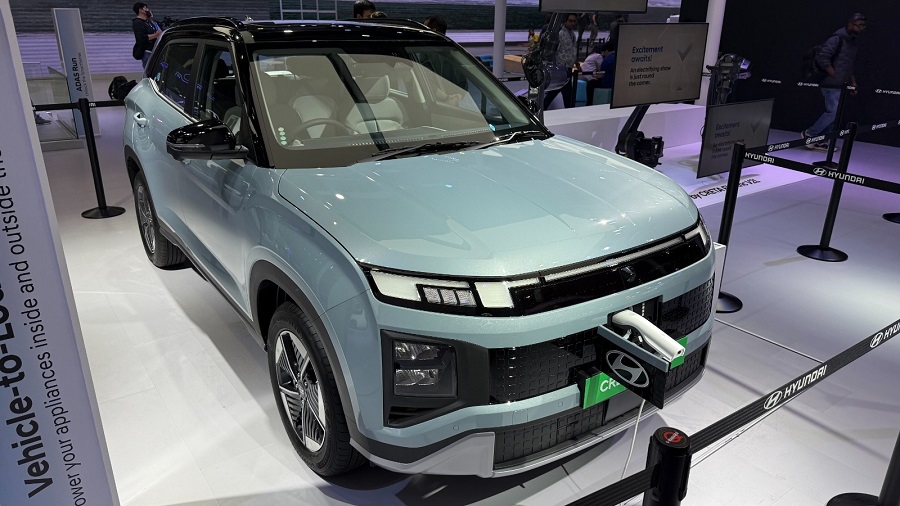
Gurugram: Hyundai Motor India Limited has integrated access to more than 30,000 electric-vehicle charging points across the country into its myHyundai mobile application, creating one of India’s largest charging networks available through a single digital platform.
The network, developed through partnerships with multiple charge point operators and service providers, is open to electric vehicles from all manufacturers—not only Hyundai models.
Users can locate charging stations, navigate to them, book charging slots in advance and make digital payments through the app. Hyundai said the integrated network provides access to charging facilities within an average radius of about 25 kilometres across India.
The company is also expanding its own fast-charging infrastructure. Hyundai currently operates 183 DC fast-charging stations across 105 cities and plans to increase the network to 600 stations by 2030.
The new chargers will be installed at major cities, highways and Hyundai dealerships. Its current charging systems offer capacities ranging from 60 kW to 240 kW, allowing compatible electric vehicles to recharge more quickly than through conventional charging equipment.
Commenting on the development, Tarun Garg, Managing Director and Chief Executive Officer of Hyundai Motor India Limited, said, “With charging infrastructure being a key catalyst for EV adoption in India, HMIL is committed to creating an ecosystem that makes electric mobility practical, convenient and accessible to all. Through the integration of over 30,000 charging points on the myHyundai app, we are empowering EV users with one of India’s largest charging networks accessible through a single platform. Importantly, the platform is open to EV owners across brands, reinforcing HMIL’s commitment to developing India’s broader EV ecosystem. HMIL will more than triple its proprietary DC fast public charging network from 183 stations today to 600 stations by 2030, bringing India’s charging infrastructure closer to global benchmarks.”
Charging Access Along Major Highways
The charging network available through the myHyundai app covers several important intercity routes, including Delhi-Gurgaon-Jaipur, Mumbai-Pune-Bengaluru, Mumbai-Ratnagiri-Goa, Chennai-Vellore-Bengaluru and Hyderabad-Kurnool-Bengaluru.
Hyundai said many of its charging stations are located near restaurants, food outlets and other amenities in cities and along highways. That allows drivers to take a break while their vehicles recharge—turning charging stops into something closer to a meal break than a roadside waiting exercise.
The company said the wider network could support long-distance electric-vehicle travel from Kashmir to Kanyakumari, although charger availability, charging speed and compatibility may vary by location and vehicle.
Three Lakh Users Access Hyundai Charging Services
Between January 2023 and June 2026, more than three lakh electric-vehicle users accessed Hyundai-owned charging services through the myHyundai app, according to the company.
Hyundai’s charging infrastructure delivered more than 50 lakh kWh of electricity during the period. The company estimates that the use of its charging stations helped avoid approximately 3.5 million kilograms of carbon dioxide emissions.
All Hyundai-owned public DC fast-charging stations can be used by electric vehicles from other brands through the myHyundai app.
The open-access approach is significant in a market where fragmented charging applications, payment systems and operator networks can make finding a charger almost as demanding as finding an unused power socket at a crowded airport.
Mass-Market Electric SUV Planned
Alongside its charging-network expansion, Hyundai is preparing to enter India’s mass-market electric-vehicle segment with a new electric SUV during the current financial year.
The company did not disclose the model’s name, specifications, pricing or launch schedule in the announcement.
India’s electric-vehicle market is expanding, but access to reliable and conveniently located public chargers remains an important factor influencing adoption, particularly among customers considering long-distance travel.
By combining chargers from multiple operators on a single platform and expanding its own high-speed network, Hyundai is seeking to reduce one of the practical barriers to electric mobility. The success of the initiative, however, will ultimately depend not only on the number of chargers displayed on a map, but also on whether they remain operational, accessible and fast when motorists actually arrive.



Comments 1
Comments are closed.