
There are some cars that come and go like fashion trends. Some arrive with loud marketing, big promises and enough chrome to blind a traffic signal. Then there are cars like the Honda City, which simply refuses to age badly. Launched globally in 1981, the City has spent more than four decades doing what few sedans have managed to do: remain desirable, reliable, respected and, most importantly, relevant.
What you see here is the 2026 seventh-generation facelift model of the Honda City, and this particular car is the top-spec ZX+ Hybrid variant. It is a Thai-origin sedan by spirit, a global Honda by engineering, and an Indian favourite by reputation. In fact, more than 36 lakh units of the City have been sold worldwide, and India alone has contributed nearly 7 lakh units to that number. That is not just sales success; that is a proper fan club with registration plates.
The Honda City is offered only with petrol powertrains, and the range starts from around ₹12 lakh ex-showroom, going up to approximately ₹21 lakh for the top variant. The one featured here is the flagship ZX+ Hybrid, which means it is not just wearing the most expensive suit in the showroom, it also has the most complicated brain in the family.
This generation of the City carries the GN codename and follows Honda’s sharp design language. The car is assembled in multiple markets including India, Thailand, Malaysia, Vietnam, Indonesia and Brazil. There is also a hatchback version of the City in some markets, but sadly, it is not currently available in India. Sedans are already fighting SUVs for attention here, so maybe Honda thought bringing the hatchback would create a family argument at the showroom.
Design: Still A Sedan, Still Serious
At first glance, the City continues to look like a proper sedan. Not a raised hatchback pretending to be adventurous, not a compact SUV trying to look like it climbs mountains while actually climbing mall ramps. This is a clean, low-slung, elegant sedan, and Honda has sharpened its appearance without making it shout.
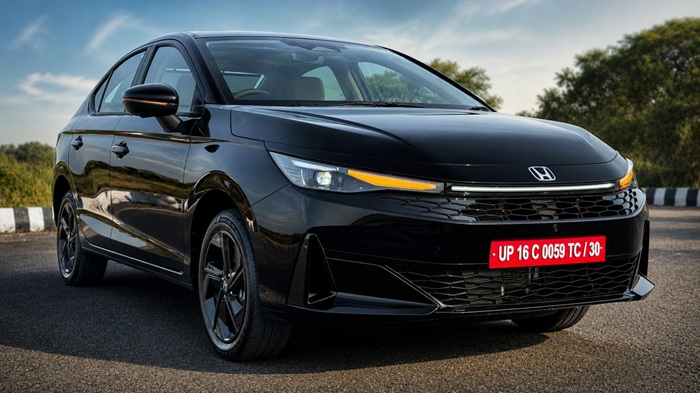
At the front, the black Aero-Blade bumper with air curtains gives the City a sportier and more aerodynamic look. The Matrix-Mesh black painted grille adds a mature aggression, while the Blade-Eye Signature Bi-LED projector headlights bring in that premium Honda identity. These headlamps are loaded with features, including integrated split LED DRLs, automatic headlight control, a light sensor, auto high-beam, follow-me-home and lead-me-to-car functions.
In simple words, the City’s headlights are now smarter than some people who still drive with high beam inside city limits.
The connected centre light bar adds visual width, while the rain-sensing wipers and power-adjustable auto-fold outside mirrors with LED turn indicators bring daily convenience. The Crystal Black Pearl colour seen here gives the car a properly premium look, although Honda also offers red, grey, blue, silver and white shades.
In terms of proportions, the City measures around 4.6 metres in length, 1.7 metres in width and 1.5 metres in height. Honda claims that this is the longest sedan in its segment, and the numbers do support its road presence. The kerb weight is around 1,300 kg, gross weight is around 1,700 kg, and the turning circle is 5.3 metres, which is fairly manageable for urban driving.
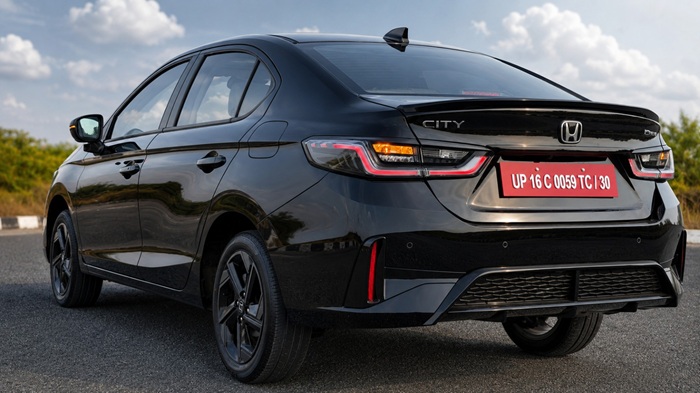
The side profile remains one of the City’s strongest angles. It looks elegant, balanced and unmistakably sedan-like. The 16-inch black Aero-Blade diamond-cut alloy wheels suit the design well, and Honda also offers 15-inch alloy and steel wheel options in lower variants. The tyres on this version are 185/55 R16 87H Bridgestone Ecopia EP150 extra-load radial tubeless units. Braking duties are handled by disc brakes at both the front and rear, which is a welcome feature, especially in the hybrid variant.
At the rear, the Z-Edge wrap-around clear lens LED tail lamps look smart and modern, while the emergency stop signal adds a safety benefit. The matrix-mesh bumper garnish and lip spoiler complete the rear design nicely. It is not flashy, but it is polished. The City is like that person who enters a room quietly but still somehow looks like the most educated person there.
Platform And Engineering: The Sensible Foundation
The Honda City is built on Honda’s Global Small Car platform, which also underpins models like the Elevate, HR-V and Jazz. This platform has been designed with practicality, efficiency and packaging in mind, and the City makes very good use of it.
The suspension setup includes McPherson struts with coil springs at the front and a torsion beam setup with coil springs at the rear. Honda has also equipped it with torsion bar type anti-roll bars and telescopic hydraulic nitrogen gas-filled shock absorbers. That may sound like something from a mechanical engineering exam, but in real life it means the City is designed to offer a balanced ride, stable handling and good comfort over mixed road surfaces.
The City also uses Honda’s Advanced Compatibility Engineering, or ACE, body structure. This is designed to improve crash protection by distributing impact forces more effectively. The City has received a 5-star safety rating from Australian NCAP, which gives it strong credibility in the safety department.
Honda has clearly not treated safety as a brochure decoration here. It has given the City a solid safety package, and in 2026, that matters more than ever. Because today, even a grocery delivery rider can appear from the wrong side of the road with the confidence of a MotoGP champion.
Warranty And Ownership: Honda Plays The Long Game
Honda offers a 3-year unlimited kilometre warranty on the City, which can be extended up to 10 years or 1.20 lakh km. For the hybrid system, the warranty stands at 5 years or 1 lakh km, while the lithium-ion battery gets an 8-year or 1.60 lakh km warranty. For commercial vehicle usage, the warranty is 36 months or 1.20 lakh km.
The engine oil change interval is every 10,000 km or 1 year, which is practical and easy to remember. Honda’s reputation for long-term reliability is one of the biggest strengths of the City, and this car continues that tradition.
The City is not the kind of car that tries to impress you for six months and then starts sending you maintenance bills written like ransom notes. It is built to stay in the family, possibly long enough for the next generation to learn driving in it.
Safety: The City Comes Prepared
The safety equipment list is extensive. The City gets 6 airbags, ABS, EBD, brake assist, seatbelt reminders, rear parking sensors, speed alarm, ISOFIX child seat mounts, vehicle stability assist, electronic stability control, traction control, Agile Handling Assist, hill start assist, automatic brake hold, tyre pressure monitoring system, vehicle immobilizer, security alarm, battery sensor, keyless entry and 3-point ELR seatbelts.
The front seatbelts come with energy-absorbing pretensioners and load limiters. There is also a 360-degree surround camera, a LaneWatch camera and Honda Sensing ADAS technology.
Under Honda Sensing, the City offers Collision Mitigation Braking, Low Speed Follow, Lane Keeping Assist, Road Departure Mitigation and Lead Car Departure Notification System. Adaptive Cruise Control is also available, making highway driving more relaxed.
The Lead Car Departure Notification System is especially useful in Indian traffic, where the car in front may move and you are still busy looking at your phone, pretending to check navigation while actually reading cricket scores.
The City also gets an Acoustic Vehicle Alerting System in low-speed EV mode. Since the hybrid can move silently at low speeds, this system creates a warning sound for pedestrians. In India, where pedestrians, cyclists, scooters, cows and occasionally one confused uncle can all appear in the same lane, this is a useful feature.
Honda Connect: Your Car Gets A Smartphone Personality
Honda offers the Honda Connect app with a 3-year free subscription. Through this connected car system, users can access several functions using a smartphone. Features include tyre pressure monitoring, parking monitoring, smartwatch connectivity, Alexa support, service scheduler, car location, geo-fencing, stolen vehicle tracking, find my car, diary and more.
This is the modern world: earlier, cars just had keys. Now they have apps, cloud connectivity and more digital memory than some old office computers.
Honda also offers a long accessories list, including chrome garnish, spoiler, bumper protector, carpets, mud guards, microfiber cloth, keychain, hammer, ambient lights, illuminated scuff plates, door visor, dashcam, seat covers, tyre pressure monitoring, body cover, steering cover, sunshade and more. So yes, if you want your City to look more premium, more sporty or more “I spent Sunday at the dealership accessory counter,” Honda has options.
Boot Space: Proper Sedan Practicality
The Honda City offers 506 litres of boot space, which is excellent for a sedan of this size. This is enough for airport luggage, family road trips, office bags, weekend shopping and the mysterious extra bags that appear whenever Indian families travel.
The boot is one of the reasons sedans still make sense. SUVs may offer height and road presence, but a sedan like the City offers clean luggage space, better aerodynamics and that satisfying feeling of shutting a proper boot lid.
Interior: Mature, Comfortable And Feature-Rich
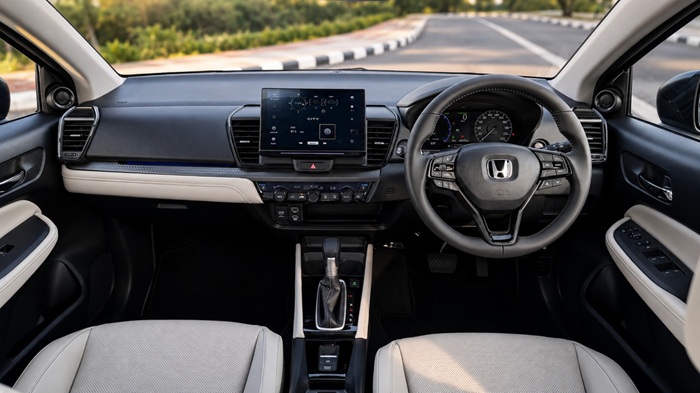
Step inside the Honda City ZX+ Hybrid and the cabin feels premium, practical and well thought out. The dashboard gets a dark iron 3D pattern garnish with ambient lighting, which gives the cabin a more upmarket appearance. The design is not overly dramatic, but that is exactly the point. Honda has focused on ergonomics, visibility and long-term usability.
The perforated leather upholstery in this top variant feels premium, while fabric upholstery is available in lower variants. The seats have a sporty design, and the driver seat is height adjustable. The front seats are ventilated, which is a blessing in Indian summers. Once you have used ventilated seats in May or June, you start looking at normal seats with mild disappointment.
The City also gets LED reading lights, dual horn, a wireless charger and auto open-close power windows with pinch guard. The one-touch electric sunroof comes with slide and tilt function as well as pinch guard. The key remote can be used to start the engine and open or close the power windows and sunroof, which is one of those features that feels small until you use it on a hot afternoon.
The steering wheel is a collapsible electric power-assisted smooth leather unit with tilt and telescopic adjustment. It also carries controls for phone, volume, instrument cluster and voice command. The leather shift lever adds to the premium feel, and paddle shifters are provided for battery regeneration in the hybrid model.
The City gets a fully automatic climate control system with heater, along with a PM2.5 dust and pollen cabin filter. This is very important in India, where the air sometimes has more texture than the road.
Infotainment And Audio: Big Screen, Big Comfort
The top-spec City features a 10.1-inch floating touchscreen IPS display audio system with optical bonding display coating. It supports wireless Android Auto, Apple CarPlay, WebLink, voice command, Bluetooth, USB, FM and radio. Lower variants get an 8-inch infotainment screen.
The City also gets an 8-speaker surround sound system, which improves the in-cabin experience significantly. Whether you are listening to music, navigation instructions or someone on a phone call explaining why they are “just five minutes away” when they have not left home, the system delivers good clarity.
The 7-inch TFT twin-ring combi-meter instrument cluster displays speed, hybrid power flow, charge level, range, average fuel economy, G-meter, safety support information, two tripmeters and outside temperature. Lower variants get a 4.2-inch TFT screen.
The hybrid power-flow display is especially interesting because it shows how the engine, motor and battery are working together. It is like watching a small engineering documentary while driving to the office.
Powertrain: Petrol, Hybrid And Honda Intelligence
The Honda City is offered only with petrol powertrains. The hybrid variant uses a 1.5-litre inline-four-cylinder DOHC 16-valve water-cooled Atkinson cycle i-VTEC Honda LEB8 Earth Dreams petrol engine. It is paired with a 172.8-volt lithium-ion high-voltage battery, a self-charging strong hybrid system, a permanent magnet AC synchronous electric motor and Variable Timing Control.
The combined output is 124 horsepower and 253 Nm of torque. The claimed fuel efficiency is around 27 kmpl, and the fuel tank capacity is 40 litres. That makes the hybrid City very efficient, especially for urban and mixed driving.
The non-hybrid version uses the same basic engine family, but in a different state of tune. It produces 119 horsepower and 145 Nm of torque, with a claimed fuel efficiency of around 17 kmpl. A two-motor e-CVT automatic transmission is offered in the hybrid, while a 6-speed manual transmission is also available in the range.
The hybrid system offers three drive modes: EV, Hybrid and Engine. At low speeds, the car can run in EV mode, making it smooth and silent. In hybrid mode, the engine and electric motor work together for better efficiency and performance. In engine mode, the petrol engine directly drives the wheels in certain conditions, especially during efficient cruising.
The system also uses an engine-linked wet-type multi-plate clutch. There is an electric AC compressor and electric coolant pump with heater, which allows the hybrid system to manage cabin comfort and thermal efficiency more intelligently.
In layout terms, the engine and motor are placed at the front, while the battery is positioned at the rear. This arrangement helps with packaging and weight distribution.
The Honda L engine family is known for reliability and has been used in several Honda cars around the world. Versions of this engine have been seen in models like the Jazz Hybrid, and modified versions have also been used in cars like the Clarity, Insight and HR-V. The L engine family is also known in Formula F competitions, which adds a tiny motorsport sprinkle to an otherwise very sensible sedan recipe.
The spark plugs are supplied by NGK or Denso, both respected names in the business. In short, this powertrain has enough engineering credibility to make a mechanical engineer nod quietly and enough fuel efficiency to make a family accountant smile.
Driving Experience: Smooth Operator
The City Hybrid is not designed to be a loud performance sedan. It does not wake up the neighbourhood, scare dogs or make tunnel runs feel like a motorsport event. Instead, it focuses on refinement, efficiency and effortless drivability.
In city driving, the hybrid system works beautifully. The electric motor provides instant torque, so the car feels responsive at low speeds. Start-stop traffic becomes much smoother because the car can move silently in EV mode. The e-CVT transmission keeps things seamless, and there are no jerks or confused gearshifts.
The 253 Nm torque figure gives the City Hybrid strong urban performance. Overtaking is easy, and the car feels calm even when traffic gets messy. It is not a car that encourages aggression, but it always has enough performance available when required.
On highways, the City continues to feel stable and comfortable. The long wheelbase, low sedan stance and well-tuned suspension help it maintain composure. The steering is light enough for the city and confident enough for faster roads. Adaptive Cruise Control and Lane Keeping Assist make highway drives more relaxing, especially on long stretches.
The battery regeneration paddles add another layer of driver involvement. You can adjust regeneration levels and recover energy while slowing down. It may not turn your daily commute into Formula 1, but it does make you feel slightly clever every time the battery gains charge.
The Electric Regenerative Braking System also helps improve efficiency. Braking feel in hybrids can sometimes feel artificial, but Honda generally does a good job of blending regenerative and mechanical braking.
The City is also E20 compliant, which means it is ready for petrol blended with 20 percent ethanol. This adds future-readiness to the ownership package.
Ride And Handling: Classic Honda Balance
Honda has traditionally been good at making cars that feel light, responsive and easy to drive. The City continues that tradition. The suspension setup is tuned more for comfort than outright sportiness, but it does not feel loose or lazy.
The front McPherson strut and rear torsion beam setup may sound conventional, but Honda has tuned it well. The car absorbs regular road imperfections confidently, and the nitrogen gas-filled shock absorbers help improve ride control. The anti-roll bars also help keep body movement in check.
The City is not pretending to be a track car, and that is a good thing. It is a family sedan that can handle daily commutes, highway runs and occasional enthusiastic driving without drama. The Agile Handling Assist and vehicle stability systems further improve confidence, especially during quick direction changes or emergency manoeuvres.
This is the kind of car that makes you drive neatly. Not slowly, not boringly, but neatly. It encourages smooth inputs, clean braking and mature behaviour. Basically, the Honda City is the car equivalent of someone who files tax returns before the deadline.
The RS That India Does Not Get
Globally, Honda also offers a more powerful RS model of the City, but it has not been brought to India. That is slightly disappointing for enthusiasts because the RS adds a sportier flavour to the City package.
India has always had a soft spot for the Honda City, and a sportier RS version would certainly find fans. But for now, the Indian market gets the more sensible range, with the ZX+ Hybrid sitting at the top.
And honestly, the hybrid makes a strong case for itself. It offers fuel efficiency, smoothness, technology and premium features, which are exactly what many modern sedan buyers want.
Verdict: The Gentleman Sedan Evolves
The Honda City has always been one of India’s most respected sedans, and this 2026 seventh-generation facelift continues that legacy with more technology, more safety and a much smarter hybrid powertrain.
It is spacious, comfortable, efficient and refined. It has a 506-litre boot, premium cabin features, ventilated front seats, a large touchscreen, wireless smartphone connectivity, a sunroof, ADAS, 6 airbags, strong hybrid technology and Honda’s long-standing reputation for reliability.
The ZX+ Hybrid variant is clearly the most advanced version of the City. It is not the cheapest option, but it offers a very well-rounded package. With prices ranging from around ₹12 lakh to ₹21 lakh ex-showroom, the City sits in a space where it has to fight compact SUVs, premium hatchbacks and other sedans. But unlike many trend-driven rivals, the City has history, engineering depth and brand trust on its side.
It may not have the towering stance of an SUV, but it has something SUVs often forget: elegance. It does not need fake skid plates, oversized cladding or an advertisement showing it climbing a mountain. The Honda City knows exactly what it is. It is a sedan. A proper one.
After more than 36 lakh global customers and nearly 7 lakh Indian buyers, the City remains one of Honda’s finest everyday cars. It is practical enough for families, polished enough for executives, efficient enough for daily commuting and refined enough for long-distance comfort.
The Honda City Hybrid, especially in this ZX+ form, is like a well-educated sedan with a hybrid degree, a clean driving record and just enough personality to keep things interesting. It is not here to shout. It is here to stay.
And in a world full of SUVs trying very hard to look tough, the Honda City quietly reminds us that sometimes, the smartest car in the parking lot is still the one with a boot, a low roofline and a Honda badge on the nose.