
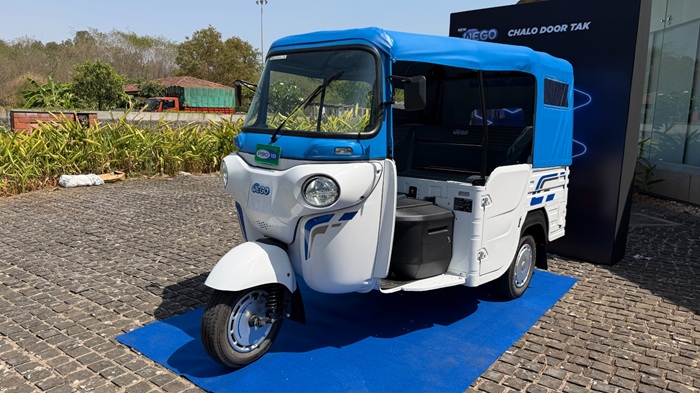
Let’s start with the kingpin of the lineup — the Bajaj Wego P90.
This thing is massive. At 3 metres long, 1.5 metres wide and 1.8 metres tall, Bajaj proudly calls it the biggest EV in the three-wheeler category. And standing next to it, you genuinely believe them. It looks less like an autorickshaw and more like a mini electric people mover that accidentally shrank in the wash.
The model you are seeing here is the P90 18, the only variant available, priced at ₹4.48 lakh ex-showroom. Which, let’s be honest, sounds expensive until you realise this thing can probably outlast several governments and a few IPL teams.
Power comes from a 17.7 kWh lithium-ion battery paired with an advanced permanent magnet synchronous motor producing 8 horsepower and 40 Nm torque. Now before you laugh at the horsepower figure, remember this vehicle is designed for Indian city traffic — where surviving one roundabout in Old Delhi should count as an endurance sport.
Top speed is 45 kmph, which is honestly the perfect speed for Indian roads. Faster than that and your passengers start praying loudly.
But the real headline here is the claimed 296 km range. That’s nearly enough to make some electric SUVs feel mildly insecure. An autorickshaw delivering close to 300 km on a charge would have sounded like science fiction a few years ago. Now it’s parked outside a chai stall discussing fleet management analytics.
Charging the P90 takes about 6 hours through the onboard charger. Plug it in overnight and by morning it’s ready to continue its mission of overtaking motorcycles with shocking confidence.
Design – The Auto Rickshaw Went to Finishing School
The Arctic White colour you see here gives the P90 a surprisingly premium look. There are also black and blue options available, but white somehow makes it look like an autorickshaw from a futuristic airport.
The LED headlamp setup immediately modernises the face. Traditional autorickshaws often look like they’ve been awake for 72 hours straight. The Wego P90, meanwhile, looks alert, educated and financially responsible.
You also get LED tail lamps, side visibility windows and a strong metal body sitting on a robust chassis. Unlike many lightweight EV experiments, this actually feels built for Indian commercial punishment.
Ground clearance is 180 mm, which means it can confidently tackle potholes that are large enough to receive Aadhaar cards.
The 12-inch steel wheels look proportionate, while drum brakes at both ends focus more on reliability and ease of maintenance rather than sporty behaviour. Nobody is taking apex corners in an autorickshaw anyway. If they are, you should probably get out immediately.
Cabin Experience – Surprisingly Spacious, Surprisingly Smart
Step inside and the first thing you notice is space. Lots of it.
The passenger bench comfortably accommodates three people, and unlike old-school autos where knees become emotional support systems for strangers, this one actually allows breathing room.
The dual-tone vinyl upholstery gives the cabin a slightly premium vibe. Sure, it’s still washable commercial-grade material, but it doesn’t look like it came directly from a school bus catalogue.
There’s also plenty of luggage space, which is important because Indian passengers travel with enough bags to suggest permanent relocation.
The digital LCD instrument cluster looks clean and modern, displaying essential information without confusing drivers with unnecessary animations or cryptocurrency graphs.
And then come the features. Oh yes, this autorickshaw has features.
Rear parking sensors.
Telematics.
Anti-theft system.
Geo fencing.
Real-time vehicle location.
At this point, the Wego P90 probably knows where it is more accurately than some humans using Google Maps.
Driving Experience – Four Modes and One Mission
The P90 comes with four drive modes — Eco, Standard, Power and Climb.
Eco mode is for maximum efficiency, ideal for squeezing every kilometre from the battery like an engineering student stretching Maggi noodles for two days.
Standard mode balances range and performance.
Power mode gives sharper throttle response, which in an autorickshaw feels unexpectedly entertaining.
And then there’s Climb mode, supported by a healthy 36% gradeability figure. Basically, this auto can tackle steep inclines without sounding like it’s reconsidering life choices.
The 2-speed automatic transmission is another interesting addition. Most electric vehicles use single-speed setups, but Bajaj has clearly tuned this for load-carrying flexibility and urban usability.
Suspension duties are handled by telescopic forks at the front and a swing-arm setup with helical coil springs at the rear. Translation? It can survive Indian roads without turning passengers into maracas.
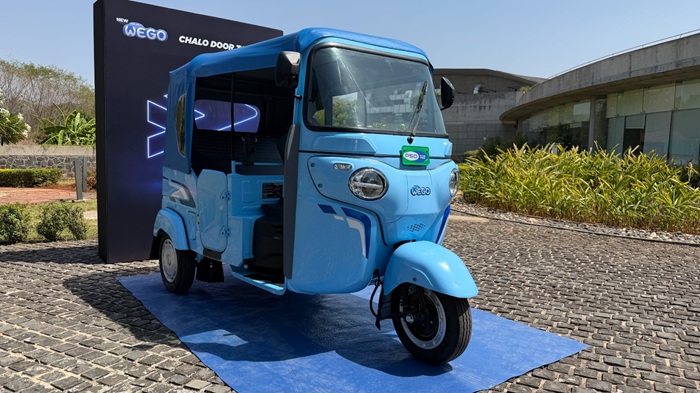
Bajaj Wego P50 – The Affordable Urban Warrior
Now let’s talk about the Wego P50.
If the P90 is the family SUV of electric autos, the P50 is the practical city commuter that skips luxury holidays but never misses EMI payments.
The P50 comes in two variants:
P50 09 priced at ₹3.11 lakh and P50 12 priced at ₹3.69 lakh ex-showroom.
The blue colour you see here gives it a youthful vibe, though green and white options are also available.
The top-spec P50 12 gets a 12.1 kWh battery producing 7 horsepower and 40 Nm torque. Top speed rises slightly to 50 kmph while claimed range stands at an impressive 272 km.
Meanwhile, the smaller P50 09 uses a 9.2 kWh battery producing 6 horsepower and 213 km range.
Charging time is quicker too — just 4 hours 30 minutes. That’s basically one good night’s sleep and two power cuts later.
Interestingly, Bajaj offers a 6-year or 1.5 lakh km warranty on the P50, which is actually longer than what many expensive passenger EVs offer.
P50 Features – Tiny Auto, Big Confidence
Despite being the smaller model, the P50 doesn’t feel stripped down.
You still get:
LED headlamp,
digital LCD cluster,
LED tail lamp,
regenerative braking,
IP67-rated battery,
Bluetooth connectivity,
hill hold assist,
roll-over detection,
anti-theft system,
park assist,
and telematics.
Imagine explaining to someone from 2010 that an autorickshaw now has rollover detection and Bluetooth. They would assume you accidentally described a fighter jet.
The steel monocoque chassis gives the P50 a strong structural feel, while the 34.5% gradeability ensures it won’t surrender midway on flyovers.
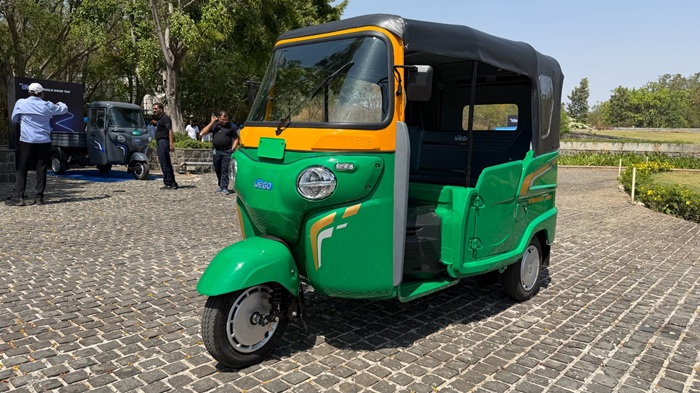
Bajaj Wego P70 – The Middle Child That Actually Makes Sense
Then comes the Wego P70.
This is the balanced all-rounder of the family. Slightly larger than the P50, slightly less gigantic than the P90, and probably the sweet spot for many fleet operators.
Variants include:
P70 09 at ₹3.23 lakh and P70 12 at ₹3.63 lakh.
The top P70 12 gets a 12.1 kWh battery producing 7.3 horsepower and 40 Nm torque, with a 260 km claimed range and 50 kmph top speed.
Meanwhile, the smaller battery version delivers 180 km range.
Charging takes around 5 hours 30 minutes, while warranty coverage stands at 5 years or 1.2 lakh km.
Dimensionally, the P70 measures 2.8 metres long with 180 mm ground clearance, giving it a planted and usable stance for city operations.
The feature list mirrors the P50 closely:
regenerative braking,
Bluetooth,
hill hold assist,
roll-over detection,
park assist,
telematics,
and anti-theft functions.
Basically, Bajaj has ensured even the middle variant doesn’t feel like the forgotten sibling at a family function.
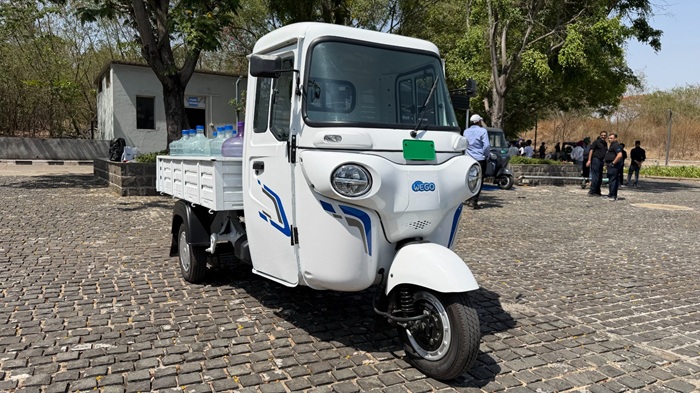
Bajaj Wego C90 – The Cargo Specialist
And finally, we arrive at the Wego C90.
This one is built for cargo operations and urban logistics. In simple terms, this is the EV equivalent of that extremely hardworking delivery guy who somehow arrives before you even place the order.
The C90 comes in:
C90 09 at ₹3.87 lakh and
C90 12 at ₹4.34 lakh.
The top variant produces 7.3 horsepower and 40 Nm torque from a 12.1 kWh battery, offering a claimed range of 207 km.
The smaller battery version delivers 149 km range.
While the performance figures are similar to the P70, the real difference lies in the utility-oriented setup and enhanced telematics package.
This includes:
rear parking sensors,
speed limit monitoring,
geo fencing,
trip analytics,
fleet insights,
real-time vehicle tracking,
anti-theft functions,
and roll-over detection.
Honestly, the C90 feels less like a traditional three-wheeler and more like a compact logistics machine pretending to be humble.
Ride and Real-World Appeal
Across the entire Wego lineup, the biggest achievement is how modern everything feels.
These are not merely electric versions of old autorickshaws. Bajaj has clearly developed them as purpose-built EVs.
The ride quality feels composed thanks to the telescopic front suspension and coil spring rear setup.
The electric power delivery is smooth and silent. There’s no vibration, no engine clatter, and no sensation that mechanical parts are arguing among themselves.
And perhaps most importantly, operational costs should be dramatically lower compared to conventional fuel-powered autos.
For fleet owners, delivery businesses and urban passenger transport operators, that matters more than fancy marketing slogans.
Final Verdict – India’s Auto Rickshaw Has Entered Its Tech Era
The Bajaj Wego range proves something important — the future of Indian mobility isn’t just about premium electric SUVs with giant touchscreens and ambient lighting that changes colour depending on your mood.
Sometimes the real revolution happens in vehicles that actually move the country every day.
From crowded railway stations to narrow city lanes, autorickshaws are the unsung heroes of Indian transport. And now they’re becoming cleaner, smarter, quieter and surprisingly sophisticated.
The P90 feels like the luxurious flagship.
The P50 is the efficient urban worker.
The P70 balances practicality and range beautifully.
And the C90 quietly prepares to dominate urban cargo delivery.
Most importantly, Bajaj has managed to make an autorickshaw feel futuristic without removing its practicality.
And honestly, that might be harder than building a supercar.
Because a supercar only needs to impress people.
An Indian autorickshaw needs to survive India.