

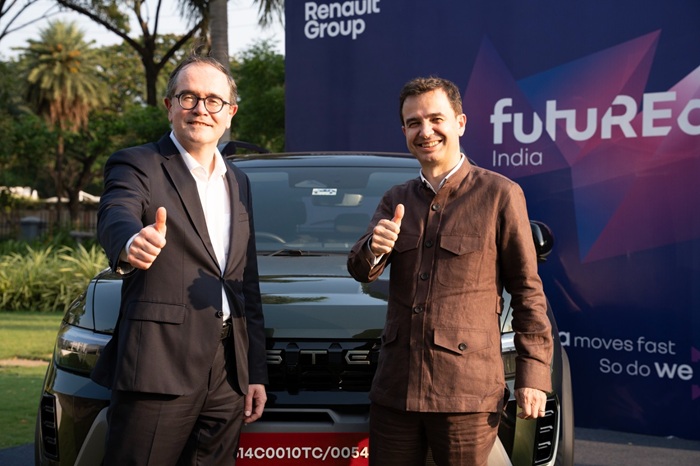
Chennai — At the Renault Group Technical Centre in Chennai, Stéphane Deblaise didn’t just deliver a speech—he delivered a reality check. If Renault’s global futuREady strategy was the headline act, India, it seems, is where the actual performance begins.
Calling the Chennai facility the brand’s largest engineering hub outside France, Deblaise made it clear that futuREady India is not a distant ambition or a boardroom PowerPoint—it’s already rolling on the ground, quite literally. And if everything goes to plan, India won’t just be a market for Renault; it will be one of its global nerve centres by 2030.
At the heart of this roadmap lies a simple but sharp formula: deliver more value per rupee, expand into faster-growing segments, and electrify—without forcing customers into a one-size-fits-all future.
Renault’s strategy rests on two new platforms that sound like they belong in a tech startup pitch but are very much rooted in the realities of Indian roads. The first, RGEP (Renault Group Entry Platform), is essentially the evolution of the CMFA platform that underpins familiar names like the Renault Kwid, Renault Kiger and Renault Triber. While CMFA helped democratise mobility for over 7.5 lakh customers, Deblaise admitted it was starting to show its age—like a smartphone that still works but refuses to run the latest apps.
Enter RGEP, designed to bring smarter engineering, bigger screens, and even underbody factory-fitted CNG—without sacrificing boot space. Yes, Renault is betting that Indian families would quite like their luggage space back, thank you very much.
But Renault isn’t just reinforcing its base—it’s aiming higher. That’s where RGMP (Renault Group Modular Platform) steps in, a more flexible architecture capable of supporting vehicles from 4.0 to 4.7 metres. The platform has already made its debut with the new Renault Duster, but Deblaise hinted that this is just the opening chapter.
By 2030, four models—including the upcoming Renault Bridger—will be built on RGMP, targeting high-growth segments with a mix of bold design, advanced infotainment, and multi-energy powertrains. And in typical Renault fashion, the Bridger won’t just arrive—it will evolve, transitioning from a turbocharged petrol SUV into the brand’s first fully electric vehicle in India shortly after launch.
Because if there’s one thing Renault wants to clarify, it’s this: electrification is not a switch, it’s a spectrum. From strong hybrids to full EVs—and even experimental concepts like e4WD—the company plans to let customers move at their own pace. A sensible approach in a country where charging infrastructure can sometimes feel like a treasure hunt.
Beyond products, Renault is also trying to fix something far less glamorous but equally critical—ownership experience. Under the “Renault Forever” programme, the company is introducing a 7-year warranty, designed to bring peace of mind, predictable costs, and even better resale value. In a market where ownership anxiety can rival fuel prices, that’s a move likely to resonate.
Deblaise summed up the plan with four clear takeaways: a broader seven-car portfolio spanning ICE, CNG and electrified options; India’s rise as a key global R&D and software hub; a stronger role as an export base targeting €2 billion annually by 2030; and a bold ambition to make India one of Renault’s top three global markets.
In short, Renault isn’t just tweaking its India strategy—it’s rewriting it. And if Deblaise’s closing line is anything to go by, the company knows exactly what it’s up against: India moves fast—so do we.
Now, the real question is—can Renault keep up with India’s pace, or will India end up setting Renault’s pace instead? Either way, the race has officially begun.