With 425 horsepower, a twin-turbocharged straight-six, rear-wheel drive, a carbon-fibre roof and a wonderfully unapologetic personality, the first-generation BMW M4 makes a compelling case for buying yesterday’s performance hero instead of tomorrow’s technological marvel.
There was a time when BMW’s interpretation of a performance car was refreshingly straightforward. Put a powerful engine at the front, send the power to the rear wheels, distribute the weight evenly, give the driver a proper steering wheel and resist the temptation to turn the dashboard into an electronics showroom. The BMW M4 F82 belongs to that era. It is muscular without looking unnecessarily theatrical, sophisticated without being excessively complicated, and sufficiently powerful to make a perfectly ordinary Tuesday considerably more interesting.
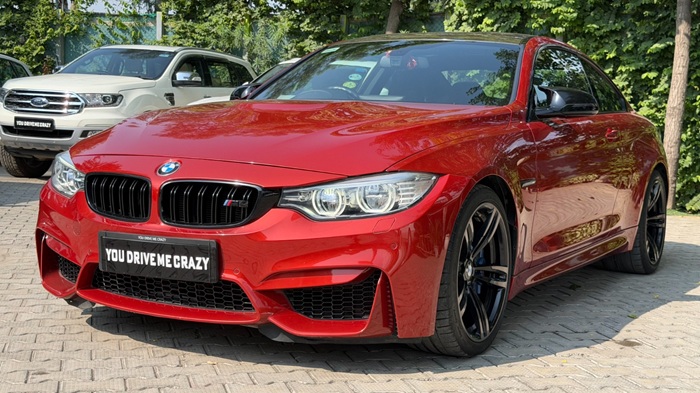
Finished in the spectacular Sakhir Orange, this particular 2017 BMW M4 Coupé is a reminder of just how handsome BMW’s performance cars could be. There is no grille large enough to accommodate a family of four, no fashionable electrification and no attempt to disguise its mechanical intentions. It is simply a German performance coupé with an exceptionally talented engine and a chassis designed around the person holding the steering wheel.
And perhaps its most interesting specification today is the price.
Originally priced at ₹1.21 crore ex-showroom in India, this pre-owned example is available through the You Drive Me Crazy dealership for ₹74 lakh. Considering that the second-generation M4 starts at ₹1.62 crore, according to the supplied pricing information, the F82 suddenly becomes a rather intriguing proposition for enthusiasts who appreciate depreciation more than digital instrument clusters.
The birth of the M4
Introduced in 2014, the BMW M4 represented a significant transition in the history of BMW M. The two-door performance model that had traditionally carried the M3 badge was given a separate identity following BMW’s decision to differentiate its coupés from its saloons through the 4 Series nomenclature.
Essentially, the M4 became the high-performance interpretation of the 4 Series, while the M3 continued as its four-door sibling. Internally designated F82, the first-generation M4 remained in production until 2020, when it made way for the considerably more extravagant-looking second generation.
India received the M4 Coupé as a petrol-powered, rear-wheel-drive model, imported from Germany as a Completely Built-Up (CBU) unit. A convertible version was also manufactured internationally, although it was not officially offered in India. The six-speed manual transmission available overseas was another piece of enthusiast-oriented equipment that Indian customers unfortunately missed out on.
The F82’s design is credited to Florian Nissl in the supplied model information, which also associates him with the M3, X5 M, X6 M, M2, M4 GTS, MINI John Cooper Works GP and Countryman. Underneath its muscular bodywork lies BMW architecture identified in the supplied specifications as the L7 platform, shared with models from the 1 Series, 2 Series and 3 Series families.
Throughout its production life, the M4 spawned several desirable derivatives, including the Competition Package, M4 GTS, DTM Champion Edition, M4 CS, Cabrio Edition 30 Jahre and M4 Edition M Heritage.
Its motorsport pedigree was equally extensive. The M4 racing family achieved success across DTM, the 24 Hours of Nürburgring, SRO competitions, IMSA, ADAC championships and GT3 racing. Although the road-going M4 is obviously a considerably more civilised machine, motorsport remained central to its engineering philosophy.
Exterior: When BMW got the proportions right
The F82 M4 is an exceptionally well-proportioned car. Its long bonnet, compact passenger compartment, low roofline and broad rear haunches deliver the classic silhouette of a front-engined performance coupé. Everything appears to have been positioned exactly where it should be.
The front end features BMW’s traditional double-bar kidney grille finished in black, flanked by automatic adaptive LED headlights incorporating four LED daytime-running light rings. High-beam assistance, headlight washers, accent lighting and a rain sensor complete the package.
The bonnet’s sculpted appearance and the deeply shaped front bumper introduce sufficient aggression without overwhelming the original elegance of the 4 Series. Large air openings communicate the cooling requirements of the engine beneath, rather than merely serving as decorative expressions of automotive anger.
Move towards the side and the M4’s muscular character becomes more apparent. Flared wheel arches accommodate its wider tyres, while the signature Air Breather adds visual detail behind the front wheels. The long coupé doors and gracefully descending roofline give the M4 an athletic stance even when stationary.
The electrically adjustable and folding outside mirrors feature automatic anti-dazzle functionality, heating, memory settings and integrated LED turn indicators. Heat-protection glazing helps manage cabin temperatures, something owners of dark-interior performance cars in India will particularly appreciate.
One of the M4’s most distinctive engineering features is its carbon-fibre roof. Beyond looking rather expensive, it serves a genuine mechanical purpose by reducing weight high up in the body and lowering the centre of gravity. Removing weight from the roof is particularly beneficial for controlling body movement during cornering.
This is lightweight engineering with an actual job to do.
Sakhir Orange suits the F82 beautifully, highlighting its creases and muscular surfaces without requiring additional graphics or enormous wings. BMW also offered white, black, silver, grey, topaz, quartz, yellow and blue exterior finishes, although the orange arguably brings out the car’s personality best.
The rear is equally successful. An integrated spoiler rises subtly from the boot lid, while a rear diffuser sits beneath the bumper. Four exhaust outlets, arranged as two pairs, provide the necessary visual confirmation that this is not an ordinary 420i wearing an ambitious body kit.
The tail lamps incorporate dynamic braking lights, while the original exhaust system features electrically controlled flaps.
This particular example, however, has been fitted with an aftermarket Valvetronic Designs exhaust system, complete with valve-control buttons. It allows the exhaust’s character to be adjusted according to the occasion, whether that involves a discreet departure from home or ensuring that the entire neighbourhood is aware of your automotive purchasing decisions.
Dimensions, wheels and everyday practicality
At approximately 4.7 metres long, 1.9 metres wide and 1.4 metres tall, the M4 is a substantial performance coupé without becoming excessively cumbersome.
Its kerb weight stands at 1,626 kg, with a gross vehicle weight of 2,062 kg. The difference gives a nominal carrying allowance of 436 kg. BMW’s characteristic 50:50 front-to-rear weight distribution remains an important part of the chassis philosophy.
Ground clearance is just 121 mm, which is perfectly understandable on a German performance car and considerably less reassuring when approaching an enthusiastic Indian speed breaker.
The 12.2-metre turning circle also means that tight parking areas and narrow residential streets require some planning. Fortunately, front and rear parking sensors and a reversing camera make low-speed manoeuvres considerably easier.
This example wears 19-inch double-spoke M light-alloy wheels, although 18-inch alloys were also offered. The staggered tyre arrangement consists of 255/35 R19 96Y tyres at the front and wider 275/35 R19 100Y tyres at the rear. The supplied vehicle details describe these as Pirelli P Zero extra-load, radial, tubeless run-flat tyres.
The wider rear rubber is particularly important given the amount of torque being sent exclusively to the back axle. It also contributes significantly to the car’s purposeful stance.
Disc brakes are fitted at both ends, while BMW offered carbon-ceramic brakes as an option for owners interested in more demanding performance driving.
Despite its sports-car intentions, the M4 remains surprisingly practical. The boot offers 445 litres of luggage capacity, enough for weekend bags, airport runs or a fairly ambitious shopping expedition. The 60:40 split-folding rear seats provide additional flexibility when carrying longer items.
It is a proper four-seat coupé rather than a two-seater with decorative rear upholstery. Naturally, the long doors and sloping roofline make rear-seat access less convenient than in the M3 saloon, but the additional practicality makes the M4 entirely plausible as an everyday performance car.
Interior: Before everything became a touchscreen
The interior of the F82 is a particularly pleasant reminder of BMW’s traditional driver-focused cabin architecture. The dashboard is conventional, the controls are logically arranged and the central console appears to have been designed by someone who understood that a driver might occasionally wish to adjust something without taking their eyes off the road.
Black Merino leather upholstery dominates this particular cabin, complemented by carbon-fibre interior trim. Silver, orange and beige upholstery options were also available.
The electrically adjustable M Sport bucket seats feature lumbar support and illuminated M logos. Their pronounced side bolsters are designed to keep occupants securely positioned during enthusiastic cornering, while electrical adjustment provides flexibility for longer journeys.
They strike a sensible conceptual balance between the heavily sculpted seats of a dedicated track car and the broader, more relaxed furniture of a luxury grand tourer.
The multifunction M leather steering wheel is another highlight. Its substantial rim, conventional controls and familiar BMW design communicate the car’s purpose immediately. Behind it sits a traditional instrument arrangement that prioritises essential driving information rather than visual entertainment.
A head-up display projects information including vehicle speed, engine rpm, gear selection and shift lights into the driver’s field of vision. In a car capable of reaching 100 km/h in just over four seconds, the ability to monitor important information without looking down is genuinely valuable.
Phone, volume and voice controls are integrated into the cabin, while cruise control incorporates a braking function and speed limiter.
Ambient lighting with mood illumination adds some evening sophistication, and the automatic anti-dazzle interior rear-view mirror is another useful feature for night driving.
There is also dual-zone automatic climate control with an active-carbon microfilter. More importantly, the climate functions retain conventional controls. Adjusting the temperature does not require navigating three submenus or accidentally changing the colour of the ambient lighting.
The carbon-fibre roof means this example prioritises weight reduction over the appeal of a conventional sunroof, an entirely appropriate decision for an M car.
The cabin may not possess the visual extravagance of contemporary luxury interiors, but its relative simplicity has aged rather gracefully. Technology inevitably becomes obsolete; a well-positioned steering wheel does not.
Infotainment and equipment
The BMW ConnectedDrive infotainment system, listed at 8.7 inches in the supplied specifications, supports BMW Apps, Bluetooth connectivity, USB, FM radio, a DVD drive, integrated hard-drive map storage and navigation with three-dimensional mapping.
The system is operated through BMW’s familiar rotary iDrive controller, positioned conveniently on the centre console.
Modern infotainment systems undoubtedly offer better graphics, larger displays and more sophisticated connectivity, but the F82’s physical controller remains a particularly sensible solution for operation while driving.
BMW also offered a 16-speaker Harman Kardon surround-sound system producing 600 watts. It is an attractive option for long-distance driving, although the aftermarket exhaust fitted to this particular M4 provides its own alternative form of surround sound.
A surround-view camera system was available optionally, supplementing the standard reversing camera and parking sensors.
The overall equipment philosophy is perhaps the greatest contrast between the F82 and modern performance cars. There is plenty of technology, but relatively little of it competes with the actual driving experience for attention.
Engine: The magnificent S55 straight-six
The centrepiece of the first-generation M4 is its engine, and what an impressive piece of engineering it is.
Under the bonnet sits the 3.0-litre BMW S55B30T0 M TwinPower Turbo petrol engine, a twin-turbocharged inline-six developing 425 horsepower and 550 Nm of torque.
Derived from BMW’s N55 engine family, the S55 represents a substantially reworked high-performance application. It features an aluminium cylinder block, high-precision direct fuel injection, double overhead camshafts, VANOS variable camshaft timing and Valvetronic variable valve lift.
Peak turbocharger boost pressure is quoted at 1.2 bar, while the engine has a 7,600 rpm redline.
The same engine powered the contemporary BMW M3, and a modified version was subsequently used in the M2. BMW has since replaced the S55 with the newer S58 engine in its latest generation of comparable M cars.
The S55 represented a major philosophical departure from the naturally aspirated V8 associated with the preceding generation of M3 Coupé. Some enthusiasts inevitably mourned the loss of the V8’s soundtrack and naturally aspirated throttle response, but the turbocharged straight-six introduced something equally compelling: enormous mid-range performance.
With 550 Nm available, the M4 does not need to spend its entire existence near the redline to feel properly quick. The engine’s broad torque delivery is particularly beneficial during highway overtaking, where acceleration from an already substantial cruising speed matters more than an impressive standing-start figure.
Yet the 7,600 rpm redline ensures that this remains an engine designed to reward drivers who enjoy exploring the upper reaches of the rev counter.
It combines the flexibility of turbocharging with the high-revving character traditionally associated with BMW M engineering. That combination is central to its appeal.
2017 BMW M4 Coupé — S55 engine performance
Maximum power
425 hp
Maximum torque
550 Nm
0–100 km/h
4.1 sec
Top speed
250 km/h
Engine redline
7,600 rpm
Peak boost pressure
1.2 bar
Transmission and performance
Power is transmitted exclusively to the rear wheels through a seven-speed M dual-clutch automatic transmission featuring Drivelogic. The gearbox was specifically engineered to accommodate the characteristics of BMW’s high-revving M engines.
Unlike a conventional torque-converter automatic, a dual-clutch transmission preselects gears through separate clutch arrangements, allowing rapid changes with minimal interruption to power delivery.
Drivelogic allows the transmission’s shifting behaviour to be adjusted, giving the driver the option of more relaxed gear changes or a more aggressive approach when performance takes priority.
Dual-clutch transmissions can feel less polished during crawling traffic and delicate parking manoeuvres than conventional luxury-car automatics. Their advantage becomes considerably more apparent when the road opens up and rapid, decisive shifts are desirable.
BMW quotes a 0–100 km/h acceleration time of 4.1 seconds and a top speed of 250 km/h.
Even by modern standards, those are serious performance figures. More importantly, the M4 delivers its power through a traditional rear-wheel-drive configuration rather than relying on four driven wheels to distribute the workload.
That distinction makes the car’s performance more involving but also more dependent on tyre condition, road surface and the driver’s judgement.
The aftermarket Valvetronic exhaust introduces another dimension to this particular example’s character. Its adjustable valves offer greater control over the exhaust note, although the resulting sound and refinement will naturally differ from those of a completely standard M4.
Ride and handling: Where the M badge earns its keep
The F82’s engineering extends considerably beyond its engine. BMW employed lightweight construction, a carbon-fibre roof, carefully balanced weight distribution and sophisticated chassis systems to create a coupé that could function both as a road car and as a credible performance machine.
The M4 features Adaptive M Suspension with Comfort, Sport and Sport Plus settings, allowing the damping characteristics to be adjusted according to driving conditions.
Comfort is the obvious starting point for everyday Indian roads. The 19-inch wheels, low-profile tyres and relatively low ground clearance already impose certain compromises, and there is little reason to introduce additional stiffness when negotiating potholes, uneven concrete surfaces and poorly repaired expansion joints.
Even in its softer configuration, buyers should not expect the isolation of a luxury saloon. The M4’s suspension is fundamentally engineered to control body movement, maintain tyre contact and provide predictable responses during demanding driving.
Sport mode offers a more focused compromise, while Sport Plus is better suited to smooth surfaces and situations where tighter body control matters more than ride comfort.
On a properly surfaced, flowing road, the benefits of the M4’s chassis configuration become much more relevant. Its low centre of gravity, balanced weight distribution and wide tyre footprint are intended to minimise excessive body roll and deliver stability during rapid direction changes.
The rack-and-pinion M Servotronic electric power steering provides speed-sensitive assistance. Its electric architecture represents another departure from the hydraulic systems beloved by enthusiasts of older BMW M cars.
Electric steering can provide accurate responses and variable assistance, although drivers who particularly value the natural texture and communication of traditional hydraulic steering may find the F82’s approach less satisfying.
The car’s real mechanical party trick, however, is the Active M Differential.
This electronically controlled limited-slip differential manages the distribution of torque between the rear wheels, improving traction, acceleration, cornering performance and driving stability.
Rather than simply allowing power to be wasted through a spinning wheel, the differential can vary its locking behaviour to make better use of the available grip. This becomes particularly important when accelerating out of corners or dealing with inconsistent road surfaces.
The system works alongside Dynamic Stability Control and M Dynamic Mode. The latter allows greater freedom of movement before stability intervention, giving experienced drivers additional flexibility in suitable controlled environments.
However, the combination of 550 Nm, rear-wheel drive and a powerful turbocharged engine deserves respect. Electronic assistance cannot repeal the laws of physics, and worn tyres or wet roads can substantially alter the car’s behaviour.
The conventional disc brakes should be entirely appropriate for normal road use, provided they are in good condition. The optional carbon-ceramic system was intended to offer advantages during repeated high-temperature braking, although replacement costs are something used-car buyers should consider carefully.
As a complete engineering package, the M4 prioritises driver involvement over effortless point-to-point performance. That is both its greatest attraction and the reason it demands more attention than an ordinary luxury coupé.
Fuel economy: Surprisingly respectable, theoretically
BMW’s quoted fuel efficiency figure is 10 km/l, accompanied by a 60-litre fuel tank.
That translates into a theoretical range of approximately 600 km under conditions matching the claimed efficiency. Actual consumption, particularly during urban driving or enthusiastic use of the engine, will depend considerably on traffic, driving style and operating conditions.
There is also a brake-energy regeneration system designed to improve efficiency and reduce unnecessary engine load by managing electrical energy recovery during deceleration.
It is a useful engineering detail, although anyone purchasing a 425 hp twin-turbocharged BMW primarily for its fuel economy may have misunderstood the assignment.
Fuel expenditure is only one element of the running costs. Premium performance tyres, brake components, insurance and specialised maintenance will all contribute to the ownership experience.
Safety and driver assistance
The M4 is equipped with six airbags, anti-lock braking, Brake Assist, Cornering Brake Control and Dynamic Stability Control.
Occupant protection includes side-impact protection, a crash sensor and three-point seatbelts, with the front belts featuring pyrotechnic tensioners and force limiters.
ISOFIX child-seat mounting points and child-lock provisions are also included in the supplied equipment information, reinforcing the M4’s credentials as something more practical than a dedicated two-seat sports car.
Additional safety and security equipment includes front and rear Park Distance Control, a reversing camera, a run-flat indicator, an electronic vehicle immobiliser, a warning triangle and a first-aid kit.
The BMW Condition Based Service intelligent maintenance system monitors relevant vehicle maintenance requirements, helping owners identify when servicing or component replacement is necessary.
The absence of a verified crash-test rating for this particular specification prevents any meaningful star-rating assessment. Its safety credentials should therefore be considered on the basis of its documented equipment rather than an assumed NCAP result.
Buying a used BMW M4 in India
At ₹74 lakh, this particular F82 offers an attractive entry point into a category of German performance machinery that now commands considerably higher prices when purchased new.
BMW M4 price comparison
2017 M4 F82 — pre-owned example
₹74 lakh
F82 M4 — original ex-showroom price
₹1.21 crore
Second-generation M4 — starting price
₹1.62 crore
Prices as supplied. Used-car asking price and new-car ex-showroom prices are not directly equivalent to on-road costs.
However, depreciation reduces the purchase price, not necessarily the cost of maintaining a car.
An independent pre-purchase inspection is particularly important for a vehicle such as this. The engine, cooling systems, dual-clutch transmission, differential, adaptive dampers, brakes and suspension components should all receive careful attention.
The S55’s crank-hub assembly is also a subject worth discussing with a knowledgeable BMW M specialist, particularly when evaluating cars that may have undergone performance modifications.
The aftermarket exhaust on this example deserves inspection for installation quality, noise compliance and its relationship with any other modifications made to the vehicle.
A comprehensive service history is considerably more valuable than freshly polished paintwork. Tyre manufacturing dates, accident history, previous track use and diagnostic records can reveal much more about the condition of a used performance car than its odometer alone.
BMW originally offered the Secure Advance package, incorporating protection provisions for tyres, alloy wheels, the engine and interior, alongside 24-hour roadside assistance and key lockout assistance. Whether any such coverage remains applicable to this particular vehicle would need to be established separately.
A well-maintained M4 can be an immensely rewarding ownership proposition. A neglected one can make its owner develop an unexpectedly close relationship with the service department.
Verdict: A modern classic in the making?
The first-generation BMW M4 occupies a particularly interesting chapter in the history of BMW M. It arrived after the era of naturally aspirated engines but before performance cars became overwhelmingly dominated by enormous screens, increasingly complicated styling and electrification.
It possesses enough modern technology to remain relevant, yet retains sufficient traditional engineering to appeal to enthusiasts who regard driving as something more than transportation.
Its greatest strengths are the formidable S55 engine, rapid dual-clutch transmission, rear-wheel-drive chassis, sophisticated Active M Differential, attractive proportions and surprisingly usable interior. The carbon-fibre roof and lightweight engineering also give it a genuine sense of purpose beyond the usual collection of performance badges.
It is not without compromises. The ground clearance is challenging for Indian conditions, the ride can be demanding, maintenance is unlikely to be inexpensive, and the electric steering may not deliver the richness of feedback associated with older M cars. Its infotainment system also belongs unmistakably to another technological generation.
But none of these shortcomings fundamentally undermines its appeal.
At ₹74 lakh, provided its mechanical condition, maintenance history and modifications withstand a thorough inspection, this 2017 BMW M4 presents a genuinely tempting alternative to considerably more expensive contemporary performance cars.
It is best suited to someone who wants a recognisable BMW M experience: a powerful engine, balanced chassis, rear-wheel drive and an engaging sense of occasion. Buyers seeking maximum all-weather traction, greater rear-seat convenience or a more forgiving ride may find an Audi RS model, BMW M3 or another performance saloon more appropriate.
The F82 M4 does not need to be the fastest, newest or most technologically advanced BMW to remain desirable. It simply needs to remind its driver why powerful German coupés became so desirable in the first place.
And with a twin-turbocharged straight-six, four exhaust pipes, a carbon-fibre roof and 425 horsepower heading towards the rear wheels, it makes that argument rather convincingly.