The 2026 MG Hector Tomahawk EV arrives with a name borrowed from a World War II fighter aircraft, an enormous touchscreen, seven seats and enough electrical firepower to keep your household appliances running. But beneath the military-inspired identity lies something rather more sensible: a spacious, technology-rich electric SUV designed for everyday Indian family life.
There is something wonderfully ambitious about naming a family SUV after a wartime fighter aircraft. The Curtiss P-40 Tomahawk was built to survive combat, endure punishment and get its pilot home. The MG Hector Tomahawk EV, on the other hand, is more likely to spend its days negotiating school traffic, navigating shopping-centre car parks and transporting seven people who cannot agree on the air-conditioning temperature. Nevertheless, the name sets expectations rather high. Fortunately, MG has given its newest electric SUV considerably more than an aggressive badge and a dramatic introduction.
Launched in India in August 2026, the first-generation Hector Tomahawk represents an important expansion of MG’s electric ambitions. This is a substantial, three-row crossover SUV aimed at buyers who want the space and presence of a traditional family SUV without the noise, fuel bills or mechanical complexity of a conventional combustion engine. It enters an increasingly competitive market where electric vehicles are no longer purchased simply because they are electric. They must now be comfortable, practical, convincing to drive and reasonably priced. Preferably all at once.
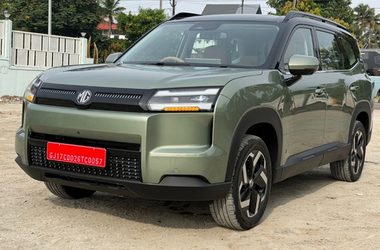
With prices starting at ₹19.49 lakh and rising to ₹23.49 lakh, ex-showroom, the Tomahawk EV makes a persuasive opening argument. The version under consideration is the range-topping Essence seven-seater, presented in Khaki Green, a colour that reinforces its military-inspired identity without making it look as though it has been borrowed from an army convoy.
There is a 69.2 kWh battery, a front-mounted electric motor developing approximately 201 hp, a claimed range of 517 km, Level 2 driver assistance and a cabin sufficiently equipped to make some luxury cars look rather conservative. Most unusually, it can also supply electricity to a house through its Vehicle-to-Home technology.
The question, then, is whether the Tomahawk possesses the substance to match its rather formidable name.
A familiar name, but a very different machine
Although the Hector name is familiar to Indian motorists, having arrived with MG’s original Hector SUV in 2019, the Tomahawk is not simply an electric version of that vehicle. Mechanically and architecturally, this is an entirely different product.
Its roots lie in the Wuling Starlight 560, developed within the SAIC-GM-Wuling partnership involving SAIC Motor, General Motors and Wuling Motors. The same basic vehicle is marketed under names including Wuling Xingguang 560 and Wuling Eksion in certain international markets. Production and assembly operations associated with the model extend across China, Indonesia and India, with the Indian MG version assembled at the company’s Halol facility in Gujarat.
The vehicle carries the development code F520S and uses an architecture known internationally as Tianyu, adapted for India under MG’s Advanced Drive Architecture Platform Technology, or ADAPT. It is related to a wider family of vehicles including the Wuling Starlight 730, Starlight S, Starlight, Baojun Yunhai and Baojun Xiangjing.
MG describes ADAPT as India’s first Multi-New Energy Vehicle platform, an architecture designed to accommodate different electrified powertrains rather than being restricted to one propulsion system. That flexibility is important because the Tomahawk is available in India as both a battery-electric vehicle and a plug-in hybrid.
While the EV is exclusively electric, the Tomahawk PHEV combines a 1.5-litre petrol engine with an electric powertrain and a 20.5 kWh battery. Its Indian prices begin at ₹25.69 lakh, with MG claiming more than 115 km of electric-only driving and over 1,100 km of combined range under the specified test conditions. A conventional petrol-powered version of the related model is also available internationally, although MG has not confirmed such a version for India.
For buyers weighing up these options, the difference is straightforward. The EV makes the most sense for those with dependable access to charging, while the PHEV provides the reassurance of a petrol engine for longer journeys or regions with limited charging infrastructure.
The electric Tomahawk comes in Excite, Exclusive and Essence trims. The Excite seven-seater opens the range at ₹19.49 lakh, followed by the Exclusive seven-seater at ₹21.99 lakh. The Essence five-seater costs ₹22.99 lakh, while the seven-seat Essence reviewed here tops the lineup at ₹23.49 lakh, all ex-showroom.
MG also offers a Battery-as-a-Service arrangement, with introductory prices starting at ₹13.99 lakh plus a battery rental charge of ₹4.90 per kilometre. It lowers the initial purchase price considerably, but the rental commitment is a significant part of the ownership calculation. Buying a car with a smaller upfront bill is attractive; paying attention to the smaller print is rather more important.
A restrained exterior with just enough attitude
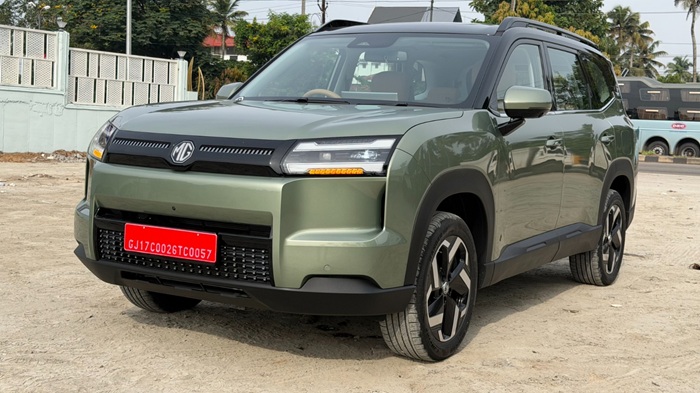
For something called Tomahawk, MG’s new electric SUV is surprisingly restrained in its styling. There are no enormous fake air intakes, no exaggerated wings and no attempt to imitate an armoured vehicle. Instead, the design favours clean surfaces, squared-off proportions and a generally upright stance.
At the front, the traditional combustion-engine grille has effectively disappeared, replaced by a largely enclosed surface and a slim dark panel incorporating an illuminated MG emblem. It looks modern without trying too hard, although the glowing logo inevitably reminds everyone that this is an expensive piece of technology rather than an ordinary family runabout.
The automatic Beacon LED twin-beam projector headlamps sit within distinctive rectangular housings, accompanied by LED daytime running lights and floating-style turn indicators. Intelligent headlamp control and a follow-me-home function provide additional convenience. The lighting signature gives the vehicle a recognisable identity, particularly at night, without resorting to the increasingly fashionable full-width illuminated strip.
The bonnet is relatively broad and upright, contributing to a strong front-end appearance, while the substantial bumper incorporates sculpted surfaces and lower detailing intended to add visual toughness. The result is neither intimidating nor especially dramatic, but it is arguably more likely to age gracefully than some of its excessively aggressive competitors.
Move around to the side and the Tomahawk’s priorities become obvious. This is a large vehicle designed around passenger accommodation. The roofline remains high, the glasshouse is generous and the body maintains a fairly upright silhouette. Muscular wheel arches and dark side-body cladding introduce some SUV character, although the overall shape occasionally comes closer to a particularly handsome people carrier than a traditional off-roader.
That is not necessarily a criticism. Families generally derive greater benefit from headroom than from enormous wheel arches and decorative air vents.
The Essence rides on 18-inch precision-cut Rotor alloy wheels wearing 225/55 R18 102V JK Tyre Ranger HP extra-load steel-radial tubeless tyres. The geometric wheel design is attractive, although the 18-inch diameter looks slightly modest against such a substantial body. The advantage is that MG has not pursued enormous wheels purely for showroom theatre, sacrificing sidewall compliance in the process.
There are disc brakes at both ends, while a 17-inch spare wheel is provided, a reassuring inclusion for Indian motorists who occasionally venture beyond the comfort of metropolitan roads.
The electrically adjustable and folding outside mirrors integrate turn indicators and cameras, while rain-sensing windscreen wipers remove another small chore from daily driving. Acoustic and UV-cut glass for the windscreen and front door windows helps reduce unwanted noise and solar heat entering the cabin. Front demisting equipment adds further practicality.
Our featured Khaki Green finish particularly suits the Tomahawk’s upright lines, and the optional black roof provides an effective contrast. Other established EV colours include Aurora Silver, Starry Black, Celadon Blue and Pearl White. Shadow Gold has also been mentioned within the wider Tomahawk colour palette, although availability should be checked against the specific EV variant.
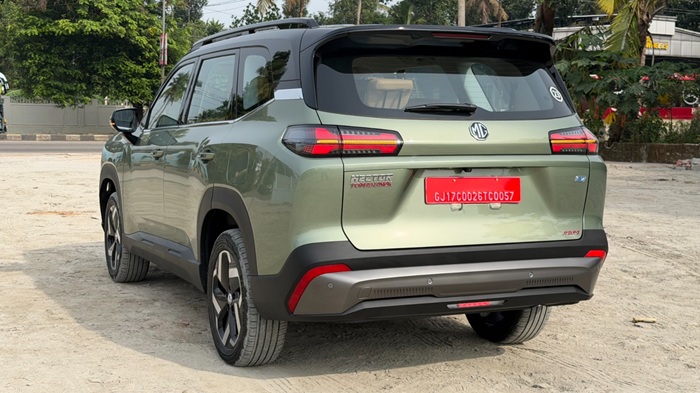
At the rear, the styling remains similarly disciplined. The LED tail lamps extend into the rear quarters, while a roof-mounted spoiler, substantial tailgate and sculpted bumper give the car a broad appearance. MG has resisted the temptation to cover the entire rear with illuminated decoration.
There is also a rear fog lamp, rear windscreen washer and wiper, and a rear defogger. These may not generate excitement on a showroom floor, but they become rather useful during a wet monsoon drive when visibility begins resembling the inside of a steam room.
The overall design is mature, practical and reasonably contemporary. It might not turn heads as dramatically as some rival electric SUVs, but not every family vehicle needs to announce its arrival three streets before reaching home.
Big on the outside, and importantly, big on the inside
The Tomahawk measures 4,745 mm in length, 1,850 mm in body width and 1,770 mm in height. Including its exterior mirrors, the overall width extends to approximately 2,130 mm. Its wheelbase stretches to 2,810 mm, while MG quotes 230 mm of ground clearance measured at the battery.
These are substantial figures, particularly for a vehicle occupying this price bracket. The long wheelbase promises useful passenger accommodation, while the generous ground clearance should help when negotiating steep ramps, damaged roads and the sort of oversized speed breakers that appear to have been designed with geological permanence in mind.
The quoted kerb weight is approximately 1,908 kg, with a gross vehicle weight of 2,450 kg. That leaves a theoretical difference of 542 kg between the two figures. It is worth remembering when filling all seven seats with adults and loading the car for a holiday; having seven seats does not mean having unlimited carrying capacity.
Boot space depends heavily on the chosen seating configuration. With all seven seats occupied, the luggage compartment measures 192 litres. That is adequate for a few small bags, although seven passengers planning a week-long holiday would be wise to pack with considerable discipline.
Fold the third row in its 50:50 arrangement and capacity increases to 528 litres, turning the Tomahawk into a genuinely useful five-person family vehicle with plenty of luggage room. Buyers who have no regular need for the third row can instead choose the dedicated five-seater, which provides an even more generous 610-litre boot.
The second-row bench is split 60:40 and offers sliding, folding and tip-and-tumble functionality. This makes access to the third row relatively straightforward, though the rearmost seats are best treated as occasional adult accommodation rather than premium seating for a full-day interstate journey.
Here, the Tomahawk’s dimensions work in its favour. There is useful headroom and the sliding middle row provides flexibility, but passengers in the third row remain dependent on the generosity of those sitting ahead. As in most seven-seat SUVs of this category, knee room and under-thigh support are the limiting factors.
For regular use with four or five occupants, however, the Tomahawk makes considerably more sense. Its cabin provides the kind of openness and flexibility that many buyers genuinely value more than dramatic styling.
A comfortable cabin with a serious technology habit
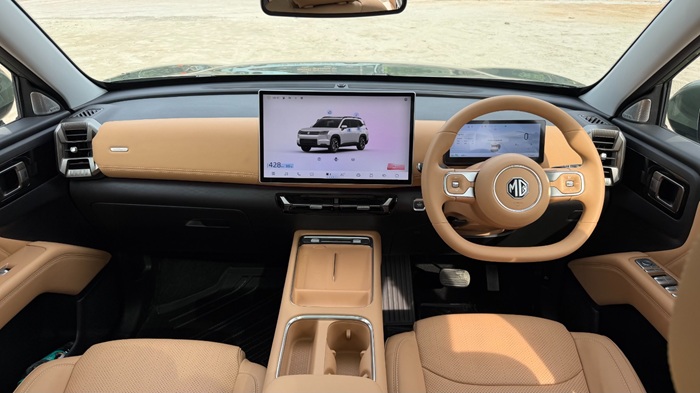
Inside, the Hector Tomahawk adopts a restrained, contemporary dashboard design dominated by a large central touchscreen. The Essence’s Almond Brown and Carbon Black interior combination creates a warm environment, with leatherette upholstery, soft-touch surfaces and leatherette-trimmed sections of the dashboard and doors helping the cabin look suitably premium.
The first impression is of space rather than sportiness. Large windows, a relatively upright driving position and the expansive dual-pane Cockpit SkyRoof make the interior feel open and airy. This is a vehicle that encourages relaxed travel, not the illusion that every drive is a qualifying lap at Silverstone.
The materials are generally appealing, although the finish is not uniformly luxurious. Some lower plastics and centre-console surfaces lack the richness suggested by the upper dashboard, and independent evaluations have identified areas where fit and finish could be improved. At ₹23.49 lakh, expectations are understandably higher than they were when large touchscreens alone were enough to impress buyers.
The front seats are broad and upholstered in artificial leather. The driver’s seat is electrically adjustable in six directions, with memory and an automatic retract function that moves the seat to ease entry and exit. The front passenger gets four-way electrical adjustment, while both front occupants benefit from ventilated seats.
That last feature is particularly worthwhile in India. Ventilated seats are less about extravagance and more about making a leatherette-lined cabin tolerable when the weather outside feels like someone has left the oven door open.
The steering wheel is wrapped in artificial leather and adjusts for both tilt and reach, helping drivers find a suitable position. Physical controls for the instrument display, infotainment, phone, audio volume, voice assistant and adaptive cruise control provide a welcome alternative to the touchscreen.
Ahead of the driver sits an 8.8-inch digital instrument cluster, displaying essential driving information without attempting to replicate an entire cinema screen. Its comparatively modest dimensions are sensible because the vehicle already has a 15.6-inch Grand View infotainment display dominating the centre of the dashboard.
The main touchscreen supports wireless Android Auto and Apple CarPlay, Bluetooth, USB connectivity, FM radio, Wi-Fi and MG’s i-SMART connected-car ecosystem. Lower variants use a smaller 12.8-inch display.
The large screen is visually impressive, and its clear graphics and responsive interface make interacting with major functions reasonably straightforward. However, MG has also entrusted it with an enormous number of vehicle settings. Drive modes, regeneration adjustments, cabin functions and assorted convenience settings can require navigation through several menus.
This is the familiar modern-car dilemma: manufacturers remove conventional buttons in the pursuit of visual simplicity, then introduce complicated interfaces to perform functions that previously required moving a finger half an inch.
MG attempts to solve some of that with i-SWIPE, a gesture-control system recognising two-, three- and five-finger inputs for functions such as air-conditioning, temperature, fan speed, music and volume. The idea is clever, although its everyday value depends on how reliably the driver can operate it without distraction.
The automatic climate-control system includes a PM2.5 air filter, and the cabin benefits from a 256-colour ambient lighting system. Naturally, nobody needs 256 colours of interior illumination to reach the office, but personalising the atmosphere is part of the appeal.
A 10-speaker Infinity audio system, including a subwoofer and amplifier, provides the soundtrack. Wireless smartphone charging with a cooling function is another thoughtful addition, particularly during longer journeys when wireless charging can generate considerable heat.
Storage is well considered, with useful door pockets, cupholders and compartments around the centre console. One-touch automatic power windows with anti-pinch protection and an auto-dimming interior rear-view mirror add to the everyday convenience.
The second row is perhaps where the Tomahawk makes its strongest impression. A long wheelbase provides generous legroom, while the sliding and reclining bench allows occupants to adjust their seating position according to comfort and third-row requirements. Rear ventilation and charging provision make longer journeys more manageable, and the broad windows prevent passengers from feeling enclosed.
The interior is not without flaws, but its central achievement is straightforward: it feels like a vehicle designed around people rather than merely around a collection of electronic gadgets.
Connected features: genuinely useful, occasionally excessive
Few modern MG vehicles are short of electronic features, and the Hector Tomahawk Essence continues that tradition with considerable enthusiasm.
Its infotainment system introduces a generative-AI-powered voice assistant capable of conversational interaction and recognising more than 30 Hinglish voice commands. This is particularly relevant in India, where drivers frequently switch between Hindi and English without considering it an event worthy of technological celebration.
The system can control compatible vehicle functions and interact with connected services, reducing the need to navigate touchscreen menus while driving. Wireless smartphone integration, over-the-air software updates, personalised memory settings, Siri Shortcuts and a digital Bluetooth key further expand its convenience credentials.
There are numerous software-based experiences, including Nap Mode, Camp Mode, Pro Pet Mode, Quiet Mode, Energising Mode and Smoking Mode.
Some are more useful than their names initially suggest. Pro Pet Mode, for example, can maintain climate control under appropriate conditions while the vehicle is parked, providing a more comfortable environment for an animal temporarily remaining inside. Owners must still follow the system’s safety instructions and should never assume that electronic climate control eliminates the need for supervision.
Camp Mode and Nap Mode are designed around stationary comfort, while Quiet Mode reduces unnecessary disturbance. The remaining modes demonstrate that software engineers now have nearly as much influence over the character of a car as the people responsible for its suspension.
Entertainment is similarly extensive. There is the Starmaanch karaoke application with access to thousands of tracks, JioSaavn integration, Jio-powered applications, games, wallpapers, in-car greetings, preloaded messages and even birthday wishes.
Document storage, a dedicated MG App Store and a Home-to-Car music feature add further flexibility. EcoTree also displays estimated carbon dioxide savings, providing an environmental statistic alongside the usual driving information.
Whether all this genuinely improves the ownership experience depends on the individual. For some families, the entertainment and convenience features will be delightful. For others, a quicker route to the climate-control settings would be a more valuable innovation than another digital entertainment platform.
The i-SMART mobile application allows remote access to functions such as cabin pre-cooling, locking and unlocking, vehicle-status checks, car location, live tracking, geofencing, speed alerts and charging notifications. Owners can also receive tyre-pressure warnings, low-battery alerts and security-related notifications, with anti-theft immobilisation functions subject to applicable controls and service availability.
MG’s eHUB application adds an important layer of EV practicality by helping owners locate charging stations, reserve charging slots where supported, plan journeys and make charging payments.
These are connected features that can make a meaningful difference, particularly for someone operating an electric SUV as the household’s primary vehicle.
One motor, plenty of torque and no unnecessary drama
The Hector Tomahawk EV employs a 69.2 kWh MAGIC lithium iron phosphate battery pack powering a permanent magnet synchronous electric motor mounted at the front.
The motor delivers 150 kW, equivalent to approximately 201 mechanical horsepower or 204 metric horsepower, along with 310 Nm of torque. Power reaches the front wheels through a single-speed automatic reduction transmission.
There is no conventional multi-speed gearbox, no engine waiting for a turbocharger to build boost and no complicated clutch arrangement. Select Drive, press the accelerator and the electric motor does the rest.
MG claims the Tomahawk will accelerate from 0 to 100 km/h in 8.2 seconds and reach a top speed of 160 km/h. These are respectable figures for a family SUV weighing close to two tonnes, even if they are unlikely to trouble the rapidly expanding collection of outrageously quick electric performance cars.
More important than the headline acceleration figure is how the available torque is delivered. With 310 Nm available essentially from the beginning of the motor’s operating range, the Tomahawk can respond promptly to ordinary accelerator inputs. Moving away from traffic lights, joining a faster road or completing a highway overtake should require little mechanical effort.
Independent first-drive evaluations describe a reasonably smooth initial response, followed by a stronger surge when the accelerator is pressed more aggressively. There is sufficient performance for relaxed motorway travel, although the front-wheel-drive arrangement introduces an interesting compromise.
When asked to deliver a large amount of torque suddenly, the front tyres must simultaneously steer the vehicle and transmit the motor’s output to the road. On imperfect surfaces, this can generate torque steer, a noticeable tugging sensation through the steering wheel under hard acceleration.
It is not an unusual phenomenon in powerful front-wheel-drive vehicles, but it does reveal that the Tomahawk’s chassis has limits when its electrical performance is fully exploited.
Four driving modes are provided: Eco, Normal, Sport and Custom. Eco softens accelerator response to encourage efficiency, while Normal provides a more balanced everyday setting. Sport sharpens the throttle and makes the electric motor feel more eager.
Custom allows drivers to personalise aspects of the power delivery and regenerative braking. Various regeneration settings are available, including an intelligent function that can adapt deceleration based on detected traffic conditions. However, drivers looking for a fully developed one-pedal driving experience may find the arrangement less satisfying than in some rivals.
There is little benefit in pretending that the Tomahawk is a performance SUV. Its strengths are smooth acceleration, readily available torque and the absence of conventional engine vibration. Those qualities make it especially well suited to daily commuting and family journeys.
The absence of an engine also helps refinement. At ordinary speeds, wind and tyre noise become the primary sources of disturbance, while acoustic glazing assists in keeping the cabin relatively peaceful.
A quiet electric drivetrain does, however, expose noises that a petrol or diesel engine might otherwise conceal, including suspension movement over rough surfaces.
Ride and handling: comfort first, enthusiasm second
Underneath, the Tomahawk uses MacPherson strut front suspension and an independent multi-link arrangement at the rear. On paper, that is a promising combination for a large family crossover, particularly one expected to accommodate seven passengers.
Independent road tests suggest that MG has prioritised everyday usability over outright sporting ability. At lower speeds, the suspension generally deals with ordinary surface imperfections competently, although sharper potholes and broken tarmac can introduce a firm response and noticeable suspension noise.
Reports differ on the precise balance between softness and firmness, which suggests that surface conditions and driving speeds significantly influence the experience. What emerges consistently is a vehicle that can be comfortable and composed on smoother roads but is less convincing when subjected to repeated sharp impacts.
The 225/55 R18 tyres provide a reasonable compromise between road-holding and compliance, but the substantial weight of the vehicle cannot be disguised completely.
At highway speeds, the long wheelbase and broad footprint contribute to a stable, reassuring character. The Tomahawk is happier maintaining a steady cruising speed than being hurried from one tight bend into another.
Steering effort is light at urban speeds, a welcome quality when manoeuvring a 4.7-metre SUV through crowded streets or narrow parking entrances. The electrically assisted system gains weight as speed increases, although feedback remains limited.
The steering is reasonably direct, but it does not deliver the communication or precision that keen drivers might expect from a more dynamically focused electric SUV. Apply significant power while cornering and the front-driven layout can further disturb the steering feel.
Body roll is present, as expected in a tall, heavy crossover, though the chassis generally maintains its composure when driven within sensible limits. Push harder and its family-oriented character becomes obvious.
Four-wheel disc brakes provide the necessary stopping hardware, supported by regenerative braking. Independent reviews have noted that the brake pedal’s progression could be more consistent, with some softness before stronger braking force develops.
That matters because good braking is not merely about how quickly a vehicle can stop. It is also about how accurately a driver can control deceleration, especially in slow traffic and when carrying passengers.
The Tomahawk’s substantial 230 mm claimed ground clearance is welcome on Indian roads, although it should not be mistaken for evidence of serious off-road capability.
There is no low-range transfer case, no mechanical four-wheel-drive system and no dedicated differential locking arrangement. The Tomahawk is a front-wheel-drive family crossover rather than an expedition vehicle.
Its ground clearance is useful for dealing with rough roads, tall speed breakers and uneven approaches, not for attacking deep ruts or difficult rocky trails.
Ultimately, this is a vehicle that rewards smooth driving. Ask it to transport a family in comfort and it makes a strong case for itself. Ask it to behave like a sporting SUV and the name Tomahawk begins making promises the chassis was never intended to keep.
Range, charging and the realities of electric family travel
MG claims a driving range of 517 km on a full charge under the MIDC test cycle. That is an encouraging headline figure for a vehicle of this size and weight.
However, certified range must not be confused with the distance every owner will achieve in everyday conditions. Driving speed, outside temperature, air-conditioning use, passenger load, terrain and tyre pressures all influence energy consumption.
The Tomahawk’s battery weighs approximately 471 kg, a substantial component of its overall mass. Its relatively tall body also means aerodynamic resistance becomes increasingly relevant at higher speeds.
In a published independent highway evaluation covering 192 km between Kochi and Kozhikode, an efficiency of 4.85 km/kWh was recorded, equivalent to a calculated range of approximately 336 km under those particular driving conditions. That is not a definitive all-conditions range figure, but it illustrates why buyers should plan journeys using realistic margins rather than assuming they will always achieve the certified maximum.
For daily commuting, the battery’s capacity should make charging a relatively infrequent activity for many owners. Longer road trips will require more preparation, particularly when travelling with seven occupants and luggage.
The vehicle supports AC charging at up to 7.4 kW. MG quotes approximately 12.5 hours for a 10–100 per cent recharge using a suitable AC charger, placing an extensive recharge comfortably within overnight-charging territory.
DC fast charging is supported at up to 90 kW, with MG quoting approximately 35 minutes to charge from 30 to 80 per cent under suitable conditions. This is useful, although some immediate competitors accept considerably higher DC charging power and can potentially reduce time spent at compatible fast chargers.
A portable charger is also supplied with the vehicle, providing an alternative charging method where appropriate electrical infrastructure is available.
For most owners, the smartest approach will remain regular home charging, with public fast charging reserved for longer journeys and occasional top-ups.
The financial advantage of electric motoring depends on electricity tariffs and how frequently public charging is required. Charging at home is generally more economical, while high-priced public DC charging can reduce the cost advantage compared with an efficient combustion-engine vehicle.
Buyers considering Battery-as-a-Service should also include the ₹4.90-per-kilometre rental charge in their calculations, alongside electricity, applicable programme terms and any associated fees.
The electric SUV that can power your home
Perhaps the Tomahawk’s most interesting feature has surprisingly little to do with driving.
MG promotes it as India’s first car equipped with Vehicle-to-Home functionality, allowing energy stored in the EV battery to be supplied to compatible household electrical systems.
The Tomahawk provides a quoted AC V2H output of up to 6.6 kVA, alongside Vehicle-to-Load capability of up to 3 kVA. Vehicle-to-Vehicle power transfer is also supported, subject to compatible equipment and operating conditions.
Vehicle-to-Load allows the car to supply electricity to suitable external appliances and devices. This could be useful for camping, outdoor activities or temporary power requirements.
Vehicle-to-Home takes the idea further. With the necessary compatible equipment and a properly configured electrical installation, stored energy from the vehicle can help power selected household loads such as lights, fans and appliances.
It is important to understand that this is not simply a matter of connecting the car to an ordinary domestic socket and expecting it to supply the entire house. A compatible V2H unit, electrical protections and professional installation are required, and the maximum practical load will depend on the system configuration.
The appeal is nevertheless substantial. In a country where power interruptions remain familiar in many areas, the ability to use a large electric vehicle battery as a supplementary household energy source could have genuine practical value.
There is a certain irony in buying a car named after a wartime fighter and discovering that one of its most useful talents is keeping the ceiling fans running.
Safety: comprehensive equipment, but no shortcut to crash-test credibility
The Hector Tomahawk Essence comes with a substantial safety equipment package.
Six airbags, ABS with electronic brakeforce distribution, electronic stability control, traction control, hill-hold assistance, brake assist and auto-hold form the principal active and passive safety systems.
There are three-point seatbelts, front seatbelt pretensioners and load limiters, seatbelt reminders, ISOFIX child-seat anchorage points, speed-sensing automatic door locking, impact-sensing automatic unlocking and high-speed warnings.
The vehicle also incorporates a direct tyre-pressure monitoring system, front and rear parking sensors and automatic approach-unlock and walk-away locking functions.
The top Essence additionally receives Level 2 advanced driver assistance features, including adaptive cruise control, bend cruise assistance, traffic-jam assist, lane-keep assist, lane-departure warning and prevention, forward-collision warning, automatic emergency braking and intelligent hydraulic braking assistance.
These systems can reduce driver workload and provide an additional layer of protection, particularly on suitable highways. However, Level 2 assistance does not make the Tomahawk a self-driving car, and the driver remains responsible for controlling and monitoring the vehicle.
A 360-degree HD surround-view camera includes transparent-chassis and wheel-view functions, allowing the driver to examine the vehicle’s surroundings from different perspectives. This is particularly useful when navigating tight parking areas or judging clearance around obstacles.
Camera performance and image clarity can still vary with lighting and conditions, so the system should support rather than replace careful observation.
The body uses high-strength steel, while MG places considerable emphasis on the protection of the high-voltage battery.
According to the manufacturer, the battery system has undergone more than 2,000 bench tests, over 490 vehicle-level validation exercises, 180-degree thermal shock testing and short-circuit tests at 55 degrees Celsius, along with trials under extreme environmental conditions.
MG also reports battery validation involving needle penetration and controlled deformation testing. These are valuable engineering claims, but they should not be confused with an independent crash-test assessment of the complete vehicle.
At the time of this review, a published Bharat NCAP, Global NCAP or Euro NCAP crash-test rating for the Indian-specification Hector Tomahawk EV has not been established. Buyers should therefore assess its extensive safety equipment separately from any assumptions about crash-test performance.
Ownership: warranty confidence and a competitive price
MG is supporting the Tomahawk EV with a lifetime battery warranty for the first owner, subject to the manufacturer’s warranty terms and conditions.
The vehicle itself comes with a three-year, unlimited-kilometre warranty, with an option to extend coverage to five years with unlimited kilometres. A three-year roadside-assistance package and three labour-free services are also included.
These benefits are significant for buyers considering a relatively new electric model, particularly when long-term battery durability and maintenance costs remain common concerns.
The battery chemistry also deserves attention. Lithium iron phosphate technology is generally valued for thermal stability and durability, although the actual service life of an individual battery remains dependent on operating conditions, charging habits and thermal management.
MG’s growing electric vehicle experience in India, supported by models such as the ZS EV, Comet EV and Windsor EV, gives the Tomahawk an existing service and ownership ecosystem rather than leaving it to establish one from scratch.
Nevertheless, buyers should verify local service capability, high-voltage repair support, warranty exclusions and the availability of replacement parts before purchasing.
Long-term reliability and resale values cannot yet be judged with the same confidence as those of vehicles that have accumulated several years of ownership data.
The price proposition, however, is immediately apparent. At ₹23.49 lakh, ex-showroom, the top Essence seven-seater offers substantial passenger space, a large battery, generous equipment and an unusually useful bidirectional charging feature.
Whether that represents excellent value will depend largely on the buyer’s priorities.
How does it compare with its rivals?
The Hector Tomahawk EV competes in an increasingly crowded section of the Indian electric vehicle market, where several manufacturers offer very different interpretations of the family SUV.
The Mahindra XEV 9S is one of its most direct alternatives, combining three-row practicality with a more overtly futuristic design and an electric platform capable of offering stronger performance and more advanced drivetrain configurations. Buyers who prioritise acceleration, charging capability and a more sophisticated driving experience may find the Mahindra more appealing. The MG counters with competitive pricing, generous cabin accommodation and an emphasis on straightforward family practicality.
The Kia Carens Clavis EV approaches the problem from a slightly different angle. Its people-carrier origins place considerable emphasis on passenger convenience and ease of use, making it an appealing choice for families frequently using all three rows. The Tomahawk offers a larger battery and stronger motor output, while its more conventional SUV-like appearance may appeal to buyers who want something less obviously MPV-shaped.
The Tata Harrier EV offers a stronger SUV identity, with a substantial road presence and rear-wheel-drive or all-wheel-drive configurations depending on the version. That gives it an advantage for buyers who value driving dynamics, more demanding conditions and additional drivetrain versatility. The Tomahawk, however, makes a compelling case on packaging and equipment.
The Hyundai Creta Electric also deserves consideration for buyers who do not need seven seats. It has a smaller footprint, making it easier to manage in crowded cities, and benefits from the familiar appeal of the Creta name. But it cannot match the Tomahawk’s three-row flexibility or sheer interior volume.
Ultimately, the MG’s strongest argument is not that it outperforms every competitor in a particular measurable category. It is that it brings together a substantial battery, a comfortable cabin, flexible seating and extensive equipment at a relatively accessible price.
That is an attractive combination, provided the buyer is willing to accept its dynamic compromises.
Verdict: More family workhorse than fighter aircraft
The 2026 MG Hector Tomahawk EV Essence is an interesting vehicle precisely because its personality is so different from what its name suggests.
It is not particularly aggressive to look at. It does not deliver sports-car acceleration, razor-sharp steering or an especially athletic chassis. Its suspension could be quieter and better controlled over difficult surfaces, its brake pedal could offer more consistent progression, and some interior materials fall short of the premium impression created by the enormous screens.
The infotainment system is impressively capable, but like many modern cars, it occasionally confuses technological abundance with ergonomic sophistication. There are moments when a conventional button would be more valuable than another software function.
Yet dismissing the Tomahawk for those shortcomings would miss the point.
This is a large, intelligently packaged electric family SUV with comfortable front accommodation, generous second-row space, useful occasional seven-seat capability and a versatile luggage compartment. Its electric motor provides ample everyday performance, the claimed range is competitive and the list of convenience and safety equipment is extensive.
The ability to supply electricity to compatible household systems gives it a practical distinction few rivals can currently match, while the introductory pricing and battery warranty strengthen its ownership appeal.
The Essence seven-seater makes the most sense for buyers who genuinely need a flexible family vehicle and have access to regular home charging. For those who only occasionally carry seven passengers, its folding third row adds useful versatility. For buyers who never require more than five seats, the dedicated five-seat Essence may be an even smarter purchase.
Enthusiastic drivers seeking a sharper chassis, more sophisticated steering or stronger performance should consider alternatives from Mahindra or Tata. Frequent long-distance travellers without dependable charging access may find the plug-in hybrid Tomahawk more suitable.
But for a family that values space, comfort, technology and sensible running costs ahead of cornering excitement, the electric Tomahawk presents a convincing proposition.
And perhaps that is the final irony. It carries the name of a combat aircraft, but its greatest achievement is not attacking a winding road or outrunning everything at the traffic lights. It is making the ordinary business of transporting a family more comfortable, more convenient and potentially less expensive.
The MG Hector Tomahawk EV may have been named after a fighter, but it is at its best when serving as a dependable family peacekeeper.